 Backflip AI
Free
Backflip AI
Free
Backflip AI is an AI-driven 3D modeling tool that quickly generates 3D models from text descriptions or reference images. Simplify the 3D content creation process for designers, game developers, and AR/VR creators. Supports standard 3D format export.
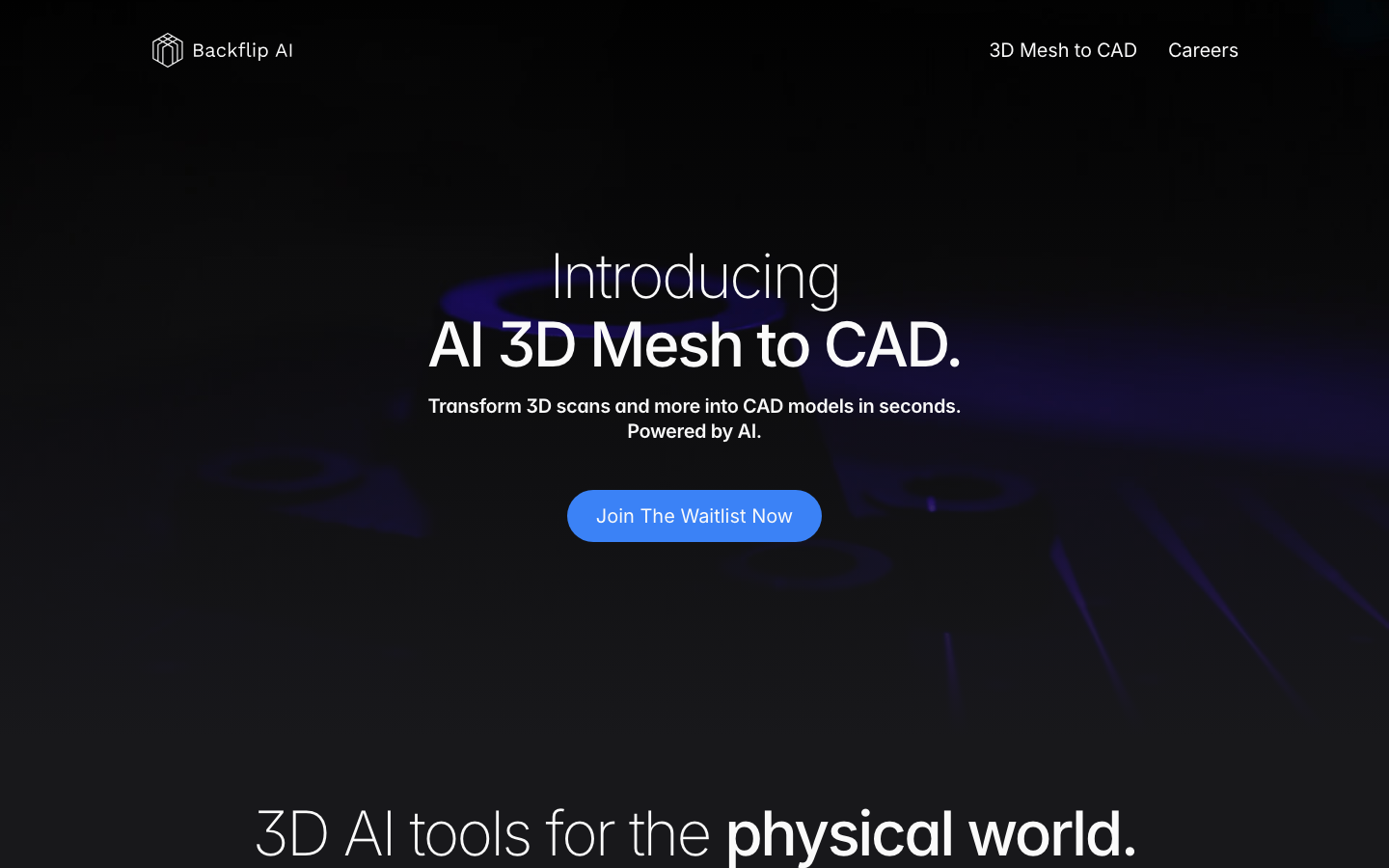
BackflipAI
Core parameters and statistics
Backflip AI is an AI 3D engineering technology company founded by serial entrepreneurs. Its core product focuses on automatically converting 3D scan/mesh data into parametric CAD models. It is officially positioned as "3D AI for the physical world". His team previously founded Markforged (NYSE: MKFG) and has more than ten years of industry experience in 3D printing and advanced manufacturing.
| Projects | Public Information |
|---|---|
| Official positioning | 3D AI for the physical world — AI-enabled tools to turbocharge CAD and 3D modeling workflows |
| Core product | AI 3D Mesh to CAD (3D scanned mesh → parametric CAD model) |
| Delivery form | Onshape plug-in (native feature tree), Web application (.STEP file export) |
| Target customer groups | Engineers, manufacturing, product designers, reverse engineering |
| Input types | 3D scan mesh, point cloud data, existing mesh model |
| Output format | Onshape native feature tree, .STEP (cross-platform CAD compatible) |
| Platform | Web, Onshape plug-in |
| Company background | Predecessor team founded Markforged (NYSE: MKFG) |
| Product stage | Beta testing (Waitlist mode) |
| Developer | Backflip AI (USA) |
Brief review in one sentence: Backflip AI is not another creative toy that "converts text/pictures to 3D", but an AI scalpel that accurately cuts into the pain points of reverse engineering and CAD reconstruction in the manufacturing industry - it directly turns 3D scan data into editable CAD models instead of grids that can only be viewed.
Positioning differences with similar tools: Most AI 3D tools on the market (such as Meshy, Tripo, 3dfy Ai) focus on the creative generation track of "text/image → 3D grid", targeting games, e-commerce and design visualization. Backflip AI has chosen a completely different direction—starting from 3D scanning to produce engineering-level parametric CAD models to directly serve the manufacturing process. This difference determines that it is not a tool that "everyone can play", but a vertical productivity platform for professional engineers.
User and market recognition
Backflip AI’s market recognition mainly comes from the industry reputation of its founding team and the product’s precise penetration of manufacturing pain points, rather than public customer numbers or financing figures (the latter is not officially disclosed).
Endorsement by the founding team: Before the founding of Backflip, the core team founded Markforged in 2013 and invented a new paradigm for 3D printing of metal and carbon fiber composite materials. Markforged was later listed on the New York Stock Exchange (NYSE: MKFG). Its technology is deployed on seven continents around the world, from space stations to submarines, and its customers include top manufacturers such as Boeing Lockheed Martin. This background gives Backflip natural credibility in the manufacturing and engineering fields, and also means that the team has a depth of understanding of the entire "from design to manufacturing" link that is rare in the industry.
Product Stage: As of July 2026, the AI 3D Mesh to CAD tool is in the Beta internal testing stage, and the official website uses the Waitlist mode to open applications. This means that the product has not yet entered full commercialization, but the Waitlist mechanism also shows that the team is deliberately controlling the pace of early users and prioritizing the delivery quality of core scenarios.
Industry Focus: Manufacturing reverse engineering has long faced the dilemma of "easy to scan, difficult to model" - 3D scanners can quickly obtain point cloud or mesh data, but converting these data into editable parametric CAD models (rather than dead meshes) usually requires hours or even days of manual reconstruction. Backflip AI directly challenges this bottleneck, so it received great attention from the mechanical engineering, additive manufacturing and reverse engineering communities upon its announcement.
Cost advantage
- C-side/Individual: Usually a free version is provided to experience the core functions, and high-frequency use requires a paid package subscription.
- API/Developer: Billed by call volume, suitable for development teams that can be flexibly integrated into their own systems.
- Enterprise/Privatized: Contact the business owner for customized quotation and deployment plan. The specific price is subject to the official real-time pricing page.
Backflip AI’s main features
Backflip AI's product functions revolve around the core link "Scan/Mesh → Engineering-grade CAD". The currently disclosed capabilities can be summarized into the following four categories:
-
AI 3D Mesh to CAD Reconstruction: Core functionality. The mesh or point cloud data output by the 3D scanner is automatically inferred through the self-developed AI model to infer geometric features (plane, cylinder, chamfer, hole, etc.) and reconstructed into a parametric CAD model. The output is no longer an uneditable triangle mesh, but a CAD solid with a native feature tree. Applicable tasks: Reverse engineering, spare parts modeling, mold repair, product modification.
-
Onshape native plug-in integration: Provides Onshape sidebar plug-in, and the conversion results are directly presented in Onshape as a native feature tree. Engineers can edit each feature (extrude, rotate, pattern, fillet) as they would manual modeling without leaving the familiar CAD context. Use value: Eliminates the loss of switching back and forth between "AI output → manual repair → import into CAD".
-
.STEP file export: For teams that do not use Onshape, the Backflip web application supports exporting to the standard .STEP format, which is compatible with mainstream CAD systems such as SolidWorks, Fusion 360, CATIA, and NX. Use Value: Not bound to a single CAD platform, suitable for enterprises with heterogeneous CAD environments.
-
Multi-platform compatibility notice: The official website has prompted "More CAD plugins coming soon", indicating that the plug-in ecosystem will be expanded to SolidWorks, Fusion 360, CATIA and other platforms in the future. Use Value: Expand tool chain coverage and reduce team switching costs.
Expert View: There is an easily overlooked synergy in Backflip's core function chain - the Onshape plug-in and .STEP export are not simple "output options", but form a "scan → AI reconstruction → CAD editing → manufacturing" link. Compared with the traditional "scan → third-party software repair → manual reconstruction", Backflip eliminates the hassle of format conversion and manual repair of data between different software. This means that not only the single reconstruction time is shortened, but the "rework rate" and "data loss risk" of the entire reverse engineering will also be reduced simultaneously.
Model and version evolution
Backflip AI's product life cycle is still in the early beta stage, and publicly verifiable version information is limited.
Current status: Beta (2026)
- Backflip AI Current (~2026-01): Supports AI 3D Mesh to CAD reconstruction core functions, and provides two delivery paths: Onshape plug-in and web application. The official website shows "AI 3D Mesh to CAD" as the headline function, and the product is in the invitation-only Waitlist stage.
Internal beta preparation period
- Backflip AI Beta (~2025-06): Internal beta version, used for core algorithm verification and early user feedback collection. Specific functions and performance indicators have not been disclosed.
Release Notes
The official has not fully disclosed the precise timeline and functional changes of the historical version. The current version_number=1.0 marks a key milestone in the product's transition from "Technical Validation" to "Beta Product". The evolution direction of subsequent versions can be expected to include: more CAD platform plug-in support, multi-object/assembly reconstruction, AI-assisted feature editing, semi-automatic datum alignment, etc.
Technical advantages
Backflip AI's technical advantages come from the team's cross-accumulation in the fields of 3D printing, advanced manufacturing and computational geometry. The design goal of its AI model is not to generate "good-looking meshes", but to produce "manufacturable parametric CAD".
Geometric Feature Inference Engine: Unlike general-purpose 3D generative models (such as the diffusion model NeRF), Backflip's AI focuses on identifying and extracting engineering semantics - parametric features such as flatness, cylindricity, verticality, concentricity, fillet radius, etc. - from discrete triangular mesh or point cloud data. This means that its output is not a mesh that "looks like" at the visual level, but a CAD entity that "can be machined" at the engineering level. The technical challenge behind it is that 3D scanning data usually contains noise, holes and non-uniform sampling, and AI needs to infer the designer's original intention based on incomplete data.
Reverse understanding of design from the manufacturing side: Markforged's background gives the Backflip team a unique perspective - they not only understand the geometric expression of 3D models, but also understand "what kind of models can be manufactured." During the AI reconstruction process, the model will prioritize identifying geometric features that are meaningful for manufacturing (mounting holes, mating surfaces, stiffeners), rather than restoring all surface details in the scanned data (such as wear marks, deformation areas) in equal proportions. This "manufacturing first" feature extraction strategy makes its output closer to actual processing needs.
Deep binding to the CAD ecosystem: Native feature tree output through the Onshape plug-in means that the results of AI reconstruction maintain the flexibility of parametric editing - engineers can modify the parameters of the feature at any time (such as adjusting the fillet radius, changing the extrusion depth), rather than just accepting or rejecting the AI's output. This is fundamentally different from the "one-time generation, non-editable" model of most AI 3D tools.
Comparison with competing technologies:
| Capability Dimension | Backflip AI | General AI 3D Tool (Meshy/Tripo) |
|---|---|---|
| Input type | 3D scan mesh/point cloud | Text description, reference image |
| Output Type | Parametric CAD (Feature Tree/STEP) | Triangular Mesh (OBJ/FBX/GLB) |
| Target market | Manufacturing, reverse engineering, engineering design | Games, e-commerce, design visualization |
| Output editability | Full editability (parametric features) | Limited editability (mesh deformation) |
| Engineering precision | For processing and manufacturing | For visual presentation |
| AI technology focus | Geometric feature extraction and parametric inference | Visual generation and style transfer |
| CAD integration | Native plug-ins/standard exchange formats | Universal mesh export |
| Product stage | Beta internal testing (Waitlist) | Already commercialized |
How to use
Backflip AI currently provides two entrances, both of which require access permissions through Waitlist:
| How to use | Suitable for people | Features | How to obtain |
|---|---|---|---|
| Onshape plug-in | Onshape user | Complete the scan → CAD one-click conversion in the Onshape sidebar and output the native feature tree | Waitlist application |
| Backflip Web App | Non-Onshape users | Upload 3D scan files, automatically reconstructed into .STEP file downloads, compatible with all major CAD | Waitlist application |
Typical usage steps (take web application as an example):
- Visit backflip.ai and click "Join The Waitlist" to submit your application.
- After receiving the private beta invitation, log in to the Backflip Web application.
- Upload 3D scan data (grid/point cloud file, please refer to official documents for specific supported formats).
- AI automatically analyzes geometric features and reconstructs them into parametric CAD models.
- Download the .STEP file and import it into CAD software such as SolidWorks, Fusion 360, CATIA, etc.
- Onshape users can choose to install the plug-in, complete the entire process directly in Onshape, and output the native feature tree.
Recommendations for implementation verification: It is recommended to prepare 3-5 scanned data of different complexities (simple prisms, medium curved parts, and complex free-form surfaces) during the trial phase for testing respectively, focusing on evaluating the AI's reconstruction quality for the following scenarios: accuracy of recognition of plane and cylindrical features, restoration of fillet and chamfer parameters, and integrity of hole and thread features. This test can help determine how well the tool matches its typical parts at the current stage.
Product Pricing
The pricing model is subject to the official real-time page. Usually a freemium or subscription system is adopted. Basic functions can be used for free, while advanced functions or high-frequency use require paid subscriptions. It is recommended that users evaluate the optimal solution based on actual usage.
Application scenarios
The implementation scenarios of Backflip AI focus on reverse engineering and CAD reconstruction in the manufacturing and engineering fields. The following four scenarios have clear verification value:
-
Spare parts reverse repair: When there are no original CAD drawings for spare parts of old equipment or imported equipment, the geometric data is obtained through 3D scanning → Backflip is reconstructed into a CAD model → Directly 3D printed or CNC processed after modification. Benefit: The spare parts delivery cycle is shortened from "waiting for several weeks for shipment from the original factory" to "repairing the same day after scanning."
-
Product modification and iteration: Design modification based on existing physical prototypes. Scan the physical prototype → AI reconstruction into CAD → directly modify the feature parameters in CAD to achieve version iteration. Benefits: There is no need to model from scratch, and the modification based on real physical data is more in line with the actual assembly context.
-
Mold Repair and Replication: Worn or damaged molds are scanned and reconstructed into CAD models that can be accurately replicated or damaged features can be reparatively modified. Benefits: The mold repair cycle is shortened from days to hours, and digital archiving facilitates subsequent repeated calls.
-
Cultural Heritage Digitization: 3D scanned data of artefacts, sculptures or architectural components are reconstructed into engineering editable CAD models for conservation restoration or reproduction. Benefits: AI automatically infers to complete the missing parts in the scanned data (such as the original geometric inference of the weathered and peeling area), reducing the workload of manual guessing.
Implementation Tips: The actual benefits of the above scenarios are highly dependent on the quality of the scanned data. It is recommended to use a fixed reference calibration object during each scan to ensure that the point cloud density and accuracy meet the minimum requirements for AI reconstruction. For high-precision mating surfaces (such as bearing seats, sealing surfaces), it is recommended that engineers conduct critical dimension review after AI output.
Applicable people
The applicable groups of Backflip AI are significantly different from general AI 3D tools, and are mainly concentrated in the field of engineering manufacturing:
-
Mechanical Engineers and Reverse Engineering Practitioners: A group of engineers who deal with 3D scanning → CAD reconstruction tasks on a daily basis. Backflip frees them from hours of manual reconstruction and focuses on design decisions and verification. Unfit boundary: The AI reconstruction quality of complex free-form surfaces (such as ergonomically shaped Class A surfaces) may not be as good as manual modeling by experienced engineers. It is recommended to use professional surface repair tools.
-
Additive Manufacturing/3D Printing Engineer: Practitioners who need to scan physical parts, modify them and then print them. Backflip's "manufacturing first" feature extraction strategy is particularly suitable for "modifying existing parts" scenarios. Prerequisites: Basic 3D scanning equipment and operating skills are required. Scanning data quality is a key input for the AI reconstruction effect.
-
Product Designer and Industrial Designer: Designers who carry out modified designs based on existing physical prototypes. Applicable scenarios: Scan clay models or prototypes → AI reconstruction into CAD → Complete refinement and engineering in CAD. Not suitable for boundaries: Concept design from scratch still requires traditional CAD modeling or creative AI 3D tools (such as text/image conversion to mesh), and Backflip is not suitable as a starting point for creative ideas.
-
Not suitable for the crowd: Game asset creators and VFX artists - Backflip outputs engineering-grade parametric CAD instead of low-polygon meshes usable by game engines, which does not match their workflow; Creative users who need to generate 3D models directly from text or images - Such needs should turn to tools such as Meshy, Tripo, 3dfy Ai; 3D printing enthusiasts in non-manufacturing fields - Backflip is aimed at engineering-grade manufacturing rather than desktop-level FDM Printing scenes may be over-designed.
Summary and Outlook
The unique value of Backflip AI is that it has chosen a completely different technical route from mainstream AI 3D tools - not "everyone can generate 3D", but "engineers can reconstruct CAD faster". Its core competency is not the speed of model generation, but the engineering usability of the output model - parametric, editable, and ready for manufacturing.
Current core advantages: The founding team’s profound accumulation in the field of advanced manufacturing gives the product a unique "manufacturing thinking"; Onshape's native plug-in provides a rare AI → CAD seamless integration experience in the industry; for the rigid demand scenario of reverse engineering, the potential for product efficiency improvement reaches orders of magnitude.
Current main limitations: The product is in the Beta stage, and the CAD platform covered is limited to Onshape (the rest are indirectly supported through .STEP export); there are certain requirements for the quality of input scan data, and the reconstruction effect of low-quality scan data needs to be verified; commercial pricing and SLA terms are not disclosed, and there is uncertainty in enterprise-level procurement; advanced functions such as multi-object assembly reconstruction and semi-automatic feature editing have not yet been released.
Follow-up observation points: User feedback and typical case displays after the waiting list is opened; timetables for mainstream CAD plug-ins such as SolidWorks and Fusion 360; transparency of pricing structures and flexibility of commercial authorization; the upper limit of AI's reconstruction capabilities when faced with the hybrid features of "free-form surface + precision fit".
Procurement and Adoption Risk Assessment: For teams that are already using Onshape and have frequent reverse engineering needs, Backflip’s Beta phase is the best window for a zero-cost evaluation—request a trial through Waitlist and use real part data to verify whether the AI reconstruction quality meets engineering usable standards. For teams using other CAD platforms, it is recommended to first verify through the .STEP export channel of the web application, and then make in-depth integration decisions after the corresponding platform plug-in is officially released. Before purchasing, enterprises need to confirm whether the transition from Beta to official version involves data migration costs, copyright and disclaimer clauses of the AI output model (especially in industries involving compliance requirements), as well as frequency control and concurrency restrictions in batch usage scenarios. In the short term, it is recommended that the AI reconstruction model be regarded as an "engineer's first draft" rather than a "final deliverable", and that secondary reviews of key dimensions should be retained.
Related tools:  Midjourney, stable-diffusion
Version Info
- Backflip AI current :Support text to 3D and image to 3D generation.
- Backflip AI beta :Internal beta version.
User Reviews