 BAGEL
Free
BAGEL
Free
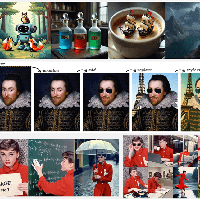
BAGEL is an open source multi-modal unified basic model (7B active parameters/14B total parameters) by the ByteDance Seed team. It is based on the Mixture-of-Transformer-Experts (MoT) architecture and integrates visual understanding, text-to-image generation, image editing, style transfer, world navigation and multi-round combined dialogue capabilities in the same model. It surpasses Qwen2.5-VL-7B in the visual understanding benchmark, benchmarks the quality of Vincent images against FLUX.1-dev, and its image editing capabilities are comparable to Gemini 2.0. Apache 2.0 license, provides Gradio WebUI and HuggingFace model weights.
BAGEL
Core parameters and statistics of BAGEL
BAGEL (Bagel AI) is an open source multi-modal unified basic model by the ByteDance Seed team. It is officially positioned as "Unified Model for Multimodal Understanding and Generation". It covers visual understanding, text-to-image generation, image editing, style transfer, world navigation and multi-round combined dialogue within a set of model weights. It is not an independent chatbot, nor a simple image generator, but a basic model that unifies understanding and generation under the same architecture.
| Projects | Public Information |
|---|---|
| Official positioning | Unified Model for Multimodal Understanding and Generation |
| Development Team | Bytedance Seed Team (Chaorui Deng, Deyao Zhu, Kunchang Li, etc.) |
| Architecture | Mixture-of-Transformer-Experts (MoT) |
| Model size | 7B active parameters / 14B total parameters (15B total weights) |
| Basic model | Fine-tuned based on Qwen2.5-7B-Instruct |
| Visual encoder | VAE (pixel level) + ViT (semantic level) dual encoder |
| Generative Paradigm | Next Group of Token Prediction |
| Open Source License | Apache 2.0 |
| GitHub Stars | 6,100+ |
| GitHub Forks | 542 |
| HuggingFace Likes | 1,210+ |
| Latest version | BAGEL-7B-MoT (2025-05-20) |
| Supported languages | English (main), the community has contributed Chinese interface |
| Run with context | 12GB+ VRAM (NF4 quantization), 32GB+ recommended |
Actual meaning of dual encoder design: The VAE encoder is responsible for capturing pixel-level details (texture, edges, color gradients), and the ViT encoder is responsible for extracting semantic-level features (object categories, scene relationships, emotional atmosphere). The collaboration between the two allows BAGEL to maintain the fine structure of the original image and understand the semantic modification target in the user's intention in image editing tasks - this is the technical basis for it to surpass most competing products in editing benchmarks.
Users and market recognition of BAGEL
BAGEL is an open source attempt by the ByteDance Seed team to unify multi-modal fields. Although it has been released for a short time (May 2025), it has gained significant attention in the technology community and formed an early ecosystem consisting of GitHub, HuggingFace and Discord.
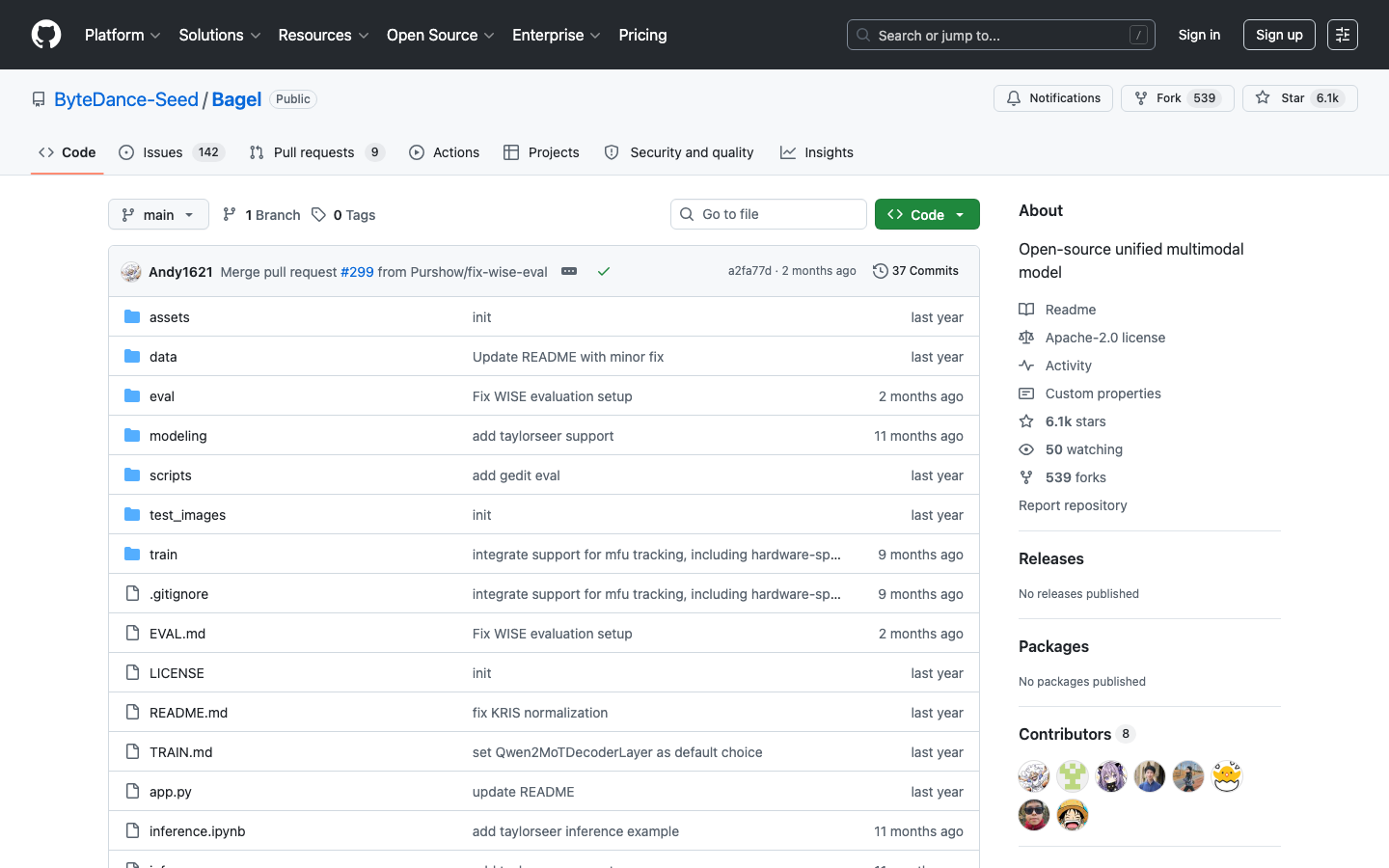
GitHub and HuggingFace community feedback: Within two months of release, GitHub received 6,100+ stars and 542 forks, and the HuggingFace model page received 1,210+ likes. Model downloads average approximately 759 times per month. The warehouse has generated 142 issues and 9 pull requests, and the community activity is at a high level among ByteDance open source projects.
Community Derived Ecosystem: After the release, the community quickly contributed multiple derived projects and tools - ComfyUI node integration (@neverbiasu), DF11 compressed version (@LeanModels), INT8 quantized version (@Gapeleon), Windows installation guide (@prartio), Docker image (@davideuler, @jnc-nj) and multiple third-party HuggingFace Space demonstration instances. This model of "official release model + community completion tool chain" shows that BAGEL's basic capabilities have been recognized by the engineering community.
Industry Benchmark Performance: In the visual understanding dimension, BAGEL surpasses Qwen2.5-VL-7B (83.5/67.1/68.2) and Janus-Pro-7B (79.2/41.0/50.0) on benchmarks such as MMBench (85.0), MMStar (67.2), and MathVista (73.1). In the Vincent graph dimension, GenEval's comprehensive score is 0.88 (including Rewritter/CoT), exceeding FLUX.1-dev (0.82), SD3-Medium (0.74) and Janus-Pro-7B (0.80). In the image editing dimension, BAGEL's performance on ImgEdit-Bench (7.36/6.83/6.52) is between Gemini 2.0 (6.73/6.61/6.32) and GPT-4o (7.85/7.62/7.53). It is one of the solutions with the strongest editing capabilities among open source models.
BAGEL’s cost advantage
BAGEL's cost structure is divided into three levels: model acquisition cost, inference running cost and fine-tuning/customization cost. The cost characteristics of each level are significantly different.
C-side/Individual users: Free models, bring your own computing power: BAGEL’s model weights are available for free download on HuggingFace under the Apache 2.0 license, without any licensing fees. However, individual users need to bring their own GPU hardware to run inference. Minimum configuration requires 12GB VRAM (using NF4 4-bit quantization), 32GB+ VRAM recommended. Taking cloud GPU rental as an example, running the inference of the 7B model requires about 1×A100-80G or 1×RTX 4090, and the on-demand rental cost is about 5-15 yuan/hour. For individual users who use it occasionally, this means that the cost of each experiment ranges from a few yuan to dozens of yuan.
Developer/API integration: No official API, you need to build your own inference service: BAGEL currently does not provide hosted commercial API services, and developers need to deploy their own inference endpoints. Deployment options include native Gradio WebUI, hosted via HuggingFace Inference Endpoints, or integrated into your own application backend. The deployment cost is mainly determined by the inference hardware - a single card A100-80G can support real-time inference of 7B models, and the monthly lease of cloud services is 5,000-8,000 yuan. The quantized versions (DF11, INT8) that have been contributed by the community can run on more economical hardware, but the output quality will be compromised.
Enterprise/Private Deployment: No licensing fees for open source, but manual operation and maintenance required: Enterprises can freely download, modify and deploy BAGEL under the Apache 2.0 license without paying any licensing fees. However, the real cost of privatized deployment is reflected in three aspects: the purchase or leasing cost of a GPU computing cluster (it is recommended to start with 4×A100-80G, with a monthly fee of about 20,000-30,000 yuan); the labor cost of model fine-tuning and customization (engineers with multi-modal model training experience are required); and the cost of continuous version updates and community tracking. Compared with commercial closed-source solutions (such as GPT-4o API, which costs about US$30/million token input and US$180/million token output), BAGEL’s open source model has significant cost advantages in high-frequency calling scenarios, but it requires enterprises to have corresponding technical operation and maintenance capabilities.
| Cost dimension | BAGEL (open source model) | Commercial closed source solutions (such as GPT-4o API) |
|---|---|---|
| Model license fee | Zero cost (Apache 2.0) | Billed by token |
| Inference hardware | Bring your own GPU (monthly rent starting from 5K-8K yuan) | Zero hardware cost |
| Unit inference cost | Depends on hardware amortization, extremely low in high-frequency scenarios | Input ~30 USD/million tokens, output ~180 USD/million tokens |
| Fine-tuning/Customization | Can be fine-tuned by yourself, the cost is computing power + manpower | Not fine-tuned |
| Operation and maintenance manpower | Requirements (model deployment, monitoring, updating) | Zero operation and maintenance |
| Data privacy | Complete self-control | Reliance on cloud service provider data policy |
Main functions of BAGEL
BAGEL's capability line covers the complete visual-linguistic range from understanding to generation. The following six core capabilities are the key differences between it and pure text models or pure generative models.
-
Visual Understanding: Receive image and text input and conduct multi-modal conversations. BAGEL not only recognizes objects and scenes in images, but also understands the text, graphics, artistic style and cultural context within the image. It surpasses Qwen2.5-VL-7B of the same parameter magnitude on comprehensive understanding benchmarks such as MMBench (85.0) and MMMU (55.3). Use value: Suitable for image content review, visual question and answer, educational material interpretation and other scenarios that require in-depth understanding of image semantics.
-
Text-to-Image Generation: Generate high-fidelity, photorealistic images from text descriptions. BAGEL adopts the Next Group of Token Prediction paradigm to represent images as discrete token sequences for autoregressive generation. The overall GenEval score is 0.88 (with Rewritter/CoT), which is better than FLUX.1-dev and SD3-Medium in fine-grained dimensions such as color, spatial relationship, and object count. Use value: Suitable for generating concept drawings in the early stages of creative design, rapid iteration of advertising materials, and visualizing product prototypes.
-
Intelligent Image Editing: BAGEL’s most prominent differentiated capability. Based on the visual identity preservation ability obtained by pre-training on video cascade data, BAGEL can perform operations such as local modification, object replacement, and background transformation of images through natural language instructions, and the edited image remains highly consistent with the original image in terms of lighting, texture, and perspective. Leading open source models on ImgEdit-Bench with CLIP scores of 7.36/6.83/6.52. Use value: E-commerce product image background replacement, portrait modification, creative advertising post-adjustment, no need to learn professional tools such as Photoshop.
-
Style Transfer: Convert the input image from one visual style to another (such as real photos to 3D animation, oil painting to watercolor), or style transfer across "worlds" (such as real scenes to science fiction world). Use Value: Stylized batch processing for content creators, pre-film and television concept design, and social media special effects.
-
World Navigation: BAGEL distills spatial navigation capabilities from video data, and can predict the next frame after performing operations such as forwarding and rotating given the current perspective image. Suitable for sci-fi scenes, artistic paintings and free navigation at different rotation angles. Use value: Automatic generation of game scenes, early preview of robot visual navigation simulation VR/AR content.
-
Composition & Thinking: Supports continuous generation and modification of images in multiple rounds of dialogue ("Generate an elf girl → turn her into a Jellycat doll → write a marketing slogan for this doll"). After turning on Thinking mode, BAGEL will first generate a detailed reasoning process (within the
<think>tag), and then generate more accurate visual output based on the reasoning results. Use Value: Creative workflows that require multiple iterations, high-precision generation tasks that require reasoning and planning.
BAGEL’s model and version evolution
BAGEL only went through a development and verification cycle of about 2-3 months from an internal research project to open source. However, the rapid growth of the community ecosystem has allowed it to form a rich derivative version system in a short period of time.
Mainline release
- BAGEL beta (~2025-03): A prototype version of the ByteDance Seed team’s internal research stage, which is in the exploration stage of unifying the diffusion model. Unpublished, no official precise date yet.
- BAGEL-7B-MoT v1.0 (2025-05-20): The first publicly released version, while open source model weights (HuggingFace), training code (GitHub), technical report (arXiv:2505.14683) and online demo. Based on Qwen2.5-7B-Instruct fine-tuning, using MoT architecture and dual encoder design, text-image unified understanding and generation.
- BAGEL-7B-MoT continuous updates (2025-05 to present): Officials maintain active code maintenance after release, including evaluation code updates (KRIS-Bench, RISEBench, ImgEdit-Bench evaluation scripts), training guide (TRAIN.md) improvements, inference optimization (MFU tracking support, hardware peak FLOPS detection), etc. The latest commit (a2fa77d) is in May 2025.
Community derived version
BAGEL's Apache 2.0 license allows the community to freely distribute and modify the model, with multiple derivative versions appearing within a short time of release:
| Version Type | Contributors | Description |
|---|---|---|
| DF11 compressed version | @LeanModels | Use DF11 format compression to reduce storage and loading overhead |
| INT8 quantized version | @Gapeleon | 8-bit quantized version, can run on lower memory hardware |
| ComfyUI node | @neverbiasu | ComfyUI-BAGEL node, which can be called BAGEL in the ComfyUI workflow |
| Windows Installation Guide | @prartio | Complete installation and operation plan of BAGEL under Windows 11 |
| Docker image | @jnc-nj, @davideuler | Docker image with precompiled flash_attn to reduce the difficulty of context configuration |
These derivative versions are not officially endorsed by the ByteDance Seed team, and the quality and compatibility need to be evaluated by users themselves.
Key model architecture details
The overall framework of BAGEL-7B-MoT contains three main components: the language backbone (the Transformer layer of Qwen2.5-7B-Instruct is transformed into MoT), the dual visual encoder (VAE provides pixel-level features, and ViT provides semantic-level features), and the projection layer that connects visual and language features. Training is divided into three stages: pre-training (large-scale interleaved multi-modal data), continued training (high-quality aligned data) and supervised fine-tuning (instruction data). On standard benchmarks such as ImageNet, BAGEL shows consistent performance that continues to improve as the amount of training tokens increases.
BAGEL’s technical advantages
BAGEL's choice of technical route explains why it can do both understanding and generation within a single model - not by "splicing" two independent modules, but through the unification of architectural design and training strategies.
Mixture-of-Transformer-Experts (MoT) architecture: MoT is the core design decision of BAGEL. Traditional MoE (Mixture-of-Experts) uses multiple expert networks in the FFN layer, while MoT uses the entire layer of Transformer (including attention and feed-forward networks) as an expert unit. This allows different experts to learn differentiated information processing modes - some experts are good at processing the spatial relationship between visual tokens, and some experts are good at semantic reasoning of language tokens. During inference, each token is only routed to the top-2 experts, and the activation parameters are about 7B (total parameters 14B), maintaining high capacity while maintaining reasoning efficiency.
Dual encoder fusion strategy: BAGEL uses two visual encoders, VAE (variational autoencoder) and ViT (visual transformer), to extract pixel-level and semantic-level features respectively. VAE encoders are good at preserving the structural details of an image—in image editing tasks, this means that the edges, textures, and lighting of modified areas blend seamlessly with the original image. The ViT encoder is good at understanding the overall semantics of the image - it lets the model know "what" the editing object "is" and "what properties it should have". The features of the two are input into the MoT backbone after fusion at the projection layer, forming a dual visual signal of "pixel accuracy + semantic understanding". Official ablation experiments show that removing either encoder results in a significant drop in editing quality.
Next Group of Token Prediction generation paradigm: Unlike most autoregressive models that predict token by token, BAGEL uses group prediction (Group Prediction) - predicting multiple consecutive tokens (a group) each time. This improves generation throughput without increasing the number of inference steps, while the internal correlation of each group of tokens gives the generated images better local consistency. Coupled with the diffusion loss of the Flow Matching training target, BAGEL reaches a level competitive with dedicated diffusion models in the quality of text-to-image generation.
Emergent capabilities brought by video cascade data: BAGEL is pre-trained on large-scale interleaved video data. The temporal consistency between video frames forces the model to learn "visual identity preservation" - that is, the ability of the same object to maintain the same appearance under different viewing angles, lighting, and postures. This capability transfers directly to image editing scenarios, allowing BAGEL to significantly modify image content (e.g., replace objects, change actions) while maintaining a consistent identity. Official experiments show that as the amount of training tokens increases, understanding, generation, basic editing and intelligent editing capabilities emerge in order. Among them, "intelligent editing" (which requires creative modification after understanding the user's intention) is the latest ability to appear, and is also the core difference between BAGEL and pure generative models.
Performance and Throughput Reference: BAGEL officially does not disclose precise inference latency data (TTFT/TPM). Actual performance depends on hardware configuration and quantization scheme. Taking a single card A100-80G running BAGEL-7B-MoT (BF16) as a reference, the single inference time of text-to-image generation is approximately in the range of 5-15 seconds (depending on the image resolution and denoising steps). Running on RTX 4090 (24GB VRAM) with NF4 quantization increases inference latency by 30-50%. In batch processing scenarios, throughput can be linearly improved by increasing batch size, but attention should be paid to the upper limit of video memory.
Not suitable for boundaries: BAGEL is not suitable for scenarios that require ultra-long text understanding (such as million token document analysis); does not support video generation (only supports single frame prediction); the Chinese understanding capability has not been specially optimized and is mainly inherited from the Chinese capability of the base model Qwen2.5-7B; does not provide commercial API or SLA guarantee; has limited support for high-resolution image generation (>1024×1024).
HOW TO USE BAGEL
BAGEL's usage paths are divided into local deployment and online experience. Currently, it does not provide hosted commercial API services.
| How to use | Suitable for people | Features | Cost |
|---|---|---|---|
| Official online Demo | Quick user experience | Visit demo.bagel-ai.org, no local GPU required | Free |
| HuggingFace Space | Quick trial users | Visit hf.co/spaces/ByteDance-Seed/BAGEL | Free (subject to HF quota limit) |
| Local Gradio WebUI | Developer/In-depth user | Local GPU running, full feature access | Bring your own GPU hardware |
| Local command line inference | Developers/researchers | Called via inference.ipynb or inferencer.py | Bring your own GPU hardware |
| Self-built inference service | Enterprise/integration requirements | Encapsulated as API endpoint, integrated into own system | Prepare your own GPU hardware + operation and maintenance |
Local Rapid Deployment (Gradio WebUI):
# 1. Clone the repository and install dependencies
git clone https://github.com/bytedance-seed/BAGEL.git
cd BAGEL
conda create -n bagel python=3.10 -y
conda activate bagel
pip install -r requirements.txt
pip install flash_attn==2.5.8 --no-build-isolation

# 2. Download model weights (Python script)
python -c "
from huggingface_hub import snapshot_download
save_dir = 'models/BAGEL-7B-MoT'
snapshot_download(
    local_dir=save_dir,
    repo_id='ByteDance-Seed/BAGEL-7B-MoT',
    local_dir_use_symlinks=False,
    resume_download=True,
    allow_patterns=['*.json', '*.safetensors', '*.bin', '*.py', '*.md', '*.txt']
)
"

# 3. Start Gradio WebUI
python app.py # 32GB+ VRAM or multiple GPUs
python app.py --mode 2 --zh # 22~32GB VRAM, INT8 quantization recommended, Chinese interface
python app.py --mode 3 # 12~22GB VRAM, NF4 quantization is recommended
Inference parameter description: BAGEL provides multiple adjustable inference hyperparameters to control the generation behavior. cfg_text_scale (recommended 4.0-8.0) controls how strongly the model follows text cues; cfg_image_scale (recommended 1.0-2.0) controls how much details of the input image are preserved; cfg_interval (recommended [0.4, 1.0]) controls the proportion of denoising steps applied by CFG; timestep_shift controls denoising The distribution shift of the number of steps (the higher the value, the more the number of previous steps, affecting the layout; the lower the value, the more the number of subsequent steps, which improves details); num_timesteps (recommended 50) controls the total number of denoising steps.
API Quick Reference: BAGEL does not provide a standard REST API, but can encapsulate custom inference services based on inferencer.py. The following is a basic Python calling pattern:
from inferencer import BagelInferencer

model = BagelInferencer(
    model_path="models/BAGEL-7B-MoT",
    dtype="bf16",
    quantize=None # Can be set to "nf4" or "int8"
)

# visual understanding
response = model.chat(
    image="path/to/image.jpg",
    text="Describe this image in detail."
)

# Text to image generation
image = model.generate(
    prompt="A photorealistic photo of a cat wearing a spacesuit, standing on Mars",
    cfg_text_scale=6.0,
    num_timesteps=50
)
ComfyUI Integration: A community-contributed ComfyUI node (ComfyUI-BAGEL) allows calling BAGEL's generation and editing capabilities within ComfyUI workflows. Please refer to the instructions at github.com/neverbiasu/ComfyUI-BAGEL for the installation method.
BAGEL PRODUCT PRICING
BAGEL currently does not have a commercial pricing system, and its usage cost is entirely determined by the user's hardware selection and deployment method.
Model Acquisition Cost: Zero cost. BAGEL model weights are publicly released on HuggingFace under the Apache 2.0 license, and businesses, individuals, and developers can freely download and use them without paying any license fees. The training code and evaluation scripts are also open source on GitHub under the Apache 2.0 license.
Inference running cost: Depends on hardware configuration. The lowest configuration (NF4 quantization, 12GB VRAM) can be run with a consumer-grade GPU (such as RTX 3090/4090), and the monthly rental cost of a single card is about 2,000-4,000 yuan. The recommended configuration (BF16, 32GB+ VRAM) requires A100-80G or equivalent computing power, and the cloud GPU monthly lease costs 5,000-8,000 yuan. Multi-instance deployment or high concurrency scenarios require linear expansion of hardware based on actual load.
Fine-tuning and customization costs: BAGEL supports LoRA-based or full-parameter fine-tuning, but fine-tuning requires higher hardware configuration (recommended to start with 4×A100-80G) and professional model training experience. The running cost of a single fine-tuning experiment ranges from hundreds to thousands of yuan (depending on the data size and the number of training steps). The quantized versions (DF11, INT8) that the community has contributed can lower the hardware threshold for fine-tuning, but there is currently no standardized fine-tuning tool chain.
Cost comparison with commercial APIs: For scenarios where the average daily call volume exceeds 100,000 times, the marginal cost of a self-built BAGEL inference service is lower than that of commercial APIs (such as GPT-4o), but it requires a one-time investment in infrastructure and operation and maintenance capabilities. For scenarios where the average daily call volume is less than 10,000 times, the "pay-as-you-go" model of commercial APIs may have more overall cost advantages.
Application scenarios of BAGEL
BAGEL's multi-modal unified capabilities enable it to demonstrate direct implementation value in four fields: content creation, e-commerce marketing, game development and academic research.
-
Content Creation and Design Assistance: BAGEL's "understand→generate→edit→understand" function makes it particularly suitable for multi-round iteration scenarios in creative workflows. For example: the designer first uses text to generate a product concept map, then modifies local details through natural language editing, and finally lets the model analyze the quality of the generated image and make suggestions for improvement. This process can be completed in a single conversation without switching between multiple tools. Implementation Tips: The output resolution of BAGEL is limited by the base model capability (approximately 1024×1024), which is not suitable for final production that requires ultra-high-definition output (such as print-grade posters). It is more suitable for mid-term proof of concept and inspiration exploration.
-
E-commerce and advertising material production: The core pain point in the e-commerce scene is the explosion of material combinations of "multiple SKUs × multiple scenes × multiple styles". BAGEL's style migration and image editing capabilities can realize batch expansion of "one product image → N background styles", shortening the material production cycle of a single SKU from days to hours. For social media operations and big promotion page design that require frequent changes in marketing visuals, BAGEL's Thinking mode can also automatically write marketing copy for the generated images, achieving integrated output of graphics and text. Implementation Tips: The images generated by BAGEL may not be as accurate as specialized brand design tools in restoring brand elements (logos, standard colors). It is recommended to use BAGEL output as the basic material, and then add brand specifications in the later stage.
-
Game and Virtual World Development: BAGEL's world navigation and style transfer capabilities provide game developers with a means of rapid prototype verification. Designers can input conceptual scene graphs and let the model predict images from different perspectives (equivalent to a "visual 3D preview"), or quickly switch between different art styles to compare effects. For independent game teams and the prototyping phase, this can significantly reduce the expense of outsourcing concept art. Landing Tips: BAGEL's world navigation currently only supports limited perspective changes (forward and backward movement, rotation) and does not support free roaming of complete 3D scenes. It is more suitable for 2D horizontal version or fixed perspective game types.
-
Academic Research and Education: As an open source model licensed under the Apache 2.0 license, BAGEL provides a reproducible, modifiable baseline for multimodal AI research. Researchers can explore the scaling law of unified multi-modal architecture, visual semantic fusion strategies, and triggering conditions of emergent capabilities based on BAGEL. In the field of education, BAGEL's visual understanding and dialogue capabilities can be used to build interactive learning assistants - for example, students upload a circuit diagram, and the model is analyzed to generate explanation text and mark key components. Implementation Tips: BAGEL's Chinese capabilities have not been specially optimized. In educational scenarios where Chinese is the main language, it is recommended to use English input or fine-tune the Chinese-English bilingual version by yourself.
BAGEL is suitable for people
BAGEL's non-commercial positioning and open source technology stack determine that it is more suitable for teams and researchers with self-deployment capabilities, rather than end users looking for out-of-the-box products.
-
AI researcher and multimodal doctoral student: BAGEL is one of the few unified multimodal models in the current open source community, providing an ideal experimental platform for studying "unification of understanding and generation", "visual-semantic joint representation" and "emergent ability". The Apache 2.0 license permits free modification and redistribution, and the citation baseline is intact. Prerequisites: Engineering experience in large model training and inference is required; hardware 4×A100-80G or above is recommended.
-
AI application developers and entrepreneurial teams: Developers can build multi-modal applications for vertical scenarios based on BAGEL (such as smart photo album editing tools, e-commerce design assistants, educational content generators), and simultaneously obtain visual understanding and generation capabilities in the same reasoning pipeline, avoiding the engineering complexity and delay superposition caused by integrating multiple independent models. Prerequisites: Model deployment and API encapsulation capabilities are required; it is recommended to evaluate the sustainability of GPU costs in the business model.
-
Content Creators and Designers (Technical): Creators who are familiar with the command line and Python can directly use BAGEL's Gradio WebUI for local creation, enjoying unlimited free generation times and complete data privacy (local running). Compared with cloud services, although local deployment requires a one-time hardware investment, the long-term use cost is lower and is not subject to the content review policy of the service provider. Prerequisites: You need to bring your own GPU hardware (RTX 4090 or above recommended); basic command line operation capabilities are required.
-
Unsuitable people: BAGEL is not suitable for the following four types of users - ① Non-technical users who pursue out-of-the-box use (BAGEL has no mobile app, no managed API, and needs to be deployed by yourself); ② Enterprises that require commercial-grade SLA and customer support (BAGEL is a community-driven open source project with no official technical support); ③ Users who require video generation or long video understanding capabilities (BAGEL The timing capabilities are limited to single-frame prediction and short-range navigation); ④ Users who require ultra-high-quality Chinese output (BAGEL’s Chinese capabilities come from the base model Qwen2.5 and have not been specially fine-tuned for Chinese scenes).
Summary and Outlook
BAGEL's core competencies and current limitations in the field of unified multimodal models are quite clear. Its value proposition and risk characteristics are as follows.
Core Competencies: BAGEL is one of the very few multi-modal models in the current open source community that realizes the three major capabilities of "understanding + generation + editing" under the same architecture. The MoT architecture and dual-encoder strategy are forward-looking in terms of technology - they do not rely on "splicing" multiple dedicated models, but use training strategies to allow a single model to emerge with multi-dimensional capabilities. In the key segment of image editing, BAGEL's open source performance is close to or reaching the level of closed source business models (GPT-4o, Gemini 2.0), which is of substantial value for data-sensitive scenarios (medical imaging, compliance review, internal design systems) that cannot use commercial APIs.
Current limitations: BAGEL is still in the early stages of an open source project, and there is a gap between it and mature projects in terms of engineering maturity, documentation completeness, and ecological tool chain. The GitHub repository does not have a formal Release release process, and version management is opaque; the official does not provide commercial APIs and support services, and enterprises rely entirely on their own technical capabilities; the model's Chinese language capabilities, high-resolution output, and video generation capabilities all have shortcomings; the quality of derivative versions contributed by the community is uneven and lacks an official verification mechanism.
Technology evolution direction: According to the scaling law analysis disclosed by the Seed team in the arXiv paper, BAGEL continues to show a performance improvement trend with more training tokens. Follow-up evolution directions worthy of attention include: the expansion of higher resolution generation capabilities, the introduction of video generation capabilities (video cascade data has laid the foundation for this direction), special optimization of Chinese and multi-language capabilities, and more efficient inference acceleration solutions (such as speculative decoding, parallel generation).
Procurement and Adoption Risk Assessment: For institutions with self-deployment capabilities and technical teams, BAGEL's low-risk adoption path is - ① Build a PoC verification core scenario on a single card A100-80G or RTX 4090 (it is recommended to start with image editing and Wensheng diagram); ② Make a horizontal comparison with domestic open source multi-modal models such as Tencent Hunyuan and Zhipu GLM-4V to evaluate the actual effect in business scenarios; ③ If the verification is passed, it can be expanded to multi-instance deployment and fine-tuning customization. There are three compliance checks to note: when training your own derivative model under the Apache 2.0 license, you need to retain the original copyright statement; you must bear the responsibility for content compliance when using commercial content generated by BAGEL; the model is fine-tuned based on Qwen2.5 and must comply with Tongyi Qianwen's additional terms of use. For teams without GPU infrastructure or lacking the ability to operate and maintain large models, it is recommended to give priority to commercial multi-modal solutions with managed APIs.
Related tools:  Midjourney, stable-diffusion
Version Info
- BAGEL-7B-MoT :The first public version, unified multi-modal understanding and generation model, 7B active parameters/14B total parameters, MoT architecture.
- BAGEL beta :Internal testing version, no official precise date yet.
User Reviews