 Banana Dev
Banana Dev provides a Serverless GPU inference platform. Developers only need to upload model code to obtain a pay-as-you-go REST API without the need to manage GPU infrastructure.
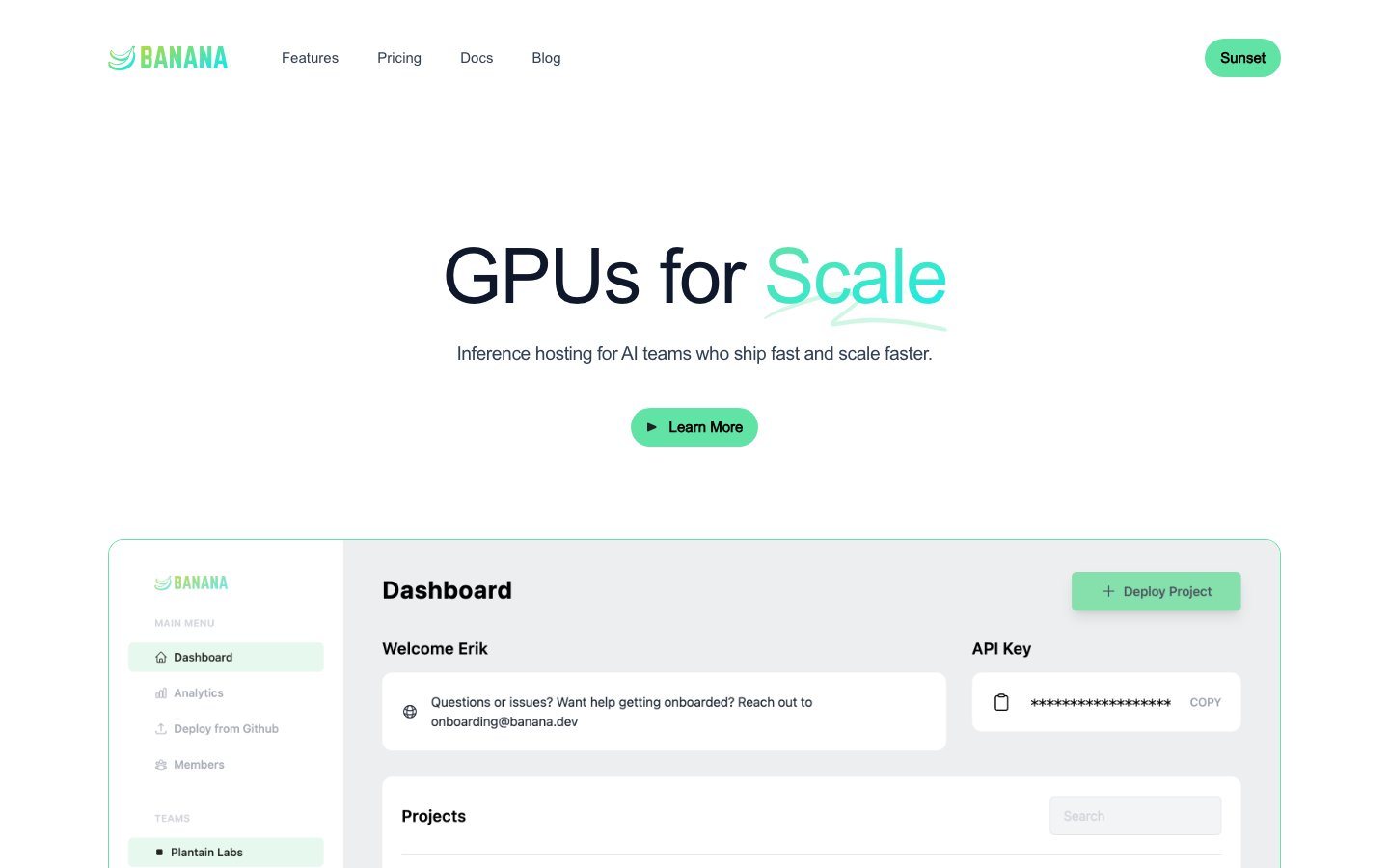
BananaDev
Core parameters and statistics of Banana Dev
Banana Dev was once positioned as a serverless GPU inference platform, solving the engineering problem of "how to run the model for others to call after training is completed." It adopts a "zero operation and maintenance deployment" model, allowing developers to only focus on model code and not manage GPU infrastructure. The platform has officially ceased service on March 31, 2024. The following parameters reflect the product form during its operation.
| Project | Public information during operation period |
|---|---|
| Official positioning | Serverless GPU inference platform |
| Deployment mode | Upload code → Automatically build Docker → Generate REST API |
| Model runtime | Python, PyTorch, TensorFlow, ONNX |
| Supports GPU | A10G, A100, L4 (via Coreweave and Runpod backend) |
| cold start | seconds (preload model weights through init function) |
| Billing method | Team monthly fee + zero bonus billing based on GPU execution time |
| Team Package | $1,200/month (includes 10 seats, 5 projects, 50 maximum parallel GPUs) |
| Open Source | Potassium Framework (Apache-2.0), Fructose (APache-2.0) |
| GitHub Stars | Potassium 103 ★, Fructose 748 ★, Serverless Template 89 ★ |
| Place of Residence | United States (US) |
Core Difference: The biggest difference between Banana Dev and traditional inference services such as AWS SageMaker and GCP Vertex AI is the simplification of the developer experience - developers only need to write an app.init initialization function and an app.handler inference function, plus requirements.txt, and the platform automatically completes Docker build GPU scheduling, automatic expansion and contraction from scratch, and load balancing. This one-click experience "from code to API" will be favored by a large number of start-up teams in 2022-2023.
Important status note: Banana Dev has announced the discontinuation of the Serverless GPU service on February 1, 2024, and officially shut down the infrastructure on March 31, 2024. Its official blog clearly stated that due to multiple factors such as runway, changes in user retention AI macro trends, and GPU supply chain constraints, the team was unable to achieve the "reliable, economical, fast, and easy-to-use" product spec, and ultimately decided to shut down the business line and transform the company. The following content is based on public information during its operation period and is provided for model selection reference and historical review.
Users and market recognition of Banana Dev
Banana Dev gained recognition from specific market segments during its operation, but its user scale and market coverage were relatively limited:
- Y Combinator Endorsement: Banana Dev is a member of the Y Combinator S21 batch. This background provided it with credibility within the entrepreneurial ecosystem and an initial user pool in its early days.
- GitHub Community Feedback: Its open source framework Potassium received 103 stars, Fructose (a more general HTTP service framework) received 748 stars, and serverless-template received 89 stars. These numbers are medium-sized among AI infrastructure open source projects, reflecting some community attention but not widespread virality.
- User composition: The main users are AI start-up teams, independent developer Hackathon participants and small and medium-sized SaaS products. The typical user profile is a team of 1-10 people who "have model deployment needs but lack DevOps manpower".
- Enterprise-level adoption: No specific list of enterprise customers or number of paying users is disclosed. The pricing page once offered Team and Enterprise tiers, but Enterprise pricing and customer information were not disclosed.
- Industry benchmarking position: In the Serverless GPU inference track, Banana Dev is in the same competitive range as Replicate, Modal, Runpod Serverless, Beam and other products. Compared with Replicate's model market ecosystem and Modal's Python native experience, Banana's core differences lie in "zero-plus GPU pricing" and "the minimalist abstraction of the Potassium framework."
Market Exit Signal: The decision to shut down in early 2024 itself reflects the cruel reality of the serverless GPU inference market - startups in the infrastructure layer (GPU orchestration) face tremendous pressure on unit economic models and retention when facing cloud vendors (AWS SageMaker, GCP Vertex AI) and more well-funded competitors (Replicate, Modal).
Cost Advantages of Banana Dev
Banana Dev's cost model was once its most differentiating selling point. The following breaks down its cost structure from three dimensions:
C-side/Individual developer layer
- Free Trial: New accounts usually get about $5 in free credits, which can be used for small-scale model verification and prototype testing.
- Pay as you go: In the early per-second billing mode, A10G costs about $0.0005/second, which is suitable for occasional inference scenarios. After the pricing is changed to "zero-plus GPU time" at the end of 2023, the GPU itself will be charged at the cloud manufacturer's cost price, and the platform will only charge a monthly fee.
- Hidden costs: Individual developers need to bear the cost of project time such as model debugging, Docker image optimization, cold start tuning, etc. Although Banana's Potassium framework simplifies deployment templates, the adaptation of non-standard models (such as custom operators, multi-modal pipelines) still requires additional engineering investment.
API / Developer Layer
- Team monthly fee $1,200/month: This is Banana Dev's adjusted pricing model at the end of 2023 - a fixed monthly fee covers platform functions (dashboard, logs, multi-projects, branch deployment), and GPU computing resources are billed at zero markup based on actual usage.
- Cost comparison: Compared with Runpod Serverless's pure on-demand pricing and Modal's per-second billing, Banana's "monthly fee + zero bonus GPU" model is more friendly to teams with large monthly inference volumes, but the monthly fee threshold is high for low-frequency users.
- Hidden fees: GPU warm-up time during cold start is also billed; multi-project parallel deployment requires a higher Team package; enterprise-level features (SAML SSO, automation API, custom inference queue) need to be upgraded to the Enterprise plan, and the pricing is not disclosed.
Enterprise / Privatization Layer
- Enterprise Plan: Pricing not disclosed, contact business. Includes SAML SSO, higher parallel GPU quotas, custom inference queues, build pipeline GPUs, dedicated support.
- Private Deployment: Banana Dev is essentially a hosted platform and does not offer a private deployment option. For enterprise scenarios with high data sovereignty and compliance requirements, this is not an option.
- Migration Cost: This is the largest hidden cost. After Banana is shut down, all users must migrate to other platforms. Its official migration guide recommends alternatives such as Runpod Serverless, Modal, Replicate, AWS SageMaker, and more. Applications based on the Potassium framework can be relatively smoothly migrated to Runpod (also a containerized HTTP Server), but migrating to Modal requires rewriting to the Modal SDK style.
Cost Advantage Summary: Banana Dev's "zero-plus GPU" pricing is clearly cost competitive in the Serverless GPU market in 2023, but this advantage is based on the business model of "the platform does not rely on GPU price differences to make profits" - which itself is a question mark for sustainable development. The final shutdown also confirmed the commercialization challenges of this model.
Main features of Banana Dev
Banana Dev's functional design revolves around the smallest path "from code to API", and each function aims to lower the deployment threshold:
- One-click model deployment: Users upload a GitHub repository or ZIP package containing model code and
requirements.txt, and the platform automatically completes Docker image building, container registration and API endpoint generation. The deployment portal provides multiple official templates (Stable Diffusion, Mistral-7B, GPT-J, Whisper, etc.), and users can directly replace the model weights after forking. - Automatic expansion and contraction from zero: The inference instance automatically expands from 0 to N according to the request volume, and shrinks back to 0 when idle. The expansion and contraction policy is triggered based on the CPU utilization percentage, and users can configure the utilization threshold in the Team package. This capability is the core value of serverless GPUs—not paying for idle GPUs.
- Multi-version management and branch deployment: The same model supports multiple versions online at the same time, and each version corresponds to an independent API endpoint. Supports Branch Deployments, allowing users to create independent deployment contexts from different Git branches to facilitate A/B testing and grayscale release processes.
- Built-in Observability: Provides inference log search, request traffic visualization, latency distribution and error rate monitoring panels. The Business Analytics feature supports tracking consumption and request volume by endpoint and time dimensions, helping teams understand business trends.
- Multi-backend Scheduling: Banana Dev announced support for multi-cloud deployment in Changelog 045 in January 2024 - users can deploy inference workloads to Coreweave or Runpod's on-demand VM backend, taking advantage of Runpod's more competitive GPU pricing (claimed to be more than 50% lower than Coreweave) to reduce costs.
- Private Docker repository integration: Supports pulling base images from private Docker Registry during the build process to meet enterprise-level security requirements.
- Automation API and CLI: Provides a RESTful API and command line tool
banana-cli(Python implementation, 22 Stars), allowing users to programmatically manage deployments, trigger builds and query status.
Functional synergy: Banana Dev's function chain is a complete package - template initialization → code upload → automatic construction → API generation → monitoring alarms → automatic expansion and contraction. Developers do not need to write Kubernetes configuration Ingress, set HPA policy, etc. in Dockerfile and switch back and forth between sections. This "fully managed" experience has obvious developer experience advantages in the GPU inference market in 2022-2023, and is also a key reason for it to gain YC endorsement and early users.
Version evolution of Banana Dev
As a continuously operating cloud service, Banana Dev's version evolution is mainly recorded through the Changelog series on the official blog. The following are key milestones during its operations:
Main publishing node
| Time | Version/Event | Key Changes |
|---|---|---|
| 2021 (S21) | YC Batch launch | Banana Dev was selected for Y Combinator S21 and received initial funding and ecological access |
| Early 2022 | Public Beta release | Serverless GPU inference platform will be available to the public for the first time |
| Early 2023 | Potassium framework open source | Release the open source HTTP inference framework Potassium (Apache-2.0) to reduce user migration concerns |
| Mid-2023 | Fructose framework open source | Release a more general HTTP service framework to further expand developer coverage |
| 2023-11 | Zero markup pricing released | Announced that the platform will no longer increase the price of GPU time, and will change to a fixed monthly fee + cost price GPU |
| 2023-12 | Changelog #042-#044 | Multiple platform optimizations and function enhancements |
| 2024-01-19 | Changelog 045 | Support Runpod backend multi-cloud deployment, private Docker warehouse integration |
| 2024-02-01 | Shutdown Announcement | CEO Erik Dunteman releases Sunsetting Serverless GPUs announcement |
| 2024-03-31 | Official shutdown | Banana Serverless GPU infrastructure is completely shut down |
Version feature analysis
- Zero Markup Pricing Pivot: The November 2023 pricing overhaul is a major turning point for Banana Dev’s business model. The platform has shifted from "profiting by the price difference of GPU" to "profiting by platform monthly fees", and GPUs are directly connected at cost price. On the one hand, this improves pricing transparency, and on the other hand, it also exposes the industry reality that "purely relying on price differences cannot support platform operations."
- Multi-cloud scheduling attempt: The Runpod backend introduced in January 2024 is Banana Dev’s last major feature iteration at the product level—an attempt to reduce user costs and improve competitiveness through a multi-cloud strategy. But just two weeks later, the team made the decision to shut down, indicating that business fundamentals problems could no longer be solved through product features.
- Open Source Legacy: Two open source frameworks, Potassium and Fructose, remain on GitHub (Apache-2.0 license) after shutdown and can be used as reference implementations or migration bases.
Banana Dev’s technical advantages
Banana Dev's technical architecture revolves around the core contradiction of "simplifying GPU inference deployment", and its technology selection directly determines the upper limit of developer experience.
Potassium Framework: From HTTP Server to Inference Primitives
Potassium is an open source Python HTTP framework developed by Banana Dev and is specially designed for GPU inference scenarios. Its core abstraction has only two functions:
from potassium import Potassium, Request, Response
from transformers import pipeline

app = Potassium("my_app")

@app.init
def init():
    """Execute once when the container starts to load the model into GPU memory"""
    model = pipeline('fill-mask', model='bert-base-uncased', device=0)
    return {"model": model}

@app.handler("/")
def handler(context, request):
    """Called every time an inference request is made, reusing the model loaded in init"""
    model = context.get("model")
    prompt = request.json.get("prompt")
    outputs = model(prompt)
    return Response(status=200, json={"outputs": outputs[0]})

app.serve()
Mechanism → Effect: @app.init is executed only once when the container is cold started to load the model weights into GPU memory (which may take several seconds to tens of seconds); @app.handler processes the actual inference request and reuses the loaded model. This "separated initialization and inference" design makes the inference delay after cold start determined only by the model inference time and network transmission, avoiding the performance disaster of reloading the model with each request.
Implementation path of automatic expansion and contraction from scratch
Banana Dev's automatic scaling is triggered based on CPU utilization percentage, rather than the simple replica number strategy of traditional Kubernetes HPA:
- Scale to zero: When the idleness of the inference instance exceeds the threshold, it is automatically terminated and GPU resources are released. Users do not need to pay for idleness. This is the core capability that differentiates Serverless GPU from traditional GPU cloud hosts.
- Start from scratch: When a new request arrives, the platform triggers new container creation → Docker image pull →
@app.initexecution → model loading → ready response. The entire process typically takes 5-30 seconds, depending on model size and image cache. - Warm Pool Strategy: Banana maintains a pool of warmed containers that significantly reduces cold start times. For latency-sensitive scenarios, users can maintain a minimum number of active instances in exchange for lower first request latency.
Multi-cloud GPU scheduling architecture
In the later stages of operation, Banana Dev's architecture evolved into a "control plane + multi-cloud data plane" model:
User Request → Banana API Gateway → Scheduler → Coreweave GPU Cluster
                                    ↘ Runpod GPU cluster
This architecture allows Banana Dev to schedule inference workloads across different GPU cloud providers, taking advantage of Runpod’s low-priced GPUs to reduce costs. From a technical perspective, this is equivalent to building an abstract Serverless scheduling layer on top of GPU cloud vendors - this idea is consistent with the direction of later products such as Runpod Serverless and Beam.
Engineering pitfall experience (based on official blog and industry common sense)
- Cold start and long-tail delay: The loading time of
@app.initfor large models (such as LLM with more than 7B parameters) can reach 30-60 seconds, which is unacceptable for scenarios with high real-time requirements. Solutions include warm-up pools, model quantization (FP16 → INT8), and optimizing loading speed using ONNX Runtime or TensorRT. - GPU supply chain constraints: Banana Dev is highly dependent on Coreweave and Runpod for GPU supply. In the context of global shortages of high-end GPUs such as the A100 in 2022-2023, the platform's GPU model selection and availability are severely restricted by upstream suppliers.
- Unit Economic Model Challenge: The gross profit margin of the Serverless GPU platform is determined by GPU utilization, cold start frequency and bidding strategy. Although Banana Dev's zero-markup pricing model is user-friendly, the platform itself lacks a profit buffer. Once the user retention rate is insufficient or the GPU utilization falls below the break-even point, commercialization will be unsustainable.
How to use Banana Dev
Banana Dev provides multiple access points during operation. The following is compiled based on its official documents and open source projects.
Deployment process (standard path)
- Prepare model code: Create a Python project containing the Potassium framework and implement the
@app.initand@app.handlerfunctions. - Configuration dependencies: Write
requirements.txtto list all Python package dependencies. - Upload to Banana: Upload to the Banana console through GitHub repository association or ZIP package.
- Automatic build: The platform detects code changes and automatically pulls the code → builds the Docker image → pushes the image warehouse.
- Deploy as API: After the build is completed, the platform allocates an API endpoint in the format of
https://<project>.banana.dev/. - Call inference: Send the inference input in JSON format through HTTP POST request to obtain the results.
SDK and API call examples
Here's how the Python SDK typically calls a deployed model:
import banana_dev as banana

#Initialize client
api_key = "<YOUR_API_KEY>"
model_key = "<YOUR_MODEL_KEY>"

# Call inference (synchronous)
inputs = {"prompt": "The quick brown fox jumps over the"}
result = banana.run(api_key, model_key, inputs)
print(result["outputs"])
# Directly call the API endpoint through curl
curl -X POST https://<project>.banana.dev/ \
-H "Content-Type: application/json" \
-H "Authorization: Key <YOUR_API_KEY>" \
-d '{"prompt": "The quick brown fox jumps over the"}'CLI tools
Banana provides the banana-cli command line tool (implemented in Python), which supports operations such as deployment management, log viewing, and build triggering:
pip install banana-cli
banana deploy --project my-model --api-key <YOUR_API_KEY>
banana logs --project my-model
Migration path (reference after shutdown)
For users who are still using Banana deployment, the following migration paths are officially recommended:
| Target platform | Migration difficulty | Adaptation points |
|---|---|---|
| Runpod Serverless | Low | Both are containerized HTTP Servers, and most of the Potassium code can be reused |
| Modal | Medium-High | Needs to be rewritten to Modal SDK style, but can get higher replica limit and faster cold start |
| Replicate (Cog) | Medium | Potassium project needs to be converted to Cog format |
| AWS SageMaker | High | Needs to adapt to SageMaker inference container specifications, but the infrastructure is the most stable |
Product Pricing for Banana Dev
Banana Dev's pricing has gone through a shift from "per-second billing" to "monthly fee + zero-plus GPU." The following is its final pricing model:
Pricing range
| Tier | Monthly fee | Content included | GPU billing |
|---|---|---|---|
| Team | $1,200/month | 10 Seats 5 Projects 50 Maximum parallel GPU, log search, request analysis, branch deployment | Zero markup based on usage (cost price) |
| Enterprise | Undisclosed (requires business contact) | Team Full Features + SAML SSO, Automation API, Higher Parallel GPU, Custom Inference Queue, Build Pipeline GPU | Zero bonus based on usage |
| Banana Delivery | $20 | CEO delivers bananas to the office (SF area only, fun additional service) | Not involved |
Pricing strategy analysis
- Zero markup GPU model: Banana Dev claims to be a "no markup" GPU inference platform - GPU computing is directly based on the cloud manufacturer's cost price, and the platform only relies on monthly fees to make profits. This is a unique pricing strategy in the Serverless GPU market in 2023, directly benchmarking the 20-50% GPU markup rate of traditional cloud vendors.
- Monthly fee threshold: The $1,200/month Team package has a higher threshold for individual developers and very early prototype teams. This pricing actually locks Banana Dev's target users at "small teams with stable reasoning needs" rather than "independent developers who occasionally try out".
- Free Credit: New accounts usually receive $5 in free credit, which can cover dozens to hundreds of inference calls for small models.
- Price comparison with competing products:
| Platform | Starting Cost | GPU Billing Model | Cold Start Performance |
|---|---|---|---|
| Banana Dev | $1,200/month (Team) + zero bonus GPU | Fixed monthly fee + cost price GPU | Second level (preheating pool) |
| Runpod Serverless | $0/month + billed by the second | Purely on-demand, no monthly fee | Second level |
| Modal | $0/month + billed by second | Purely on-demand, free monthly quota | Sub-second level (high-speed snapshot) |
| Replicate | $0/month + billed by second | Pure on-demand | Second level |
| AWS SageMaker | $0/month + per-instance billing | Per-instance running time | Minutes (requires warm-up) |
As can be seen from the table above, Banana Dev's monthly fee model is more cost-effective for high-frequency inference teams (there is no bonus to GPU costs after the monthly fee is diluted by a large number of inferences), but for low-frequency or fluctuating inference loads, pure on-demand platforms (Modal, Runpod) are more flexible.
Application scenarios of Banana Dev
Banana Dev is best suited for the following scenarios during its operational life:
- AI prototype rapid launch: Startup teams or Hackathon projects deploy a HuggingFace model as an accessible API within 24 hours for demo demonstrations, user verification, or investment pitches. Official templates provided by Banana (Stable Diffusion, Mistral-7B, Whisper, etc.) reduce deployment time from days to hours. Verification focus: During the prototype stage, priority is given to evaluating whether the cold start delay is within an acceptable range.
- Back-end inference for small and medium-sized products: The back-end of AI capabilities in SaaS products (such as image generation, text classification, speech transcription), the monthly inference volume ranges from tens to hundreds of thousands, and the traffic has obvious "peak-trough" characteristics. Banana’s ability to automatically scale up and down from zero ensures that GPU resources are not wasted during trough periods. Verification focus: Evaluate the GPU execution time corresponding to the total monthly inference volume and determine whether the unit cost after monthly amortization is better than that of a pure on-demand platform.
- Batch offline inference jobs: Submit batch inference tasks through the API, and use automatic expansion and contraction to start multiple GPU instances for parallel processing at the same time. It is suitable for scenarios such as data set annotation, batch content review, and large-scale Embedding generation. Key points to verify: Pay attention to the maximum parallel GPU limit of the platform (50 for the Team package) and the stability of long-running jobs.
- Multi-model A/B testing and grayscale release: Leverage Banana Dev's multi-version management and branch deployment capabilities to run multiple versions of the same model simultaneously to compare inference quality, latency and cost. This scenario is particularly important in AI teams with frequent model iterations. Verification focus: Confirm whether the observability capabilities of traffic segmentation and indicator comparison between versions meet the team's needs.
Unsuitable Scenarios: Banana Dev is not suitable for the following scenarios - millisecond-level real-time inference (such as online advertising recommendation, transaction risk control), because the cold start second-level delay is unacceptable; enterprise scenarios with sensitive data sovereignty (private deployment is not supported); ultra-large-scale inference (tens of thousands of QPS levels), because the platform scale and SLA are not as good as cloud vendors; and inference scenarios that require special hardware (such as IPU, TPU, Habana Gaudi).
Applicable people of Banana Dev
Banana Dev’s positioning determines that it is only valuable to specific groups of people:
- Technical leader of AI start-up team: Team size is 1-10 people, with model training or fine-tuning capabilities but lack of full-time DevOps. Banana Dev's "upload code as API" experience allows a CTO or algorithm engineer to deploy in hours without waiting for support from the infrastructure team. Prerequisites: The team needs to have Python development capabilities and model encapsulation experience (loading models into the Potassium framework).
- Independent AI Developers and Freelancers: Independent developers who undertake AI model deployment projects or develop personal AI products. Banana Dev’s free credits and low operational burden make it a low-cost option for the prototyping phase. Prerequisite: You must be able to withstand the Team payment threshold of $1,200/month (or complete verification before the free quota is exhausted).
- Hackathon Participants and AI Learners: Quickly turn model ideas into demonstrable APIs in a 48-hour Hackathon. Official templates significantly lower the entry barrier. Prerequisite: You need to have a certain understanding of the HuggingFace model ecology.
- Evaluators seeking Serverless GPU comparison: Teams who are evaluating platforms such as Modal, Runpod Serverless, Replicate, etc., Banana Dev provides a reference benchmark of "zero markup pricing + fully managed" as a control sample.
Not suitable for the crowd: Not recommended for use by the following groups - enterprise customers who require private deployment (Banana does not support it); real-time systems with strict requirements on inference latency (<100ms P99); teams with non-Python technology stacks (only supports Python runtime); and budget-sensitive individual developers (the team package starting at $1,200/month has a higher threshold).
Summary and Outlook
Review of Core Competencies
Banana Dev defined a minimalist paradigm for the Serverless GPU inference platform during its operation period - through the Potassium framework's "two function" abstraction, automatic scaling from scratch, and zero-plus GPU pricing, the engineering threshold for model deployment was reduced to the lowest level at the time. It has gained some recognition in the Y Combinator ecosystem and the AI developer community, and its open source frameworks Potassium and Fructose remain on GitHub as technical legacies.
Review of current restrictions and closure reasons
- Insufficient Business Sustainability: The core contradiction of Banana Dev is that the Serverless GPU platform needs to strike a balance between high GPU utilization (profitability) and scaling from zero (user value). Although zero-markup pricing has gained favor among developers, the platform itself lacks sufficient profit buffer. Founder Erik Dunteman admitted in the shutdown announcement that the team was unable to achieve the specs required for product-market fit given the current runway, retention and GPU supply chain constraints.
- Missing economies of scale: Compared to GPU inference services from cloud vendors (AWS, GCP) and well-funded competitors (Modal, Replicate), Banana Dev is at a disadvantage in terms of GPU procurement costs, geographic distribution, and brand recognition.
- Limited technical barriers: Although the Potassium framework has an excellent experience, its core design (HTTP Server + init/handler mode) is not technically irreproducible. Runpod Serverless and Modal then provide a similar or even better developer experience.
Implications for the Serverless GPU industry
The rise and fall of Banana Dev provides an important reference case for the Serverless GPU reasoning track: It is difficult for a pure platform middle layer (building a GPU orchestration layer on top of cloud vendors) to survive independently in the absence of differentiated technologies and business model moats. Successful serverless GPU platforms either have their own GPU infrastructure (such as Coreweave), lock users through the model market ecosystem (such as Replicate), or are tied to a broader developer platform (such as Modal's data science platform positioning).
Alternatives and Migration Suggestions
For teams still running or planning serverless GPU inference, the following alternatives are worth evaluating:
- Modal: Python native experience, excellent cold start performance (high-speed snapshot technology), suitable for teams that have requirements for both latency and development experience. However, it should be noted that the SDK style of Modal is relatively customized, and code migration requires certain engineering investment.
- Runpod Serverless: The architecture closest to Banana Dev (containerized HTTP Server + scaling from zero), has the lowest migration cost, and provides on-demand VMs as a supplement. Prices are competitive in the serverless GPU market.
- Replicate: For teams using mainstream open source models, its Cog tool is similar in design philosophy to Banana Dev's Potassium. The advantage of Replicate is that it has a large number of pre-optimized models, and there is no need to configure the inference environment yourself.
- AWS SageMaker: suitable for enterprise scenarios that require extremely high infrastructure stability, but the developer experience and cold start performance are not as good as the above-mentioned professional Serverless GPU platforms.
Procurement/Adoption Risk Assessment: Before evaluating any Serverless GPU platform, "platform shutdown/business termination" must be factored into the decision-making as a core risk factor - Banana Dev's experience proves that even with YC endorsement and signs of product-market fit, the survival of GPU inference infrastructure startups is still highly uncertain. It is recommended to keep platform coupling to a minimum when designing the architecture (using standard Docker container HTTP interfaces and open source inference frameworks) to ensure a relatively smooth migration to alternatives when the platform changes. For business-critical inference workloads, reserve multi-platform deployment capabilities or maintain compatibility with direct deployment paths from cloud vendors. In addition, service termination clauses, data migration windows and balance refund policies should be reviewed when signing commercial contracts, details that have proven to be key risk points in the Banana shutdown case.
Related tools:
Banana Dev’s model and version evolution
Continuous iterative updates, the latest version introduces performance optimization and new features. Historical version information can be viewed through the official release page. There is currently no complete public version evolution timeline.
Banana Dev How to use
- Web client: You can use it by visiting the official website and registering an account. Most functions do not require installation.
- API access: Provides RESTful API, developers can obtain the API Key and integrate it into their own applications.
Version Info
- Banana Platform 2026 :There is no official precise date yet. Optimize cold start time and model caching strategy.
- Banana Platform 2025 :There is no official precise date yet. Supports more model runtimes and automatic scaling enhancements.
User Reviews