 Baseten
Baseten is an AI training model and production inference platform for developers and enterprise AI teams, covering custom model deployment, pre-optimized Model APIs, Training/Loops, Frontier Gateway, multi-cloud capacity management, automatic expansion and contraction, and observability.
Baseten
Core parameters and statistics
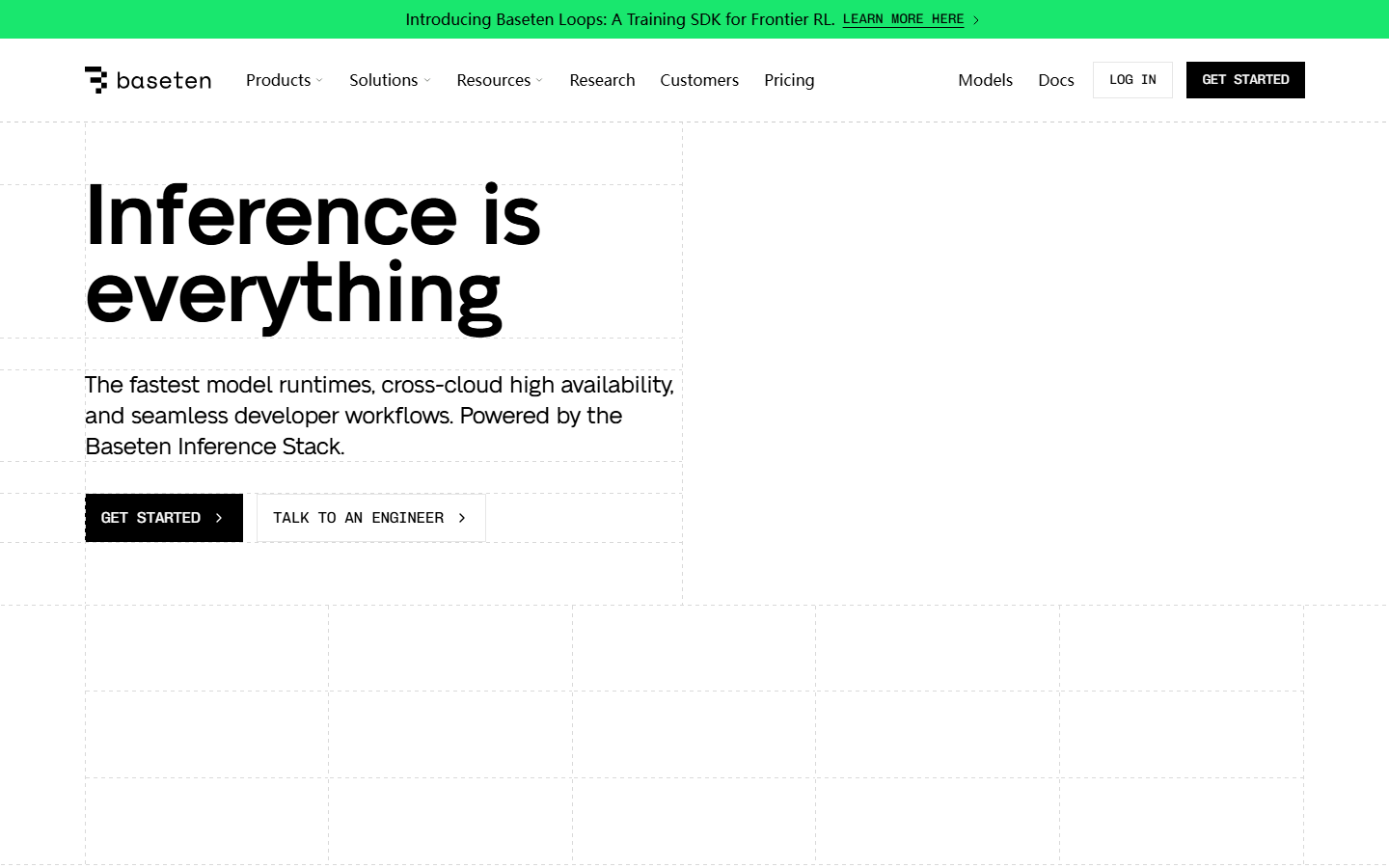
Baseten's official positioning is not a general data cleaning platform, but an AI training and inference platform for production context. It lets teams bring in Hugging Face open source models, fine-tune checkpoints or custom models, and turn the models into production API endpoints with autoscaling, observability, and optimized serving infrastructure. The homepage of the official website further condenses the proposition into "Inference is everything", with the core values focusing on model runtime, multi-cloud high availability and developer workflow.
| Projects | Public Information |
|---|---|
| Official positioning | Training and inference platform |
| Main entrance | Web console API, document Model APIs |
| Core Products | Dedicated Inference, Model APIs, Training, Frontier Gateway |
| Deployment forms | Baseten Cloud, Self-hosted, Hybrid, Embedded engineering |
| Reasoning capabilities | Automatic expansion and contraction, model streaming output, asynchronous reasoning, structured output JSON mode, Function calling |
| Infrastructure | GPU scheduling across multiple clouds, Multi-cloud Capacity Management, engine-level optimizations |
| Compliance and Reliability | Pricing page displays SOC 2 Type II, HIPAA; Home page displays 99.99% uptime |
| Latest product node | Baseten Loops SDK, 2026-05-08 |
Positioning boundaries: Baseten is more suitable for bringing models into production APIs, post-training processing, and inference infrastructure management; it is not a chatbot for personal creation, nor is it a low-code data table tool. It is classified under ai-model-training because the official product line already covers Training/Loops and forms the same model life cycle path as inference deployment.
User and market recognition
Baseten's market signals mainly come from official website customer cases, customer logo walls and official public indicators, rather than the total number of public users. The homepage and pricing page of the official website show customers or cases such as Writer, Zed, Clay, Notion, OpenEvidence, ClickUp, etc. The Writer case disclosed that with the help of TensorRT-LLM on Baseten, the tokens per second of new industry LLM increased by 60%; the Zed case disclosed that the Edit Prediction function achieves 45% lower p90 latency, 3.6x higher throughput and 100% uptime.
Enterprise Adoption Characteristics: These cases collectively point to high throughput, low latency, production reliability, and GPU cost control, rather than a single model demo. For enterprise users, the value of Baseten is to integrate containerized GPU scheduling, multi-cloud capacity, cold start, log indicators and calling interfaces in model launch into one platform, reducing the cost of infrastructure teams repeatedly building inference stacks.
Public Data Boundaries: Baseten does not consistently disclose the total number of users, annual revenue, or complete customer numbers on its official website. If company-level information such as financing and valuation is used for business judgment, official news pages and real-time announcements should be used as the basis. Customer logo walls should not be directly converted into market share.
Cost advantage
Baseten's cost advantage does not come from "replacing all GPU costs for free", but from putting model deployment, automatic expansion and contraction Model API, training and enterprise support into the same billing and engineering system. The pricing page gives the hierarchical structure of Basic, Pro, and Enterprise, and makes it clear that Basic is $0 per month, pay as you go.
| Cost level | Official public form | Applicable boundary |
|---|---|---|
| C-side/individual | There is no independent subscription product for ordinary consumers; Basic can be paid per use starting from $0/month | Suitable for trial deployment by technical individuals or small teams, not suitable for code-free consumer chat |
| Developer/API | Dedicated deployments, Model APIs, Training; pay according to consumption of deployment, expansion and contraction, prediction and other activities | Suitable for prototype verification, model API, low to medium-scale production traffic |
| Enterprise/Private | Pro, Enterprise, Self-hosted, Hybrid, Embedded engineering | Business confirmation required GPU, dedicated computing, higher rate limits, SSO/SCIM, compliance and contract terms |
Explicit Cost: There is no monthly fee threshold for the Basic tier, but inference, training, or GPU-related costs will still be incurred when the model is actually running. Hidden costs: The team still needs to maintain model quality prompts/call logic, monitor alarms, rollback strategies, and cloud bill management. What Baseten reduces is the cost of inference infrastructure engineering, not model development and business verification itself.
Main functions
- Dedicated Inference: Used to deploy custom, fine-tuned or open source models, convert the models into production API endpoints, and obtain automatic scaling and observability.
- Model APIs: The homepage of the official website displays trial model entrances such as Kimi K2.6, DeepSeek V4, GLM 5.1, etc., suitable for quick evaluation or starting new workloads with pre-optimized models.
- Training and Loops: Loops is a Python SDK for frontier RL post-training, emphasizing one-click deployment of long sequences, asynchronous RL and checkpoints to the Baseten Inference Stack.
- Frontier Gateway: used to host models as inference API through Baseten, suitable for faster commercialization and external services for model providers.
- Multi-cloud and High Availability: Documentation Description Baseten schedules workloads across multi-cloud and multi-region through Multi-cloud Capacity Management; home page shows 99.99% uptime.
- Observability and Operations: The document includes operation and maintenance portals such as Logs, Metrics, Status and health, and Secure model deployment, which is suitable for production-bound troubleshooting and cost management.
The combination of these capabilities is suitable for the stage when "the model already has business value and needs to enter scalable API services". If the team only needs temporary notebook experiments or one-time batch inference, Baseten's platform capabilities may appear to be overweight.
Model and version evolution
Baseten is a continuously iterative cloud service that does not have traditional desktop software version numbers. More reasonable version clues come from official product milestones: Training infrastructure, Training/autoresearch scenarios and Loops SDK.
| Time | Milestone | Product Meaning |
|---|---|---|
| 2026-01-23 | Baseten Training infrastructure | Extend from inference to training infrastructure, allowing existing training code to run on scalable compute |
| 2026-03-31 | Baseten Training: an autoresearch substrate | Emphasis on the combination of Training with automated research and experimental iteration |
| 2026-05-08 | Baseten Loops SDK | For frontier RL post-training, connecting the post-training checkpoint and the production inference stack |
Evolutionary direction: Baseten’s main line has expanded from “deployment model” to “training, deployment, service and monetization model”. This path is critical for AI-native product teams, as training vs. inference runtime mismatch, checkpoint deployment, capacity scheduling, and cost control are often major frictions when moving from experimentation to production.
Technical advantages
Mechanism: Automatic expansion and contraction + scale to zero. Document description Baseten can configure minimum/maximum replicas, concurrency targets and scale-down delays based on traffic; the model can be scaled to zero when it is idle, and then expanded when traffic arrives. The effect is to reduce costs during quiet periods while retaining production traffic capacity, which is suitable for model APIs with obvious peaks and troughs.
Mechanism: Multi-cloud Capacity Management. Baseten documentation describes MCM that schedules workloads across multiple clouds and regions and keeps models available during provider-level disruptions. The effect is to reduce the impact of single-cloud GPU capacity constraints on the business, and is suitable for AI products that require cross-regional low latency and high availability.
Mechanism: engine-level optimizations. The document mentions engine-level optimizations such as TensorRT-LLM, and the official website cases also show the improvements in throughput and latency of Writer and Zed. The effect is to productize the underlying serving optimization, which is suitable for organizations that do not have a dedicated reasoning performance team but need production performance.
Cost: The more complete the platform abstraction is, the more the team needs to understand its deployment model, scaling parameters, log metrics, and billing structure. Baseten is not a tool that automatically solves model quality problems. It solves the engineering problems of production inference and training infrastructure.
How to use
The typical usage path for Baseten is to start with a model deployment or Model APIs and then expand to Pro, Enterprise, self-hosted or hybrid deployments based on traffic and compliance needs.
| Entrance | Typical tasks | Suitable for teams |
|---|---|---|
| Official homepage/Console | Create an account, deploy models, and view product portals | Developers who need to quickly verify the production inference experience |
| Documentation Quickstart | Deploy Hugging Face model, call inference API, configure streaming/async/structured outputs | Engineering team ML platform team |
| Pricing/Basic | Start a trial run from $0/month pay as you go | Small team or early product validation |
| Pro/Enterprise | Dedicated computing, priority GPU, higher Model API rate limits, SSO/SCIM, contract support | Enterprises with large production traffic or high compliance requirements |
The actual implementation can be carried out in three steps: first deploy a non-core but real model API and observe cold start, concurrency, logs and bills; then compare the existing self-built inference service with Baseten in terms of p95 latency, tokens per second, error rate, and unit request cost; finally, only migrate models with clear performance benefits and operation and maintenance benefits to production.
Product Pricing
The Baseten pricing page gives three tiers: Basic, Pro, and Enterprise. Basic includes Dedicated deployments, Model APIs, Training, fast cold starts, SOC 2 Type II and HIPAA compliant, email and in-app chat support, and is marked with $0 per month, pay as you go. Pro adds unlimited autoscaling, priority compute access, priority access to high-demand GPUs, dedicated compute and higher Model API rate limits on Basic. Enterprise's SSO/SCIM, deployment boundaries, compliance, support SLA and contract terms are subject to business confirmation.
- Individuals and Small Teams: Basic has a low monthly fee, but actual costs vary with deployment, scaling, forecasting, and training activities.
- Developer/API: Focus on unit request cost, cold start time, concurrency rate limits and GPU supply stability.
- Enterprise/Private: Fees are typically determined by a combination of compute resources, availability targets, compliance, support response, dedicated deployment and contractual commitments, as shown on the official live page and commercial quotes.
When evaluating purchases, it is not advisable to only compare GPU hourly unit prices. For production AI products, cold start, failure retry, manual maintenance, performance optimization, monitoring troubleshooting and capacity reservation will all enter the total cost.
Application scenarios
- AI product inference backend: Expose open source LLM, fine-tuned models or custom models as stable APIs. The benefit is to shorten the distance from the model to the product interface. The verification focuses on p95 latency, error rate and expansion and contraction speed.
- High-throughput generative AI service: For text generation, speech, image embedding or compound AI workloads, the benefit is to hand over runtime optimization and GPU scheduling to a unified platform, and the verification focuses on throughput, unit output cost and peak traffic acceptance.
- Post-training reinforcement learning and checkpoint deployment: Loops is oriented to frontier RL post-training. The benefit is to connect the training products to the inference stack faster. The verification focus is on training code compatibility, long-sequence support for checkpoint deployment links and online effect regression.
- Model API commercialization: Frontier Gateway is suitable for model providers to use Baseten to provide inference API. The benefit is to turn model services into callable products faster. The verification focuses on rate limit, billing callback, stability and customer isolation.
These scenarios all have a common premise: the model itself already has business value or has clear experimental goals. If model quality, data authorization, or business relationships have not yet been confirmed, the infrastructure platform cannot replace early verification.
Applicable people
- AI Product Engineering Team: Need to stably integrate the model API into the product, and continuously manage latency, throughput, cost and error rate.
- ML Platform and Infrastructure Team: Hope to reduce the duplication of construction of self-built serving stack GPU scheduling, multi-cloud capacity and monitoring system.
- Model startups and model providers: Hope to serve models more quickly through Frontier Gateway or Model APIs.
- Enterprise AI mid-office team: Need to strike a balance between compliance, availability, dedicated computing and support terms, and unified governance of multiple model services.
People who are not suitable include: ordinary users who only need web chat, individual creators without engineering resources, early ideas who have not yet determined the business value of the model, and high-isolation situations where third-party cloud infrastructure is completely unacceptable. The latter should first check the business and security terms of Self-hosted or Hybrid.
Summary and Outlook
Baseten's core competency lies in connecting training, inference, pre-optimized Model APIs, multi-cloud capacity, automatic scaling and production observability into a single model launch path. It is most suitable for AI product teams that have passed the demo stage and need to stably serve real traffic; for such teams, Baseten can reduce the engineering burden of self-built inference infrastructure and forward performance optimization, capacity scheduling and operation and maintenance management to the platform layer.
The current restrictions are equally clear: price details and enterprise contracts need to be based on the official real-time page and business quotations; customer cases do not mean that all models can obtain the same performance improvement; platform abstraction cannot replace model quality, data authorization, evaluation system and business relations. It is recommended to run a real model with Basic or a controlled pilot to quantify p95 latency, tokens per second, unit request cost, cold start, error rate and manual maintenance time, and then decide whether to expand to Pro, Enterprise, self-hosted or hybrid deployment.
Related tools:  Hugging Face, replicate
Version Info
- Baseten Loops SDK :Baseten releases Loops SDK, positioning it as a Python SDK for frontier RL post-training, supporting long sequences, asynchronous RL and one-click deployment of checkpoints to the Baseten Inference Stack.
- Baseten Training: an autoresearch substrate :The official blog revolves around Baseten Training and autoresearch scenarios, emphasizing the combination between training infrastructure and experimental automation.
- Baseten Training infrastructure :The official product article introduces Baseten extending from inference to training infrastructure, allowing teams to use existing code to run on scalable training calculations.
User Reviews