 Beamery
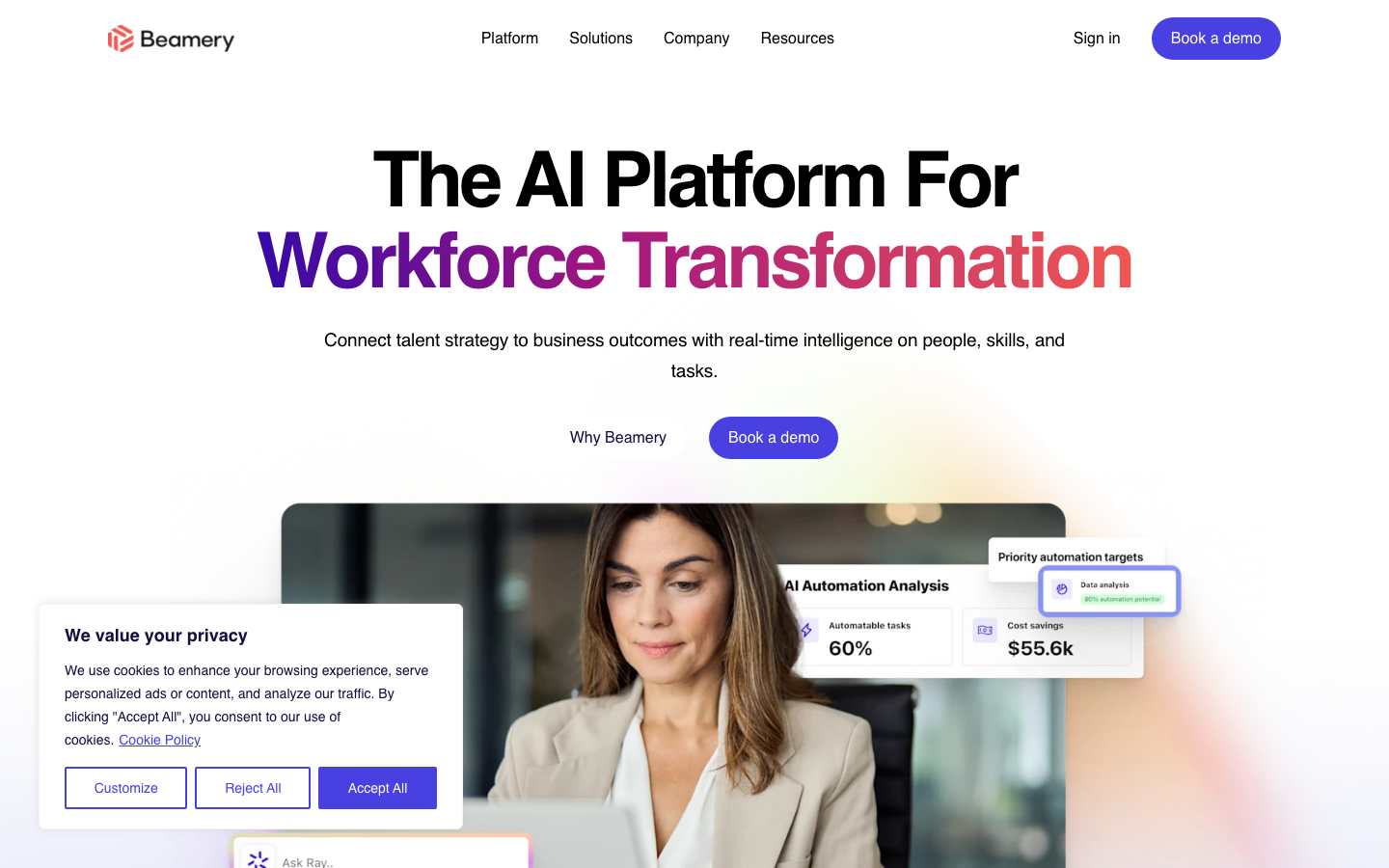
Beamery is the leading AI workforce intelligence platform helping large enterprises transform their workforce through skills data and AI-driven talent decisions. Serving global brands such as Salesforce, Wells Fargo, GM, Johnson & Johnson, and Hilti, covering all scenarios of recruitment, skills management, talent mobility, and workforce planning.
An in-depth analysis of # Beamery
Core parameters and statistics
| Parameter items | Public information |
|---|---|
| Product Positioning | AI-driven Workforce Transformation Platform |
| Core Technology | Workforce Intelligence + Skill Intelligence + Agentic AI |
| Delivery form | SaaS |
| Serving customers | Salesforce, Wells Fargo, GM, Johnson & Johnson, Hilti, Flex, BBC, etc. |
| Customer scale | Large enterprises covering 75K+ (Salesforce) to 225K+ (Wells Fargo) employees |
| Total financing | Over US$150 million |
| Major investors | Including McKinsey, IRL, Tiger Global, etc. |
| Headquarters | London, UK / San Francisco, USA |
| Established | 2014 |
Beamery originally started as a "recruiting CRM" but has evolved into a workforce intelligence platform covering the entire talent lifecycle. Its core concept is "skill-oriented talent management" - no longer taking job titles as the only dimension, but building talent portraits through skills data. Different from Phenom's full-stack HR platform route, Beamery emphasizes "connecting the HR ecosystem" rather than replacing it. It integrates data from existing systems such as Workday and SAP through the Data Platform and superimposes an AI analysis layer on top of it.
User and market recognition
- Global top customer base: Serving very large enterprises such as Salesforce, Wells Fargo (225K+ employees), General Motors, Johnson & Johnson, Hilti, Flex (140K+), BBC, UBS, etc. The customer list is among the highest among similar HR AI platforms.
- Quantitative Case Effect: Hilti's case claims to achieve talent strategy transformation through Beamery, with a target saving of $260M in recruitment costs; Flex uses Beamery to transform unstructured job descriptions into customized skills frameworks; Salesforce improves recruitment quality and data risk control.
- Ecological Cooperation: Deeply integrated with SAP Talent Intelligence Hub, officially recommended by SAP. Closely tied to the Workday ecosystem.
- Compliance Certification: Passed Warden AI's AI ethics audit certification, emphasizing "Highly Effective, Ethical AI".
Cost advantage
C-side/Personal: Beamery is not for individual users and does not have a personal version. Candidates receive services through a portal provided by the enterprise.
API/Developer: Undisclosed standalone API pricing. Platform capabilities are available through enterprise subscriptions.
Enterprise/Private: Pricing is based on SaaS annual fee, for large enterprise customers. Cost structures typically include:
- Platform Basic Subscription: stratified by number of employees or hiring volume
- Module Fees: Skills Intelligence, Task Intelligence, Agentic Workforce Consultant and other modules are billed independently
- Data integration fee: Implementation fee for connecting with core systems such as Workday/SAP
- Professional service fee: Skill classification system construction, data management consulting, etc.
Hidden Costs:
- Initial construction cost of skills classification system: Beamery's "skill-oriented" value is highly dependent on the quality of the company's own skills classification system. If the company does not have a ready-made skill classification, it needs to invest in a dedicated team to perform job-skill mapping.
- Organizational Culture Transformation Cost: Shifting from "job title management" to "skills management" requires the HR department to establish a new evaluation and reporting system. This shift is not just a tool replacement, but also involves adjustments to the organizational structure and performance evaluation methods.
- Multi-system data governance cost: Beamery serves as the "data integration layer", and its quality depends on the quality of the data connected to the system. Dirty data (outdated positions, inconsistent skill tags) will directly affect the accuracy of AI analysis and requires supporting data governance processes.
Main functions
- Workforce Intelligence Suite: Consolidates data scattered across multiple HR systems into a unified view of the workforce. It can answer strategic questions such as "Which skills gaps do we have?" "Which positions are at risk in talent supply?" "Changes in talent demand in the next 12 months." Core value: Provide data-driven workforce decision-making basis for CHRO and management.
- Skills Intelligence: Automatically extract and classify skill tags from job descriptions, resumes, and performance data to build a dynamic skills map of the enterprise. Different from the traditional "manual maintenance of skills dictionary" method, Beamery can automatically generate a skills framework from unstructured job descriptions - in the Flex case, the customer used AI to convert unstructured JDs into customized skills systems.
- Task Intelligence: Analyze specific job tasks rather than just job titles to identify which tasks can be automated or reorganized. This is Beamery's differentiated function from most HR AI products - it doesn't just focus on "who", but also on "what".
- Agentic Workforce Consultant: An AI Agent launched in 2026 that can simulate labor allocation solutions under different business scenarios. For example, "If we want to enter the Southeast Asian market, what skills are needed, where to obtain them, and how long it will take." Agents interact with managers in a conversational manner rather than just looking at the dashboard.
- Talent CRM (Recruitment CRM): Beamery's starting product, manages candidate relationships, talent pools and recruitment marketing activities. Unlike CRM systems such as Salesforce, Beamery's Talent CRM is specifically designed for recruitment scenarios.
- Data Platform: The underlying data base connects to HRIS systems such as Workday, SAP, SuccessFactors, etc., and unifies the data model. This is the technical basis for Beamery's positioning as an "ecosystem connector".
Synergy: Data Platform (data integration) -> Skills Intelligence (skills identification) -> Task Intelligence (task analysis) -> Agentic Consultant (decision deduction) form a complete link of "data-insight-action". The data platform maintains real-time synchronization with systems such as Workday/SAP. Skill intelligence extracts skill tags from it. Task intelligence analyzes which tasks can be automated. Agentic Consultant provides managers with "if...then..." scenario deductions based on the first three layers of data.
Model and version evolution
2014-2018: Recruitment CRM period
- Founded in London in 2014 by Abakar Saidov and others
- The initial product is an AI-driven recruitment CRM to help recruitment teams manage candidate relationships and talent pools
- Obtained early financing in 2016-2017
2019-2022: Platform expansion
- Expanding from recruitment CRM to the full link of talent management in 2019-2020
- Introducing skills classification and talent intelligent analysis capabilities in 2021
- Receive larger-scale financing from McKinsey and others in 2022
2023-2025: Intelligent Transformation of the Workforce
- Launch of Skills Intelligence and Task Intelligence in 2023
- Upgrade Data Platform in 2024 to strengthen integration with Workday/SAP
- Officially upgrade the brand positioning to "Workforce Transformation Platform" in 2025
2026-present: Agentic AI stage
- Launch of Agentic Workforce Consultant in 2026
- Deepen cooperation with SAP Talent Intelligence Hub
Technical advantages
Causal chain: Data Platform (system connection) -> Skills Intelligence (skills extraction) -> From organizational chart to skills network diagram
Beamery's technical route is different from traditional HRIS. The core data structure of traditional HRIS is the "organizational chart" - who reports to whom and what position. Beamery's core data structure is a "skills network graph" - who has what skills, how those skills are related to each other, and which skill sets are most important to business goals. This data structure allows AI to do analysis that traditional HRIS cannot do - for example, "find employees who have skill A and are learning skill B" rather than just "find people with the title of senior engineer."
Causal chain: Task Intelligence -> task-level granular analysis -> more accurate automated judgment than job analysis
Most HR AI tools use "position" as the basic unit of analysis. Beamery's Task Intelligence sinks the granularity down to the "task" level - analyzing how much time an engineer spends on coding, how much time is spent on code review, and how much time is spent on meeting coordination. This granularity allows organizations to identify "which tasks can be automated by AI" and "which tasks require human judgment", thereby making more refined resource allocation decisions than "replace this position".
Guide to engineering pitfalls:
- Cold start problem of skills data: The effectiveness of Skills Intelligence depends on the quality of the company's initial skills data. If skill labels in existing data are missing, outdated, or inconsistent, AI skill recommendation accuracy will be low. It is recommended to conduct a skill data audit and cleaning before deploying the platform.
- Task Intelligence granularity selection: Task analysis requires sufficient granularity to have decision-making value, but too fine a task classification will increase data collection and maintenance costs. It is recommended to start the pilot with key positions (such as engineers, product managers) rather than covering the entire organization at the beginning.
- Data Platform's data synchronization delay: Beamery, as a "data integration layer", relies on real-time data synchronization with systems such as Workday/SAP. In a multinational enterprise scenario, delays in data synchronization across regions can lead to inconsistent views of the workforce. It is recommended to evaluate the API frequency control limitations and synchronization delays of HRIS before implementation.
How to use
- Web client: You can use it by visiting the official website and registering an account. Most functions do not require installation.
- API access: Provides RESTful API, developers can obtain the API Key and integrate it into their own applications.
Product Pricing
The pricing model is subject to the official real-time page. Usually a freemium or subscription system is adopted, basic functions can be used for free, and advanced functions or high-frequency use require payment.
Application scenarios
- Large enterprise workforce strategic planning: When CHRO needs to answer "What skills do we need in the next three years?", Skills Intelligence analyzes the gap between the existing skills stock and business goals, and Agentic Consultant deduce the effects of different recruitment/training/outsourcing solutions. Suitable for large organizations with 5,000+ employees and diversified businesses.
- Skill-driven recruitment transformation: Shift from "recruiting by job title" to "recruiting by skill set". For example, instead of looking for "Python engineers", you are looking for a skill set of "Python + data analysis + financial industry background". In the Flex case, Beamery is used to convert unstructured JD into a customized skills framework.
- Internal Talent Mobility and Succession Planning: Skills Intelligence identifies employees’ hidden skills and cross-position transferability, and Talent CRM manages the internal candidate pool. In the case of Hilti, Beamery helps them maintain passive candidate relationships and move closer to strategic recruitment goals.
- Assessment of the impact of AI on jobs: Task Intelligence analyzes the task composition of each position and identifies which tasks can be automated by AI and which require manual processing. Applicable to companies that are planning AI strategies - before making decisions about "AI replacing people", first use data to understand the actual task composition.
Applicable people
- CHRO and HR Strategy Team: The core user group, Workforce Intelligence provides the data basis for workforce strategy, replacing the past reliance on Excel and intuition for workforce planning.
- Recruitment Operations and Talent Search Team: Talent CRM and Skills Intelligence help the recruitment team locate and reach candidates more accurately and improve the efficiency of the recruitment funnel.
- Organizational Development and Learning Team: Skills Intelligence identifies skill gaps and provides data to support training programs and internal mobility initiatives.
- Management (CEO/CFO/COO): The scenario deduction provided by Agentic Workforce Consultant can assist talent allocation decisions during business expansion or transformation.
- Not suitable for the crowd:
- SMEs (<1000 people): The platform functions and pricing are designed for large enterprises and are difficult for SMEs to digest.
- Organizations with fully standardized HR processes and no need for transformation: If the company's existing HR processes are running well and there is no pressure for skill transformation, Beamery's incremental value will be limited.
- Organizations that have not yet established an HRIS foundation: If you need to use Workday/SAP before you can use Beamery, the overall investment is too high. It is recommended that you prioritize laying a solid foundation for the HR system.
Summary and Outlook
Beamery has successfully transformed from a recruitment CRM into a workforce intelligence platform, and its "skills-oriented" technology route (Skills Intelligence + Task Intelligence) has differentiated advantages among similar products. Top enterprise customer groups such as Salesforce and Wells Fargo have verified its enterprise-level delivery capabilities. Its positioning of "connecting to the HR ecosystem" rather than replacing it reduces customers' technology binding risks. Current limitations include: product capabilities are highly dependent on the company's existing HRIS data quality; the initial construction cost of the skills classification system is high; the actual reasoning accuracy of Agentic Workforce Consultant still needs to be verified by more cases.
Procurement/Adoption Risk Assessment: It is recommended that large enterprises with existing core HRIS such as Workday or SAP SuccessFactors conduct an assessment. Take 1-2 business departments as a pilot, use Skills Intelligence to generate a skills baseline report, and verify the accuracy of the AI against the manual inventory results. In the procurement contract, key points need to be paid attention to: the intellectual property ownership of the skill classification system (whether the customized skill classification is transferable), the data collection scope of Task Intelligence (whether it involves employee personal performance data), and whether Agentic Consultant's decision-making model is auditable and traceable.
Related tools:
How to use Beamery
| Entrance | Description |
|---|---|
| Web management terminal | Log in through beamery.com, for HR managers and business executives |
| API integration | Connect with Workday, SAP SuccessFactors and other HRIS through Data Platform |
| Candidate Portal | Enterprise-customized candidate and employee portal |
Typical implementation path:
- System docking: Connect the enterprise’s core HRIS (Workday/SAP, etc.) through Data Platform
- Skill Classification Configuration: Build or customize skill classification based on the company’s existing position system
- Data Analysis: Skills Intelligence and Task Intelligence generate workforce baseline reports
- Scenario Configuration: Configure business scenario parameters in Agentic Workforce Consultant
- Pilot verification: Select 1-2 business units to verify the accuracy and operability of AI analysis
- Full rollout: Expand to workforce planning and hiring decisions across the organization
Version Info
- Beamery Workforce Intelligence Platform 2026-H1 :Launched Agentic Workforce Consultant and upgraded Task Intelligence and Skills Intelligence modules. There is no official precise date yet.
- Beamery Platform 2025-Q3 :Launched Skills Intelligence and Task Intelligence modules. There is no official precise date yet.
- Beamery Platform 2024-Q4 :Upgrade the Data Platform data base to strengthen the deep integration of Workday and SAP. There is no official precise date yet.
User Reviews