 BigModel
BigModel is ZHIPU·AI's large model open platform for developers and enterprises. It provides API calls for the GLM series of text, multi-modal, image, speech and vector models, and covers one-stop capabilities such as agent MCP services, model fine-tuning, knowledge base and privatized deployment.
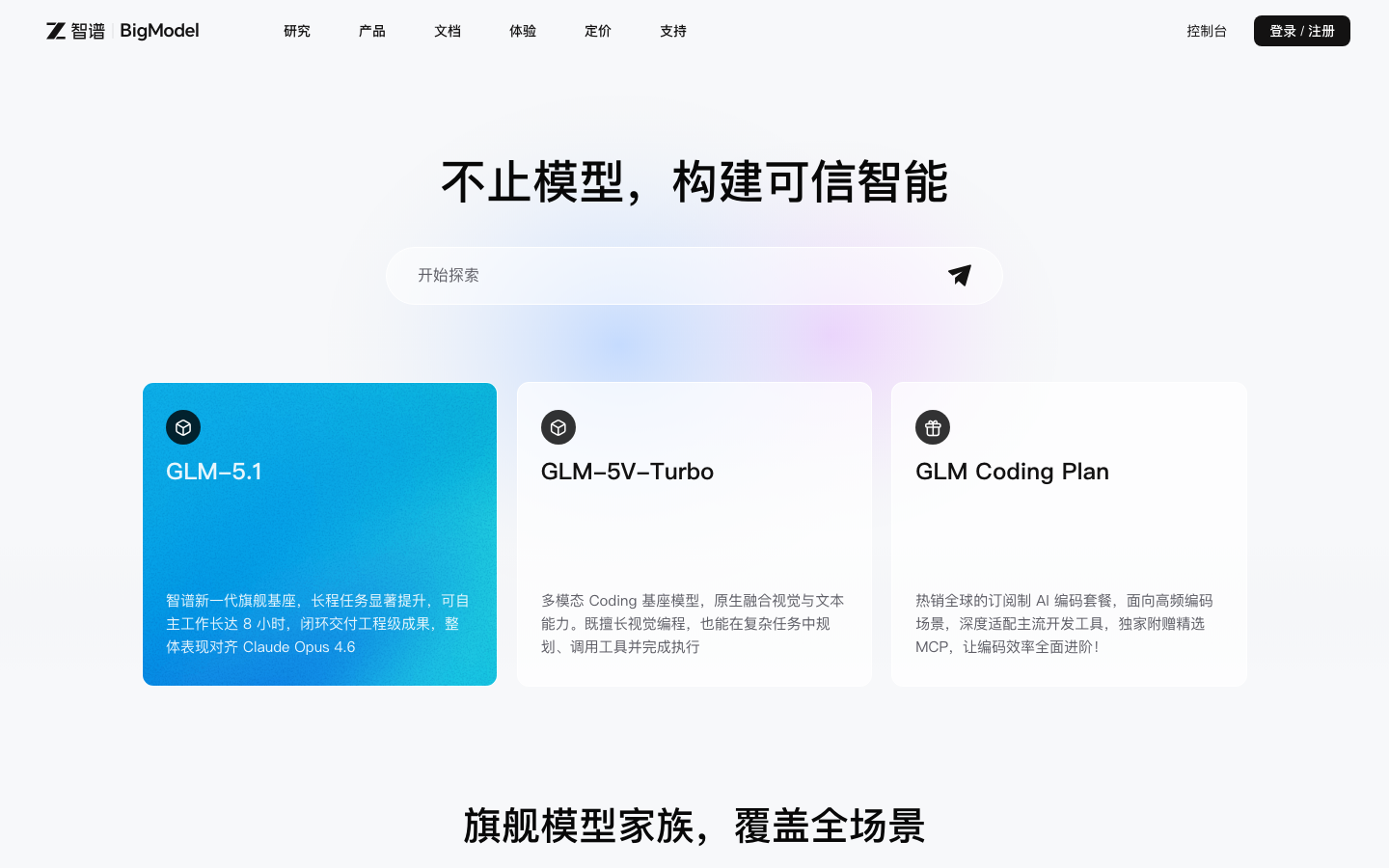
BigModel
Core parameters and statistics
BigModel is ZHIPU·AI's large model open platform for developers and enterprises. The official proposition is "More than just models, build trusted intelligence." The platform integrates the text, multi-modal, image, speech and vector models of the GLM series, together with agent MCP, fine-tuning, knowledge base and privatized deployment, into the same console and billing system.
| Projects | Public Information |
|---|---|
| Platform Positioning | Zhipu GLM Large Model Open Platform (MaaS) |
| Flagship model | GLM-5.1, GLM-5, GLM-5-Turbo, GLM-5V-Turbo |
| Model matrix | Text, visual understanding, multi-modal generation, speech, vector, image |
| Platform capabilities | API, agent market MCP service, model fine-tuning, knowledge base |
| Deployment form | Public API, cloud private instance, local privatized all-in-one machine |
| Billing method | Billed by token, Wen Shengtu is billed by the number of requests, Batch API is 50% off |
| Longest context | Some models support 200K, GLM-4-Long supports 1M |
| Supported Platforms | Web Console API |
Model layering: Flagship files (GLM-5.1/5/5-Turbo) are for complex reasoning and long-range tasks, cost-effective files (GLM-4.5-Air, GLM-4-FlashX) are for high concurrency and low-cost scenarios, and free files (GLM-4.7-Flash, GLM-4-Flash-250414, GLM-Z1-Flash) are for verification and lightweight calls.
Capabilities are limited: The platform not only provides model inference, but also puts the agent MCP connection, fine-tuning and knowledge base into the same console. Developers can extend from "calling the model" to "building and launching AI applications".
Long context and recall: GLM-4-Long provides 1M context input. Officially disclosed, GLM-4 achieved 100% accurate recall in the 128K needle-in-a-haystack test, which is suitable for long document and knowledge base retrieval tasks.
User and market recognition
BigModel's recognition mainly comes from Zhipu's technical status and developer ecosystem in the field of Chinese large models, rather than public revenue figures (the latter has not been officially disclosed).
Technical Endorsement: The GLM series is a fully self-developed base by Zhipu. The official benchmarks the overall performance of GLM-5.1 against Claude Opus 4.6, and emphasizes open source SOTA capabilities in coding and long-range tasks, indicating that it is in the first echelon of domestic flagship models.
Ecological Breadth: The homepage of the platform displays the partner matrix of "Walking with Global Innovators", and provides intelligent agent market MCP services and GLM Coding Plan coding packages, covering the access path from individual developers to enterprises.
Prerequisites for implementation: For platform-based MaaS to truly realize its value, it usually requires the team to have certain engineering capabilities and be able to build its own applications around APIs, fine-tuning, and knowledge bases; pure experience users are more suitable to start with the free model or programming package.
Cost advantage
The cost advantage of BigModel is not a single low price, but a complete cost path covering "free verification - pay-as-you-go - privatized annual subscription", allowing teams of different sizes to find corresponding gears.
C-side/Individual: The platform provides free model files such as GLM-4.7-Flash, GLM-4-Flash-250414, GLM-Z1-Flash, etc. New users can verify text and reasoning capabilities at zero cost; GLM Coding Plan covers high-frequency coding scenarios on a subscription basis.
Developer/API: Billed by token, the price is graded according to the model level and input length. For example, GLM-5.1 input [0,32) range is about 6 yuan / output 24 yuan (the caliber of one million tokens is subject to the official pricing page), GLM-4.5-Air and other cost-effective gears are significantly lower, Batch API can enjoy 50% off for large batch tasks, and search tool services are billed on a pay-per-use basis (Search-Std is about 0.01 yuan/time).
Enterprise / Privatization: Provides private instances of models (billed by computing power unit/day, such as GLM-4.6 about 175 yuan/computing power unit/day), cloud privatization annual packages (such as GLM-4.5 about 1.1 million yuan/year including computing power and training corpus quota), and local privatized all-in-one machine solutions. Such quotations fluctuate with specifications and are subject to official business confirmation.
True cost structure: For MaaS platforms, the explicit token unit price is often not the biggest factor. What really affects the total cost is the call scale, context length, fine-tuning and privatized deployment computing power usage. When evaluating, the actual QPS, average context length, and whether data isolation is needed should be measured together.
Main functions
BigModel's capabilities are designed around "one-stop completion from model to product", and its public capabilities can be summarized into five categories:
- Multi-modal model API: covering text (GLM-5.1/5), visual understanding (GLM-5V-Turbo), image generation (GLM-Image), OCR (GLM-OCR), speech and vector models, adapting to different task types.
- Agent Market: Provides selected agents and supports API direct connection to production environments, making it easy to quickly integrate industry scenario capabilities into business processes.
- MCP service: Encapsulate external systems and internal capabilities into reusable interfaces through MCP to reduce repeated integration.
- Model fine-tuning: Supports LoRA and full-parameter fine-tuning, billed by training token, and helps enterprises customize private models for business scenarios.
- Knowledge Base: Provides pay-as-you-go knowledge base expansion (approximately 0.04 yuan/GB/hour), and supports retrieval enhancement applications with the long context model.
The actual effect of platform capabilities depends on three key points: whether the selected model level matches the task difficulty, whether long context recall meets retrieval requirements, and whether fine-tuning and privatization meet data compliance requirements.
Model and version evolution
BigModel's version context takes GLM base iteration as the main line, and differentiates into multiple product lines according to scenarios.
Flagship Main Line
GLM-5.1 is the current flagship, designed for long-range missions, can work independently for about 8 hours and delivers engineering-level results; above it are flagship files such as GLM-5 and GLM-5-Turbo, and the price is gradually reduced.
Multimodal vs. specialized models
GLM-5V-Turbo is a multi-modal coding base that natively integrates vision and text and supports 200K contexts; GLM-Image focuses on image and text mixing and text rendering, and GLM-OCR focuses on lightweight and high-precision OCR, forming a line of image and visual understanding.
High cost performance and free files
GLM-4.5-Air, GLM-4-FlashX, and GLM-Z1 series cover high-concurrency and low-cost scenarios; GLM-4.7-Flash, GLM-4-Flash-250414, and GLM-Z1-Flash provide free files for low-cost verification. The official release date of each model has not been disclosed. The version node is subject to the pricing page and update log.
Technical advantages
The technical advantages of BigModel can be broken down into a three-layer causal chain of "base capability - engineering platform - deployment flexibility".
Base capacity determines the upper limit: The GLM series is a fully self-developed base. Compared with GLM-3, the performance of GLM-4 is improved by about 60%. The IFEval command following evaluation is as high as 90%, and the 128K needle in the haystack can be recalled with 100% accuracy; GLM-5.1 further strengthens the continuous execution and complete delivery of long-range missions, which determines the availability of complex missions.
Engineering platform reduces integration costs: Integrate the model, agent MCP, fine-tuning, and knowledge base into the same console and billing system. Developers do not need to assemble between multiple services, shortening the link from prototype to launch.
Deploy elastic adaptation compliance: Public API, cloud private instance, and local privatized all-in-one are available in three forms, allowing data-sensitive industries to smoothly transition between "first verifying with the public pool and then migrating to privatization."
How to use
BigModel provides multiple entrances from experience to production. The typical paths are as follows:
- Console Experience: Try text, visual and multi-modal models directly in the experience center, and evaluate the effects without writing code.
- API Access: Create an API Key in the console, call the corresponding model according to the official development guide and API documentation, and support HTTP calls and Batch API batch processing.
- Agents and MCP: Select ready-made agents from the agent market or access MCP services to embed capabilities into business systems.
- Fine-tuning and privatization: Customize private models by uploading business corpus through model fine-tuning; customers with high data isolation requirements can contact the business to obtain private instances or local all-in-one solutions.
It is recommended to start with the free model and experience center. After confirming the effect, select the paid model and fine-tuning according to the call scale.
Product Pricing
BigModel adopts a hybrid model of "pay-as-you-go billing as the main component, supplemented by privatized annual subscriptions". The billing dimensions vary with different product lines:
| Billing type | Billing dimensions | Public examples |
|---|---|---|
| Model reasoning | Based on thousands/million tokens | GLM-5.1, GLM-5, GLM-4.5-Air and other tier pricing, free tiers can be called at zero cost |
| Vincent Pictures | By the number of requests | Image generation model pay-per-view |
| Search tools | Pay-per-view | Search-Std is about 0.01 yuan/time, Search-Pro is about 0.03 yuan/time |
| Knowledge base expansion | By volume | About 0.04 yuan/GB/hour |
| Model fine-tuning | By training token | For example, GLM-4.5 (32k) is about 0.1 yuan/thousand tokens |
| Private instance | By computing unit/day | For example, GLM-4.6 is about 175 yuan/computing unit/day |
| Privatized annual package | Yearly | For example, GLM-4.5 is about 1.1 million yuan/year (including computing power and training corpus quota) |
New products often come with limited-time free or discounted experience packages. The specific unit price, free quota and enterprise quotation are subject to the official pricing page and business confirmation.
Application scenarios
- Intelligent Customer Service and Dialogue: Use flagship or cost-effective text models to build customer service, Q&A and dialogue assistants, and the long context model supports multiple rounds and knowledge retrieval.
- Multimodal understanding and generation: Use GLM-5V-Turbo, GLM-Image, and GLM-OCR to handle image and text mixing, visual programming, document recognition, and poster generation.
- Enterprise knowledge base and RAG: Combine the knowledge base and 1M context model to build document Q&A and retrieval enhanced applications.
- Agent and process automation: Through the agent market and MCP, model capabilities are embedded into business processes to achieve automation.
- Industry privatization deployment: Data-sensitive industries such as finance and government affairs meet compliance requirements through private instances or local all-in-one machines.
The verification focus of each scenario is different: the dialogue type focuses on response quality and cost, the multi-modal type focuses on recognition and generation accuracy, and the privatization type focuses on data isolation and computing power cost.
Applicable people
- Individual Developer: You can start from the free model and experience center to verify ideas at low cost, suitable for independent development and prototype stages.
- AI application team: A team that needs stable API, agent and MCP capabilities to build products and can make full use of the engineering integration of the platform.
- Enterprises and Institutions: Medium and large organizations that have requirements for data compliance, privatized deployment and customized fine-tuning are the target customers for private instances and annual packages.
Not suitable for the boundary: For pure C-end users who only need a light chat experience and do not intend to do engineering integration, it is more straightforward to use end-user products such as Z.ai; teams with strict requirements for overseas data compliance need to confirm the service area and data storage terms in advance.
Summary and Outlook
BigModel's core competitiveness lies in packaging Zhipu's self-developed GLM base with an engineering platform of "model + agent + MCP + fine-tuning + knowledge base + privatization" to form a one-stop MaaS capability from experience to production, and significantly lower the threshold for trial and error with tiered pricing and free files. The current uncertainties are: the precise release date, users and revenue scale of each model have not been officially disclosed. Privatization and annual package quotations fluctuate with specifications and require business confirmation. Overseas data compliance terms also need to be verified item by item.
For teams planning to adopt it, it is recommended to first use the free model and experience center to complete the effect verification, and then select the paid model based on the actual call scale; when fine-tuning or privatization is involved, key contract details such as computing unit occupancy, training corpus quota, and data isolation terms should be confirmed with the official before expansion.
Related tools:  Hugging Face, replicate
Technical advantages and capability boundaries
As an AI model and API product, BigModel's core capabilities can be deeply understood through the following dimensions, which directly affect technology selection and implementation effects.
Inference Performance and Benchmark Performance The model’s reasoning performance is reflected in its performance on standard NLP tasks (text generation, code completion, semantic understanding, multi-turn dialogue, information extraction, etc.). It is recommended to conduct horizontal comparison through public benchmark test lists (such as MMLU, HumanEval, GSM8K, etc.), but please note that there may be a gap between benchmark test scores and actual business scenario performance. Key indicators that affect the actual user experience include: inference speed (Token/s or response delay, which directly determines the smoothness of the user experience), context window length (which determines the input size that can be processed at a time, affecting the complexity of the tasks that can be processed), and consistency of output quality (the stability of the results of multiple outputs of the same input, which affects the perception of reliability).
API Compatibility and Development Ecosystem The depth of API compatibility with mainstream development frameworks (LangChain, LlamaIndex, Semantic Kernel, etc.) directly affects the cost and cycle of integrated development. It is recommended to pay attention to the following integration dimensions: the coverage of language types supported by the SDK (whether mainstream languages such as Python, JavaScript, Go, and Java have official SDKs), streaming output support (SSE/WebSocket protocol compatibility), function calling and tool usage capabilities (whether it supports mapping model output to structured function calls), the flexibility of structured output (JSON mode), and the ability to integrate with enterprise-level infrastructure (VPC deployment, Private Link, unified identity authentication). Complete API documentation and rich code examples can significantly lower the entry barrier to development and reduce integration time and costs.
Deployment Flexibility vs. Cost Tradeoff Depending on data privacy requirements, latency sensitivity, and usage scale, BigModel can choose between cloud API calls or on-premises deployment options. The advantages of cloud deployment are zero operation and maintenance costs and elastic scalability, which is suitable for scenarios with large fluctuations in usage and rapid prototype development; local deployment provides complete data sovereignty and low latency (no network round-trip overhead), but you need to bear the cost of purchasing hardware such as GPUs and operation and maintenance manpower. It is recommended to use a monthly API call volume of 1 million times or a monthly fee of US$1,000 as a reference dividing line: below this threshold, cloud APIs have better cost-effectiveness and flexibility. After exceeding this threshold, the total cost of ownership of the self-deployment solution should be comprehensively evaluated, taking into account factors such as hardware depreciation, electricity, operation and maintenance manpower, etc.
Model selection and version strategy
For the selection of BigModel series models, it is recommended to match the model capabilities of different versions according to specific usage scenarios. The large-parameter version performs better on complex reasoning and multi-step tasks, but has higher costs and longer delays; the small-parameter version can already provide satisfactory output quality in scenarios such as daily conversations and simple question and answer, and the cost is only a fraction of the large version. The recommended selection strategy is: use small and medium versions in standard scenarios to reduce costs, and only call large version models when complex inference tasks need to be processed. This hierarchical calling strategy can reduce the overall API cost by 40-60% without significantly affecting the output quality.
Version Info
- GLM-5.1 flagship base :The new-generation flagship base designed for Long Horizon Tasks can independently plan and execute a single mission for up to about 8 hours, while delivering engineering-level results and overall performing the official benchmark Claude Opus 4.6. There is no official precise release date yet.
- GLM-5 flagship text model :The previous generation flagship text model has a lower pricing level than GLM-5.1 and is one of the main inference models of the platform’s flagship model family. There is no official precise release date yet.
- GLM-4.7 series :Later versions of the GLM-4 series include GLM-4.7, GLM-4.7-FlashX and the free version GLM-4.7-Flash, covering multiple needs from cost-effective to free experience. There is no official precise release date yet.
User Reviews