 Bito
Free
Bito
Free
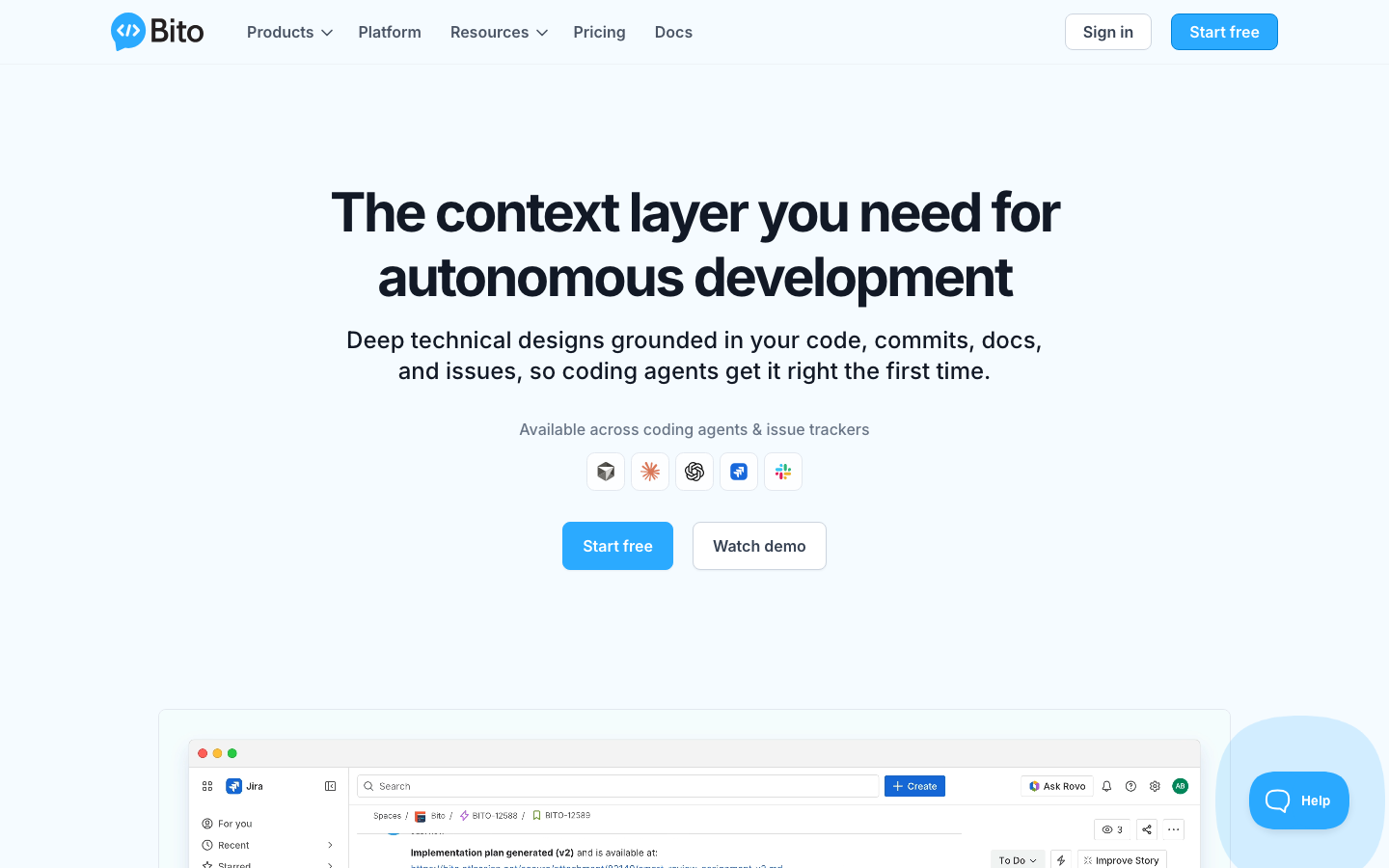
Bito is a AI programming context layer product for engineering workflow. It is officially positioned as "the context layer needed for your engineering workflow". By integrating code, submission, document and work order context, it provides programming agents with a complete system context, covering technical design, code generation and code review.
Bito
Core parameters and statistics
The problem Bito solves is "the programming agent lacks a complete system context": when programming agents such as Cursor and Claude write code directly based on scattered information, it is easy to break away from the real code base, business background and historical decisions. Bito positions itself as the "context layer" of engineering workflows, integrating code, submissions, documents and work orders to produce well-founded technical designs, allowing programming agents to "get things right the first time."
| Projects | Public Information |
|---|---|
| Official positioning | Context layer required for engineering workflow |
| Core Competencies | Integrate the system context of code, submissions, documents, and work orders, and output technical designs |
| Product Evolution | IDE Assistant → Code Review Agent → AI Architect (Context Layer) |
| Collaboration objects | Used across programming Agents and work order systems (such as Jira) |
| Access form | Web platform IDE plug-in API |
| Support Platform | Web, Desktop, API |
Context first: The difference of Bito is not to recreate a programming agent, but to add "context that it cannot see" to the existing programming agent, including the code base structure, submission history, business background in documents and work orders.
Throughout design to review: It applies context to the three sections of technical design, code generation and code review, with the goal of moving AI-involved development from "running" to "complying with the real constraints of the system".
Collaboration rather than replacement: The official website emphasizes "available across coding agents & issue trackers" and is positioned as a context hub for collaboration with existing Agents and work order systems, rather than requiring teams to change tool chains.
User and market recognition
Bito was early recognized by the developer community for its AI assistant and automated code review within the IDE. Now its focus is shifting to the context layer for independent development. Officials have not disclosed unified paying user numbers or revenue data.
Source of product reputation: Bito's code review agent was once its main capability, and it accumulated developer knowledge in automated PR review scenarios; the context layer is an extension of its capabilities rather than reinventing the wheel.
Collaborative Ecology: The official website shows that its context can be used across a variety of programming agents and work order systems, indicating that its value is in "becoming a contextual bridge between agents and work orders" rather than exclusive use of a certain editor.
Prerequisites for implementation: The benefits of the context layer depend on whether the team's code base, documents and work orders have sufficient accumulation. For teams with thin documents and disconnected work orders and code, the effective information that can be extracted by the context layer is limited, and engineering materials need to be completed first.
Cost advantage
- C-side/Individual: Usually a free version is provided to experience the core functions, and high-frequency use requires a paid package subscription.
- API/Developer: Billed by call volume, suitable for development teams that can be flexibly integrated into their own systems.
- Enterprise/Privatized: Contact the business owner for customized quotation and deployment plan. The specific price is subject to the official real-time pricing page.
Main functions
Bito's capabilities are organized around "providing system context for programming agents and engineering processes":
- System context integration: Aggregate code, submission history, documents and work orders into a complete context that can be used by Agent.
- AI Architect Technical Design: Produce a well-founded technical design based on context, which serves as an alignment baseline before coding.
- Code review capability: Continuing its code review agent capability, it provides contextual feedback on changes.
- Cross-Agent Collaboration: Collaborate with multiple programming agents and inject context into their workflows.
- Work order system integration: Link with work order systems such as Jira to incorporate business background into the development context.
The actual value of these capabilities depends on three points: whether the context extraction is accurate, whether the integration with existing Agents/work orders is smooth, and whether the output quality of the Agent can be quantified after getting the context.
Model and version evolution
Continuous iterative updates, the latest version introduces performance optimization and new features. Historical version information can be viewed on the official release page. There is no complete public version evolution timeline yet. It is recommended to pay attention to the official announcement to understand the rhythm of feature updates.
Technical advantages
Bito's technical advantages are concentrated in the two lines of "context construction" and "co-location":
Multi-source context aggregation: Aggregate code, submissions, documents and work orders into a unified context. The mechanism makes up for the shortcomings of the programming agent that only sees partial information. The effect is that the generation and review are more in line with the real constraints of the system, and is suitable for projects with complex code bases and important business backgrounds.
Design pre-production: Produce a well-founded technical design before coding, which reduces the rework of "the agent starts directly and makes major changes after the direction deviates". It is suitable for tasks with vague requirements and many constraints.
Collaboration rather than exclusive: As a contextual bridge across Agents and work orders, teams do not have to replace existing programming Agents, reducing introduction costs.
The price is that context quality is highly dependent on team data accumulation. When documents and work orders are not standardized, the output quality of the context layer will be limited, and supporting engineering data management is required.
How to use
Bito uses "context layer + multiple entrances" to access the engineering process:
- Web Platform: Connect code libraries, documentation and work orders, build system context and generate technical designs.
- IDE Plug-in: Invoke context and review capabilities within the editor.
- Collaboration with Programming Agent: Inject the built context into the programming Agent workflow used.
The typical path is to first use a free entrance to connect a code base and the corresponding work order project, verify the accuracy of context extraction, then let the programming agent complete one or two real tasks based on the context, compare the rework rate before and after access, and finally decide whether to expand to more warehouses and teams. The initial focus should be on verifying whether the context covers key business constraints.
Product Pricing
The pricing model is subject to the official real-time page. Usually a freemium or subscription system is used, and basic functions can be used for free. Advanced functions or high-frequency use require paid subscriptions, and users are advised to evaluate the optimal solution based on actual usage.
Application scenarios
Bito's implementation scenarios focus on teams that "need system context to support AI development":
- Technical design for complex tasks: Before coding, use context to produce technical designs aligned with system constraints to reduce directional rework.
- Contextual Code Review: Provide review feedback on changes that combines the code base and business context.
- Programming Agent Quality Improvement: Supplement the system context for Cursor, Claude and other programming agents to improve the first-time success rate.
Applicable people
Bito mainly serves three types of roles:
- Team using Programming Agent: Already using Programming Agent, but suffering from its lack of system context leading to rework.
- Platform/Architecture Team: Hope to align technical design with context before coding.
- Individual Developer: Use the free entrance first to experience the improvement of generation quality caused by context integration.
Scenarios that are not suitable are: the code base and documentation are weak, work orders are seriously disconnected from the code, or the team has not yet used programming agents. In these scenarios, the context layer lacks effective information that can be extracted, and the value is difficult to reflect.
Summary and Outlook
The core value of Bito is to integrate scattered codes, submissions, documents and work orders into system contexts available to programming agents, so that development involving AI can be more in line with real constraints and reduce introduction costs through co-location. It is suitable for teams that are already using programming agents and have accumulated certain engineering data, rather than scenarios where the data is sparse or agents have not yet been introduced. The current uncertainties mainly include the officially unpublished unified dated version and enterprise-level terms, and the quality of the context also depends on the team's own data management.
The implementation suggestion is to first use a free entrance to connect a code base and a work order project for a small-scale pilot, quantify the rework rate and first-time success rate before and after the programming Agent is connected to the context, and then decide whether to expand; before purchasing, enterprises should focus on verifying the key business constraints covered by the context, the depth of integration with existing Agents and work order systems, as well as private deployment and data security terms.
Related tools:  GitHub Copilot,
  Cursor
Version evolution of Bito
Bito's product form has experienced a clear shift in focus. The official has not disclosed a unified version number with a date. The following is a summary of the public milestones.
Product stage milestones
- AI Architect / Context Layer (~2026-04): The current focus is to provide system context for independent development and output technical design.
- Code Review Agent (~2025): A stage with automated PR review as the core, accumulating code quality feedback capabilities.
- IDE AI Assistant (~2023): In the early days, it focused on dialogue and completion within the IDE, laying the foundation for IDE integration.
Since the official communication is based on product milestones rather than unified version numbers, the team should base its evaluation on the current context layer capabilities and pay attention to its integrated version compatibility with the programming agent used.
Comparison of competing products
| Comparison dimensions | Bito | Competitor A | Competitor B |
|---|---|---|---|
| Core Differences | — | — | — |
| Price | — | — | — |
| Target Users | — | — | — |
Note: The above comparison is based on product public information, and actual differences are based on user experience.
Version Info
- Bito AI Architect (context layer) :The official product focus has been expanded to the context layer AI Architect for independent development, integrating code, submissions, documents and work orders into the system context; the official has not disclosed a unified dated version number, so it is recorded according to the milestone on the public page, and there is no official precise date yet.
- Bito AI Code Review Agent :The product phase with the automated code review Agent as the core covers PR review and code quality feedback; the official has not disclosed the precise version date, and there is no official precise date yet.
- Bito AI Assistant (IDE plug-in) :The early product stage focused on the AI assistant and dialogue completion within the IDE, laying the foundation for IDE integration; the official has not disclosed the precise version date, and there is no official precise date yet.
User Reviews