 BLACKBOX AI
Free
BLACKBOX AI
Free
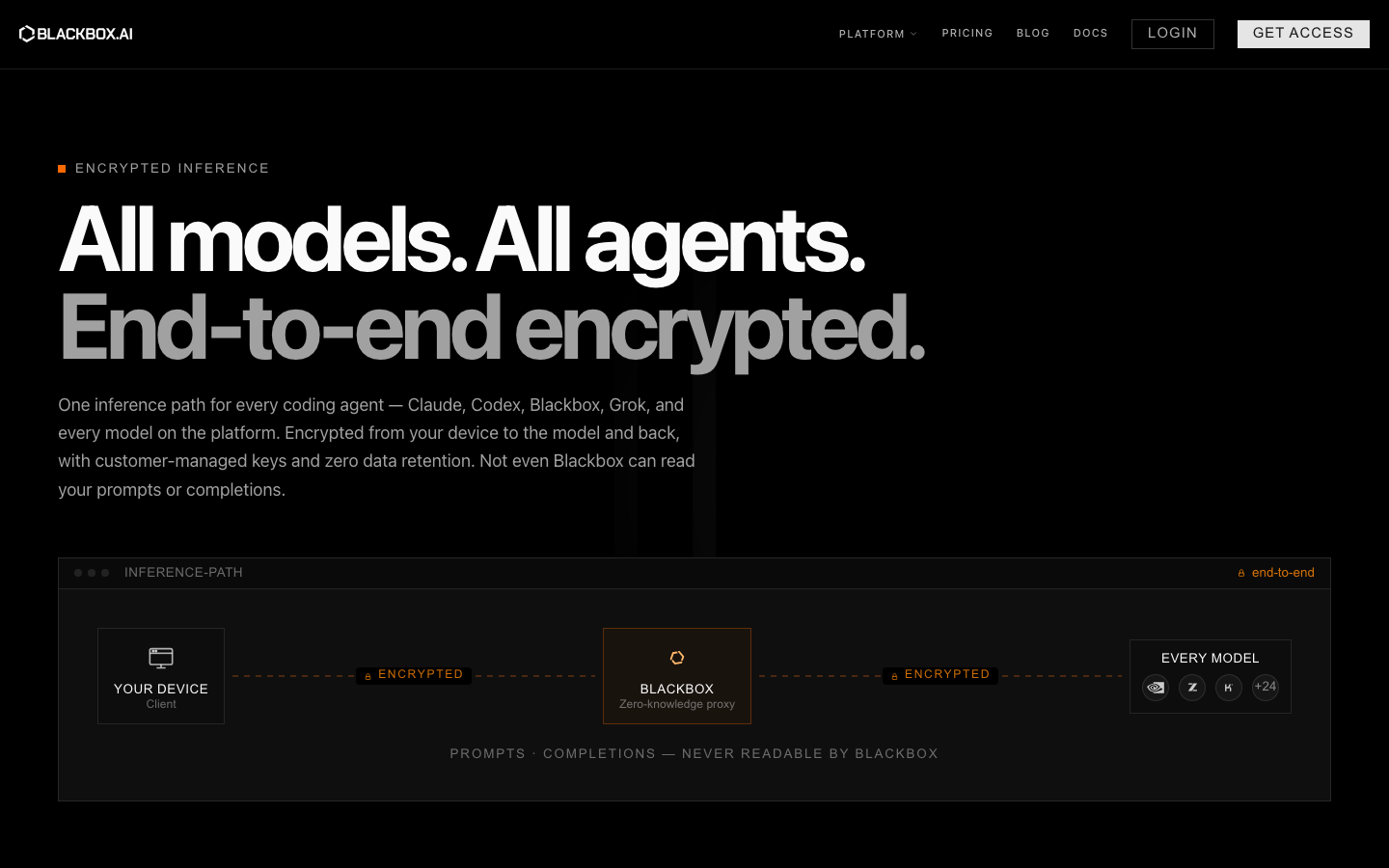
BLACKBOX AI puts coding agents, IDE-integrated CLI scheduling and OpenAI-compatible APIs on the same platform, focusing on an encrypted inference layer that is faster, cheaper and has zero data retention.
BLACKBOXAI
Core parameters and statistics
[Brief comment in one sentence]: It is not a simple AI code completion, but a layer of "Agent competition scheduler + inference gateway" for the development team.
| Projects | Public Information |
|---|---|
| Official positioning | All models. All agents. End-to-end encrypted. |
| Surface Morphology | CLI, IDE, API, Cloud Agents |
| Public Agent/Model Size | 12+ agents, 24+ models, 1 API |
| data policy | 0 data retention |
| Publicly claimed advantages | The same model is 3 times faster and 3 times cheaper |
| Corporate Signal | The official website displays multiple Fortune 500 brand logos |
[Publicity Verification]: The core selling point of the official website is “the same model is faster, cheaper and end-to-end encrypted”. This point is not about individuals writing code, but the pain points of teams worried about privacy, cost and fragmentation of engineering access.
User and market recognition
Clear positioning of the development team: The official website continuously emphasizes that ready-made Agent harnesses such as Claude Code, Codex, Copilot, Cursor, Cline, Windsurf, etc. can be connected, indicating that its main focus is "unified upper-layer orchestration" rather than replacing each individual Agent.
Corporate Signal: The homepage directly displays brand logos such as Deloitte, Microsoft, Intel, Apple, Amazon, and Salesforce. It's more of a purchasing signal than a public customer list, but it's enough to illustrate that BLACKBOX AI is targeting enterprise engineering teams.
Performance Endorsement: The official website directly quotes Artificial Analysis’s comparison of the same open source model service provider, and lists the output speed TTFT and price together. This kind of endorsement is more implementable than the general "faster".
Cost advantage
[The truth about free]: Free capabilities are mainly used to enter the platform and experience Agent requests. It does not mean that all cutting-edge models are infinitely available. The real value lies in the credits, agent capabilities and team collaboration layer given by the subscription tier.
C-side/Individual: Pro $10/month, Pro Plus $20/month, Pro Max $40/month. Looking at the AI programming market, this price range is clearly on the path of “cheaper than Devin and more economical than stacking multiple tools”.
API/Developer: The official website of the platform emphasizes OpenAI compatible endpoints, streaming output JSON mode and multi-agent orchestration, and the cost logic is more like a unified gateway. Teams can consolidate previously dispersed inference access into a single audit point.
Enterprise/Private: Enterprise offers SAML SSO, zero wait, custom SLA, and on-premise options, but public pricing is not given and is subject to sales confirmation.
[Hidden benefits/costs]: If a team is switching back and forth between Claude Code, Codex, and Cursor, the hidden benefit of BLACKBOX is to reduce the cost of configuration, billing, and result comparison; the hidden cost is that the execution layer is tied to the new middle layer, and the fault surface will increase.
Main functions
- Dispatch multiple encoding agents in parallel: The same task can be thrown to different agents for competition at the same time.
- Chairman LLM Evaluation: Score candidate solutions based on correctness, performance, risk, and complexity.
- Unified Inference Gateway: Access multiple models through an OpenAI compatible API.
- Multiple surface access: CLI, IDE, API, and VS Code can all become entrances.
- Automatic Delivery: Package the winning solution into a PR with test results and diff.
[Expert point of view]: The real hidden linkage is not "can connect many models", but "model competition -> automatic evaluation -> output PR" which forms an engineering relationship. It automates in advance the action that originally required technical leaders to manually compare multiple candidate patches.
Model and version evolution
BLACKBOX AI is currently better understood in terms of product capability milestones.
Unified API stage: First solve the problem of unifying model access and calling surfaces.
Multi-Agent Execution Phase: Moving from single inference to multi-candidate parallel solution.
Encrypted Reasoning Platform Stage: The current main line emphasizes end-to-end encryption, zero data retention and enterprise governance, and the product focus has shifted from "easy to use" to "can be adopted at a team scale".
Technical advantages
Mechanism -> Effect -> Scenario: Multiple coding agents are run in parallel on the same task, and then Chairman LLM performs weighted evaluation. The effect is to reduce the single point of error of "only betting on one model". Best suited for medium to high complexity fixes, refactorings and test generation.
Inference Gateway Value: For teams that already have OpenAI SDK, the migration cost is very low. Just replace the base URL and key to try.
Security expression is more engineering: Expressions such as end-to-end encryption, zero data retention, and customer-managed keys are closer to corporate procurement language than ordinary AI programming marketing rhetoric.
[Compliance and Risk]: The platform has access to code, testing and PR processes, which means that permission boundaries must be tight. Teams without hierarchical permissions and approval points are not suitable for directly activating automatic merges or high-privilege operations.
How to use
CLI path: Initiate a task in the terminal, let multiple Agents work in parallel and return the results.
IDE Path: Trigger code generation, refactoring, and testing within VS Code or Blackbox IDE.
API path: Connect the unified endpoint to the existing engineering pipeline and call chat completion or multi-Agent orchestration.
[Quantified cost reduction and efficiency increase] Deduction: For a R&D team of 5 to 20 people, the common process of "writing the first version of the patch + manual review + generating a PR description" has the opportunity to be reduced from 45 to 60 minutes to 15 to 25 minutes; for test completion or low-risk refactoring tasks, the benefits are more obvious. The above is a workflow deduction, not an official commitment.
Product Pricing
Pro: $10/month for individual developers.
Pro Plus: $20/month, opening up core capabilities such as Multi-Agent Execution, App Builder, Coding Agent, etc.
Pro Max: $40/month, adds team collaboration, centralized billing, analytics, and stronger security controls.
Enterprise: Customized, including SSO, priority support on-premise and other terms.
Application scenarios
- Dimensionality reduction attack scenario: Related to projects such as competitive repair, reconstruction, supplementary testing, and PR generation with multiple candidate solutions.
- Platform Engineering Team: People who need to unify multi-model and multi-Agent billing, permissions, and auditing.
- AI Native R&D Organization: It has accepted Agent into the development process and hopes to further advance automation.
Applicable people
- Technical Leader: I hope to see multiple candidate solutions instead of only getting one model answer.
- Platform/DevEx Team: Cares about unified access, auditing, encryption, and team governance.
- Medium to Large Engineering Teams: Someone with clear processes for PR automation, evaluation, and permission boundaries.
[Dissuade/not applicable]: Independent developers who only do lightweight code completion may not necessarily need a multi-agent scheduling layer; for outsourced or strong compliance code libraries, if the approval system is not ready, it is not appropriate to directly connect it to the main pipeline.
Summary and Outlook
The strength of BLACKBOX AI is not to “create a model that is better at writing code”, but to add a layer of unified execution and governance infrastructure to the world of coding agents. For teams that have entered the multi-agent pilot period, this makes more purchasing sense than single-point code completion. Its risks also come from here: once evaluation, distribution, and inference are pushed to the middle layer, the requirements for permissions, rollbacks, and SLAs will increase instantly.
[Human-machine collaboration boundary]: Generating candidate patches, supplementary testing, drafting PR, and preliminary evaluation can be highly automated; when it comes to production changes, database migrations, security fixes, and high-risk deployments, manual confirmation points must be retained. Before purchasing, it is best to conduct a trial run in a low-risk warehouse for two weeks, focusing on verifying the PR quality, assessing credibility, and whether authority governance is stable enough.
Related tools:  GitHub Copilot,
  Cursor
Comparison of competing products
| Comparison dimensions | BLACKBOX AI | Competitor A | Competitor B |
|---|---|---|---|
| Core Differences | — | — | — |
| Price | — | — | — |
| Target Users | — | — | — |
Note: The above comparison is based on product public information, and actual differences are based on user experience.
Version Info
- Encrypted Inference Platform 2026 :Currently, the main line of the official website has been switched to end-to-end encrypted inference, multi-agent parallel execution and unified API/CLI/IDE interface. There is no official precise release date yet.
- Multi-Agent Execution :The official pricing page has listed Multi-Agent Execution as the core capability of Pro Plus and above packages, and there is no official precise date yet.
- OpenAI-Compatible API :The official website discloses the unified entrance of API, CLI, VS Code and IDE, indicating that the platform has formed a complete developer product line. There is no official precise date yet.
User Reviews