 Blue J Legal
Blue J Legal uses machine learning models to predict case outcomes in the areas of tax and employment law, helping attorneys and tax professionals with risk assessment and strategy planning.
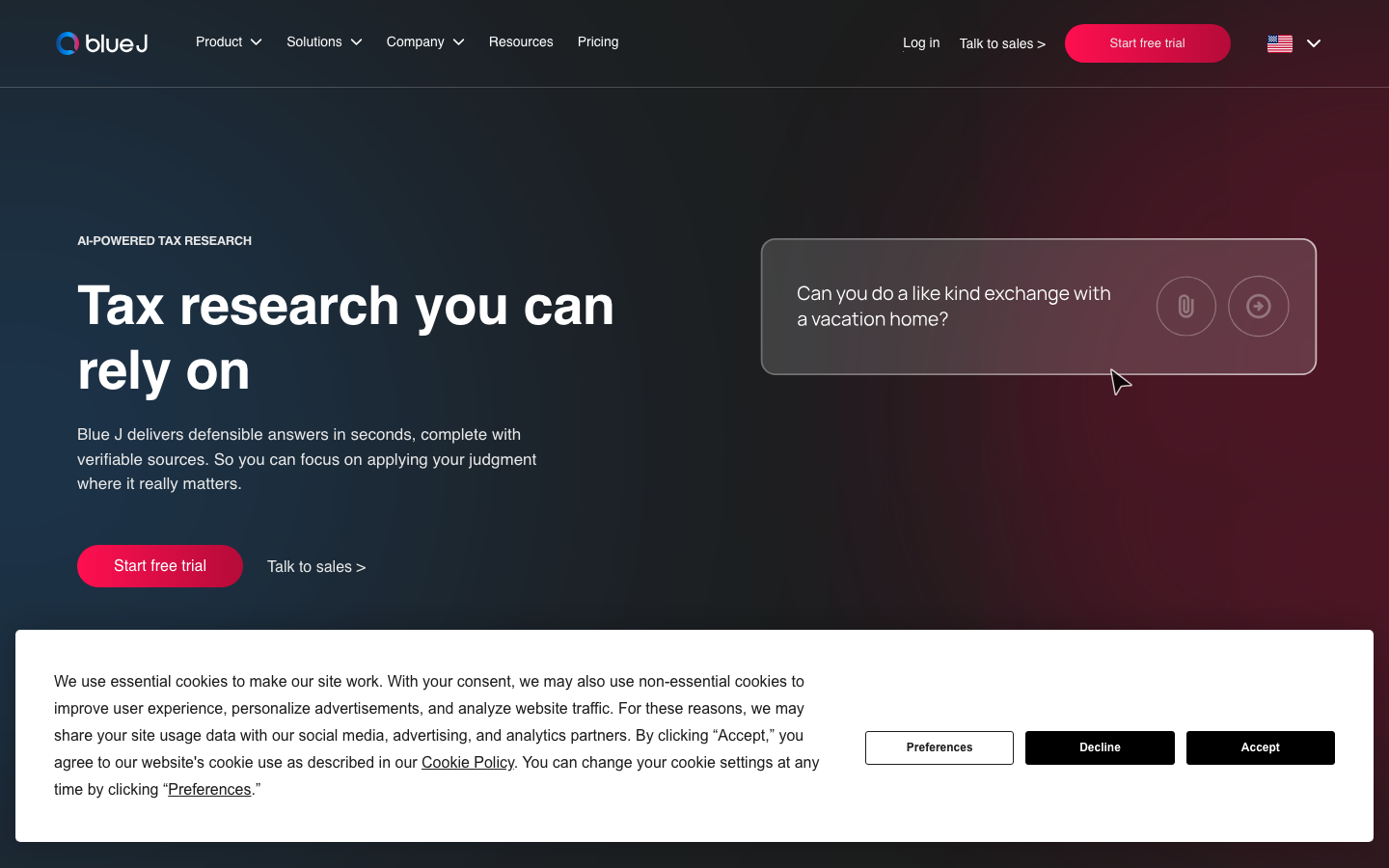
Blue J: AI Tax Research Platform – Transformation from Legal Outcome Prediction to Generative Tax Research
Tool introduction
Blue J (formerly Blue J Legal) is a tax-focused AI research platform founded in 2015 by Benjamin Alarie (CEO), Albert Yoon and Anthony Niblett at the University of Toronto Law School. The company initially entered the legal market with a machine learning prediction engine to predict the outcomes of Canadian tax and labor law cases. In 2023, with the help of major breakthroughs in generative AI, Blue J launched tax research products based on large language models, and used this as the core to complete its strategic transformation - from "predicting how judges will rule" to "instantly answering complex tax questions with verifiable citation sources." In August 2025, the company completed Series D financing led by Oak HC/FT and Sapphire Ventures. As of mid-2026, more than 5,000 accounting firms and tax teams have adopted Blue J as a daily tax research tool, with an average weekly activity rate of more than 70% (source: bluej.com official data).
Brief review in one sentence: Blue J is not a general chatbot, nor a traditional keyword legal database - it is an "AI research co-pilot" specially created for tax professionals, finding a feasible balance between authoritative content library and generative AI.
Promotion Verification: Officially claims to "start answering complex tax questions in 20 seconds" and "save each user 3 hours per week". These data come from user behavior statistics within the platform and are verifiable. The core value proposition - "AI Q&A combined with authoritative tax content sources" - really hits the pain points of low search efficiency and steep learning curve of traditional tax research tools (such as Checkpoint, CCH IntelliConnect).
Core functions
Blue J’s current product form is an end-to-end generative tax research platform. The core functional modules are as follows:
-
Natural Language Tax Q&A: Users can ask tax questions in everyday language (e.g., "How have the shareholder payroll tax deduction rules for S corporations changed post-TCJA?"), and the system returns structured answers in seconds with inline citations to the source. Different from the keyword search of traditional tools, Blue J supports multiple rounds of dialogue and questioning, and can complete a complete research link in one "Thread".
-
File upload and personalized analysis: Supports uploading customer documents such as tax returns, operating agreements, partnership contracts, etc. The platform combines user-owned documents with authoritative tax content libraries to generate personalized recommendations for specific customer scenarios (source: bluej.com/security product description). Uploaded files are automatically deleted after 24 hours.
-
Expert Curated Content Library: The platform has built-in high-quality content sources selected by tax experts, including exclusive commentary and analysis from authoritative publications such as Tax Notes and IBFD. The content library is updated daily and covers federal tax (US Federal), state and local tax (SALT), case law, secondary information and primary regulations (source: bluej.com/pricing feature list).
-
Tax writing and deliverable generation: Users can convert research results into formal deliverables in client email, memo (Memo) or PDF/DOCx format with one click, with inline references intact. Officially called the "tax writing" function, it is designed to shorten the link from research to customer communication.
-
Source highlighting and citation tracing: The citation sources attached to each answer support highlighting and positioning, and users can jump to relevant paragraphs of the original text for cross-verification with one click. Supports "request more sources" questions, as well as questions on a single document.
-
AI Suggested Questions: The system automatically generates suggested follow-up questions based on the current research context to help users dig deeper into complex tax law gray areas (source: bluej.com/pricing function list).
[Expert View]: Blue J's core competitiveness does not lie in a single function, but in the close linkage between functions - the complete research link from "question → search → generate answer → traceability verification → generate deliverable" is all completed in a dialogue interface. This means that tax professionals no longer need to switch back and forth between search engines and traditional databases and Word documents, and the efficiency improvement from research to output is achieved throughout the entire chain.
Pricing strategy
Blue J operates on a subscription-only pricing model, with no perpetual license or per-query billing options.
| Plan | Price | Applicable objects | Core benefits |
|---|---|---|---|
| Individual Plan | $1,498/year/user | Sole Practitioner | National federal and state tax coverage, unlimited questions, file upload, inline citation, source list PDF/DOCx export, source highlighting Memo/email generation |
| Team Plan | Contact Sales Quotation | Team of Multi-Tax Professionals | Individual All Benefits + Dedicated Customer Success Manager, Guided Onboarding, Team Usage Analytics Reports SSO & Custom Access Controls |
(Source: bluej.com/pricing, accessed July 2026)
The Free Truth: Blue J offers a 7-day free trial, no credit card required. After the trial period, you must pay for a subscription to continue using it. There is no permanent free quota or community edition.
Three-tier cost analysis:
- C-Side (Solo Practitioner): $1,498/year which is about $125/month, and for a tax professional making $200–$500 an hour, the cost will be paid for in 2–3 hours per month.
- Developer/API Layer: Blue J does not provide a public API. Customized integration requires enterprise version negotiation, and the price is not disclosed.
- Enterprise Tier: Priced per seat, including SSO, custom permissions, dedicated CSM and usage analysis. Corporate clients include large accounting firms such as Crowe, RSM, BDO and others (Source: bluej.com client case page).
Cost comparison with competitive products:
| Products | Pricing Model | Annual Cost Per Person Estimate | Content Coverage |
|---|---|---|---|
| Blue J | Subscription-based (7-day trial with no credit card) | $1,498/year | Federal Tax + SALT + Tax Notes/IBFD Expert Review |
| Thomson Reuters Checkpoint | Subscription (billed by module) | $2,000–$6,000+/year | Massive modules such as federal tax, state tax, and international tax (prices vary greatly depending on module combination) |
| Bloomberg BNA | Subscription | $3,000–$8,000+/year | Federal, state, combined pricing |
| CCH IntelliConnect | Subscription | $2,500–$5,000+/year | Federal taxes, state taxes, accounting and auditing |
| General AI (ChatGPT/DeepSeek) | Free/low monthly fee | $0–$240/year | Non-professional tax source, no authoritative guarantee |
From the comparison, it can be seen that the valuation of Blue J is in the mid-to-low price range of traditional tax research tools, but its core difference is not in the absolute value of the price, but in the combination of the "content authority" of traditional tools and the "interaction efficiency" of AI, eliminating the high learning costs of traditional tools and the hidden costs caused by low retrieval efficiency.
Advantages and Disadvantages Analysis
Core Advantages
-
Combination of authoritative content + AI interactivity: This is Blue J’s core differentiating advantage. Traditional tax research tools (Checkpoint, CCH) have authoritative content but backward interactive experience, and search relies on precise keywords and Boolean logic; general AI tools have natural interactions but unreliable content and are prone to hallucinations. Blue J finds the productization balance between the two—constraining the scope of AI’s output with a library of expert-curated content while retaining the convenience of natural language conversation.
-
Complete research to delivery link: From questioning → traceability verification → customer memo generation, all are completed within one platform, eliminating the efficiency loss caused by cross-tool switching.
-
Extremely low entry threshold: The official claim is that "most users can complete their first query within minutes of logging in for the first time", without the need for a long training cycle. This significantly reduces organizational friction for accounting firms migrating from traditional tools to Blue J.
-
SOC 2 Type II + Data No Training Commitment: The platform has passed SOC 2 Type II certification, and has signed supplementary agreements with OpenAI and Google, prohibiting the use of Blue J’s user data for model training (source: bluej.com/security). This is critical in the tax industry with stringent compliance requirements.
-
Customer base of over 5,000 institutions: Adoption by top accounting firms including Crowe, RSM, BDO and others validates the product’s enterprise-grade reliability.
Main Disadvantages and Risks
-
Coverage limitations: Currently only covers U.S. federal tax (Federal) and state and local tax (SALT), and does not support professional sub-fields such as international tax (cross-border tax), inheritance tax, and consumption tax. Canadian tax law content is no longer a product focus.
-
Pure cloud architecture that cannot be offline: The platform is completely hosted on AWS us-east-1, relies on public network access, and does not support local deployment or private cloud. This may pose a compliance barrier for customers with strict data residency requirements (such as tax authorities in Canada, the EU).
-
No public API: Inability to deeply integrate with enterprise internal systems (such as automatically synchronizing customer data from CRM to trigger tax research), limiting application in highly customized workflows.
-
Pricing Threshold Not Friendly to Small Practices: The $1,498/year per-person price imposes cost pressures on solo practitioners making less than $100,000 per year, and there is no flexible option for per-query billing.
-
Third-party dependency on LLM: Blue J uses OpenAI and Google's LLM as the underlying inference engine (source: bluej.com/security AI Data Privacy chapter), which means that the platform's response quality and stability depend in part on the availability and evolution path of third-party APIs.
Applicable scenarios
Dimensionality reduction strike scene
-
Daily client consultation from Sole Practitioner: Faced with the "quick questions" thrown by clients at any time, use Blue J to give answers with quotes within 20 seconds, avoiding hours of search and verification. This is the official clear core usage scenario (source: bluej.com/sole-practitioner).
-
Tax research standardization for small and medium-sized accounting firms: A tax team of 5–50 people can use Blue J to establish a unified research portal and knowledge base, and track research hot spots and efficiency bottlenecks through SSO and team analysis functions.
-
Batch research output during busy season: During the peak tax season, tax preparers need to quickly produce a large number of customer memos and emails. Blue J's "tax writing" function converts research results directly into deliverable format, which can significantly shorten the production cycle.
-
Quick Adaptation after Tax Law Updates: When the IRS issues new regulations or the courts issue important tax decisions, Blue J's library of daily updated content ensures users have immediate access to the latest interpretations and impact analysis.
Discourage/Inapplicable people
-
Professionals who need international tax or cross-border tax research: Blue J currently does not cover international taxes (Transfer Pricing, BEPS, tax treaties, etc.). Such scenarios require the use of Bloomberg BNA’s International Tax module or professional international tax consultants.
-
Deep customization needs of large accounting firms: If the enterprise requires deep integration with internal CRM/practice management systems, custom AI training models, or deployment in non-AWS regions, Blue J's lack of corresponding API and deployment flexibility may become a bottleneck.
-
Litigators who only need case law searches: Blue J has transitioned into a tax research tool and no longer provides case outcome predictions in other areas of law. Litigation attorneys should use traditional legal research platforms such as Westlaw, LexisNexis, and others.
-
Budget-sensitive individual practitioners: The subscription fee of $1,498/year may be high for part-time tax accountants with low annual income or new practitioners at the beginning stage. You may consider using general AI tools to assist basic research first, and then upgrade to Blue J when your business volume increases.
Efficiency improvement comparison
Based on official published data and common industry benchmarks, the following is a comparison of the efficiency of Blue J and traditional tax research tools:
| Comparative dimensions | Traditional tax research tools (Checkpoint/CCH) | Blue J | Efficiency improvement |
|---|---|---|---|
| Single simple query time | 15–30 minutes (including keyword construction, multi-database search, cross-validation) | 20–60 seconds (natural language questions → generate answers with quotes) | 90–98% reduction |
| Complex multi-step research (e.g. TCJA’s impact on S corp salaries) | 2–4 hours (multiple searches, manual integration, comparative analysis) | 15–30 minutes (challenge + file upload + automatic integration) | 75–87% reduction |
| Client memo/email writing | 30–60 minutes (from research notes to formal document) | 5–10 minutes (one-click generation, quotes automatically embedded) | 80–90% reduction |
| Time to get started with a new tool | Days to weeks (training courses and certification required) | Minutes (can be used for real work after first login) | 99% reduction |
| Citation tracing time | 5–15 minutes (manual location of original text) | <1 minute (inline highlighting + one-click jump) | 90% reduction+ |
| Total research time per week (official statistics) | Approx. 10–12 hours | Approx. 7–9 hours | Save 2.9–3 hours per week |
(Efficiency improvement value: Blue J official data comes from bluej.com/why-blue-j ("2.9 hours saved per week", "75% reduction in research time"); the traditional tool benchmark value is an industry estimate, based on the tax research position of a medium-sized accounting firm as a reference)
Automation Boundary
Blue J's automation capabilities cover the three sections of the tax research link: "Search → Analysis → Writing", but manual intervention must be retained in the "Judgment → Decision → Signature" section.
Can be 100% automated and organized
- Tax Regulation Search and Preliminary Interpretation: For clear tax law provisions (such as IRC §162 business expense deduction rules), Blue J can directly provide accurate interpretations with authoritative citations.
- Location and extraction of case law citations: Within the covered tax law fields, relevant cases are automatically retrieved and key judgment reasons are extracted.
- First draft generation of regular client memos: Automatically generate a formatted memo draft based on research results, including citation sources.
- Tax Update Summary: Automatically capture the latest changes in content sources every day and match the user's research field push.
Must be manually confirmed (Human-in-the-Loop)
- Planning proposals involving large tax amounts: Any planning proposal involving taxes exceeding six figures must be manually reviewed by a licensed tax attorney for completeness of analysis and citations provided by Blue J.
- Irreversible tax declaration decisions: For irreversible decisions such as whether to submit an amended return or whether to choose a specific tax accounting method, AI can only provide information support and cannot act as a proxy for decision-making.
- Highly gray edge cases: New transaction structures that are not clearly explained by the current tax law (such as the tax treatment of cryptocurrency staking gains) require a comprehensive analysis by a tax accountant based on professional judgment and informal IRS guidance.
- FINAL SIGNATURE BEFORE CLIENT DELIVERY: All Blue J-generated client communication documents must undergo a final review by a professional confirming the accuracy of wording, quotes and recommendations, and assuming professional responsibility.
Architecture link
User questions → Blue J front-end (natural language) → LLM (OpenAI/Google) + expert curation database (Tax Notes/IBFD/Case Law)
    → Content retrieval → Relevance sorting → Answer generation (including inline citations) → User verification of citations → Generate deliverables
Control flow: User ⇄ Blue J Web Interface ⇄ LLM API ⇄ Structured Database/Vector Database
Data flow: Authoritative content library (updated daily) → Retrieval Enhanced Generation (RAG) → Answers with citations → User confirmation → Formal deliverables
Security and Compliance
Blue J’s security compliance system is at a relatively high level among similar AI tax tools, and is specifically reflected in the following dimensions:
-
SOC 2 Type II Certification: An annual review by an independent auditor that objectively verifies an organization's controls for security, availability, processing integrity, and confidentiality. Customers can obtain reports after signing an NDA (Source: bluej.com/security).
-
AI Data Privacy: Blue J does not use customer data to train generative AI models. The company signed supplemental agreements with OpenAI and Google that explicitly prohibit the use of Blue J’s user data for model training or abuse monitoring. Uploaded customer files are automatically deleted after 24 hours (source: bluej.com/security AI Data Privacy chapter).
-
Data Encryption: Data at rest is encrypted using AES-256, keys managed by AWS KMS; data in transit is encrypted using TLS 1.2+ (Source: bluej.com/security).
-
Data Residency: All data storage and processing is in AWS us-east-1 (N. Virginia, US), data residency options in other regions are not supported, and on-premises deployment options are not available.
-
Compliance Framework: Meet CCPA, GDPR requirements (Source: bluej.com homepage and security page). "Right to be forgotten" support is provided, and customers can make data deletion requests at [email protected].
-
Access Control: Adopt the Principle of Least Privilege, mandatory 2FA authentication for all employees, and regular access rights review. Enterprise Edition supports SSO and custom access controls (source: bluej.com/pricing Team Plan feature list).
-
Penetration testing and vulnerability scanning: Penetration testing is conducted annually by an independent third party, vulnerability scanning is performed quarterly, and remediation is performed according to SDLC priority (source: bluej.com/security).
-
Vendor and Sub-Processors Management: Key vendors include OpenAI, Google Cloud, AWS, Auth0, Pinecone, Snowflake, etc., and all sub-processors have undergone security review (source: bluej.com/security Vendors/Sub-Processors list).
Integrated Ecosystem
Blue J's current integration capabilities are relatively limited and are in the early stages of product development:
| Integration Type | Support | Description |
|---|---|---|
| Single Sign-On (SSO) | Support (Team Plan) | Support custom SSO and access control |
| CRM Integrations | No public integrations | Use Salesforce and Hubspot internally, but no integration interfaces open to customers |
| Practice Management System | None | Does not support data synchronization with Thomson Reuters Practice Law, Clio and other systems |
| API Access | Not supported | Custom integrations can be negotiated with Enterprise Edition, but no public REST/gRPC API |
| File format export | Support | PDF, DOCx, email text, memo formats |
| Data Import | Support | Users can upload PDF, operating agreements, tax returns and other files for analysis |
| Third Party Content Sources | Built-in | Content such as Tax Notes, IBFD and more are integrated directly into the platform |
| Collaboration Tools | Basic | Workspace collaboration within the platform, supports email notification (SPF/DKIM/DMARC configuration) |
Integration Strategy Recommendation: Blue J is currently designed as an "all-in-one tax research terminal" rather than a platform component that can be embedded into existing workflows. If your team relies on highly customized workflows (such as automatically syncing customer information from a CRM to trigger a research process), you may need to wait for Blue J to open the API or build a bridge solution through a browser plugin/no-code tool (such as Zapier).
Implementation suggestions
Based on Blue J’s product features and target user profiles, the following are phased implementation suggestions:
Phase 1: Trial Evaluation (1–2 weeks)
- Start the 7-day free trial: Sign up for the Individual Plan trial from bluej.com, no need to bind a credit card.
- Select 5–10 real customer cases for testing: Enter tax research questions that the team has recently handled into Blue J, and compare the output results with the team’s completed answers in terms of accuracy, citation completeness, and efficiency.
- Cross-validate citations: Focus on verifying whether the citation sources given by Blue J actually support its answers, and the timeliness of the sources (whether they contain the latest jurisprudence and regulatory updates).
- Evaluate team acceptance: Let 2–3 team members try it out independently and collect feedback on learning curve, search efficiency, and user interface experience.
Phase 2: Team Pilot (1–2 months)
- Choose 1–2 areas of focus to pilot: For example, select the two modules "Federal Corporate Income Tax" and "SALT State Tax" for in-depth use, rather than covering all tax areas from the beginning.
- Establish an efficiency baseline: Record the team's average time spent on research (per week/person) before deployment, and compare whether Blue J's official "2.9 hours saved per week" data is replicated in the team after deployment.
- Establish a verification mechanism: Develop internal SOPs that require answers generated by Blue J to be manually reviewed and signed by at least one senior tax accountant before being used for customer delivery.
- Contact sales to upgrade Team Plan: If the pilot effect is satisfactory, contact the Blue J sales team to upgrade to Team Plan and configure SSO and user permissions.
The third stage: comprehensive promotion and optimization (3–6 months)
- Full-staff training and best practice accumulation: Organize the team’s efficient questioning patterns, verification techniques and common pitfalls in using Blue J, and form an internal knowledge document.
- Tracking ROI: Statistics on a quarterly basis Blue J’s quantified benefits in the three dimensions of "reduction in research time", "shortenation of customer delivery cycle", and "reduction in time for new employees to get started", compared with the subscription cost of $1,498/year.
- Keep an eye on product updates: Pay attention to whether Blue J opens APIs, increases international tax coverage, or launches localized deployment solutions to expand the scope of use at the right time.
Counterexamination and risk mitigation
- Don’t abandon existing tools all at once: Keep access to legacy tools like Checkpoint/CCH as a backup until the accuracy and stability of Blue J are fully proven in team workflows.
- Focus on the impact of model updates on answer consistency: Blue J relies on a third-party LLM, and the answering style and accuracy of the same question may change after the model version is upgraded. It is recommended that the team establish a snapshot comparison mechanism for answers to key questions.
- Note Data Residency Limitations: If your team has Canadian or EU customers whose data needs to be processed on-premises, Blue J's AWS us-east-1 US-only region option may not meet compliance requirements. In this case, it is recommended to clarify in the contract the compliance responsibilities for cross-border data transmission.
Summary and Outlook
Blue J represents the cutting-edge practice of transforming tax research tools from "keyword search database" to "AI research co-pilot" paradigm. It has successfully found a productized balance between "content authority" and "interaction efficiency" - a proposition that neither traditional tax publishers nor general AI companies have yet perfectly solved. Series D financing in 2025 and adoption by 5,000+ institutions validate the market’s initial recognition.
From a more macro perspective, Blue J's transformation path itself is an industry signal worthy of attention: from its original "result prediction" product for legal professionals, it has proactively contracted into the vertical field of taxation and focused on "research efficiency" - this adjustment of "from wide to narrow, from prediction to assistance" reflects the reality of AI's implementation in the professional services field: Narrow and deep scenarios are more likely to generate implementable business value than wide and shallow predictions.
Not suitable for the boundary: Research needs in non-US tax fields (international tax, inheritance tax, consumption tax); compliance scenarios that require offline and local deployment; highly customized workflows that require deep API integration; institutions that have strict risk control requirements for LLM third-party dependencies.
Procurement/Adoption Risk Assessment:
- Vendor Lock-in Risk: Low to Moderate. Blue J is a subscription-based, annual payment, and there is no long-term contract lock-in; but once the team is deeply dependent on its workflow, the organizational cost of migrating back to traditional tools cannot be ignored.
- Technical Risk: Medium. The platform relies on OpenAI and Google's LLM API, and the uncertainty of third-party models (availability, accuracy fluctuations, pricing changes) will directly affect the quality of Blue J's delivery.
- Compliance Risk: Low. SOC 2 Type II + CCPA/GDPR + data-free training commitment, leading compliance level among similar AI tax tools.
- Substitution Risk: Medium. Traditional tax publishers (Thomson Reuters, Bloomberg) are accelerating the development of their own AI functions and may launch competing products with overlapping functions with Blue J in the future. However, in the short term, Blue J will still maintain its lead in AI-native interactive experience.
Overall, Blue J is ideal for U.S. tax professionals and small and mid-sized accounting firms seeking tax research efficiency. For large multinational accounting firms and organizations with a focus on international tax business, it is recommended to wait until their APIs are opened and international tax coverage is expanded before making an evaluation.
Blue J Legal’s main features
- Core Processing Capabilities: Provides core AI capabilities in relevant scenarios to support users to quickly complete tasks.
- Multi-modal interaction: supports text input and result output, and some scenes support image or file upload.
- Workflow Integration: Can be embedded into existing workflows or linked with other tools through APIs to reduce context switching.
Blue J Legal application scenarios
- Personal Creation: Quickly generate or process content to improve daily work efficiency.
- Team Collaboration: Unify workflow and reduce repetitive manpower investment.
- Enterprise-grade deployment: Embed capabilities into on-premises systems via API or private deployment.
Blue J Legal’s Applicable Groups
- Individual Users: Content creators and knowledge workers who need AI assistance to improve their daily work efficiency.
- Developers: Technical teams who need to integrate AI capabilities into their own products or services through APIs.
- Enterprise: Organizations seeking to deploy AI at scale in their field.
Blue J Legal’s technical advantages
- Algorithm Optimization: Special optimization at the model or algorithm level has been carried out for the corresponding scenario to achieve a balance between response speed and result quality.
- Low-latency architecture: Adopts streaming or asynchronous processing architecture to reduce user waiting time and is suitable for high-frequency interaction scenarios.
Blue J Legal’s core parameters and statistics
Specific technical parameters (such as model size, context length, supported file formats, input and output restrictions, etc.) are subject to the official product page. It is recommended that users verify the latest technical specifications and system requirements before choosing to ensure that they match their own usage scenarios.
Blue J Legal’s users and market recognition
Gradually build user awareness in the field, and product capabilities are used by content creators and teams to improve work efficiency. Some industry users have incorporated it into their daily workflow. It is recommended to refer to the latest official disclosures for specific user scale and industry adoption rate data.
Blue J Legal’s Cost Advantage
- C-side/Individual: Usually a free version is provided to experience the core functions, and high-frequency use requires a paid package subscription.
- API/Developer: Billed by call volume, suitable for development teams that can be flexibly integrated into their own systems.
- Enterprise/Privatized: Contact the business owner for customized quotation and deployment plan. The specific price is subject to the official real-time pricing page.
Blue J Legal’s model and version evolution
Continuous iterative updates, the latest version introduces performance optimization and new features. Historical version information can be viewed on the official release page. There is no complete public version evolution timeline yet. It is recommended to pay attention to the official announcement to understand the rhythm of feature updates.
Blue J Legal How to use
- Web client: You can use it by visiting the official website and registering an account. Most functions do not require installation.
- API Access: Provides RESTful API, developers can obtain the API Key and integrate it into their own applications.
Blue J Legal’s Product Pricing
The pricing model is subject to the official real-time page. Usually a freemium or subscription system is used, and basic functions can be used for free. Advanced functions or high-frequency use require paid subscriptions, and users are advised to evaluate the optimal solution based on actual usage.
Version Info
- Blue J 2026 :There is no official precise date yet. Expand prediction model coverage and improve accuracy.
- Blue J 2025 :There is no official precise date yet. Added labor law prediction function.
User Reviews