 Bocha AI search
Free
Bocha AI search
Free
Bocha AI Search is a AI Search product that supports multiple models. It not only provides users with intelligent search Q&A, but also provides developers with search API access capabilities.
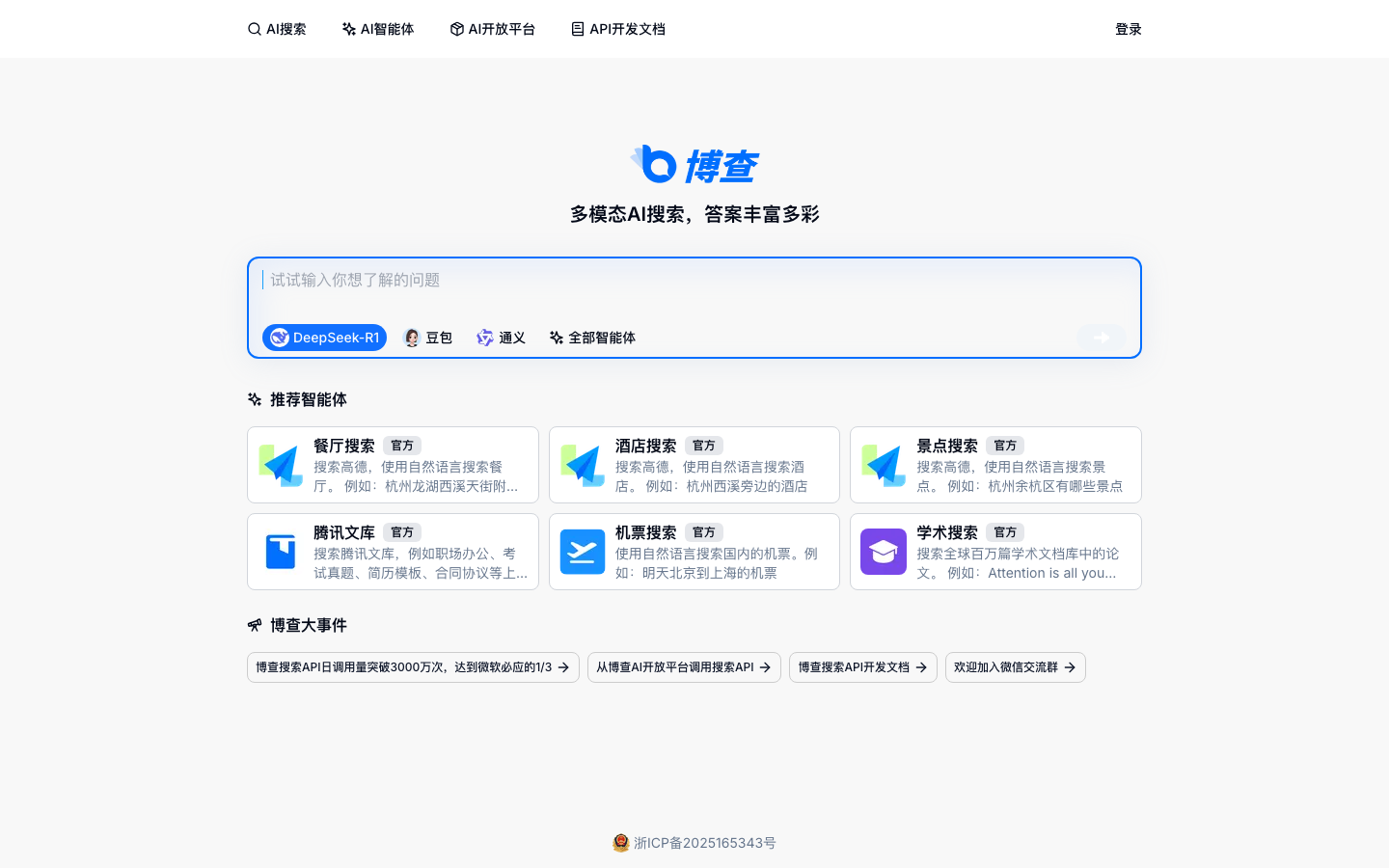
Bocha AI search
Core parameters and statistics
Bocha AI Search is an AI search product that supports multiple models. Understand it in one sentence - it has two faces: for ordinary users, it is an intelligent search question and answer tool that can switch between multiple models; for developers, it is a set of callable "search APIs" to enable their AI applications to have Internet search capabilities. It addresses the underlying need of "AI applications need to obtain real-time and reliable information."
| Projects | Public Information |
|---|---|
| Official positioning | Multi-model AI search + search API |
| Core Competencies | Intelligent Search Q&A |
| Multiple models | Support switching multiple models |
| Developer capabilities | Search API access |
| Product form | Web + API |
| Target Users | Users + Developers |
| Support Platform | Web, API |
| Place of Belonging | China |
| Billing form | Free trial + API billing |
Product Boundary: It takes into account both C-side search experience and B-side API services; for developers, the greatest value is "adding Internet search to AI applications."
Capability source: Integrate search and retrieval capabilities with multi-model question and answer, providing external product entrances and opening retrieval capabilities in the form of APIs.
User and market recognition
Gradually build user awareness in the field, and product capabilities are used by content creators and teams to improve work efficiency. Some industry users have incorporated it into their daily workflow. It is recommended to refer to the latest official disclosures for specific user scale and industry adoption rate data.
Cost advantage
The cost logic of Bocha AI search is divided into two levels: free experience on the C-side, and billing on the B-side based on API usage.
C-side/Individual: Provides free search experience, and can use multi-model question and answer directly on the web page.
Developer/API: Open in the form of a search API, billed according to the amount of calls, allowing developers to add networking capabilities to their applications without building their own search system.
Enterprise/Scale: Plans and prices for high-frequency calls must be subject to the official real-time page and business communication.
Hidden cost: For developers, the real cost is related to the call frequency and retrieval complexity; the hidden benefit is the elimination of huge engineering investment in self-built search infrastructure. The evaluation should be based on a measurement of the size of the search calls of a real application.
Main functions
- Multi-model search: You can switch between different models for Q&A.
- Intelligent search Q&A: Integrate and give answers after retrieval.
- Search API: Provides developers with an Internet search interface.
- Real-time information: Supplement the time-sensitive information that large models lack.
- Multi-modal/all-encompassing extension: Expand the search form in conjunction with the ability to search all-encompassing information.
Hidden linkage: Its core linkage is the dual form of "C-side product + B-side API" - the same set of search capabilities can be used as a user product experience and as an infrastructure that developers can call, allowing Bocha to work simultaneously in the two markets of "people use" and "application use".
Model and version evolution
Continuous iterative updates, the latest version introduces performance optimization and new features. Historical version information can be viewed on the official release page. There is no complete public version evolution timeline yet. It is recommended to pay attention to the official announcement to understand the rhythm of feature updates.
Technical advantages
Mechanism: Integrate search retrieval and multi-model question answering, and provide external product entrances and standardized APIs so that retrieval capabilities can be directly called by applications.
Effect: The user side obtains multi-model optional intelligent search; the developer side can supplement real-time retrieval for AI applications without building a self-built search system, significantly lowering the construction threshold.
Applicable scenarios: Developers who need to access Internet search for AI applications/Agents, and users who want to use multiple models for intelligent search can benefit most from this.
How to use
- Visit bochaai.com to experience intelligent search Q&A.
- Select the desired model to search.
- If you are a developer, apply for a search API key.
- Call the search API in your own application to obtain real-time information.
- Monitor usage and costs based on call status.
The entrance is Web and API, and the C-side is free to experience.
Product Pricing
The pricing model is subject to the official real-time page. Usually a freemium or subscription system is used, and basic functions can be used for free. Advanced functions or high-frequency use require paid subscriptions, and users are advised to evaluate the optimal solution based on actual usage.
Application scenarios
- AI Application Networking: Access real-time retrieval for Q&A/Agent.
- RAG Search: Search source generated as a search enhancement.
- Intelligent search experience: User multi-model search Q&A.
- Information Timeliness Supplement: Make up for the knowledge time lag of large models.
Applicable people
- AI Application Developer: Requires Internet search API.
- Agent/RAG Builder: Requires reliable retrieval source.
- General search users: Want multi-model intelligent search.
Unsuitable Boundary: For users who only need general web search and no need for AI integration, traditional search is sufficient; professional scenarios with extremely high requirements on search coverage and timeliness require comprehensive evaluation based on multi-source data.
Summary and Outlook
Bocha AI Search enters the AI search market with the dual form of "multi-model search + open search API". It not only provides users with an intelligent search experience of optional models, but also provides developers with the most needed network search capabilities for AI applications. It is a representative of search infrastructure in the AI era. Its value depends on search quality, coverage and price competitiveness.
Implementation suggestions: Developers can first use small traffic to access the search API to verify the retrieval quality and response speed, and then evaluate the cost based on the actual call scale; teams building RAG or Agent are particularly suitable to use it to complement online retrieval, while ordinary users can directly experience its multi-model search Q&A.
Related tools: perplexity, you-com
Version evolution of Bocha AI search
As an online product and API service, capabilities iterate with versions and there is no traditional discrete version number.
Main line context
- Product release period (~2024): Launch AI search products and open search API.
- Continuous iteration period: Expand multi-model support, improve retrieval quality, and extend multi-modal search (encyclopedia of everything) and other capabilities.
The official unified version number and precise date have not been disclosed, and the text is marked with the online version at the time of collection.
Version Info
- Bocha AI search (online version) :The product continues to iterate, and multi-model search and API capabilities are updated with versions; the official unified version number has not been disclosed, and the online version at the time of collection is marked here. There is no official precise date yet.
- Bocha AI search released :Bocha launches AI search products and opens search API; there is no official precise date yet.
User Reviews