 Boomy
Free
Boomy
Free
Boomy lets anyone create and publish original music in seconds, and the resulting songs can be submitted to streaming platforms like Spotify and earn royalties.
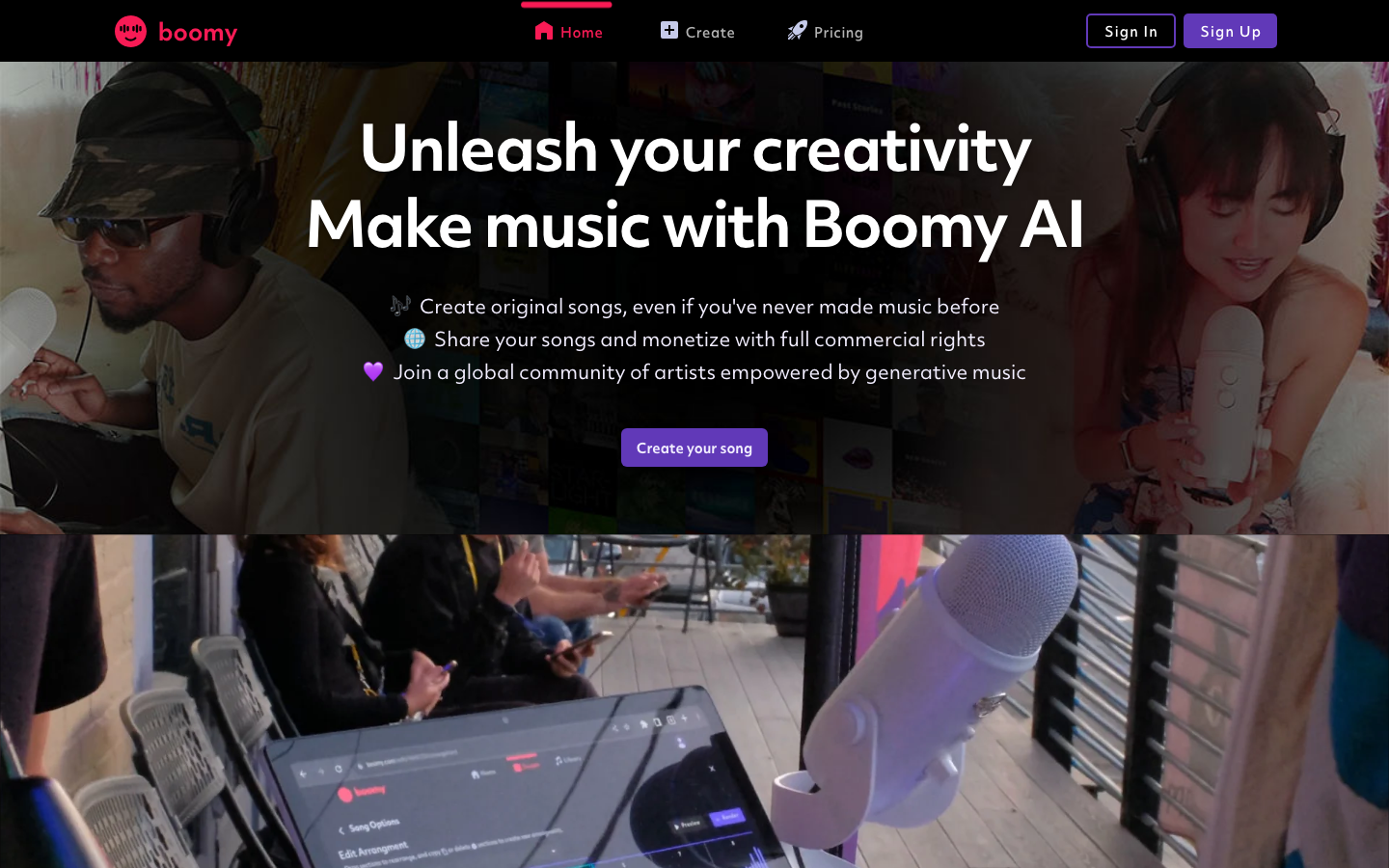
Boomy
Boomy’s core parameters and statistics
Boomy's slogan is "Let everyone have the opportunity to become a musician" - its biggest selling point is not the quality of music, but the "extremely low threshold for creation" and the possibility of "royalty income". Founded by former classical violinist Alex Mitchell at the end of 2018 and headquartered in Berkeley, California, it is currently one of the AI music platforms with the largest number of user creations in the world.
| Projects | Public Information |
|---|---|
| Official positioning | An AI platform where everyone can create and realize original music |
| Core Technology | Multi-style AI music generation + vocal synthesis + streaming media distribution |
| Total number of user creations | 22,102,381+ (real-time count on official website) |
| Streaming media distribution channels | Spotify, Apple Music, TikTok, Amazon Music, etc. |
| Royalty Share Ratio | Creators receive 80% of streaming royalties |
| Pricing model | Free / Creator ($9.99/month) / Pro ($29.99/month) |
| Supported styles | Electronic, hip-hop, pop lo-fi, rock, world music, etc. |
| Support Platform | Web |
| Founded | 2018, Berkeley, California |
Core difference: Boomy is the only platform that uses "AI creation + streaming distribution + royalty income" as a selling point - you create a song on Boomy, you can submit it to Spotify with one click, and you will make money when someone plays it. This direct line "from creation to realization" is its most essential positioning difference from pure generation tools such as Suno and Udio.
The number of user creations has reached 22 million+: The real-time counter at the bottom of the official website shows more than 22 million original songs. Compared with the nearly 5 million songs reported by the BBC in early 2022, it has increased by about 4.5 times in four years, reflecting that the platform is still expanding steadily rather than stagnating.
Boomy’s users and market recognition
Boomy's market recognition mainly comes from three levels: mainstream media attention, global user base and early entrepreneurial ecological endorsement, rather than public financing or revenue figures.
Mainstream media coverage: Boomy has been reported by BBC News ("The AI software that could turn you into a music star"), Axios, Engadget, Protocol, TechCrunch, Business Insider, Consequence of Sound and other leading technology and music media. The BBC’s in-depth report details the background of founder Alex Mitchell, the platform’s royalty sharing model (80% goes to creators), and real-life examples of users paying rent through Boomy during the epidemic.
User scale and behavioral portrait: The official website shows that 85% of users have never made music, which shows that Boomy has indeed fulfilled its promise of "zero-threshold creation". The BBC report mentioned that more than 10,000 users have released a total of more than 100,000 songs to the streaming platform, and some creators have received monthly royalties of $100-200 during the epidemic. Although these numbers are not large, they prove that the "AI creation + passive income" model is truly established among the long-tail creator group.
Community Activity: Boomy operates a Discord community (you can join directly from the official website) and keeps updated on Twitter. The official website displays testimonials from multiple users, including amateur creators, animators, and music lovers, indicating that its user profile has gone beyond the "early adopter" stage, and content creators who continue to use it have emerged.
Limitations: Official undisclosed financing amount, paying user conversion rate, number of corporate customers and other key indicators. Mainstream media reports focus on 2021-2022, and the volume has been relatively quiet recently. We need to pay attention to whether the platform is still on the growth channel.
Boomy’s Cost Advantage
As an AI music platform for C-side creators, Boomy's cost structure is divided into three tiers: free tier, paid subscription and royalty implicit costs, and there is no API or enterprise privatization deployment path.
C-side/Personal (Free Tier): Free plan is $0/month, includes 25 song saves, basic editing tools, and the ability to submit streams but Boomy retains a higher percentage of royalties. For users who simply want to experience "what does AI creation feel like", the free tier is enough to cover their first trial needs.
C client/individual (paid subscription):
- Creator Plan: $9.99/month (original price $14.99, 33% off), 500 song saves, advanced editing tools. Suitable for amateur musicians with regular creative needs.
- Pro plan: $29.99/month (original price $39.99, 25% off), unlimited song storage, and a full set of advanced editing tools. Suitable for content creators who need high-volume output and pursue maximum creative flexibility.
Hidden costs and royalty sharing: Boomy owns the copyright of each song recording. After the streaming revenue enters the platform, 80% is distributed to the creator and the platform retains 20%. This means that the royalties received by creators are "net revenue after deducting the platform's share", and Boomy's pricing page and FAQ do not indicate whether there is a difference in the share ratio between free users and paying users. In addition, streaming media platforms (Spotify, etc.) have very low revenue per play (about $0.003-$0.005/time). Even with tens of thousands of plays per month, the actual amount received may still be only tens of dollars. Therefore, royalties are more appropriately viewed as "added incentives to create" rather than as a sustainable source of livelihood.
Comparison with competing products: Compared with Suno (free + $10/$30 subscription, focusing on generation quality) and Udio (free + $10/$30 subscription, focusing on professional sound quality), the core difference of Boomy lies in "distribution monetization" rather than pure generation capabilities. Suno and Udio currently focus mainly on competing for music quality, while Boomy is the only one-stop platform covering creation to distribution. But this also means that the music generated by Boomy each time sounds more "templated" than Suno/Udio. This is the hidden price of "sacrifice of sound quality for distribution convenience" in its cost structure.
Boomy’s main features
Boomy's capabilities are designed around the complete link of "quick creation → editing and polishing → distribution and monetization" and is not a single AI generator.
- AI rapid music generation: Select a style (electronic, hip-hop, pop Lo-fi, rock, etc.), click "Create Song", and AI will complete the composition in 30 seconds - including automatic arrangement of key, chord progression and melody. This is the core entry-level function of Boomy and a key step for users to go from 0 to 1.
- Song structure editing: After generation, you can adjust the length and arrangement of the intro, verse, chorus, and outro, add or remove instrument layers (drums, bass, synthesizers, strings, etc.), and modify the speed and volume balance. This makes up for the shortcoming of pure AI generation that lacks "human orchestration sense", allowing creators to add personal aesthetic judgment.
- AI Vocal Synthesis: Supports AI-generated vocal singing, which can be combined with lyrics to create a complete song with vocals. For creators who do not have recording conditions or cannot sing, this is a key function for "from pure instrumental music to complete songs".
- One-Click Streaming Distribution: Submit songs directly to major streaming platforms such as Spotify, Apple Music, TikTok, Amazon Music, YouTube Music and more. This is the differentiated feature of Boomy from all pure generation tools - it solves the last-mile problem of "how to put AI creation on the shelves".
- Royalty Tracking and Data Analysis: Check the play volume, revenue trends and geographical distribution of each song on various streaming media platforms. Although the data granularity is not as good as that of professional musician distribution platforms (such as DistroKid, TuneCore), it is intuitive enough for novices who are experiencing "data-based creation" for the first time.
Expert View: The five functions of Boomy form a comprehensive synergy of "Creation → Editing → Vocal → Distribution → Tracking". Among them, "one-click distribution" is the most critical differentiating capability - it not only eliminates the need to independently register for a distribution platform, but also upgrades the "creative motivation" from "just for fun" to "maybe making money", significantly improving user retention. But this also means that Boomy’s business is highly dependent on partnerships with streaming platforms. If platforms such as Spotify adjust content policies or AI music listing rules, Boomy’s distribution capabilities will be directly affected.
Boomy’s model and version evolution
Boomy does not disclose the architectural details of its underlying AI model (parameter scale, training data, inference framework, etc. are not disclosed), and its public information is closer to "product functional milestones" than traditional large model version iterations.
Product Milestones (based on the minimum node that can be confirmed by public information):
- End of 2018: The Boomy platform is officially launched, providing basic AI music generation functions and open to global users for free.
- 2021-2022: The number of user creations increased from one million to nearly 5 million; BBC, Axios, TechCrunch and other media concentrated reports; the streaming media distribution function was introduced and the Spotify submission channel was opened.
- 2025 Summer (~2025-07): Introducing AI vocal generation and Spotify direct submission function (written in frontmatter history_versions), advancing the platform from "pure instrumental music generation" to the "complete song creation" stage.
- 2026 Release (~2026-03): Enhanced multi-style generation capabilities and royalty distribution functions, currently the latest version (no official precise date yet).
Version evolution features: Boomy's "version" concept is closer to the continuous delivery of SaaS products than to the named version numbers of large models. Its product update rhythm is not disclosed to the public, and there is no traceable release page similar to GitHub Releases. This means that it is difficult for third parties to accurately assess their iteration speed and new feature delivery cycle.
Technical route speculation: Boomy may adopt a route based on symbolic music generation (rule-based + probabilistic model) in the early stage instead of end-to-end neural network generation. This can explain the characteristics of its generation results that have a "strong sense of template" but are "fast, stable and controllable". If we shift to a diffusion Transformer architecture similar to Suno in the future, its music quality may be greatly improved, but we need to pay attention to the trade-off between increased production costs and reduced real-time performance that this may bring.
Boomy’s technical advantages
Boomy's technical advantage lies not in "the strongest AI model" but in "engineering the AI creation and distribution process into available products."
Prioritize generation speed over generation quality: Boomy's AI can compose a full song in 30 seconds, compared to 1-3 minutes for comparable tools like Suno v4. This "instant feedback" design reduces the psychological waiting cost of non-professional users - users can try different styles multiple times in a short period of time to find satisfactory results. The price is that the music complexity, dynamic range and timbre realism are significantly weaker than competing products. This is a reasonable trade-off in scenarios where "quantity" takes precedence over "quality" (such as mass production of background music).
Depth of integration in the distribution technology stack: Boomy’s integration with Spotify, Apple Music, TikTok and other platforms is not a simple “export upload”, but automatically handles metadata tags, cover art and royalty reporting through its distribution infrastructure. Behind this is the need to continuously maintain API compatibility with various streaming media platforms, content delivery agreements and copyright declaration processes, which is an engineering capability with high maintenance costs.
Preliminary simplification of copyright processing: Boomy simplifies the copyright structure into a single model in which "the platform holds the recording copyright and the creator receives 80% of the royalties", eliminating the complex multi-party licensing negotiations in traditional music distribution. For non-professional creators, this "one-click acceptance" copyright model significantly lowers the legal threshold, but it also means that the creator gives up complete control over the copyright of the recording.
Engineering rather than model innovation: Boomy’s engineering advantages are reflected in the product packaging level rather than underlying model innovation. It has not publicly published AI model papers or benchmark results, and it has no open source code. This means that its technology moat mainly comes from distribution channel partnerships, user creation data accumulation and product experience optimization, rather than technology patents. It has long been faced with the squeeze of competing products such as Suno and Udio in terms of production quality and distribution capabilities.
How to use Boomy
Boomy only provides a web portal and does not have a standalone desktop app or mobile app (but the web portal is available in mobile browsers). The usage process is very short and suitable for zero-based users.
Registration and Getting Started:
- Visit boomy.com, click "Sign Up" to register an account (email or Google login).
- After logging in, enter the creation page and select a music style (electronic, hip-hop, pop Lo-fi, rock, etc.).
- Click "Create Song" and AI will generate a complete original song in about 30 seconds.
- Use editing tools to adjust structure, instrument layers, tempo, and vocals.
- When you are satisfied, save it to your personal music library and distribute it to platforms such as Spotify with one click through "Submit to Streaming".
Distribution Process: Submitting to the streaming platform requires completing the song metadata (title, cover, style tag), and Boomy will handle the subsequent distribution process. It usually takes 1-2 weeks after the initial submission to get listed on platforms like Spotify. Play volume and royalty earnings can be viewed in the Boomy dashboard after distribution.
Usage Restrictions:
- Free Plan: 25 song save quota, basic editing tools, no advanced vocal features.
- Creator Plan: 500 saves, unlocks advanced editing and full vocal features.
- Pro Plan: Unlimited saving, unlimited functions.
Usage Suggestion: For users who just want to experience it, the free quota is enough to complete 3-5 attempts. For users who plan to continuously produce content (such as updating the background music library every day), it is recommended to choose the Pro plan directly to avoid being frequently limited by save quotas and interrupting the creative rhythm. When submitting channels to streaming media for the first time, it is recommended to submit 2-3 first to test the water, verify the metadata review and shelf duration, and then submit in batches.
Boomy’s Product Pricing
Boomy uses a three-tier subscription system and does not offer a pay-per-view or API billing model. Price, the following is the current public information:
| Plans | Price | Song Saving | Editing Tools | Core Differences |
|---|---|---|---|---|
| Free | $0/month | 25 songs | Basics | Suitable for first time experience |
| Creator | $9.99/month (original price $14.99) | 500 songs | Advanced | Suitable for amateur regular creation |
| Pro | $29.99/month (original price $39.99) | Unlimited | Advanced full-featured | Suitable for high-frequency content production |
Is the free quota enough?: 25 saves are consumed quickly for serious creators - if you are not satisfied with the subsequent version after creating a song, each save will occupy a quota. The actual number of "creation attempts" available is much lower than the numerical 25. It is recommended to first verify whether Boomy meets your needs through the free tier, and then upgrade and pay after confirmation.
Royalty sharing for free users: The official has not clearly stated whether there is a difference in the royalty sharing ratio between free users and paying users. If the share ratio for free users is less than 80% or there is a withdrawal threshold, this will significantly affect the credibility of the promotion that "free creations can also make money". It is recommended to read the terms and conditions carefully before upgrading.
Boomy application scenarios
Boomy's implementation scenarios focus on the two core directions of "rapidly producing commercially available music" and "zero-threshold creation experience":
- Getting started with zero-based music creation: Users without any music knowledge can create their first song in 30 seconds. The data that 85% of users have never made music shows that Boomy has indeed assumed the role of an "enlightenment tool for music creation". Suitable for curiosity-driven personal attempts and as an auxiliary teaching tool in music education scenarios.
- Video and social media background music mass production: Batch generate Lo-fi, electronic, and ambient music for short video reels, YouTube channels, podcasts, and other scenarios. Boomy's generation speed advantage is most obvious here - one song takes 30 seconds, and dozens of background music of different styles can be generated in one hour, with full commercial use rights and no need to worry about copyright disputes.
- Passive Income Experiment: Create songs on Boomy and submit them to streaming platforms to earn royalties through playback. To be clear, this is a "low expectations" scenario - the revenue per play is extremely low, and reaching a meaningful revenue threshold requires a large accumulation of songs and long-term operations. But as an introductory experiment in understanding the economics of streaming music, Boomy offers the lowest-cost path to participation.
- Rapid music prototyping and inspiration capture: Creators (including experienced musicians) can use Boomy to quickly generate a style framework, and then manually recreate it based on this. This is much more efficient than starting from a blank project file.
Scene suitability judgment: Boomy's generation quality determines that it is most suitable for "functional music" (background, atmosphere, rhythm template) rather than "expressive music" (scenes that require unique emotional expression, complex arrangement or high-fidelity mixing). If you're aiming for the latter, Suno or a professional DAW would be a better choice.
Who is Boomy suitable for?
Boomy's crowd adaptation boundary is very clear - it is an "entry tool for the creator economy" rather than professional music production software.
- Zero-Based Creation Enthusiasts: People who have never made music but want to try it. Boomy's 30-second generation + one-click distribution compresses the "creation to publishing" cycle to minutes, greatly reducing the psychological startup cost. Not Fitting the Boundary: If you want to learn real music production skills (instrumental playing, mixing, composition theory), Boomy's "black box" creative process offers no learning curve.
- Content Creators and Social Media Operations: Content creators who need to continuously produce background music for videos, podcasts, and live broadcasts. Boomy's combination of fast generation + clear copyright (with full commercial use rights) is more flexible than selecting from copyright-free music libraries and more economical than hiring a composer. Not suitable for boundaries: If your content requires highly customized musical emotional expression (such as brand theme songs, emotional narrative soundtracks), Boomy's template generation cannot meet the requirements.
- Passive Income Explorer: Individuals who are interested in streaming royalty economics and want to test the hypothesis of "whether AI creation can make money." Boomy provides complete link verification from creation to monetization. Misfit Boundary: If you expect royalty income as your main source of income, you need to be aware that reaching $100 a month may require hundreds of songs and millions of plays, which is not a high-probability path.
- Music Educator: Introducing AI music creation as an auxiliary method in teaching to help students quickly understand song structure, style differences and music industry processes. Boomy's fast iteration feature is suitable for "hypothesis testing" teaching in the classroom.
Not suitable for the crowd: Professional music producers, recording studio engineers, projects that require high-fidelity mixing or complex arrangement capabilities, and service scenarios that require customized composition. In these scenarios, the depth of Boomy's musical quality is nowhere near sufficient to meet professional delivery standards.
Implementation efficiency deduction (position-level estimation)
Based on Boomy's "from inspiration to distribution" full-link compression capability, the following is a deduction of efficiency changes in key positions (unofficial commitment):
- New media operation (short video background music requirements): The traditional method is to audition and screen songs one by one from the copyright-free library, and an average song takes 15-30 minutes; after using Boomy, select the style → generate in 30 seconds → simple edit → export, compress to 3-5 minutes, and increase the efficiency by about 5-10 times.
- Amateur music creators (first listing scenario): The traditional path requires purchasing a DAW, learning to arrange, find a mixer, and registering for a distribution platform (DistroKid annual fee is $20+). From idea to listing on Spotify, it takes days to weeks; Boomy's full-link closure compresses the first listing to within 30 minutes, and no prepayment is required.
- Content Team (Batch Music Production): Assuming that 10 different styles of background music are required every week, the monthly subscription fee for traditional material library is $50-100; the Boomy Pro plan provides unlimited creation for $29.99/month, and the style can be customized instantly, which has advantages in flexibility and cost.
Human-machine collaboration boundary:
- 100% automatable: The process of style selection → basic generation → streaming submission can be completely completed by AI.
- Human intervention required: Editing and adjustment of song structure (the structure generated by AI may not be as expected), lyric creation (vocals require user input of lyrics), final quality acceptance (whether it is worth submitting for distribution), royalty income management and tax declaration. These issues involve subjective aesthetics, legal liability and financial operations, and are not suitable for full automation.
Summary and outlook of Boomy
Boomy's core competitiveness lies in "one-stop service from creation to monetization", not the quality of AI generation itself. It lowers the threshold for music creation from "requiring years of training" to "30 seconds of clicks", and adds economic incentives to creative behavior through streaming media distribution - this product logic is complete and self-consistent.
Current Limitations:
- Ceiling of generation quality: Music complexity, dynamic range and timbre realism are significantly weaker than Suno v4/Udio, and it is not competitive in the "expressive music" scenario.
- Transfer of copyright structure: The platform holds the recording copyright, and the creators only receive royalties. This is in fundamental conflict with the industry practice of traditional musicians "retaining the copyright of the master tape" and may limit the willingness of professional creators to participate.
- Distribution Platform Dependency: The business partnership is entirely based on cooperation with platforms such as Spotify and Apple Music. If streaming platforms tighten their AI music listing policies, Boomy’s core selling point will be directly weakened.
- Insufficient information transparency: Key indicators such as AI model architecture, financing status, and payment conversion rate are not disclosed, making it more difficult to evaluate long-term stability.
Procurement/Adoption Risk Assessment:
- Individual creators (zero-based/amateur) can feel free to use the free tier experience: the risk is extremely low, and the biggest cost is time investment. Make sure you meet your needs before upgrading and paying.
- The content team needs to verify before purchasing the Pro plan: whether the sound quality of the music generated by Boomy meets the broadcast standards of the video project; it is recommended to subscribe to the Creator plan for one month to produce 10-20 songs, and then evaluate whether to renew or upgrade after using it in actual projects.
- Enterprises (such as MCN organizations) need business confirmation before batch adoption: whether the copyright terms support commercial groups using the 2026 version and whether the platform's long-term maintenance plan and technical support channels are friendly to enterprise customers.
- It’s not appropriate to position Boomy as an “AI alternative for professional music production” – it’s still significantly behind the professional level in terms of sound quality and creative freedom. It is more accurate to position it as a "functional music tool for rapid content production".
Related tools:  ElevenLabs, udio
Version Info
- Boomy 2026 Release :There is no official precise date yet. Enhanced multi-style generation and royalty distribution functions.
- Boomy 2025 Summer :There is no official precise date yet. Introducing AI vocal generation and Spotify direct submission.
User Reviews