 Botpress
Free
Botpress
Free
Botpress is an open source conversational AI platform that provides a visual conversational designer NLU engine and multi-channel integration, supporting low-code construction of customer service and automated robots.
Botpress
Botpress’s core parameters and statistics
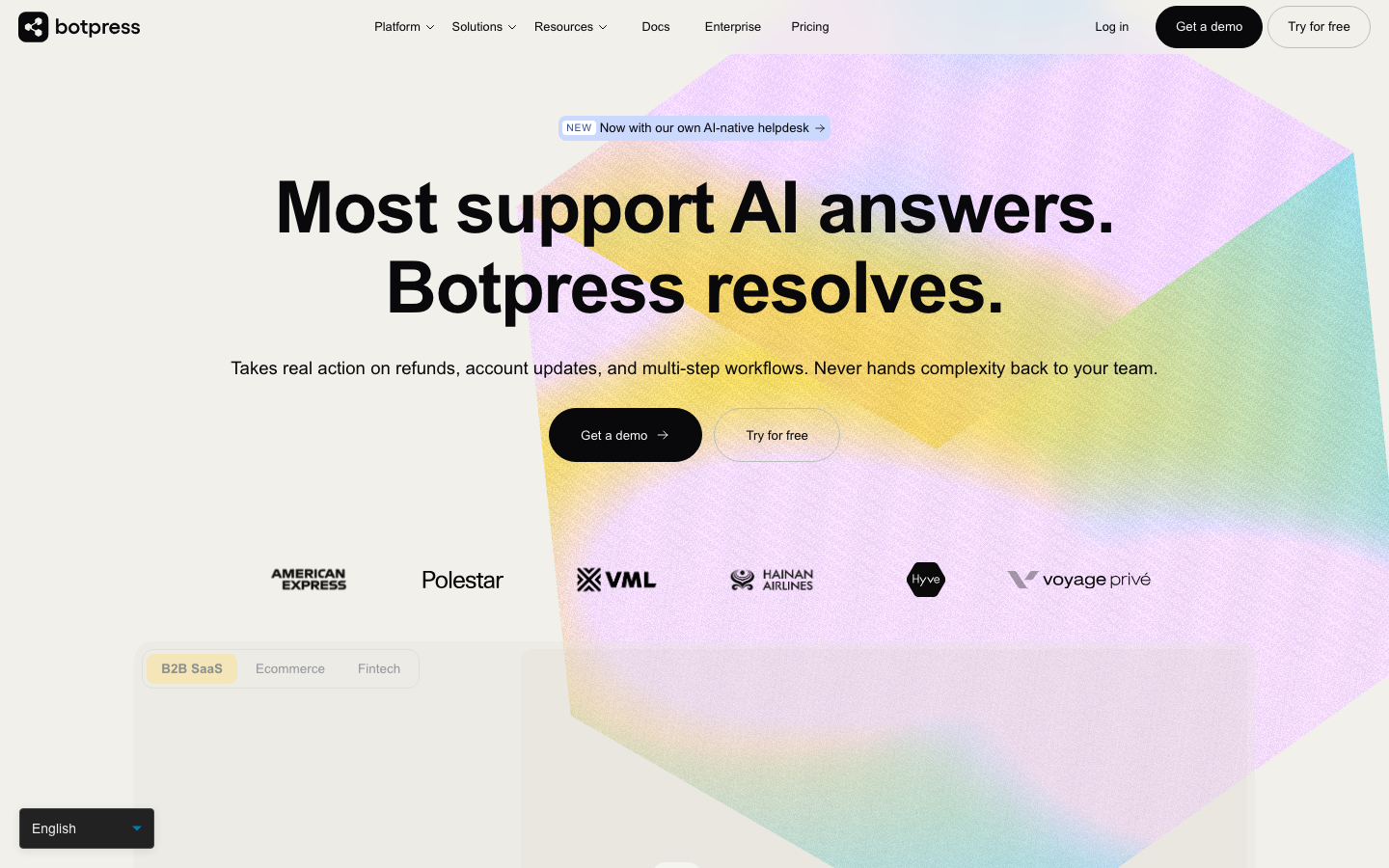
Botpress has evolved from an early open source conversational AI platform to an "AI agent platform + AI native help desk" - the official positioning is no longer a simple chatbot framework, but allows AI agents to directly perform actual operations such as refunds, account updates, and multi-step work orders. The product page clearly states: "Most support AI answers. Botpress resolves."
| Projects | Public Information |
|---|---|
| Official Positioning | AI Agent Platform and AI Native Help Desk |
| Core capabilities | AI agent construction Autonomous Engine autonomous reasoning, knowledge base, structured data table, multi-channel release |
| Deployment method | Cloud version SaaS / Botpress Cloud |
| Help desk form | Botpress Desk (built-in AI help desk, can be used independently or connected to Zendesk/Intercom) |
| Customer Cases | American Express, Polestar, VML, Hainan Airlines, Hyve, Voyage Prive |
| Security Compliance | SOC II Certification GDPR Compliance KPMG Penetration Testing, Enterprise Edition Support HIPAA BAA |
| Infrastructure | AWS auto-scaling, zero maintenance |
| Open source license | MIT (Botpress Cloud repository) |
| Community size | GitHub about 14.8k stars, 2.3k forks, 231 contributors |
| Latest version | v12.4 (cloud version continuous delivery, no fixed version number) |
| Place of Belonging | CA |
Positioning evolution: Botpress was originally known for the open source NLU chatbot framework (v12 series) and completed its transformation into an AI-native help desk in 2024-2026. The core difference is that it is not an "AI auxiliary tool for customer service personnel", but a working platform that allows AI agents to independently perform end-to-end operations - refunds, account inquiries, work order routing and other operations can be completed without manual intervention.
Ecological Density: The official Hub provides hundreds of integrations, channels and LLM adapters, covering all aspects from the underlying model to the business system connection. Developers can publish custom integrations into the Hub ecosystem through CLI and SDK.
Botpress’ users and market recognition
Botpress's market recognition comes from three levels: enterprise customer adoption, community activity and third-party reviews.
Corporate Customers: The logo wall disclosed on the official website includes American Express, Polestar, VML, Hainan Airlines and other brands, covering finance, aviation, automobiles, advertising and other industries. Customer cases show that Hostifai achieved a 75% automatic resolution rate, Waiver Group increased visitor interaction by 9 times, and Extendly reduced call volume by 30%.
Community size: GitHub main repository (botpress/botpress) has approximately 14.8k stars, 2.3k forks, and 231 contributors. Official Discord community with over 31k members. The product page publicly claims "750k AI agents built" - that is, the platform has created a total of 750,000 AI agents, covering more than 1 million users in 180+ countries.
Industry evaluation: G2 score 4.5 (out of 5). User reviews mainly mention differentiated values such as "no migration required to connect to Zendesk", "pricing based on conversations instead of seats", "AI can handle complex work orders instead of just FAQs". The pricing page provides direct comparison data: Botpress's annual fee is $9,000 (25 seats/month, 1,200 conversations), Zendesk is about $71,100, and Intercom is about $39,756 - this comparison curve reflects Botpress's intention to impact the seat pricing model.
Prerequisites for implementation: The value of Botpress is reflected in the scenario where "there is already a customer service team and the number of work orders reaches a certain scale". For teams with minimal ticket volume or no need for a help desk, there is an oversupply of platform capabilities.
Botpress’s cost advantage: Conversation volume pricing breaks the seat binding model
Botpress's current cost structure is designed around "conversation volume" rather than "seats/agent", which is officially called the "No per-seat cost" strategy.
Cost model comparison (official deduction example)
| Pricing Dimensions | Botpress | Zendesk | Intercom |
|---|---|---|---|
| Billing unit | Monthly conversation volume | Number of seats | Number of seats |
| Typical annual fee (25 seats / 1,200 conversations/month) | $9,000 | $71,100 | $39,756 |
| Excess conversations | $65–$50/100 | Stacked by agent | Stacked by agent |
| AI call fee | Included in conversation package | Additional billing | Additional billing |
| Free plan | 100 conversations/month | Limited free | Limited free |
The above comparison is based on self-test data published on the Botpress official website. Actual costs vary depending on contract terms.
Three-tier cost breakdown
C client/individual: The free plan includes 100 conversations/month, 3 seats and 3 AI agents, suitable for individual developers to verify product capabilities. There is no need to bind a credit card, and it will automatically recharge when it is not used.
Developer/Team (Plus Plan): $150/month (annual payment), including 250 conversations/month, unlimited AI agents, 3 seats. Excess $65/100 Conversation. The fees for AI reasoning Embedding, web search, etc. are all packaged in the conversation price - there is no independent Token billing.
Enterprise/High Scale (Team and Enterprise): Team starts at $750/month (paid annually), includes 1,500 conversations/month, and unlimited seats. Enterprise is a customized quotation, including Voice voice channel, custom storage, exclusive SLA, and security review HIPAA BAA. Additional conversations $50/100. Storage expansion $40/month (+100K table rows + 1GB vectors + 10GB files).
Hidden Costs: Conversation pricing removes the unpredictability of seat costs, but the definition of "conversation" needs to be noted - any exchange containing at least 2 messages counts as 1 conversation (including AI-to-AI only interactions and test conversations in the simulator). The same ticket across months and sessions may be counted multiple times. It is recommended to use historical work order volume to estimate monthly conversation consumption before purchasing, rather than simply converting it based on the number of seats.
Main functions of Botpress
Botpress's functional system is designed around "Build → Deploy → Operate → Optimize" rather than an isolated conversation editor.
-
Botpress Studio (Visual Agent Builder): Drag-and-drop canvas design agent behavior logic, supporting branching, looping, and conditional nodes. Each node can be configured with Autonomous Engine (autonomous decision-making) or deterministic rules. Built-in conversation simulator for testing without deployment. Supports "Start from Prompt" - enter a sentence to automatically generate a complete conversation flow.
-
Autonomous Engine: Mixes LLM reasoning and structured logic. The agent decides for itself what tools to use next, what APIs to call, and how to respond to unseen questions. Developers can set constraints and fallback logic, and LLM handles the rest. Essentially solves the maintenance problem of "exhaustively enumerating all branches" of traditional dialogue trees.
-
Knowledge Bases: Supports uploading documents (PDF, DOCX, TXT, MD), crawling websites/blogs/FAQs, importing CSVs and structured tables. Botpress automatically indexes and quantifies, and the agent provides precise citations when answering. Content can be managed dynamically via API, eliminating the need for manual re-uploads.
-
Tables (Structured Data Tables): Persistent storage of structured data across sessions - product catalogs, user records, order status, etc. Supports real-time lookups and updates, with capacities ranging from 1K rows (free) to millions of rows (enterprise). Agents can read and write tables in conversations and implement stateful operations such as "remembering user preferences" and "updating order status".
-
Botpress Desk (AI native help desk): Built-in help desk system to handle L1/L2/L3 work orders. The AI agent handles most tickets automatically, transferring them only when a human is required and carrying full context (conversation history, account information, attempted troubleshooting steps). Supports Teams & Routing, customized work order status, labels, merging, and pausing Threaded Replies. Can be connected to existing Zendesk/Intercom (no migration required) or can be replaced independently.
-
Multi-Channel Publishing: Build once and publish to Webchat (white label supported), Email, WhatsApp, Slack, Discord, Telegram, Instagram, Facebook Messenger, Voice (Enterprise Edition). Supports channel-level permission isolation and personalization.
-
Multi-LLM strategy: Different models can be configured on different nodes of the same workflow - some nodes use GPT-4o to handle complex inference, and others use Claude Haiku or open source models to reduce cost and latency. Unbound single large model.
-
Analysis optimization included: Botpress Desk has a built-in team analysis panel, which can view drill-down analysis of automatic resolution rate, transfer rate, average processing time, and AI usage by category (Playbooks, translation, workflow, etc.). The agent continues to learn from manual solutions, and the same work order will be automatically processed next time.
Botpress model and version evolution
Botpress goes through three distinct release phases:
1. Open source NLU engine stage (v12 series, ~2016–2023)
Botpress first came out as an open source conversational AI framework, and its core is a self-developed NLU engine (intent recognition and entity extraction). v12 is the mainline version at this stage, supporting self-hosting, plug-in architecture and visual process designer. The last calibrated version of the GitHub warehouse botpress/v12 was v12.30.9 (2023-06-23), after which the mainline was migrated to Botpress Cloud.
2. Botpress Cloud Phase (2023–2025)
Starting in 2023, the team will shift its focus to the cloud SaaS platform (botpress/botpress warehouse), adopting the MIT license. This stage introduces the LLM integration strategy (connected to OpenAI/Anthropic), Botpress Studio visual builder and Hub integration ecosystem. Versions are mainly delivered continuously on the cloud version and are no longer iterated strictly according to digital version numbers. v12.3 (~2026-02) and v12.4 (~2026-05) previously recorded by frontmatter are sub-versions of this stage, which introduce LLM-driven dialogue generation and enhanced intent recognition.
3. AI native help desk stage (2025–present)
In 2025-2026, Botpress will launch Botpress Desk (built-in AI help desk) and Autonomous Engine (autonomous reasoning engine), completing the positioning upgrade from "chat robot construction platform" to "AI customer service operating system". The product page publicly mentions "10 years of AI infrastructure", emphasizing more than 10 years of technology accumulation in the field of conversational AI.
Current version context:
| Version ID | Time | Core changes |
|---|---|---|
| v12 series (open source) | ~2016–2023 | Self-developed NLU engine, self-hosting, plug-in architecture |
| Botpress Cloud v12.3 | ~2026-02 (no official precise date yet) | Introducing LLM-driven dialogue generation capabilities |
| Botpress Cloud v12.4 | ~2026-05 (no official precise date yet) | Enhanced AI intent recognition and multi-round dialogue management |
| Botpress Desk released | 2025–2026 | Built-in AI help desk Autonomous Engine, Knowledge Bases/Tables |
When deploying in production, it is recommended to use the latest available version of Botpress Cloud (the cloud version is automatically updated) instead of relying on a specific version number.
Technical advantages of Botpress
Botpress's technical route is different from traditional chatbot platforms - it does not rely on preset dialogue trees, but handles complexity through a hybrid architecture of "structured logic + LLM autonomous reasoning".
Hybrid Reasoning Architecture (Mechanism → Effect → Scenario): The traditional NLU platform requires developers to exhaustively exhaust all dialogue branches (Intent → Flow → Response), and maintenance costs increase exponentially with business complexity. Botpress's Autonomous Engine combines structured constraints (rules, tool definitions, fallback strategies) with the flexible reasoning of LLM - after receiving user input, the agent determines whether it is "direct answer from available knowledge base" or "needs to call API to query data" or "needs to be transferred manually". The effect is: developers only need to define "what the agent can do" rather than "what the agent should do", significantly reducing the maintenance costs of complex scenarios. It is suitable for customer service scenarios where there are various types of work orders and all branches cannot be predefined.
Contextual Memory: Botpress's Tables store structured data across sessions, allowing the agent to maintain state between multiple rounds of conversations. Unlike pure LLM calls (which reset the conversation context every time), Tables allow agents to read and write persistent information such as user records, order status, preferences, etc. in the conversation. This is crucial for business scenarios that require "remembering users" (such as after-sales work orders, account management).
Cost-Efficient Design: Multi-LLM strategy allows the use of different models for different sections in the workflow. For example: use low-cost models (Claude Haiku or GPT-4o-mini) for intent classification, and switch to flagship models (GPT-4o or Claude Sonnet) for complex reasoning. The AI calling fee is packaged in the conversation price, eliminating the uncertainty of Token billing - for high-frequency conversation scenarios, the ability to predict monthly costs itself has financial planning value.
Security Architecture: SOC II Certification + GDPR Compliance + KPMG Penetration Testing + HIPAA BAA (Enterprise Edition). The infrastructure runs on AWS and scales automatically without team intervention. Supports customized data retention and residency strategies (Enterprise), which can meet the requirements of highly regulated industries such as finance and medical care.
Architecture Boundary Tip: Botpress's hybrid inference architecture brings flexibility, but also means that agent behavior is less predictable than a pure rule system. For high-risk scenarios that "must be executed 100% according to a fixed process" (such as financial transaction compliance review), it is still necessary to set up hard constraint nodes and retain manual confirmation in key sections.
How to use Botpress
Botpress currently mainly provides services through the cloud version SaaS (just register with botpress.com), and the self-hosted model is no longer the official recommended path (the original v12 community version has stopped mainline updates).
| How to use | Suitable for people | Features and prerequisites |
|---|---|---|
| Botpress Cloud (Sign Up) | All users | Free 100 conversations/month, no deployment required, supports OAuth integration with existing help desk |
| Plus/Team paid version | Growth and enterprise customer service team | Dialogue package purchase, AI usage included, unlimited agents |
| Enterprise version | Organizations with large traffic and high compliance requirements | Customized storage Voice channel, dedicated SLA, HIPAA BAA |
Typical path to get started quickly:
- Register an account at botpress.com and choose the Free plan.
- Create the first AI agent: Use natural language Prompts to describe the goal (such as "Help my e-commerce website handle return and refund requests") in Botpress Studio, and the Autonomous Engine automatically generates the initial dialogue flow.
- Configure the knowledge base: Upload the FAQ document or enter the official website URL, and Botpress will automatically crawl and index it.
- Select the publishing channel: Webchat (embedded in the website), Slack, WhatsApp, etc., and press OAuth to authorize.
- Choose whether to enable Botpress Desk: If Zendesk/Intercom already exists, the AI agent will automatically take over pre-work order processing after OAuth is connected; if not, Botpress Desk can be used independently as a help desk.
- Monitor the automatic resolution rate in the Analytics panel and continuously optimize the knowledge base and Playbooks.
Developer Portal: Botpress CLI (npm install -g @botpress/cli) supports custom integrated development and deployment. Botpress API provides knowledge base Tables and programming interfaces for agent configuration. SDK (@botpress/sdk) is used to build custom integrations. Developers can publish self-built integrations to Hub (private or public) through bp deploy.
Implementation Suggestions: It is recommended to use the free plan to connect 1-2 actual work order routes (such as returns and refunds, account inquiries) in the first 2 weeks to verify the knowledge base coverage and automatic resolution rate. After confirming that the AI processing quality meets the standards, upgrade the paid plan and expand channels. Key acceptance indicators: automatic resolution rate ≥ 60%, manual transfer rate ≤ 40%, average single conversation processing time reduction ≥ 30%.
Product Pricing for Botpress
Botpress pricing uses "conversation volume" as the core measurement unit. All plans have no seat fees, and AI inference fees are packaged in the conversation price.
| Plans | Monthly (paid annually) | Conversations included | Seats | AI agents | Core limits |
|---|---|---|---|---|---|
| Free | $0 | 100/month | 3 | 3 | Webchat Help Center only, community support |
| Plus | $150/month | 250/month | 3 | Unlimited | +WhatsApp, White Label Webchat, Custom Domain, Technical Support |
| Team | $750/month | 1,500/month | Unlimited | Unlimited | +Teams & RBAC, routing, analytics dashboard, real-time collaboration |
| Enterprise | Business Quote | Custom | Unlimited | Unlimited | +Voice, Custom Storage, Dedicated SLA, HIPAA BAA |
Excess Chat: Plus will be automatically renewed at $65/100 lines and Team at $50/100 lines, and 80%/90% usage will be notified automatically. Unused conversation packages expire at the end of the month and are not accumulated.
Storage Charge: Plus/Team can purchase storage expansion for $40/month (+100K table rows + 1GB vector storage + 10GB file storage).
Must Read Terms (Hidden Costs):
- Conversation definition: Any exchange containing at least 2 messages is counted as 1 conversation (including interactions between AIs and simulator tests), and conversations across months are counted in each month.
- AI usage: packaged in the conversation price, but if AI consumption reaches the limit early, automatic renewal of the conversation package will also be triggered. Studio/ADK users can view AI usage breakdown.
- Community edition (open source) is no longer the official recommended path, and the v12 series has stopped mainline updates. Currently all new features (Desk, Autonomous Engine, Tables) are only available in the cloud version.
- Enterprises need to confirm before purchasing: data residency policy, SSO integration method, exclusive SLA terms, and BAA (if HIPAA is involved).
Botpress application scenarios
The value of Botpress is concentrated in areas such as "customer service scenarios where work orders are highly complex and diverse, requiring AI to have practical operational capabilities."
-
E-commerce and retail customer service: AI agents automatically handle order inquiries, return and refund applications, logistics tracking, and coupon issuance. Typical process: The user initiates a return request → the agent queries the order status → verifies the return policy → generates a return label → updates the Tables record. The process that traditionally requires 3-4 manual transfers can be compressed into one AI turnaround. Key points of verification: accuracy of refund policy understanding, reliability of multi-SKU return processing.
-
SaaS and technical support: AI agents handle work orders such as account management, billing disputes, API key reset, and how to use functions. Autonomous Engine can directly call APIs (such as querying user subscription status, unlocking accounts) instead of just returning words. Product page examples show that Hostifai achieves a 75% automated resolution rate. Key points of verification: security audit of API operations and rollback mechanism for misoperations.
-
Financial Services (Compliance Sensitive Scenarios): High-risk work orders such as credit card loss reporting, account freezing, transaction disputes, etc. Botpress supports setting hard constraints on Guardrails - the agent can perform operations such as "query balance" and "freeze card", but high-risk operations such as "large transfer" and "modify personal information" must be done manually. The Enterprise version provides HIPAA BAA and penetration testing reports. Verification focus: Guardrails configuration integrity and compliance audit logs.
-
Internal IT Service Desk: Connected to Slack/Teams, employees can submit IT work orders (computer failure, software installation, permission application) in natural language. The agent automatically classifies, assigns, and responds to the processing progress. Compared with traditional ITSM tools, the advantage is that employees do not need to fill in structured forms, which lowers the bill of lading threshold. Verification focus: classification accuracy and SLA compliance rate.
-
WhatsApp and social media interactive marketing: automatically handle event registration, coupon issuance, appointment reminders, and customer feedback collection on WhatsApp. Supports white label Webchat, suitable for scenarios with high brand consistency requirements. WhatsApp channels are available starting with the Plus plan. Key points of verification: Upper limit of message concurrency, unified context across multiple channels.
Not suitable for scenarios: Botpress is not suitable for scenarios that only require a simple FAQ chatbot (overkill), fixed process operations that AI cannot perform in strong compliance scenarios (such as bank core system transfers), and internal tool scenarios that do not require a help desk at all. For operations that "must be performed with 100% certainty", a traditional BPM or rules engine is still required.
Applicable groups of Botpress
The product form of Botpress determines that it is mainly targeted at organizations that "have customer service teams and need AI to replace manual processing of work orders", rather than individual developers or general conversational AI explorers.
-
Customer Service Team Leader/Operations Manager: Hope to use AI to reduce the volume of manual customer service orders, shorten the average processing time, and improve 7x24 coverage capabilities. The value of Botpress lies in the transparent cost structure of "pay per conversation" - unlimited seats means expanding the team without increasing software bills. Suitable for teams with more than 500 work orders per month. Unsuitable boundary: When the work order is mainly a simple FAQ and does not require multi-step operations, the cheaper pure FAQ robot is more suitable.
-
Developer/Technical Integrator: Technical role required to embed conversational AI into self-built systems or contribute integrations to Botpress Hub. Botpress CLI, SDK, and API provide a complete tool chain from custom integration development to CI/CD deployment. Entry threshold: Familiar with TypeScript/Node.js, understanding OAuth and Webhook mechanisms. Not suitable for boundaries: If the team does not have back-end development capabilities, Botpress's custom integration capabilities will not be fully utilized.
-
Enterprise Architect/IT Decision Maker: Evaluate the compliance, security, and cost structure of incorporating AI customer service into the enterprise technology stack. Botpress's SOC II, GDPR, HIPAA compliance (Enterprise) and custom data residency policies are key selling points. However, it is necessary to confirm whether the current RBAC granularity of Botpress Desk meets the requirements of the enterprise's organizational structure, whether the audit log supports SIEM docking, and whether the data deletion policy complies with local regulations.
-
Low-Code Business Users: Botpress Studio's visual builder and "Start from Prompt" enable non-technical roles to configure basic AI agents. However, development support is still required when it comes to API integration, custom code actions, and complex conditional logic. The boundaries of the "no code" scope need to be confirmed during actual evaluation.
Key Reminder: Botpress is currently positioned as an "AI native help desk" and its value proposition directly competes with Zendesk/Intercom. If the team is deeply bound to a certain help desk ecosystem, the cost of migration or parallel operation needs to be included in the assessment. OAuth is officially supported for connecting to existing help desks (no forced migration), but some advanced features (such as deep Autonomous Engine integration) may be limited in connected mode.
Summary and Outlook
Botpress started as an open source NLU conversation framework and took about 10 years to evolve into an AI-native help desk platform. Its core competitive barrier does not lie in the capabilities of a single AI model, but in the complete relationship of "autonomous inference engine + structured data layer + multi-channel help desk", as well as the alternative cost structure to the traditional help desk "seat pricing" model. 750,000 created AI agents and enterprise customer cases show that this solution has been verified at scale in medium-complexity customer service scenarios.
Current uncertainties and risks:
- The Community Edition (v12 series) has essentially stopped updating. The sustainability of the open source ecosystem depends on the API openness of Botpress Cloud and the activity of the Hub community.
- Although "conversation-based pricing" eliminates the unpredictability of seat fees, conversation definitions may result in repeated counting - cross-month work orders, simulator tests, and internal tests are all included in consumption.
- The behavior of Autonomous Engine's LLM reasoning in extreme edge cases is difficult to predict 100%, and Guardrails and manual backup are required.
- Enterprise-level features (Voice, HIPAA BAA, custom data residency) are only provided in the Enterprise plan. The price is not disclosed and is subject to business negotiation.
Procurement/Adoption Risk Assessment: It is recommended to adopt a three-stage strategy of "small-scale pilot → control period → expansion". During the pilot phase, use the Free plan to connect 1-2 actual work order routes (such as refund processing) to verify the automatic resolution rate and manual transfer rate within 2-3 weeks. The comparison period assigns the same ticket type to Botpress and the existing help desk for parallel processing to compare costs and user satisfaction. Expand channels and work order types after confirming that the AI processing quality meets standards (automatic resolution rate ≥ 60%, customer satisfaction does not decrease). Enterprises need to focus on confirming before purchasing: data residency policy, SSO and RBAC granular SLA terms, pricing cap protection mechanism for AI usage.
Related tools:  CrewAI,
  LangChain
Version Info
- Botpress v12.4 :There is no official precise date yet. Enhanced AI intent recognition and multi-round dialogue management.
- Botpress v12.3 :There is no official precise date yet. Introducing LLM-driven dialogue generation capabilities.
User Reviews