 brain is cape
Brainscape designs smart memory cards based on cognitive science principles, and AI dynamically adjusts review frequency to maximize learning efficiency.
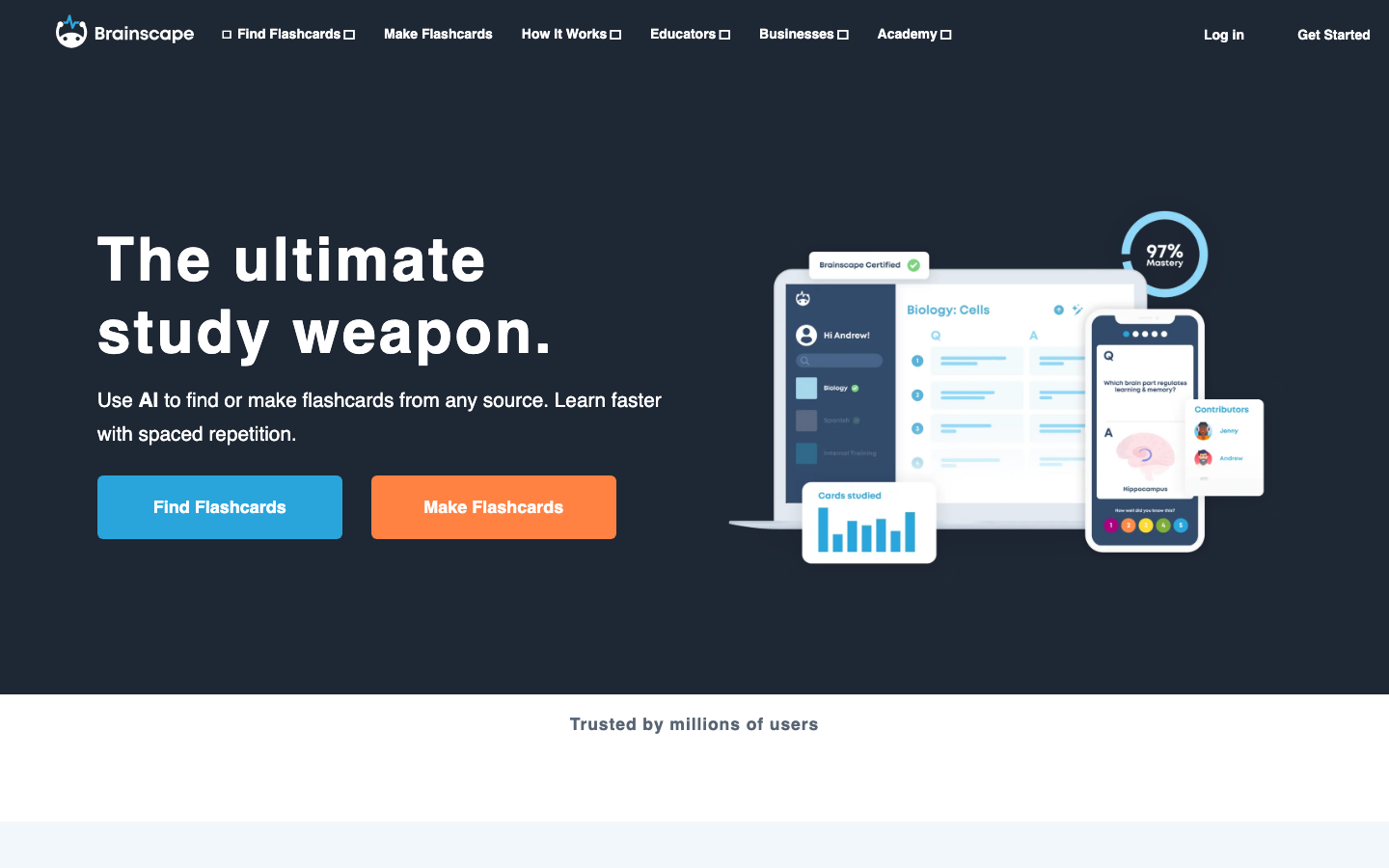
Brainscape
Core parameters and statistics
Brainscape belongs to the digital memory card track like Anki and Quizlet, but its core difference lies in the "Confidence-Based Repetition" mechanism - during review, users actively evaluate their knowledge of each card, and AI dynamically adjusts the frequency of review based on this subjective score, instead of passively waiting for the algorithm to trigger review at fixed intervals. Officially, it is positioned as "the most effective learning platform in the world", targeting serious long-term learners rather than casual light users.
| Projects | Public Information |
|---|---|
| Official positioning | Cognitive science-driven smart memory card platform ("The ultimate study weapon") |
| Core method | Confidence-based repetition (CBR) + Spaced Retrieval (Spaced Retrieval) |
| Corporate Headquarters | New York, USA (159 W 25th Street, Suite 517) |
| Operating entities | Bold Learning Solutions |
| Global Learners | 10M+ |
| Cumulative learning cards | 1 billion+ |
| Accumulated learning time saved | 20 million+ hours |
| Subject coverage | Hundreds of preset subjects (Knowledge Genome) |
| Content source | User-made + expert certification + publisher cooperation |
| Deployment method | Web, iOS, Android |
| Business Model | Freemium (Basic Free + Pro Subscription + Enterprise Volume License) |
| Latest version | 2025 Release (~2025-10) |
Core Difference: Each time a memory card is reviewed, Brainscape asks the user to rate their confidence in their answer (1-5), and the AI dynamically adjusts the review frequency of the card based on this score - the less confident the answer, the faster the next review will come. This mechanism incorporates the user's subjective metacognitive judgment into the algorithm's decision-making, and is better able to capture subtle changes in individual differences in mastery of knowledge points than purely objective spaced repetition algorithms (such as Anki's SM-2).
Brainscape’s users and market recognition
Brainscape's market recognition is based on two dimensions: active adoption by C-side learners and bulk purchases by B-side educational institutions. The two mutually verify the applicability of the product in different scenarios.
Global user scale: The official page publicly shows that there are more than 10 million learners all over the world, the cumulative learning cards exceed 1 billion, and the cumulative learning time saved exceeds 20 million hours. These data come from official statistics. Although no third-party audit verification is provided, they still have certain reference value as self-reported indicators for long-term operating products. Judging from the officially displayed popular subject data, Spanish alone has 615,000 learners and 14,000 cards, World Geography 284,000 learners, and NCLEX-RN Nursing exam 177,000 learners. The user density of the top subjects shows that it has formed a scale effect in fields such as language learning, medicine, and geography that require a large amount of fact memory.
Adopted by educational institutions: The official clearly provides the Enterprise solution for teachers, schools, and corporate training departments, including privatized content management, detailed learning analysis, and branded login pages. The specific list of enterprise customers has not been made public, but the "Schools and Companies" sales channel exists and is active, supporting volume licensing and Digital Privacy Agreement (DPA) signing - indicating that it has entered the compliance-sensitive education and corporate training market.
Industry benchmarking: In the memory card learning track, Brainscape forms a triangular competition with Anki (open source, free, highly customizable) and Quizlet (gamified, lightweight, social). Brainscape's positioning is more towards "serious learning", not emphasizing "fun" but emphasizing "long-term memory efficiency". This makes it differentiated and competitive in high-pressure scenarios such as exam preparation and professional certification, but it is naturally disadvantaged in scenarios that require rapid communication and social fission.
Brainscape’s Cost Advantage
Brainscape's cost structure presents a three-tier model of "personal free entrance + personal subscription upgrade + enterprise volume discount", forming a clear layered contrast with competing products.
C-side/individual users - free truth: The Basic plan is completely free and covers core learning features - users can create unlimited memory cards, import existing card sets, use AI to generate up to hundreds of cards, share card sets with classmates or students, set editing permissions, learn 2500 preset cards, unlimited learning of cards created by yourself or shared, use spaced repetition algorithm, track personal progress and set learning reminders. The main limitations of the free version are: there is an implicit upper limit on the number of AI-generated cards (the specific amount is not disclosed), the inability to access the "certified" card group (Certified content), the inability to add images and sounds, the inability to reset learning statistics, and the inability to support reverse cards. For light users, the functions of the free version are sufficient; for intensive test preparation users, the limits of the free version will be reached within 2-4 weeks.
Personal Subscription (Pro) - Pricing Comparison with Competitive Products: The Pro plan is priced at $7.99/month, and you can save 60% by paying annually (equivalent to about $3.20/month). Pro unlocks all limitations: AI-generated unlimited cards, unlimited access to certified decks, adding images and sounds, reset statistics, bookmark cards, reverse card mode, content privacy. Compared with direct competitors:
| Products | Personal monthly fee (equivalent to annual payment) | Practicality of free version | Core differentiation |
|---|---|---|---|
| Brainscape Pro | ~$3.20/month (paid annually) | High – core learning features free | Confidence Assessments + Certified Content Library |
| Quizlet Plus | ~$3.00/month (paid annually) | Medium – some features limited | Gamification + social sharing |
| Anki | $0 (desktop) / $25 (one time for iOS) | High - completely free | Open source + plug-in ecosystem + fully customizable |
| RemNote | ~$5.00/month (annual payment) | High - basic functions are free | Integration of notes and memory cards |
Brainscape's annual equivalent price is slightly higher than Quizlet Plus, but significantly lower than RemNote, and Anki completely crushes all three on price. Brainscape's premium comes from the curated quality of certified content and the differentiated experience of the CBR algorithm - a premium that is justified for users who want a high-quality deck "out of the box."
Enterprise/Institution (Enterprise) - Hidden Cost: The Enterprise plan adopts volume discount pricing. The official claim is "up to 70% savings compared to Personal Pro", but please contact sales for specific prices. Enterprise includes: content visibility control, branded private login pages, signable digital privacy agreements (DPA), detailed student learning data reports, content development assistance and dedicated customer service support. Suitable for educational institutions and corporate training departments with compliance needs. Hidden costs are mainly reflected in the following: In the initial stage of deployment, teachers or training administrators are required to complete content migration and account configuration. This part of the labor investment is not officially included in the pricing calculation; if the organization wants to customize special content formats or deeply integrate with the existing LMS, it may require additional development investment.
Brainscape’s main features
Brainscape's functions are designed around the four-step learning process of "Create → Learn → Evaluate → Optimize". It does not make AI an independent chat tool, but embeds it into every step of the memory card life cycle.
-
Confidence-Based Repetition (CBR): This is the core of Brainscape’s algorithm. During each review, users rate their mastery on a scale of 1-5 after seeing the answers (1=didn’t remember it at all, 5=completely mastered it). The score directly determines how soon the card will appear again - a score of 1 may reappear in minutes, a score of 5 may be delayed until weeks or months later. Different from Anki's purely objective SM-2 algorithm, CBR introduces the user's "metacognitive" judgment - the learner himself knows best whether a certain knowledge point is "really understood" or "deceived". This design elevates the user from a passive recipient of the algorithm to an active participant in scheduling decisions, but it also brings risks: dishonest self-ratings (overestimation or underestimation) will directly destroy the algorithm effect.
-
AI card generation (multi-source import): Officially provides the ability to generate memory cards from multiple sources such as PPT, PDF, Word, Excel, videos, photos, etc. with one click. Users upload a 30-page PPT, and AI converts it into a set of structured memory cards within tens of seconds. After generation, users can modify, add, delete, sort cards, add pictures, sounds and even animated GIFs in the flexible editor. The key value of this function is to compress the most time-consuming part of the learning process of "making cards" from hours to minutes. Implementation Tips: The quality of the cards generated by AI depends on the degree of structure of the source material - highly structured PPT or table-like PDFs have good conversion effects, while the conversion effects of pure narrative text or scanned documents may not be ideal and require manual secondary cleaning.
-
Certified Knowledge Base (Knowledge Genome): Brainscape collectively refers to all classified subjects as "Knowledge Genome", covering 20+ major categories of subjects such as entrance examinations, professional certifications, foreign languages, science, medical nursing, law, humanities and social sciences, mathematics, technical engineering, etc. Among them, the "certified" card set is created and reviewed by education experts (publishers, examination institutions, senior teachers), and users can use it directly without making it from scratch. According to official data, the quantity and quality of cards in top subjects have formed a competitive barrier - 14,000 Spanish cards, 3,011 human anatomy cards, and 3,747 NCLEX-RN cards - these planned content assets are an important driving force for new user retention.
-
Collaborative learning and class management: Supports creating classes, generating sharing links, and setting editing permissions. Teachers can create a class and invite students to join, and view each student's learning progress (number of cards, mastery, study time) and overall class mastery report. Content permissions are divided into "public sharing" (free access through links), "private sharing" (accessible only to invited email addresses) and "paid sharing" (used to sell card content). For corporate training scenarios, the Enterprise plan also provides a branded login page and management backend.
-
Learning Habit Tracking and Statistics: The official provides a progress dashboard, which is divided into two dimensions: "Progress" (mastery) and "Persistence" (persistence). Progress displays the mastery progress percentage of each card in the current knowledge map; Persistence displays the number of daily learning cards, learning duration and number of consecutive learning days. The combination of the two dimensions helps users identify whether they "cannot learn" or "are not learning" - the former points to the need to adjust the difficulty of the content, and the latter points to the need to strengthen habit development.
-
Learner Report (Teacher): Class teachers or administrators can view detailed data for each learner - number of cards learned, mastery percentage, study time. The value of this function is that it allows teachers to shift from "judging students' mastery by feeling" to "precise intervention based on data" - when they find that a student's mastery has stagnated for many days in a row, teachers can proactively intervene instead of waiting until the test results come out to discover the problem.
Brainscape model and version evolution
Brainscape's version iteration follows the rhythm of "large version of product functionality + continuous lean optimization" rather than the retraining cycle of the AI model. The following version context is compiled based on publicly released information:
Founding period (2006-2012)
- 2006: Founder Andrew Cohen developed an Excel macro tool based on his own needs for learning Spanish, and verified the core mechanism of confidence assessment + spaced repetition.
- 2008—2009: Brainscape was officially established and shifted from personal tool projects to product operations.
- Before 2012: Complete the initial version of the web client and launch the iOS App, and enter the student market.
Growth period (2018-2024)
- 2018: Established the founding executive team (Andrew Cohen, Andy Lutz, Jay Stramel, Jonathan Thomas, Ron Cadet) and completed the product architecture reconstruction.
- ~2020: Launched AI card generation function, supporting PDF/PPT import.
- ~2022: Launch the Knowledge Genome classification system and certification card group project, and introduce publisher cooperation.
- 2024.2 (v4, ~2024-06): Introducing AI-generated intelligent review plans and knowledge graph functions to support more fine-grained visualization of mastery.
Current version
- 2025.3 (2025 Release, ~2025-10): Enhanced AI confidence assessment algorithm and collaborative learning functions. Specific updates include: parameter tuning of the CBR algorithm, batch operation improvements for class management, and data dimension expansion for learner reports. There is no official precise date yet.
An important feature of version iteration: Brainscape's updates are more focused on "functional improvement of learning efficiency products" rather than "underlying model replacement" - unlike tools for large AI models, its core technology engine (CBR) has maintained a stable basic framework for more than ten years. Iterations mainly occur in: front-end interactive experience (editor, dashboard), content ecology (quantity and quality of certified card sets), AI auxiliary functions (source material type expansion for card generation).
Brainscape’s Technical Advantages
Brainscape's technical competitiveness does not lie in large model scale or computing power, but in its system engineering capabilities of "implementing cognitive science principles into executable algorithm strategies."
Algorithmic logic of Confidence-Based Repeating (CBR): The core formula of CBR can be simplified to "interval = f (confidence score)" - the lower the confidence score, the shorter the interval; the higher the confidence score, the longer the interval. But the key difference from SM-2 (the standard algorithm used by Anki) is that SM-2 takes a "correct/wrong" binary result as input, while CBR uses a 5-point rating to capture the subtle difference between "getting it right" and "getting it right." For example, if the user correctly answered "The capital of France is Paris", but knew in his heart that he was right (score 2), CBR would make the card appear again 10 minutes later; while SM-2 would directly double the interval of the card because of the correct answer. This mechanism is more effective for scenarios that require precise grasp of subtle differences (such as medical diagnostic standards, memory of legal provisions), but for knowledge points where "you can get it right if you choose one of the two", the honesty of user self-assessment directly affects the algorithm effect - this is an inherent risk of CBR.
Engineering architecture of AI card generation: Official details of the underlying model have not been disclosed, but inferred from functional performance, its AI generation pipeline is roughly as follows: source file parsing (PDF/PPT/DOCX and other format parsing and text extraction) → semantic chunking (based on NLP to divide long text into knowledge point units) → question and answer pair generation (generating "question-answer" pairs of memory cards for each knowledge point) → user editing and acceptance. This pipeline works best for structured documents (documents with a clear hierarchy of tables, lists, and headings), while pure narrative text requires more manual correction. The difference from general AI tools (such as ChatGPT) that directly extract knowledge is that the output format of Brainscape is fixed to "question and answer pairs", which is naturally adapted to memory card learning scenarios and saves users the time of manually organizing cards from conversational AI results.
Cloud-first cross-platform synchronization: Brainscape uses a cloud architecture, and all content is synchronized in real time between Web, iOS, and Android. This means that the cards created by the user on the mobile phone can be reviewed immediately on the computer, and the progress remains continuous. This design is crucial for mobile learning scenarios - users can use the app to review while commuting, and use the web to manage and edit cards in front of the computer. Compared with Anki's architecture that relies on third-party synchronization plug-ins (AnkiWeb or self-built servers), Brainscape's out-of-the-box experience has clear engineering advantages.
Technical architecture of content ecology: Knowledge Genome is essentially a structured subject classification data model. Each knowledge point card is attributed to the three-level hierarchy of "Subject → Class → Card Group". This hierarchical design allows users to quickly locate relevant knowledge points, and also provides a clear management path for the review and version update of the "Certification Card Group". For users with large amounts of content (such as an entire semester's courses), hierarchical management is easier to navigate than a flat tab system.
How to use Brainscape
The usage path of Brainscape is divided into two perspectives: "learner" and "creator/teacher", with each entrance and learning steps focusing on each.
| How to use | Suitable for people | Features | Cost |
|---|---|---|---|
| Web version | All users | Visit brainscape.com to register and use, suitable for content management and editing | Free / Pro subscription |
| iOS App | Mobile learners | App Store search "Brainscape" to download, supports offline learning | Free / Pro subscription |
| Android App | Mobile learners | Google Play search "Brainscape" to download, supports offline learning | Free / Pro subscription |
| Enterprise version | Schools, companies | Browser access + branded private login page, management background allocation account | Batch licensing (need to contact sales) |
Learner Quick Start (5 minutes):
- Open brainscape.com and register for a free account.
- Find the required subjects in the search bar (such as "Spanish", "NCLEX-RN"), or browse 20+ major categories of subjects through the "Subjects" directory.
- Click on a preset card deck to start learning: read the question → recall the answer → click to view the answer → give yourself a confidence score of 1-5 points → automatically enter the next card.
- Log in every day to complete the review tasks arranged by the system, and check the mastery progress on the dashboard.
- If you need to expand: You can use AI to import and generate customized cards from your own learning materials (PDF, PPT, DOC).
Quick Start for Creators/Teachers:
- Create a "Class" after registration and fill in the subject name and description.
- Create a "Deck" (deck) under the class, enter it manually or import the existing deck file through "Import" (supports CSV, Anki APKG and other formats).
- Use the AI generation function: Upload the source file (PPT/PDF/Word/Excel/Video link), and AI will automatically generate a draft card.
- Review, modify, and sort the cards in the editor before publishing.
- Generate a sharing link and send it to learners, or invite specific members to join via email.
- View class learning data and each person's mastery in the "Learners Report" on the dashboard.
Advanced Tip: For creators who need to sell card content, Brainscape offers a paid card sharing channel—the creator sets the price, Brainscape handles payment and distribution, and the proceeds go to the creator. This function is applied through the "Earn Money" page, and the specific share ratio is subject to the official real-time page.
Brainscape Product Pricing
Brainscape adopts a three-tier pricing structure, covering all scenarios from free personal learning to enterprise batch deployment. The following information is from the official pricing page (collected as of 2026-07).
| Plan | Pricing | Applicable objects | Core benefits |
|---|---|---|---|
| Basic (Free) | $0 | Individual learners, light users | Unlimited card creation, import, limited AI generation of 2500 preset cards, spaced repetition, progress tracking |
| Pro (individual subscription) | $7.99/month (annual payment ~$3.20/month) | Exam preparation-intensive, heavy learners | Unlimited AI generation, unlimited certification decks, pictures/sounds, reverse cards, private content |
| Enterprise (volume licensing) | Contact sales (save up to 70% compared to Pro) | Schools, corporate training institutions | Permission control, branded landing page DPA, detailed analysis reports, dedicated customer service |
The real boundaries of the free version: The Basic plan is suitable for the "testing" stage (1-4 weeks), but when users begin to systematically prepare for large-scale certifications, the limitations of the free version - especially the limit of 2,500 preset cards and the inability to access the certification deck - will be reached quickly. For learners who need to study for medical certification (NCLEX-RN ~3747 cards) or advanced foreign languages, upgrading to Pro is almost a must.
Economic evaluation of the Pro plan: The annual payment is equivalent to $3.20/month (about 23 yuan/month), which is equivalent to the price of a cup of milk tea. Compare the time cost of crafting a deck of cards by hand: If a student spends 2 hours a week making cards, and 8 hours a month, the time cost is well over $3.20 at minimum hourly wage. The value proposition of Pro is "exchanging subscription fees for time" - the combination of AI generation + certified content + optimization algorithm allows learners to shift their energy from "making cards" to "learning cards".
Implicit terms for the Enterprise plan: Quotes for volume licensing include content visibility controls (who can see what content) and branded landing pages, but do not necessarily include deep integration with LMS (e.g. Canvas, Blackboard) - if SSO single sign-on or Gradebook grade synchronization is required, this needs to be explicitly agreed in the contract. Although the official provides Content Development Assistance, the specific service scope and deliverables need to be confirmed before purchasing. It is recommended that institutional customers request a trial management backend before signing a contract to verify whether the export format of learner data (CSV/API/PDF) meets internal reporting requirements.
Brainscape application scenarios
The core value of Brainscape lies in "embedding factual knowledge that needs to be memorized repeatedly into a systematic spaced review process." The following four types of scenarios have been verified on a large scale:
-
Standardized Test Prep: Students preparing for exams such as SAT, GRE, GMAT, MCAT, NCLEX-RN, NREMT, etc. are Brainscape's core user group. The common features of these exams are: a clear scope of knowledge points (covered by the exam syllabus), requiring a large amount of factual memory (terms, formulas, classifications, processes), and a review period of 2-12 months. Brainscape's preset certification decks are ready to use, and the AI plan ensures all knowledge points are covered before the exam. Implementation Tips: In the exam preparation scenario, it is recommended to do a set of simulation questions at the beginning to locate weak areas, and then select the deck in a targeted manner - do not apply equal effort on all subjects. Brainscape's CBR mechanism will naturally focus learning efforts on low-scoring areas. This feature is highly consistent with the "diagnose first, treat later" test preparation strategy.
-
Medical and Nursing Education: According to official data, medical subjects such as NCLEX-RN (177,000 learners), human anatomy (13,000 learners) and NREMT (54,000 learners) are among the most active content areas on the platform. The special thing about medical education is that a large number of knowledge points are hierarchical (from anatomical structures to pathological mechanisms to treatment paths) and cannot be memorized in isolation. Brainscape's three-level hierarchy (subject → class → deck) allows users to gradually expand their learning according to the course progress, rather than facing a flat card list. Implementation Tips: In medical scenarios, it is recommended that teachers or schools purchase the Enterprise plan - because medical content usually involves copyright and privacy compliance (HIPAA), privatized content control and DPA signing are urgently needed.
-
Language Learning: Brainscape official data shows that Spanish has 615,000 learners, making it the single subject with the largest number of users on the platform. The core pain points of language learning—vocabulary requires a lot of repetition, and grammatical rules are easily confused—are exactly the areas where the CBR algorithm has advantages. Different from Duolingo's "gamification + short-term and high-frequency" model, Brainscape is more suitable for systematic learning - learners can create or use ready-made vocabulary decks on the platform to complete learning at their own pace. Implementation Tips: Language learning is recommended to match actual usage scenarios (conversation, reading, writing). Brainscape is responsible for "establishing the foundation of vocabulary and grammar", but it cannot replace the actual communication training of language.
-
Enterprise Training and Compliance Learning: For enterprises that require employees to master a large amount of standardized knowledge (such as compliance training for pharmaceutical companies, standardized operation training for chain stores, and product knowledge training for financial practitioners), Brainscape Enterprise's class management and learner reporting functions can replace some of the usage scenarios of traditional LMS. Implementation Tips: In enterprise scenarios, it is recommended to first evaluate the "cardability rate of knowledge" - if the training content is mainly process operations and soft skills (such as communication skills, leadership), memory cards are not the optimal form; if the training content is factual knowledge (product specifications, safety specifications, regulatory provisions), Brainscape may be more efficient than LMS.
-
Not suitable for scenarios: For subjects that require in-depth understanding and critical thinking (philosophy, literary criticism, strategic analysis), memory cards can only cover the "fact layer" but cannot touch the "meaning layer". For learning that requires long-term in-depth study and is not exam-oriented, the marginal utility of flashcard tools will be diminishing. Brainscape is not suitable as a sole learning tool - it is best suited as a "systematic review" segment embedded into a more complete learning package (listening/reading → comprehension/discussion → memory card consolidation → practical application).
Who is Brainscape suitable for?
Brainscape's three-tier pricing and dual-entry (learner + creator) design serves different user roles, but not everyone gets equal value from it.
-
Students preparing for exams (high school students, college students, graduate students): This is Brainscape’s core user group. Whether you're preparing for college entrance exams (SAT, ACT), medical school exams (MCAT, USMLE), or nursing certification (NCLEX-RN), Brainscape's certification decks and CBR algorithm can significantly compress the time from "learn it" to "memorize it." Quantitative deduction: Assuming that an NCLEX-RN candidate needs to master about 3,000 knowledge points, it takes about 30-40 hours to make cards manually (1 hour per day, about 1 month), but using Brainscape AI to generate + certification card sets, this time can be compressed to 2-5 hours. The efficiency improvement in the learning phase depends on the accuracy of the CBR algorithm in identifying personal weaknesses - under ideal conditions, the total number of reviews required for the same level of mastery is reduced by 30-50% compared with traditional methods. Misfit Boundary: For learners who have weak self-control and need strong external motivation, Brainscape's "pure learning interface" (no points, no rankings, no social rewards) may cause persistence difficulties. This type of user may be better suited to Quizlet’s gamified design or Duolingo’s daily check-in mechanism.
-
Teachers and Educational Institutions: Teachers can manage review progress for their entire class by creating classes, setting sharing permissions, and viewing learner reports. The Enterprise plan's content privacy and branded landing pages allow schools to maintain brand consistency. Human-computer collaboration boundary: Brainscape can 100% automatically complete knowledge point review scheduling and progress tracking, but the following sections must be completed manually by teachers: content review of the initial card group (AI-generated cards require teachers to confirm whether the accuracy and difficulty match the course goals), learning intervention based on learner reports (when it is found that student mastery has stagnated, teachers need to judge whether additional tutoring or adjustment of teaching methods is needed). Teachers cannot rely solely on reports to make automated decisions.
-
Enterprise Training Manager: For enterprises (chain stores, pharmaceuticals, finance and insurance) that need to unify employee knowledge standards, the Enterprise plan provides solutions from content creation to learning tracking to report analysis. Prerequisites for implementation: Enterprises should first complete the "knowledge base standardization" of training content - organize training materials scattered in different PPTs, PDFs and emails into a structured list of knowledge points, and then hand it over to Brainscape to generate cards. Without structured materials, the AI generation effect will be greatly reduced.
-
Knowledge Creators and Content Entrepreneurs: Brainscape's "Sell Cards" function allows knowledge creators to sell learning content and earn passive income. This provides a monetization path for independent creators in the education and training field - but only if the content created is of high enough quality and can pass the platform's "certification" review. Not suitable for the boundary: Content monetization requires high content planning capabilities of creators - not all subjects have sufficient demand, and the high-quality certification card sets on the platform have already covered the top exam subjects. New creators need to consider differentiated positioning (segmented subjects, localized content, specific exam directions).
Summary and Outlook
Brainscape’s positioning of differentiation among digital memory card tools is clear and firm: don’t make it the most interesting, make it the most effective. It replaces the binary judgment of the traditional spaced repetition algorithm with a confidence evaluation (CBR) mechanism, and incorporates the user's metacognitive ability into scheduling decisions. This design is more efficient than a purely objective algorithm in scenarios that require precise grasp of subtle knowledge differences. The scale of 10 million+ users and 1 billion+ study cards has formed a competitive barrier in the content ecology - especially the certification card group's coverage of top examination subjects, which is an asset that is difficult for latecomers to copy in the short term.
Current core advantages: The differentiated experience of the CBR algorithm brings better novice friendliness than Anki and deeper learning efficiency than Quizlet; the AI multi-source import function significantly reduces the time threshold for card production; the content system of Knowledge Genome provides learners with a "ready-to-use" path; the Enterprise plan's volume licensing and DPA enable it to enter the compliance-sensitive education and enterprise markets.
Current main limitations: The effect of the CBR algorithm is highly dependent on the user's self-assessment honesty - overestimating oneself will cause cards to disappear prematurely, and underestimating oneself will lead to excessive repetition; the 2500 preset card limit of the free version may reach the top prematurely for users who need to prepare for multiple subjects at the same time; although the content ecology covers the top subjects, the content of long-tail subjects (minor languages, unpopular certifications) still needs to be made by users; lack of integration with mainstream The native integration of LMS (Canvas, Blackboard) limits its penetration depth in the school market; the quality of AI card generation is greatly affected by the structural degree of the source material, and the processing effect on pure narrative text is unstable.
Follow-up observation points: Whether Brainscape will introduce a more objective "automatic confidence assessment" (such as implicit assessment based on answer speed and accuracy) to supplement the bias of user self-evaluation, which will determine the next evolution direction of the CBR algorithm; the category expansion speed of the certification card group - especially whether it enters popular fields such as programming language learning and data science; the progress of the integration of the Enterprise solution and the LMS platform - the willingness of school customers without native integration to deploy will be significantly restricted.
Purchase and Adoption Risk Assessment: For individual learners, the free plan does not have any capital risk. It is worth spending 1-2 weeks before the start of the test preparation season to experience whether the CBR algorithm is in line with personal learning habits - if you feel "more profound in memory than traditional methods" after use, the annual investment of $38.4 for Pro has almost no risk of trial and error. For educational institutions, it is recommended to start with a pilot purchase of the Enterprise solution for a single class or course to verify teachers' adoption of learner reports, students' long-term activity curves (whether there is a typical pattern of "intensive use in the first two weeks, and significant decline in the third week") and the man-hour consumption of content migration, and then decide whether to expand to the entire institution. Enterprise training customers should focus on confirming before signing: whether the contract includes implementation support for LMS integration, whether the export format of learner data meets internal audit requirements, and the specific delivery definition of "content development assistance" in the Enterprise plan (whether it includes deck template production, content migration services or secondary development support).
Related tools:  Khanmigo, quizlet
Version Info
- Brainscape 2025 Release :There is no official precise date yet. Enhance AI confidence assessment algorithms and collaborative learning capabilities.
- Brainscape v4 :There is no official precise date yet. Introducing AI-generated intelligent review plans and knowledge graph functions.
User Reviews