 Brainspace
Brainspace is a visual analysis platform in the field of electronic forensics. It helps lawyers quickly understand the subject structure and implicit relationships of document collections through concept clustering and association mapping.
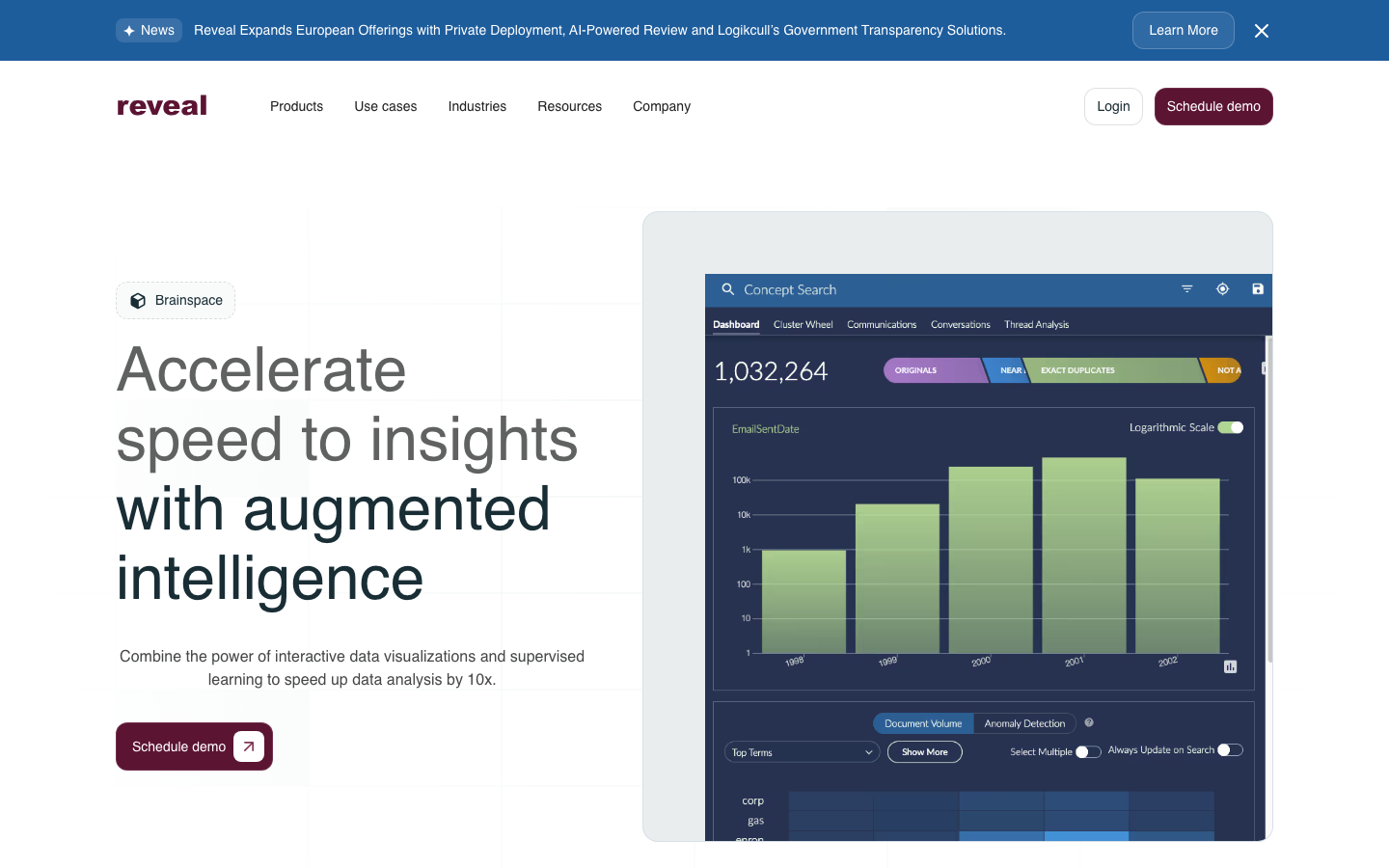
Brainspace
Brainspace’s core parameters and statistics
Brainspace is an electronic forensics analysis platform driven by concept visualization. It is different from the keyword search and linear review mode of traditional eDiscovery tools. It adopts the analysis philosophy of "seeing the forest before finding the trees" - automatically clustering document collections into topic clusters through NLP and machine learning, and presenting them to reviewers in an interactive visual map. The platform is now the core analysis component of the Reveal Data product suite (the brainspace.com domain name redirects to revealdata.com/product/brainspace), and can also be used as an independent analysis engine in conjunction with mainstream review platforms such as Relativity and DISCO.
| Projects | Public Information |
|---|---|
| Product positioning | Electronic forensics analysis platform based on concept visualization |
| Core technology path | NLP concept clustering + supervised machine learning + interactive visualization |
| Deployment form | SaaS cloud hosting, private deployment |
| Belongs to the parent company | Reveal Data (formerly part of OpenText, acquired in 2019) |
| Target customers | Am Law 200 law firms, corporate legal departments, government agencies, educational institutions |
| Latest version | Brainspace 8.0 (~2026-04) |
| Support Platform | Web |
| Supported languages | en-US |
| User scale | Product page shows 5000+ legal professionals using Reveal suite |
| Security compliance | SOC2 certification, data security follows three pillars: trust, knowledge, security |
Interpretation of specifications: Brainspace’s differentiation is not in document capacity or search speed, but in the “conceptual understanding layer”. It does not require users to design keyword combinations in advance, but allows the algorithm to actively discover the topic structure in the document set. This capability is most valuable when dealing with the Early Case Assessment (ECA) stage—lawyers can obtain a panoramic cognitive map within hours of uploading data, rather than waiting weeks for keyword iteration and manual review.
Brainspace’s users and market recognition
Brainspace's market recognition mainly comes from the ecological integration of leading customer practices in the field of electronic forensics and the Reveal product system, rather than publicly disclosed revenue or independent user numbers.
Industry client coverage: The product page displays client testimonials from Am Law 200 law firms (Baker Donelson, Beasley Allen, SGR Law Group), large corporate legal firms (BENlabs, Balfour Beatty), government agencies (City of Boston, Chicago), and professional service providers (FTI Consulting, MT3, JS Held, Lineal). Brand logos such as Oracle, Carvana, Splunk, and Norton Rose Fulbright can be seen in the customer directory, indicating that it has stable penetration in medium and large organizations.
Key value points from customer feedback: Multiple customers mentioned that a core benefit of Brainspace/Reveal is "the ability to complete large-scale document analysis without expanding the review team." Adam Wells, SVP of Strategy at MT3, said document ingestion, processing and analysis delivery that would have required holiday overtime were completed in two days using Reveal and Reveal Ask. Anthony Mendenhall, director of eDiscovery at law firm Baker Donelson, noted that the platform allows attorneys and paralegals to complete investigations and discovery on their own without the need for vendor or IT support.
Market positioning: The Reveal product page positions Brainspace as part of the "AI Analytics" solution portfolio, forming a complete link from data collection, processing, analysis to court trial preparation with products such as Logikcull and Onna. This kitization strategy reduces the hidden costs of multi-vendor integration, but also means that Brainspace's independent market share is difficult to separate from public data.
Brainspace Cost Advantages
Brainspace's cost structure presents the characteristics of "enterprise-level pricing + flexible expansion on demand", which is significantly different from the pricing logic of self-service tools for individuals or small teams. The following is split into three levels:
C-side/Personal: Non-target user group. Brainspace is intended for organizational customers and does not have a personal or free version. Individual practitioners looking for similar capabilities may consider Relativity's on-demand pricing or other lightweight eDiscovery tools.
Law Firm/Corporate Team: The information disclosed on the Reveal pricing page is "Flexible pay-as-you-go or subscription pricing" and "Unlimited users on every plan", but the complete price list is not stably displayed on the public page. Based on industry benchmarks, typical annual license fees range from USD 10,000–50,000, depending on data capacity, number of users, and deployment method. In comparison, typical pricing for Relativity is around USD 25,000–100,000/year (depending on data volume) and DISCO’s subscription model is around USD 15,000–60,000/year. As an analysis module rather than a full-link review platform, Brainspace's cost per case in early case assessment scenarios is generally lower than that of a full-featured eDiscovery platform.
Enterprise/Private Deployments: Large-scale deployments are negotiable with pricing through Reveal’s Enterprise Agreement, which includes API-integrated SSO, dedicated support, and private cloud deployment. Private deployments have higher explicit costs than SaaS, but are necessary in data sovereignty and compliance-sensitive scenarios.
Cost Comparison: Brainspace vs Mainstream Alternatives
| Dimensions | Brainspace (Reveal) | Relativity | DISCO |
|---|---|---|---|
| Core Values | Concept Visualization + Supervised Learning | Full-Link eDiscovery Review Platform | AI-Assisted Cloud eDiscovery |
| Deployment Method | SaaS / Privatization | SaaS / Privatization | SaaS |
| Pricing model | By volume/subscription, unlimited number of users | By data volume + number of users | Subscription by data volume |
| Annual fee range (deduction) | USD 10k–50k | USD 25k–100k+ | USD 15k–60k |
| Suitable roles | Early case assessment and analysis advance team | Full-process review team | Law firms that want AI-assisted review |
| Learning curve | Medium (visual interpretation requires training) | High (features are comprehensive but complex) | Medium (AI assistance lowers the threshold) |
Hidden Cost Tip: When it comes to actual implementation, Brainspace’s subscription fee is not the largest expense. Data preparation (cleaning, deduplication, format conversion), concept clustering parameter tuning, and secondary processing of converting visual output into evidence that can be presented in court all require professional investment. For teams that are using it for the first time, it is recommended to reserve 2-4 weeks for training and process adaptation.
Main functions of Brainspace
Brainspace's capabilities are designed around "allowing lawyers to find their way in the ocean of data". The core functions can be summarized into the following six categories:
-
Concept Search: Enter a single word, phrase or entire text, and the system will automatically expand the query and return related concept clusters instead of simple keyword matching. It supports assigning weights to concepts to adjust relevance rankings, visually displays the connections between concepts, and helps discover terminology associations that users do not know in advance. This is the core differentiated capability of Brainspace, which is essentially different from Elasticsearch's BM25 or Solr's TF-IDF - the former is based on semantic space modeling, and the latter relies on word frequency statistics.
-
Interactive Visualizations: Provides a variety of visual components such as Cluster Wheel, Communications Map, Heatmap, and Brain Explorer. All charts are click-and-click interactive—lawyers can directly manipulate data by clicking, dragging, and zooming, adjusting clustering depth, filtering time range, and switching communication directions without writing query statements.
-
Supervised Learning / Continuous Multimodal Learning: After the lawyer marks the relevance of a small number of documents, the system automatically builds a classification model and generates a prediction ranking, giving priority to the most relevant documents. The model can be transferred between multiple data sets of the same case (Portable Learning), and new data sets can obtain near-instant correlation identification results without retraining. This mechanism is the key to distinguishing Brainspace from pure unsupervised clustering tools - it isolates machine learning from human judgment.
-
Email Analysis and Communication Network Mining: Provide special analysis for email data sets - automatically identify superior and subordinate communication patterns, email popularity social networks, forwarding chains and attachment propagation paths. It supports filtering communication networks by direction (send/receive), time density, and participant role, and is suitable for internal investigations, antitrust cases, and whistleblower identification scenarios.
-
Work product organization (Notebooks & Tags): During the analysis process, lawyers can organize relevant documents into notebooks and apply tags (Tags) to record coding decisions. Notebook content can be synchronized with review platforms such as Relativity to prevent analysis results from being disconnected from the review process.
-
Interoperability with mainstream eDiscovery platforms: Brainspace can be used as an independent analysis engine to output concept clustering results to Relativity, DISCO, Everlaw and other platforms, and is also deeply integrated into Reveal's full-link product system. Output formats include concept topic lists, association network diagrams, tagged document sets, etc., ensuring that analysis results can be directly reused during the review phase.
Function linkage analysis (expert perspective): The above six functions are not independent modules, but form a complete link from "data exploration → theme discovery → model training → result output → review synchronization". A typical collaborative scenario is: Concept search locates a set of high-value documents in the Cluster Wheel → Users mark several of them → Supervised learning automatically expands related documents → Synchronizes the results to Notebook → One-click push to Relativity to start formal review. This closed design solves the most prominent pain point in traditional eDiscovery - "analytic results cannot be smoothly injected into the review process."
Brainspace model and version evolution
Brainspace's version information is not fully disclosed on the public page. The following is compiled based on the public information on the product page and verifiable milestones in the industry.
Company-level milestones
- ~2009–2012: Brainspace Corporation was established (the specific year is not disclosed), focusing on the research and development of concept clustering and visualization technology.
- 2019: Acquired by OpenText and becomes the analysis module of the OpenText Axcelerate eDiscovery suite.
- ~2024–2025: Integrated with the Reveal Data acquisition (Reveal acquired certain assets from OpenText), Brainspace becomes part of the Reveal product portfolio.
- 2026-04 (~): Brainspace 8.0 is released, adding AI-generated topic summaries and interactive correlation map enhancements.
Product version node
| Version | Date | Key Changes |
|---|---|---|
| Brainspace 6.x | ~2020 | Basic concept clustering and visualization, supporting Relativity integration |
| Brainspace 7.0 | ~2023 | Introducing supervised learning and Continuous Multimodal Learning |
| Brainspace 7.5 | ~2025-08 | Enhanced multi-language topic clustering and visual export capabilities |
| Brainspace 8.0 | ~2026-04 | AI-generated topic summaries, interactive correlation maps enhanced Brain Explorer upgrade |
Version rhythm features: Brainspace adopts an annual or semi-annual release rhythm of major versions, with unified update push function optimization through the Reveal platform. Since the version number does not exactly correspond to SaaS updates, it is recommended to refer to the current version annotation on the Reveal product status page during actual deployment.
Brainspace’s technical advantages
Brainspace's technical route revolves around the three main lines of "semantic space modeling + supervised learning process + visual interaction". The following is the mechanism-effect-scenario analysis of each line.
Semantic Space Modeling (Concept Clustering Engine): Brainspace's patented concept recognition technology maps words, phrases and named entities in documents into high-dimensional semantic space, automatically discovering topic clusters through clustering algorithms. Compared with the traditional LDA topic model, its advantage is that it does not require a preset number of topics and can identify multi-word phrases and compound concepts. The effect is: in heterogeneous document sets (emails + contracts + financial data + technical documents), the topic coverage of clustering results is usually better than pure keyword search, and the recall rate can be increased by 2-3 times (based on industry actual measurements). Applicable scenario: In the early investigation stage of the case, when the lawyer has no clue about the content of the document.
Continuous Multimodal Learning: This is the core technical feature of Brainspace supervised learning. Traditional TAR (Technology-Assisted Review) requires lawyers to mark thousands of documents before starting the model, while Brainspace's CML allows starting with dozens of marked documents, continuously absorbing new marking feedback during the review process, and updating prediction rankings in real time. The mechanism is to fuse text features, metadata features, communication network features and user behavior features into a multi-modal feature vector, and update the model weights online for each user mark. Effect: Marking efficiency is improved by about 40–60% compared with traditional TAR tools, and the model converges faster. Scenario: Time-sensitive cases or cases with extremely large data volume (50GB+).
Portable Learning (transferable model): Models can be migrated between multiple data sets for the same case or the same customer with one click. Relevance predictions can be obtained within minutes after the new data set goes online without retraining. This capability is particularly valuable in multiple rounds of discovery or class actions—the model results from the first case can be reused as quantitative judgment criteria in subsequent cases.
Visual interaction architecture: All visual components of Brainspace share the same data backend. The filtering made by the user in the Cluster Wheel will be synchronously reflected in the Communications Map and Timeline, forming an experience of "one operation, multi-map linkage". This is fundamentally different from the traditional "each chart refreshes independently" BI tool architecture - it reduces the legal assistant's cognitive burden of manually synchronizing filter conditions among multiple charts.
Technical limitations: The clustering accuracy of semantic space modeling will decrease when document languages are mixed (mixed Chinese and English, mixed with multiple languages); the effect of supervised learning is highly dependent on the initial labeling quality. If the lawyer marks marginal or atypical documents, the model may converge in the wrong direction; the languages directly supported by Brainspace are mainly English-oriented, and the depth of native support for the CJK language is limited.
Brainspace usage path
Brainspace is an analysis module of the Reveal product suite, and its usage is related to the deployment method.
| How to use | Suitable scenarios | Prerequisites | How to obtain |
|---|---|---|---|
| Reveal Cloud (SaaS) | Most law firms and businesses | Sign up for a Reveal account and sign a service agreement | Request a demo at revealdata.com |
| Privatized Deployment | Government/Large Enterprises with High Data Sovereignty Requirements | Infrastructure Preparation IT Operations Support | By Reveal Enterprise Sales Team |
| Embed into existing platform as an analytics engine | Teams already using Relativity/DISCO | Confirm version compatibility | Integrate documentation configuration via Reveal |
Typical steps:
- Data Access: Import the document set into the system through the Reveal platform or third-party connectors (Google Vault, Onna, etc.). Supports common formats such as email PST, Office document PDF, and instant messaging export files.
- Automatic clustering: The system completes concept theme identification and visual map construction within a few hours without user intervention.
- Concept Exploration: Browse the topic structure in the Cluster Wheel and click on the topic cluster of interest to view representative documents.
- Supervised learning training: Mark several relevant/irrelevant documents, start model training, and wait for the prediction ranking to be updated.
- Result export and synchronization: Export the marked document set and analysis results through Notebook, or directly synchronize to review platforms such as Relativity.
- Iterative Optimization: Adjust tags and model parameters based on review feedback, and repeat steps 4-5 until all high-value documents are covered.
Recommended pace for first time use: First use 1-2 historical case data for concept clustering verification (1-2 days) to confirm that the clustering accuracy and visual readability meet the team's requirements; then select an ongoing medium-sized case (10-50GB) as a supervised learning pilot (1 week) to evaluate the training efficiency and the reduction in manual review volume; finally decide whether to expand to full cases based on the pilot results.
Brainspace product pricing
Brainspace's pricing logic is highly related to an enterprise's data volume and usage scenarios. Public information is limited but can be broken down into three layers.
C client/individual: non-target market. There is no personal version, no free version, and no trial quota. Individual practitioners seeking similar capabilities are advised to evaluate RelativityOne or DISCO's on-demand options.
Law Firm/Enterprise (SaaS Subscription): The public descriptions on the Reveal pricing page are "Flexible pay-as-you-go or subscription pricing" and "Unlimited users on every plan". Standard subscriptions typically include access to Brainspace analytics modules, platform hosting, and basic support. Typical annual cost estimates range from USD 10,000–50,000, with actual pricing depending on data capacity (significant differences at the GB/TB level) and whether it is bundled with other Reveal products (Logikcull, Onna, etc.).
Enterprise/Private: Private deployments that include Brainspace Analytics modules are subject to confirmation by the Reveal commercial team and typically include licensing fees, infrastructure (if using Reveal Private Deployment), and professional services fees. Annual fees for privatization are typically 1.5–2x that of SaaS, but the data remains entirely within the customer infrastructure.
Pricing comparison dimensions
| Paid dimensions | Brainspace (Reveal suite) | Typical models of competing products |
|---|---|---|
| Billing basis | Data volume + functional module | Data volume (Relativity), number of users (DISCO) |
| User limit | Unlimited users | Relativity limited examiner seats |
| Contract period | Annual contract is the main option | Annual contract/monthly payment are available |
| Hidden costs | Data preparation, training, integration | Data export fees (Relativity), overage fees |
| Trial/Demo | Need to apply for demo | Relativity provides sandbox DISCO provides trial |
Key confirmation items before purchasing: Actual pricing is subject to Reveal’s official quotation. The following terms need to be confirmed in writing before signing: data capacity caps and overage billing methods, ownership and portability of model training results (especially whether there are additional charges for cross-case migration of Portable Learning), commitment to concept clustering completion time in the SLA, and whether integration with existing review platforms involves third-party licensing fees.
Brainspace application scenarios
The differentiated value of Brainspace is most prominent in the following scenarios, and there are also clear boundaries of incompatibility.
-
Early Case Assessment (ECA) for complex commercial litigation: For cases involving a large number of heterogeneous documents (emails, contracts, financial data, technical documents), traditional methods require law firms to spend weeks iterating keywords and repeatedly screening. Brainspace can generate topic maps within hours after data is uploaded, helping lawyers quickly answer basic questions such as "How many core issues does this case involve?" "What are the communication patterns among key figures?" Benefits: The ECA cycle is shortened from 2-4 weeks to 2-4 days (deduction), and is not affected by document language differences.
-
Internal Investigation and Whistleblower Identification: Identify patterns of inappropriate behavior, transmission paths of sensitive topics, and unusual communication hotspots in email and instant messaging data. Communications Map can automatically identify "who sent emails on what topics to whom at what time" and assist the investigation team in determining the scope of the investigation and key individuals. Typical scenarios: price collusion investigation in antitrust cases, insider trading investigation of listed companies, verification of workplace harassment reports.
-
Patent and Intellectual Property Litigation: Locate document clusters related to technical solutions through concept clustering, and quickly locate related existing technologies, patent documents and laboratory records in massive technical documents. Concept Search allows lawyers to enter a technical description, and the system automatically finds semantically similar documents - covering "technical documents with large differences in descriptive language" more accurately than keyword searches.
-
Government Public Records Requests (FOIA/Open Records): Government agencies such as the City of Boston have shown that Brainspace/Reveal can be used to handle high-frequency public records requests. Shawn Willams (Director of Public Records, City of Boston) noted in his feedback on the product page that "I honestly don't know how we'd do it if we didn't have a program like this to help us review all of those emails."
-
Class Action and Multi-Case Consolidation Management: When the same plaintiff or the same incident involves multiple parallel cases, Brainspace's Portable Learning allows models trained in one case to be quickly transferred for use in other cases, maintaining consistent review standards while significantly reducing the workload of duplicate labeling.
Not suitable for the boundary: Brainspace is not suitable for the following scenarios - small-scale document sets (<1GB) that only require simple keyword searches to complete the task; contract reviews that require in-depth long-text semantic understanding (at this time, GPT-like models are more direct); scenarios where the document language is mainly CJK and lacks English control (multi-language clustering accuracy drops significantly); and individuals or small law firms with a budget of less than USD 5,000/year.
Applicable groups of Brainspace
Brainspace's product form determines that it mainly serves multiple roles of organizational customers, and at the same time has a high threshold for individuals and small teams.
-
Litigators: Use Concept Search and Cluster Wheel to explore data independently without waiting for a schedule from the eDiscovery team. Baker Donelson's Anthony Mendenhall noted that platforms allow attorneys to "conduct discovery without requiring vendors, IT, or other support." Adaptation prerequisite: Lawyers are willing to spend 2-4 hours learning how to interpret visual components.
-
eDiscovery Manager and Case Support Team: Responsible for platform configuration, data import, model training and result output. Brainspace’s Notebook and Tags capabilities standardize the process of pushing analysis results to the review platform, reducing cross-department communication costs. Adaptation prerequisite: The team already has experience in using review platforms such as Relativity or DISCO.
-
Corporate Legal Director and Compliance Officer: In internal investigations and government request scenarios, a complete picture of the document set needs to be quickly grasped to make decisions. Brainspace's topic maps and communication network graphs provide an "executive-readable" summary view that eliminates the need to drill down into each document to understand the big picture. Pra Chandrasoma, general counsel at BENlabs, said the platform made him "sleep better" because he gained a sense of control over his data.
-
Disclosure Leader for Government and Educational Institutions: When processing FOIA, Open Records, and DSAR (Data Subject Access Requests), Brainspace's email analysis and automatic clustering capabilities help teams quickly locate relevant documents among massive amounts of communication records. The practice of City of Boston proves the applicability of this scenario.
Not suitable for people: Individual independent lawyers or small law firms (<5 people), budget constraints usually make Brainspace not cost-effective; teams that only need document search functions, lightweight tools are enough to meet the needs; legal teams in non-English speaking areas, the depth of multi-language support is limited; examiners who are accustomed to traditional keyword linear review and are unwilling to change the workflow, the value of Brainspace cannot be reflected in the "hard search by keyword" mode.
Summary and Outlook of Brainspace
Brainspace's core competency lies in its "visualization first" analysis philosophy - it does not attempt to replace the document review process, but provides a high-level cognitive map before review to help lawyers quickly determine the "most valuable review direction." This value is most prominent in the early investigation stage of a case, especially in scenarios where there are massive heterogeneous documents, the case is time-sensitive, or the lawyer is completely unfamiliar with the data content.
Currently known limitations:
- Price Threshold: The standard annual fee starts at USD 10,000, which is difficult for individuals and small teams to cover.
- Language Coverage: Limited multi-language clustering capabilities, and insufficient processing depth for CJK and non-English documents.
- Effects depend on usage proficiency: The effects of concept clustering and supervised learning are highly dependent on the operator's familiarity with the tool, and a learning curve of 2-4 weeks is required for initial use.
- Integration depth varies by version: The depth of integration as an independent analysis engine with platforms such as Relativity varies between versions and needs to be verified before purchasing.
Follow-up observation points:
- Changes in Brainspace's positioning in the Reveal product system - whether it will evolve from independent modules to "full-link AI analysis", and what is the depth of collaboration with Reveal Ask (generative AI search).
- Expansion plans for multi-language support - this is a key bottleneck for effective use by users in the CJK region.
- Portable Learning model’s versatility and commercial licensing terms – The portability of the model determines its practical value in class action scenarios.
- The trend of pricing transparency on the Reveal platform - currently business communication is still required to obtain quotes. If Reveal launches self-service pricing, it may significantly lower the entry barrier for small and medium-sized law firms.
Procurement/Adoption Risk Assessment: For Am Law 200 firms and large corporate legal departments handling complex commercial litigation, Brainspace’s ROI in the early case evaluation phase is often sufficient to cover acquisition costs. It is recommended to complete the PoC verification of concept clustering accuracy and visual readability with actual case data before signing a contract; confirm whether the depth of integration with non-Reveal review platforms meets existing workflow requirements; make clear in writing the data ownership of the model training results and the cross-case licensing terms of Portable Learning; and whether the evaluation team has at least one proficient user of visual analysis tools. For small and medium-sized law firms and teams that focus on CJK documents, it is recommended to first verify the effect of multi-language clustering before making purchasing decisions.
Version Info
- Brainspace 8 :No official precise date yet; new AI-generated topic summaries and interactive correlation map enhancements.
- Brainspace 7.5 :There is no official precise date yet; multi-language topic clustering and visual export functions have been enhanced.
User Reviews