 Brandmark
Brandmark quickly generates logos and brand visual materials through keyword input, which is suitable for early brand building and marketing design needs.
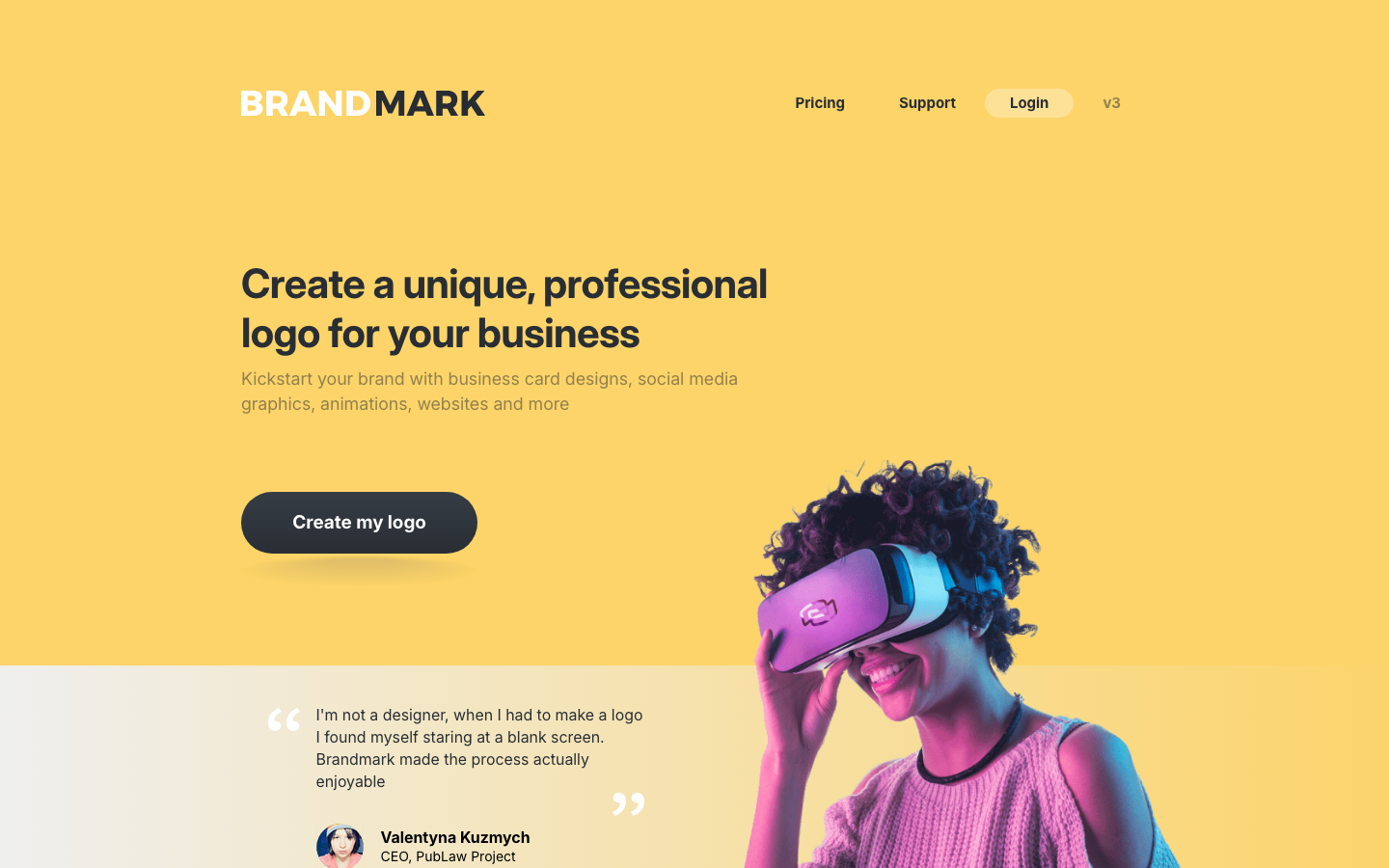
Brandmark
Brandmark’s core parameters and statistics
Brandmark is an AI logo and brand visual generation tool for non-designers. It is positioned between an "automated logo generator" and a "lightweight brand asset management platform". It does not provide Photoshop-level pixel-level editing, nor does it do Canva-style general graphic design. Instead, it focuses on the narrow but high-frequency demand of "quick implementation of brand vision from 0 to 1."
| Projects | Public Information |
|---|---|
| Product positioning | AI Logo and brand visual generation |
| Entry form | Web (including v3 version entrance app.brandmark.io/v3/) |
| Target users | Entrepreneurial teams, small and medium-sized enterprises, operations and marketing personnel with non-design background |
| Core output | Logo source files, brand guidelines, color schemes, font matching, business cards, social media materials, one-page website, presentations, invoice templates, animation design |
| Generation method | Enter the brand name and keywords, and AI will generate multiple sets of candidate solutions, supporting manual fine-tuning |
| Price model | Buyout system (Basic $35 / Designer $95 / Enterprise $195, one-time payment) |
| Copyright Terms | Full copyright coverage for commercial and personal projects, no subsequent monthly fees |
| Free Tools | AI Color Wheel Logo Rating Logo Compression, Font Pairing Generator |
| Export formats | SVG, PNG, PDF |
| Home | US |
Speciality of the pricing model: Brandmark adopts a "one-time buyout" rather than a monthly subscription, which is relatively rare in the SaaS design tool market. For budget-conscious early stage teams, this structure means upfront costs are predictable and there are no hidden costs of “forgot to cancel your subscription.” However, the price of the buyout system is that subsequent major version upgrades (such as migrating from the current Web version to the v3 architecture) may require separate payment, which needs to be confirmed before purchasing.
Brandmark’s users and market recognition
Market Coverage: The official website claims to serve "millions of users", but does not disclose the specific number of registrations, number of paying customers or NPS score. Judging from the customer cases displayed on the official website (including small and medium-sized institutions such as PubLaw Project), its core customer groups are concentrated in early-stage startups and small organizations. The product is frequently included in tool directory sites such as Product Hunt and Alternativeto, indicating that it is a top candidate under the segmentation tag of "AI Logo Generation".
Industry Benchmarking: Compared with similar tools such as Looka (formerly Logojoy), Hatchful (Shopify), Tailor Brands, etc., Brandmark’s differentiation lies in the commitment of buyout pricing and “one-time payment and permanent use”, rather than the breadth of functions. Its competitive barriers do not come from the AI model itself (the technical threshold for Logo generation models is not high), but from the accumulation of brand material template libraries - the official website displays a large number of preset fonts, icons and layout templates. The coverage and style diversity of these materials determine the usability of the output.
Community and Ecosystem: Brandmark does not have an independent community forum or public API ecosystem. User interaction occurs primarily through email support ([email protected]). This “light service” model is consistent with its pricing strategy—the low-price buyout system cannot support large-scale community operations or customized customer service.
Brandmark’s Cost Advantage
Brandmark's cost structure is unique in the "Logo and brand visual generation" category. The core lies in the long-term cost predictability brought about by the buyout system instead of the subscription system.
C-side/individual users: The Basic plan ($35 one-time) can get logo files in PNG and vector formats. For side projects or personal brands that only need a usable logo, this is more cost-effective than hiring a designer (usually $500-$2000/project) or subscribing to Canva Pro ($12.99/month). However, if the user needs to continuously produce multiple sets of brand materials, the marginal value of the Designer plan ($95)’s brand guide, business cards, and social media material templates will quickly exceed that of Basic.
Freelance Designer/Small Studio: The Designer plan ($95) is a fraction of the price of a client project quote, but can produce a full set of deliverables such as a brand guide, one-page website, business cards, presentations, and more. For designers who need to quickly produce concept drafts in the early stages of receiving orders, Brandmark can be used as a "first draft generator" to reduce the time cost during the window period.
Enterprises and Institutions: The Enterprise plan ($195) includes access to downloads of up to 10 completely original handmade concept drafts and fonts, suitable for medium-sized companies that need to make decisions between multiple brand directions. But to be clear, Brandmark's Enterprise is not an "enterprise-level brand management system" - it does not provide team collaboration, brand asset management (DAM), permission classification or approval processes. If the enterprise's need is a brand management platform for multi-person collaboration, professional DAM tools such as Frontify or Bynder are the benchmark categories.
Hidden costs: Under the buyout system, the migration costs of subsequent version upgrades (such as switching from the current product to the v3 architecture) need to be confirmed separately. In addition, Brandmark’s template and font libraries are closed—users cannot access third-party material libraries like they can in Canva, which means that the scalability of brand assets is limited by the frequency of updates to the official template library.
Brandmark’s main features
Brandmark's functions are designed around "the complete link of brand vision from generation to delivery" rather than a single Logo production. The following five capability lines constitute its product skeleton:
-
Keyword-driven Logo Intelligent Generation: Input a brand name and several descriptors, and AI will match graphics, fonts and color combinations in the internal template library and output multiple sets of candidate solutions. This is not "generating from scratch", but combinatorial optimization within the preset design system - this means that the lower limit of the output is guaranteed (no weird unusable graphics will appear), but the upper limit is limited by the coverage of the template library.
-
Brand Visual System Expansion: After selecting the logo, it can be extended with one click into brand guides (color matching, font specifications), business cards, social media avatars and covers, one-page website, presentations, invoice templates and product mockups. This chain generation mechanism of "once setting, global application" is the core difference between Brandmark and pure Logo generators - it reduces the brand consistency problem from "manual item-by-item maintenance" to "automatic derivation with one configuration".
-
AI-assisted color matching and font tools: The official website independently provides four free tools - AI color wheel (automatic color matching of graphics), Logo Rank (objective scoring of existing logos), Logo Crunch (generating multi-resolution logo packages), and font generator (providing font pairing suggestions). Although these tools are not tied to paid plans, their actual role is to reduce the decision-making friction for users to enter paid plans - after users experience the effect of AI color matching in free tools, they are more likely to pay for the complete brand package.
-
Unlimited modifications and after-sales fine-tuning: The official website promises that the logo can still be modified unlimited times after purchase, and the official website provides free manual fine-tuning services. This is a key design to reduce purchasing anxiety under the buyout system - users do not have to worry about a one-time decision-making error that will lead to irreversibility.
-
Multi-format export and cross-scenario delivery: Supports three mainstream formats: SVG (vector scalable), PNG (bitmap) and PDF (printing), covering common scenarios such as websites, social media, print and mobile icons.
Hidden linkage: The real product power of Brandmark does not lie in the quality of a single logo generation, but in the coherence of the link "selected logo → automatically derive a full set of brand materials → export in multiple formats → unlimited subsequent modifications". Users do not need to repeatedly export and import between the logo generator Canva and brand guide templates, which reduces the context break cost of switching between tools.
Brandmark model and version evolution
Brandmark is not a model-driven product (such as Midjourney or DALL·E). Its product iterations focus on updating web front-end functions and template libraries, rather than upgrading the underlying model version.
Mainline version
| Version ID | Description | Time |
|---|---|---|
| Brandmark Web (current mainline) | Stable version running on the official website brandmark.io | Continuous updates |
| Brandmark v3 | Independent entrance app.brandmark.io/v3/, may be the next generation UI or feature preview line | Online but no release date |
Version disclosure status
The official website does not provide a standardized version release log or changelog. The existence of the v3 portal implies that the team is developing the next-generation product architecture in parallel, but the functional differences, migration paths, and data compatibility between the two have not been made public. For users who need to rely on Brandmark to export brand assets for a long time, it is recommended to confirm whether v3 includes additional costs or needs to be repurchased before purchasing.
Brandmark’s technical advantages
Mechanism → Effect → Scene: Brandmark’s technical implementation is not “using a diffusion model to generate a logo”, but “combination search and optimization within a preset design system”. The role of AI is matching - mapping the keywords entered by the user into the arrangement and combination of icons, fonts, colors and layouts, and then the rules engine ensures the visual consistency of the output (basic design rules such as contrast, white space, hierarchy, etc.).
Why this is important to target users: The problem with pure AI generation (such as using DALL·E to generate Logo) is that it is uncontrollable - the style of the results generated each time jumps greatly, and there is no guarantee that the output is suitable for printing or scaled to a small size. Although Brandmark's template constraint method sacrifices creative freedom, it gains the certainty that "every output is a usable brand asset." For non-designer users, certainty is more valuable than wild ideas.
Engineering Feature: Brandmark's editor completes all operations within the browser, without downloading software. Vectorized output (SVG) means the logo can be scaled from a website favicon (16x16) to outdoor billboard dimensions with fidelity. For teams without the Adobe suite, this is the shortest path from zero to working brand assets.
How to use Brandmark
The process for using Brandmark is highly linear, typically completed within 10-30 minutes from input to delivery:
- Input brand direction: Enter the brand name and 2-3 descriptors (such as "technology, simplicity, security") on the official website homepage or chat.brandmark.io/generate, and AI will generate multiple sets of candidate logos in a few seconds.
- Screening and fine-tuning: Browse candidate solutions, select your preferred direction and enter the editor. You can adjust parameters such as icons, fonts, color matching, and layout. The editor supports real-time preview, and modifications take effect immediately.
- Brand Asset Expansion: After confirming the logo, you can optionally add extended content such as brand guides, business cards, and social media materials. Designer and Enterprise plans include a full set of branded material templates.
- Export and Delivery: Select SVG/PNG/PDF format to export. Logo source files are only included in Designer and above plans.
- Subsequent modifications: After purchase, you can still enter the editor to modify at any time by logging in with your account, without additional payment.
Portal Diversity: Brandmark currently only provides a web portal, and there is no native desktop or mobile app. The official website mentions "mobile version available", which actually refers to mobile browser adaptation, not a stand-alone app. For teams that need to edit offline or frequently operate on their phones, this is a limitation that needs to be evaluated.
Brandmark Product Pricing
Brandmark adopts a one-time buyout three-tier pricing structure with no monthly or annual fees, which is unique in the design tool market:
| Plan | Price (one-time) | Core benefits |
|---|---|---|
| Basic | $35 | Logo file (PNG + vector format) |
| Designer | $95 | Logo source file + unlimited modifications + brand guidelines + one-page website + business cards + social media assets + presentations |
| Enterprise | $195 | Designer full set + up to 10 original handmade concept drafts + font download |
Free Strategy: Brandmark allows users to generate unlimited logo previews for free without registering an account. You only need to pay when exporting high-resolution files or using paid material packages. This “try before you buy” model effectively lowers the threshold for first-time use.
Cost comparison deduction: Take an early-stage entrepreneurial team that needs logo + business card + social media materials as an example. Hiring a designer costs about $500-$2000 (mid-market), Canva Pro subscription $12.99/month ($155.88 a year), Brandmark Designer $95 one-time. If the team's brand material needs do not change frequently within 12 months, Brandmark's cost advantage is obvious; but if the brand needs to change the visual style every quarter (such as FMCG marketing activities), the flexibility of the subscription tool is more suitable.
Application scenarios of Brandmark
The value of Brandmark is most obvious in the following three types of scenarios:
-
Entrepreneurial Brand Cold Start: From company registration to the launch of the official website, social media accounts, and business card printing, it usually takes 2-4 weeks for the design cycle. Brandmark condenses this process into 1-2 days, with no need to wait for a designer to schedule. The benefit lies not only in shortened time, but also in the product thinking of "first have a usable brand image and then iterate" - there is no need to pursue the perfection of the first version in terms of brand vision, but to quickly go online to verify market feedback.
-
Brand upgrade for small and medium-sized enterprises: When existing enterprises update their logos and unify their visual language, Brandmark's "Brand Guide" function allows non-design teams to maintain brand consistency. The actual benefits are reflected in the efficiency of marketing material output - from "finding a designer to change the template" to "changing the color value in the editor", the time is shortened from 2-3 days to 1-2 hours.
-
Marketing Activities and Social Media Operations: For operations teams that need to frequently change social media avatars, cover images, and event posters according to event themes, Brandmark's template derivation capability makes it possible to "adapt a set of brand visuals to N events." However, it should be noted that Brandmark’s templates are more focused on basic brand materials rather than event thematic pages or complex composite images – the in-depth visual needs of high-frequency events may still require Canva or Figma.
Applicable groups of Brandmark
-
Entrepreneurs and Micro Teams: Need to quickly establish a brand vision but have limited budget (within $100) and no professional design background. Brandmark's buyout system and low operating threshold are the core matching points. Unsuitable situations: Brand visuals that require high differentiation and strong industry attributes (such as medical and legal). These scenarios require the industry insight and originality of professional designers.
-
Marketing and Operations Staff: Need to produce social media materials consistent with the brand at high frequency, but the proficiency in design tools is not high. Brandmark's "set once and apply globally" mechanism can reduce duplication of work across tools. Prerequisites to note: The initial version of the brand vision needs to be determined by Brandmark, and subsequent materials will be derived around this baseline. If the brand vision itself is still in the stage of frequent changes, Brandmark's template derivation may actually amplify the inconsistency.
-
Freelance designers and small studios: Brandmark can be used as a first draft generator - quickly generate multiple concept directions for customers to choose, and then manually deepen in the selected direction. This collaborative model of "AI first draft + manual refinement" can significantly reduce the time investment in the proposal stage (from 2-3 days to 2-3 hours). But the boundaries need to be clear: Brandmark’s material library copyright is granted to users, and designers cannot resell Brandmark’s templates or icons as “original materials” to multiple customers.
Not suitable for boundaries: Brandmark is not suitable for the following groups - large enterprises that require a fully customized brand strategy system (requiring in-depth intervention of a brand consulting company); scenarios that require complex vector illustrations or highly original graphic design (Brandmark is a combination rather than a creation); teams that require team collaboration and a brand asset management platform (Brandmark is a single-person tool); companies that have strict compliance requirements for font copyrights (the commercial scope of preset fonts needs to be confirmed item by item).
Summary and Outlook
Brandmark's core competitiveness lies in the combination of "buyout system + one-click derivation of full-brand materials", which reduces the entry-level cost of brand vision from thousands of dollars and weeks to tens of dollars and hours. It’s not the most flexible, nor the most original design tool, but for early-stage teams that “just need a decent and consistent brand identity,” it’s one of the highest ROI options on the market right now.
Current limitations: The product form is single (Web only), without team collaboration and version management functions; the coverage of the template library determines the upper limit of the output style; the version iteration path is opaque (the relationship between v3 and the main line is not disclosed); major upgrade and migration costs under the buyout system need to be confirmed before purchase.
Procurement and Adoption Risk Assessment: In a single brand or single activity scenario, it is recommended to first verify whether the template style meets expectations with the $35 Basic plan, and then upgrade to the $95 Designer to obtain a full set of brand materials. Before an enterprise purchases an Enterprise solution, it is important to verify: whether the commercial authorization scope of the preset fonts covers the industry and channel; whether subsequent version upgrades (such as v3) require additional fees; whether brand materials can be exported to standard formats (SVG/PDF) to support cross-platform reuse and avoid being locked by a single tool. For teams that already have a Figma/Adobe workflow, Brandmark is more suitable as an auxiliary tool in the first draft stage of the brand, rather than replacing the existing design pipeline.
Related tools:  Midjourney, stable-diffusion
Version Info
- Brandmark Web Latest :The official website is continuously updated, and there is currently no official precise version number and release date.
- Brandmark Web Previous Milestone :There is no official precise date yet, and the historical evolution is subject to the official real-time page.
User Reviews