 Brandwatch
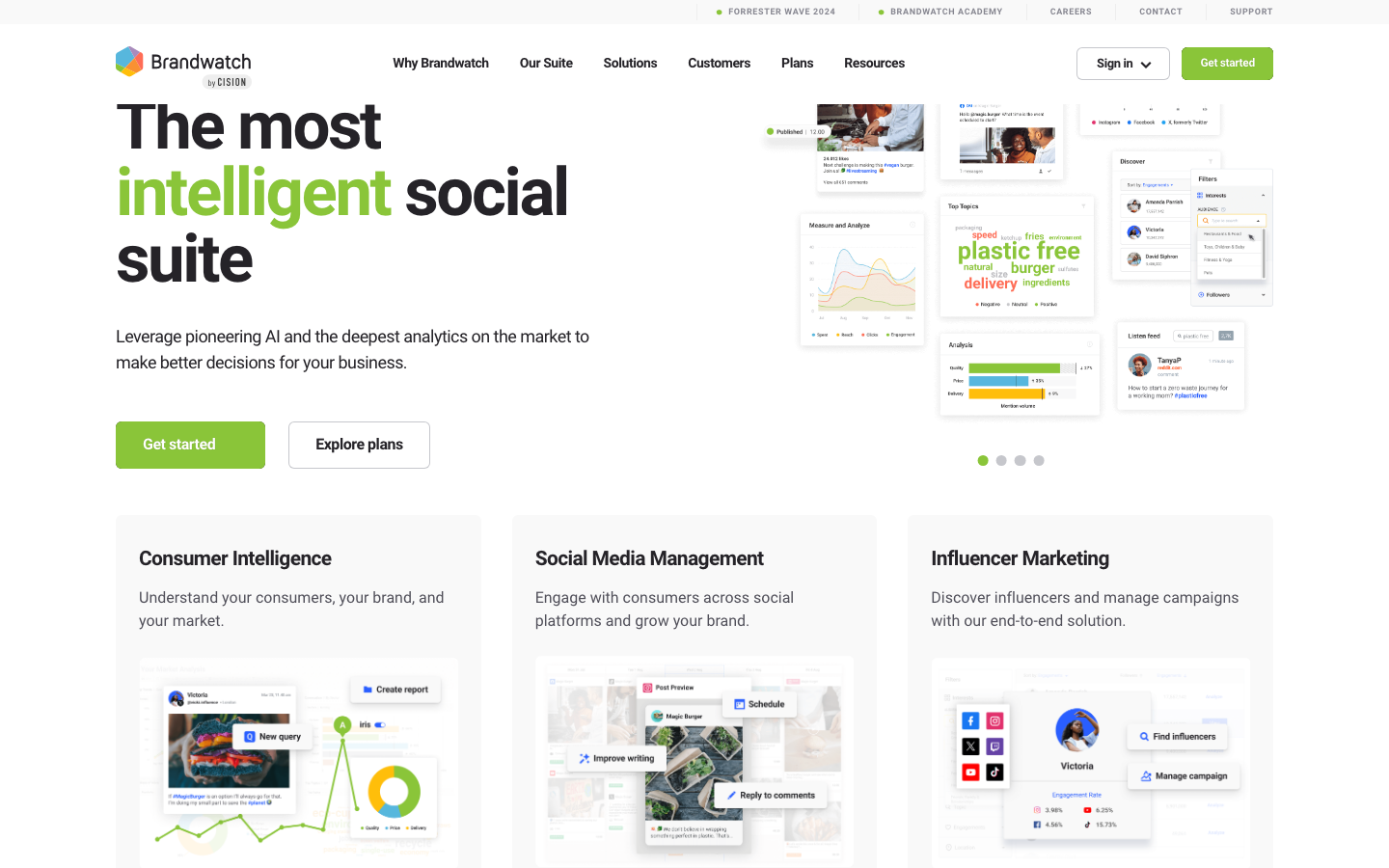
Brandwatch is a full-stack social media monitoring and consumer insight platform for enterprises. It tracks brand mentions in social media, news, forums and blogs in real time. It uses the AI-driven Iris intelligence engine to complete sentiment analysis, image recognition, topic clustering and trend prediction, providing data-driven decision-making basis for public relations, marketing and market research teams.
Brandwatch
Core parameters and statistics
| Parameter items | Data |
|---|---|
| Product positioning | Enterprise-level social media monitoring and consumer insights (full-stack suite) |
| Core form | SaaS web client, providing API access |
| Product Suite | Consumer Intelligence, Social Media Management, Influencer Marketing, Media Intelligence, Search Intelligence |
| Data coverage | 100M+ independent sites, billions of data sources |
| Historical data volume | 1.7 trillion conversations (back to 2010) |
| New daily | 501 million new conversations |
| Languages covered | 30+ languages |
| Enterprise customers | 2000+ |
| AI engine | Iris (self-developed LLM + traditional NLP hybrid architecture) |
| Latest version | 2026.07 (monthly rolling update) |
| Pricing model | Subscription-based, business pricing, no public price |
| Free plan | None (only free demo available) |
Brandwatch’s core data infrastructure is its deepest moat in social media listening. It has official firehose direct connection permissions for Twitter and Tumblr, which is a data advantage that most competing products do not have. The 1.7 trillion historical conversations and the daily intake of 500 million new ones mean that the time span and sample density of public opinion analysis are in the first echelon among similar products. Data sources cover everything from mainstream social networks (X/Twitter, Facebook, Instagram, LinkedIn, YouTube, Reddit) to emerging platforms (Threads, Bluesky), to broadcasts, news, blogs and forums, forming a true "omni-channel monitoring surface". However, it should be noted that the coverage rate of Chinese social media (WeChat, Weibo, Douyin, Xiaohongshu) is significantly lower than that of English platforms. This is a core shortcoming in the non-English market, and localization verification must be done through demo before purchasing.
Brandwatch’s users and market recognition
Industry status: Brandwatch has been listed as a leader quadrant product in the field of social media monitoring by Gartner, Forrester and other analysis agencies for many years in a row. Its "Consumer Intelligence" product is officially positioned as the "#1 consumer intelligence platform" - although this statement has a marketing component, its data coverage scale and enterprise customer base do have leading competitiveness in the market segment.
Customer structure: The number of officially disclosed corporate customers is 2,000+, covering the world's top 500 brands and leading agents. Public examples include Spinnin' Records (using social monitoring to discover emerging artists and guide marketing campaigns), Omni Hotels & Resorts (increasing reach by 50% with Brandwatch social media management), and Franco Communications Group (using Brandwatch suite to scale account management). These cases cover consumer goods, entertainment, hotels, medical, non-profit and other industries, indicating that the platform has been verified in different vertical fields.
Ecosystem and Partners: Brandwatch has established a strategic cooperation with Google Cloud on Gemini AI to integrate Gemini models into the platform to enhance conversational analysis and video content understanding. As part of Cision Group, Brandwatch can also call Cision's media database and PR Newswire's news distribution network to form a "social listening + news monitoring + media relations" partnership. This ecological integration is a structural advantage that is difficult for competing products such as Talkwalker and Meltwater to replicate.
Market limitations: The product positioning is clear and targeted at medium and large enterprises, but the SMB market coverage is weak. Although the ratings on user evaluation platforms such as G2 are generally positive, small and medium-sized users generally report that the learning curve is steep and the minimum purchase threshold is too high. There is no public NPS or third-party satisfaction quantification data.
Brandwatch’s cost advantage
C-side/Personal Cost: Brandwatch does not offer a personal version or free plan. All features are only available through enterprise subscriptions, and individual researchers, freelancers, and small entrepreneurial teams are effectively excluded from the target user group. Alternatives on the market include Google Alerts (free but very weak), Talkwalker Free Plan (free version but limited data), and Meltwater (both enterprise-level and priced similarly). For individual users, the price/performance ratio of Brandwatch is almost zero.
Developer/API Cost: Brandwatch offers an API interface, but again no public pricing. API call quotas, rate limits, and data ranges need to be clearly agreed in the business contract. The API layer integrated with Cision supports cross-querying social data with media coverage data, but this capability is typically only available at the Suite level. For development teams that only need data flow, the cost of Brandwatch API is much higher than directly using native interfaces such as Twitter/X API v2, but it saves the engineering investment of building a self-built NLP pipeline in terms of data cleaning, emotional annotation and structured output.
Enterprise/Team Cost: This is Brandwatch’s core billing scenario. Pricing is based on three variables: Mentions Volume, number of data sources, and user seats. Since there is no public price, corporate purchases must go through sales demonstration and business negotiation. Hidden costs mainly include: data overage fees (exceeding quotas are billed on a pay-as-you-go basis, and the unit price is opaque), additional fees for advanced AI functions (such as the Iris AI deep analysis module that may require separate licensing), and additional fees bundled with the Cision suite. Compared with competing products, Brandwatch's TCO (total cost of ownership) is generally higher than Talkwalker's for the same data scale, but lower than Meltwater's high-end solutions. It is recommended to lock in a quota growth rate of 12-24 months in the procurement contract to avoid out-of-control bills due to excess expenses after business expansion.
Key Features of Brandwatch
-
Omni-channel brand mention monitoring: Define monitoring topics through Boolean Query, and capture brand/product/industry keyword mentions in social media, news, forums, blogs, broadcasts and comment areas in real time. Brandwatch's query syntax is known for its flexibility in the industry and supports multiple levels of nesting and exclusion conditions, but the learning threshold is correspondingly high. The AI Query Writer launched in 2025 allows users to describe requirements in natural language, and AI automatically generates Boolean query strings, significantly reducing the configuration cost for new users.
-
Iris AI Intelligent Analysis Engine: This is Brandwatch’s core AI capability matrix, which contains five sub-modules:
- Sentiment Analysis: Automatically classify mentions as positive/negative/neutral, support viewing trend changes along a timeline, and refine the emotional fluctuations of specific topic dimensions.
- Image Analysis: Automatically detect objects, scenes, actions and brand logos in pictures. After the Iris 2.0 upgrade in 2024, the recognition accuracy will be greatly improved, and it can identify the exposure of competing product logos in the background of the photo.
- Auto Segmentation: Machine learning automatically clusters mention data according to preset classification standards, replacing manual annotation.
- Dashboard Summaries: When a user logs into a dashboard, Iris automatically generates AI summaries across all charts to quickly locate key insights.
- Ask Iris Quick Search: Natural language question-and-answer search. Users directly query data with spoken questions. AI automatically constructs queries, analyzes content and returns answers, supporting questioning interaction.
-
Audience Profiling and KOL Discovery: Analyze mentioner demographics, interest tags, influence scores, and audience overlap. The Influencer Marketing module has a built-in database of 30 million+ creators, supports screening of potential partners by topics, volume, influence and other dimensions, and provides full-link Campaign management.
-
Competitive Benchmarking Panel: Compare the social volume, emotional trends, and topic distribution of the brand and competing products side by side, and supports custom benchmarking cycles and dimensions. It can identify the paid promotion content of competing products (Promoted Post Detection, new in 2026), and distinguish between natural voice volume and paid voice volume.
-
Vizia real-time visualization on large screens: Project data panels onto office large screens or digital signs, supporting tracking of viewer interaction rates and report scores. Suitable for enterprise internal data culture construction and cross-department visibility needs.
-
Automated reports and alerts: Automatically generate public opinion reports on a daily/weekly/monthly basis, and the output format supports Excel, PPT, PDF and API push. After setting keyword trigger conditions, AI can automatically send real-time alerts to stakeholders via email (AI-driven alert prioritization new in 2026).
Brandwatch model and version evolution
Brandwatch adopts a "monthly rolling release" SaaS update rhythm, with non-semantic version numbers (such as 2026.07 representing a July 2026 release). The following are the key milestones in the past three years:
Mainline 2024: AI infrastructure upgrade
- 2024.03 (Iris 2.0): A major upgrade in AI image recognition capabilities, extending from only supporting text analysis to multi-modality. Signed the Gemini cooperation framework with Google Cloud to initiate joint research and development of next-generation AI capabilities.
- 2024.09: Launched AI-driven Auto Segmentation to automate the traditional manual labeling process; supports Bluesky data source access.
Main line in 2025: AI productization and Cision integration
- 2025.06: Launched AI Query Writer (natural language → Boolean query); Threads data source is online; Dashboard Summaries enter Beta.
- 2025.11: Deeply integrate the Cision media database to achieve a unified view of "social monitoring + news monitoring"; Dashboard Summaries is officially GA; the Earned Media Value (EMV) evaluation model is launched.
2026 Main Line: Conversational AI and Omni-Channel Coverage
- 2026.03: Ask Iris Quick Search is officially released, supporting natural language question and answer analysis; TikTok Mentions reply function is online.
- 2026.07 (current): Sentiment analysis accuracy is enhanced, multi-language topic clustering capabilities are expanded; Gemini-driven video content analysis enters the preview stage; web accessibility reaches WCAG 2.2 standards.
The core logic of version evolution is to shift from "tool platform" to "AI partner": establish AI infrastructure in 2024, productize AI capabilities into specific functions in 2025, and achieve conversational interaction in 2026. The implication of this roadmap for purchasers is that contracts before 2024 may not include the current AI function module. When renewing or upgrading, it is necessary to confirm whether the authorization of the AI function is covered in the existing contract.
Brandwatch’s technical advantages
Data ingestion and processing pipeline: Brandwatch has official firehose direct connections to Twitter and Tumblr, which is a data pipeline advantage that most competing products do not have. Firehose means 100% of the full data inflow, not a subset after API sampling or keyword filtering. Coupled with the daily incremental processing capacity of 500 million items, Brandwatch has established structural barriers in the two dimensions of "real-time" and "data integrity". However, this advantage is mainly limited to the English market - firehose-level data access on the Chinese platform is almost impossible to achieve due to domestic policies.
AI architecture: self-developed LLM + traditional NLP hybrid: Brandwatch’s AI engine Iris is not a pure LLM solution, but combines a self-developed large language model with traditional NLP classifiers (used for sentiment analysis and entity recognition). The advantage of this hybrid architecture is that high-frequency deterministic tasks such as sentiment analysis are performed by lightweight classifiers with low latency and controllable costs; while semantic understanding tasks such as content summarization and natural language queries are handled by LLM. Iris's training data is based on 17 years of accumulated social corpus, which makes its domain adaptability in the brand/product dimension better than general LLM.
Technical implementation of image analysis: Iris' image recognition module uses a multi-modal model to detect brand logos, products, scenes and actions in pictures. Its unique value lies in "cross-image brand association analysis": automatically discovering that users have inadvertently brought in competing product logos in Instagram photos, thereby helping brands quantify "passive exposure" scenarios. This function is particularly useful in industries such as FMCG and fashion 3C.
Project pitfalls and architectural limitations:
- Query Complexity vs. Performance Tradeoff: Complex Boolean queries (more than 50 conditions nested) can significantly increase retrieval latency. Optimization suggestion: Split large-scale queries into multiple subqueries, use Brandwatch's query grouping function to retrieve in parallel and then merge the results.
- Accuracy attenuation of non-English sentiment analysis: Officially claims to support 30+ languages, but the accuracy of the sentiment analysis model on non-Indo-European languages such as Chinese and Arabic is 15-20% lower than English. It is recommended that non-English users do secondary calibration by uploading custom training data or using the platform’s built-in Micro-Classifiers.
- Massive data export bottleneck: When the number of mentions exceeds tens of millions, the speed of exporting through the UI drops significantly. It is recommended to use the API interface for high-frequency export scenarios and set up segmented export windows (segmented by day/week).
How to use Brandwatch
Access and use of Brandwatch is divided into three levels:
1. Web-side full-featured platform: Apply for demo through the official website and then the sales team will open it. The typical usage process is: configure query (Boolean query or AI Query Writer natural language input) → select data source and time range → enter the dashboard to view analysis → set alerts or generate reports. New users are advised to first complete Brandwatch Academy’s free certification course, which provides structured training from basic querying to advanced analysis.
2. API integration: Brandwatch APIs provide RESTful interfaces to support data query, dashboard management and report automation. API authentication uses the OAuth 2.0 process, and endpoints include query execution, mention retrieval, sentiment aggregation, etc. Specific access needs to specify API quotas and rate limits in the contract. A typical integration scenario is to import Brandwatch data into an in-house BI system (Tableau, Power BI) or CRM (Salesforce).
3. Cision Suite Bundle: Brandwatch’s social data, Cision’s media database and PR Newswire’s news distribution can be managed simultaneously through the Cision unified platform. Suitable for public relations teams that have purchased the Cision ecosystem, it can realize single sign-on and unified billing of "social monitoring → news monitoring → media relations management".
In terms of entry barriers, Brandwatch requires all users to go through a sales process - there is no self-service registration channel. This means it typically takes 1-3 weeks from initial contact to gaining actual access. It is recommended to clarify the list of data sources (especially non-English sources) and the upper limit of user seats during the Demo stage to avoid discovering that the coverage does not match business needs after the POC.
Product Pricing by Brandwatch
| Plan level | Applicable objects | Pricing model | Core capabilities | Description |
|---|---|---|---|---|
| Consumer Intelligence | Market research/analysis team | Business pricing (based on mentions + seats) | Full social monitoring Iris AI analysis, custom dashboards, automatic reports | Basic core products |
| Social Media Management | Social media operations team | Business pricing (based on number of channels + seats) | Multi-channel management, content calendar, social CRM, brand monitoring | Usually bundled with Consumer Intel |
| Influencer Marketing | Influencer Marketing Team | Commercial Pricing (based on Campaign Number) | 30M+ Creator Library, Discovery & Management Campaign Reports | Can be purchased independently |
| Suite | Full Stack Brand Team | Commercial Pricing (Annual Contract) | All of the Above + Cision Media Database + PR Newswire | Premium Bundle |
| API | Development team | Business pricing (based on call volume) | Data query API, report automation | Additional API agreement required |
Standard prices are not disclosed for all plans, and sales must be contacted to obtain a quote. Key variables in pricing include: mention volume quota (Mentions Volume), number of user seats, data source coverage (global vs. single region), and whether advanced AI capabilities are included (Iris deep analysis modules may be licensed separately). Implicit cost reminder: The pay-as-you-go unit price that exceeds the quota is usually higher than the unit price in the package; if the annual quota increase in a multi-year contract is not agreed in advance, you may face a significant price increase when renewing the contract in the second year. It is recommended to include "annual quota increase by X%" and "excess rate cap" clauses in the contract.
Application scenarios of Brandwatch
-
Real-time warning of brand crisis: When the amount of negative mentions detected on social media exceeds the preset threshold within 1 hour, AI automatically triggers a graded alert (general/serious/urgent) and notifies the public relations team via Slack email or Webhook. With the Image Insights function, negative image content with brand logos can also be detected. Typical Benefits: Crisis response time shortened from hours to minutes. Key points of verification: Whether the coverage of the Chinese platform meets localization requirements; the false alarm rate of alarms is within the acceptable range (it is recommended to tune the threshold in the POC stage).
-
Continuous tracking of competitive product dynamics: Set up competing product brand queries, and periodically compare the social volume, emotional tendencies, topic popularity and audience overlap between your own and competing products. New in 2026, Promoted Post Detection allows teams to differentiate between competing products’ organic content and paid promotion strategies. Typical benefits: Weekly competitive product reporting is reduced from 3 man-days to 2 hours (deduced value, unofficial commitment). Key points of verification: Within what range is the refresh delay of the competitive product comparison panel controlled?
-
New product launch ROI evaluation: Set monitoring queries before and after product release to collect the discussion popularity, user sentiment curve and key topic distribution about new products on social media. First-party sales data can be overlaid and analyzed with social trends through CSV upload to identify the correlation between social volume and sales conversion. Typical benefits: The marketing team can quantify the link of "peak social volume → official website traffic → additional purchase conversion" to guide the next round of release strategies.
-
Influencer Campaign full-link management: Discover KOLs that match the brand's tonality from a library of 30 million+ creators, communicate and cooperate through the built-in Messaging Module, and track mentions, sentiment changes, and Earned Media Value (EMV) during the campaign. Typical Benefits: Influencer screening time reduced from manual hours to AI-recommended minutes. Verification focus: The coverage quality and activity of the Chinese area KOL database.
-
Media intelligence and PR effect quantification: Integrate Brandwatch social data and Cision media database to quantify the amount of discussion, emotional tendency and communication chain triggered by a press release on social media after it is released. Suitable for public relations teams who need to report "media investment ROI" to senior management.
Applicable groups of Brandwatch
-
Brand/Public Relations Director: A senior management team that needs 24x7 public opinion monitoring and crisis warning. Brandwatch's real-time alerts and Vizia's large visualization screen can help management sense changes in public opinion immediately. Not suitable for boundaries: If the team only operates with 1-2 people and the budget is limited, the procurement cost and operation and maintenance effort of Brandwatch may exceed the actual benefits. It is recommended to consider Google Alerts + basic social platform native analysis first.
-
Market Research Analyst: A research team that needs to regularly produce competitive product analysis and industry trend reports. Brandwatch’s historical data (going back to 2010) and flexible query syntax are a powerful tool for comparing long-term trends. Prerequisite: You need to have the basic ability of Boolean query, or be willing to invest time in learning AI Query Writer.
-
Social Media Operations Manager: The operation team responsible for the daily release of multi-platform brand accounts, community interaction and effect reporting. The Social Media Management module provides a unified content calendar and social CRM, but the operational support for Chinese platforms (such as direct publishing on WeChat and Douyin) is still very limited. Domestic social media operation teams need to evaluate carefully.
-
Influencer Marketing Manager: A team that needs to screen and manage KOL collaborations at scale. The coverage of the 30 million+ creator database is deep enough in English-speaking markets, but the degree of localization in Asia-Pacific and Latin American markets is uneven. Not suitable for the boundary: If influencer marketing is mainly oriented to the Chinese Xiaohongshu/Douyin ecosystem, domestic local tools such as Meizhi and Cicada Mama may be more suitable.
-
Data & Analytics Team: The technical team that needs to import social data into internal BI systems. The Brandwatch API provides standardized data output, but quotas and frequency control limits need to be specified at the contract stage. Not suitable for boundaries: If you only need raw data streams without cleaning and emotional annotation, it may be more cost-effective to directly use the native API of the social platform.
Summary and Outlook
Brandwatch's core competitiveness lies in the triple combination of "data scale × AI depth × ecological breadth": 1.7 trillion pieces of historical data, the self-developed Iris AI engine (covering 5 sub-modules), and the media database and news distribution capabilities brought by Cision Group, making it the top position in the enterprise-level social media monitoring market. The product has evolved from a single social monitoring tool to a full-stack suite covering "monitoring → management → marketing → analysis".
Current Limitations and Uncertainties:
- Pricing is completely opaque, and procurement requires business negotiation, which is a significant cost for teams that need to compare prices quickly.
- Chinese and Asia-Pacific social platforms have insufficient coverage, and the data availability of WeChat, Weibo, Douyin, and Xiaohongshu is far lower than that of English platforms.
- The lack of a free plan means that a sufficient POC cannot be done before purchasing (relying only on sales-led demos).
- AI sentiment analysis has accuracy attenuation in non-English scenarios, and non-English users need to do additional model fine-tuning or calibration.
- The learning curve is steep, with Boolean query syntax and the platform’s deep capabilities taking weeks to master.
Procurement/Adoption Risk Assessment: Brandwatch has a strong lock-in effect - once the public opinion monitoring process is migrated to the platform, the switching cost includes data historical migration, query configuration reconstruction and team training investment. It is recommended to focus on verifying the following three items during the 2-3 month POC period: 1) Whether the data coverage of Chinese/target markets meets business needs; 2) Iris AI's sentiment analysis accuracy on specific industry terms; 3) Whether the quota growth model matches the business growth rate. The contract should clearly specify the data source list, mention quota, overage rate API call limit and service level agreement (SLA). For medium and large enterprises that clearly need cross-language social monitoring and unified analysis of news media, Brandwatch is still one of the most comprehensive and mature options on the market.
Related tools:  Notion AI, google-workspace
Version Info
- Brandwatch July 2026 Release :Enhanced AI sentiment analysis accuracy, added multi-language topic clustering and Ask Iris Quick Search natural language query functions
- Brandwatch 2025 End-Year :Integrate Cision media database to achieve a unified view of social and news monitoring; launch Dashboard Summaries AI summary function
- Brandwatch Mid-2025 :Launched the AI Query Writer Boolean query automatic generation function; launched Threads data source access
- Brandwatch Iris 2.0 :Upgraded AI-driven image recognition capabilities to support automatic detection of brand logos in images; Google Cloud Gemini cooperation project launched
User Reviews