 Braze
Braze
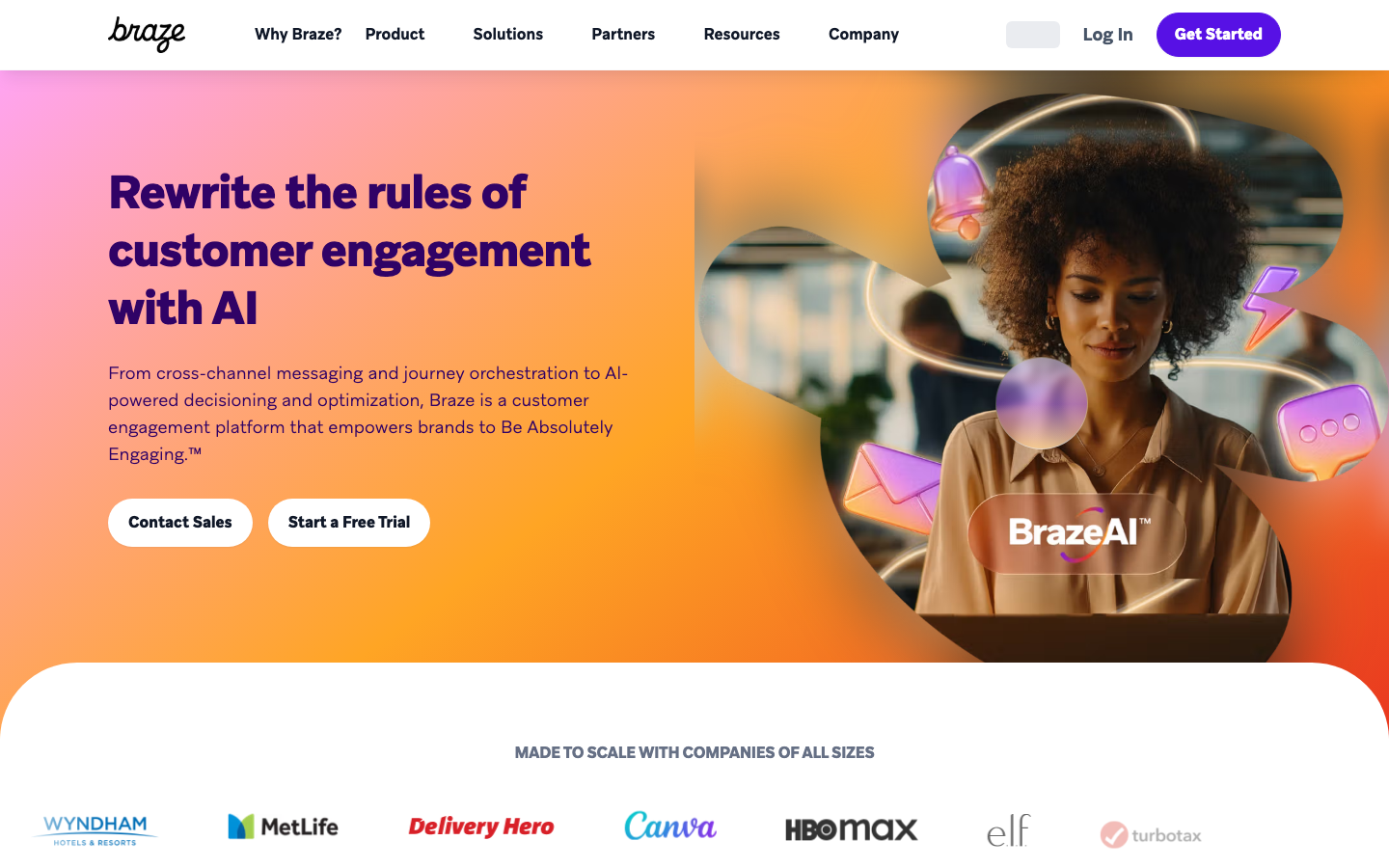
Braze is the world's leading enterprise-level Customer Engagement Platform, focusing on reaching users across channels through email, push notifications, in-app messages, SMS and webhooks. Known for its AI-driven personalization capabilities at scale.
Braze
Braze’s core parameters and statistics
Braze is the most mature representative of mobile capabilities among enterprise-level Customer Engagement Platform (CEP). The product is built around the three capability lines of "real-time event-driven + cross-channel orchestration + AI personalization" and continues to be in the Leaders quadrant in Gartner and Forrester's CEP assessments.
| Parameter items | Data |
|---|---|
| Product Positioning | Enterprise Customer Engagement Platform (CEP) |
| Core form | SaaS Web client + SDK (iOS/Android/Web) + REST API |
| Listing Information | NASDAQ: BRZE (November 2021) |
| Headquarters and employees | New York, USA, approximately 1,100+ people |
| Typical Customers | Disney+, HBO Max, Walmart, Uber, Lyft, Domino's, Sephora, BBC |
| Channel coverage | Email, push notification (iOS/Android/Web), in-app messaging, SMS/MMS, WhatsApp, Content Cards, Webhook, LINE, Roku |
| Real-time data processing | Kafka-based streaming engine, millisecond-level event processing |
| AI Engine | BrazeAI: Intelligent Timing, Intelligent Channel, Intelligent Selection, Predictive Suite |
| Data Export | Currents (real-time export to Snowflake, Redshift, BigQuery, Databricks) |
| Latest version | 2026.07 |
| Revenue scale (FY2025 public financial report) | About 590-620 million US dollars, a year-on-year increase of ~28% |
| Pricing model | Business subscription based on MAU + channel combination |
Real-time event processing is the underlying capability difference of Braze: When a user triggers events such as abandonment of the shopping cart, browsing the product details page, or completing registration within the app, Braze's streaming engine can complete the judgment within tens of milliseconds and perform orchestration actions across multiple channels such as email, push, and content cards within the SMS app. This ability is particularly critical during big promotion peaks and social fission scenarios - the user behavior window is narrow, and a delay of a few seconds may lead to the loss of conversion opportunities.
Ecological scalability: Through the Connected Content function, Braze can pull dynamic data from external APIs (product recommendations, weather, inventory, exchange rates) before sending messages, instead of being limited to existing fields within the platform. This makes Braze more flexible than competing products in industries with dispersed data sources such as e-commerce, tourism, and travel.
Positioning differences with competing products: Compared with Salesforce Marketing Cloud, which prefers email marketing, and HubSpot, which prefers inbound marketing for small and medium-sized enterprises, Braze's core strength is mobile-first high-frequency real-time interaction. Iterable is the closest competitor, but Braze leads in brand awareness and number of large customers on the market.
Braze’s users and market recognition
Braze's market recognition is mainly reflected in three dimensions: financial transparency of listed companies, adoption rate by top global brands, and continued recognition by analyst institutions.
Financial fundamentals of listed companies: According to Braze’s public financial report, FY2025 (as of January 2026) revenue will be approximately US$590-620 million, a year-on-year increase of approximately 25-30%. Subscription revenue accounts for more than 90%, and the net retention rate (NDR) remains in the 115-120% range - which means that the average spending of existing customers increases by 15-20% annually, indicating that Braze's value penetration among large customers continues to deepen. The gross profit margin is approximately 70%, which is at the upper-middle level in the SaaS industry.
Top Brand Adoption Density: Customer cases on Braze’s official website cover Disney+ (user lifecycle management), HBO Max (content recommendation and churn warning), Walmart (omni-channel promotion collaboration), Uber (city-level targeted push), Lyft (user tiered incentives), Domino’s (full link push from ordering to meal pickup), etc. The common characteristics of these cases are: high concurrency, high frequency, and cross-channel—a real-time interaction rhythm that traditional email marketing platforms cannot handle.
Analyst Recognition: Braze has been named a Leader in Gartner’s 2024 Magic Quadrant for Multichannel Marketing Hubs, as well as in the Leaders quadrant in the Forrester Wave Customer Engagement Platforms evaluation. The Forrester report singled out Braze's differentiators in mobile push, real-time personalization and AI capabilities, but noted that its email editor and marketing calendar features are not as feature-rich as traditional ESPs.
Community and Ecology: Braze officially operates the Bonfire community (bonfire.braze.com), with more than 100,000 registered users, and is an active user communication platform in the field of customer participation. The Forge Global User Conference is held every year, with more than 3,000 attendees in 2025. There are a large number of integration best practices and policy templates active in the community, which are of reference value for enterprise teams to build operating systems.
Braze’s cost advantage: three-tier cost structure and hidden bills
Braze doesn’t disclose standard pricing, but it can break down its three-tier cost structure from industry consensus and public financial information.
C-side/individual users: Braze is not sold to individual users, and individuals cannot purchase it directly. However, individual developers can experience the platform functions through Braze’s free Sandbox - Sandbox provides a free quota of about 100,000 MAU, which is suitable for technology evaluation and proof-of-concept (PoC) stages. Sandbox has many limitations: only basic channels, no BrazeAI function, and does not support Currents export. For technical verification purposes only and cannot be used in production environments.
Developer/API Integration Cost: Braze provides a REST API and SDK for integration. The API calls themselves are not billed, the cost is based entirely on MAU and channel consumption. This means that technology and labor costs are concentrated upfront - SDK integration typically requires 2-4 weeks of development time, extending to 4-8 weeks if custom event tracking and data mapping are required. For small and medium-sized development teams, the learning curve for integrating Braze is steep: the front end needs to handle SDK event callbacks, the back end needs to manage API frequency control (default 50,000 RPM), and the data team needs to maintain the Currents export pipeline. The man-day investment for overall integration is usually 40-80 man-days, which is approximately RMB 80,000-160,000 based on outsourcing development costs.
Enterprise/Business Pricing (Core Cost Segment): Braze’s pricing structure consists of three core variables:
- MAU base: The number of monthly active users, usually billed at 10-30% of the total (the platform distinguishes between "total number of users" and "reachable MAU"). The starting MAU of the Enterprise plan is usually more than 5 million, and the annual fee starts at about US$150,000-250,000.
- Channel Combination: Email, push notification, and WhatsApp SMS are priced separately by channel. SMS and WhatsApp channels have additional carrier costs. Additional channels usually require supplementary agreements during the contract period.
- Add-on modules: BrazeAI (prediction model + recommendation engine), Currents (data export) and Feature Flags are priced as add-on modules. The annual fee for BrazeAI Pro is approximately US$50,000-100,000.
| Cost Dimension | Growth Plan | Enterprise Plan |
|---|---|---|
| Annual fee starting reference | About 50,000-150,000 US dollars | Starting at about 150,000 US dollars, usually 250,000-500,000 US dollars |
| MAU benchmark | ~1-5 million | 5 million+ |
| Channel Coverage | Email + Push + In-App Messaging | Omni Channel + WhatsApp + Content Cards + LINE |
| BrazeAI capabilities | Basic version (intelligent time + frequency control) | Pro version (predictive model + recommendation + personalization) |
| Currents export | Not included | Included (need to negotiate the upper limit of data size) |
| Implementation Support | Standard Onboarding (~8 weeks) | Dedicated CSM + Technical Consultant |
Hidden Cost List:
- Implementation and Migration Cost: Typical cycle time for migrating from an existing ESP (e.g. Salesforce Marketing Cloud, Iterable) to Braze is 3-6 months, involving historical data backfilling, reach strategy rebuilding, template bulk migration, and SDK replacement. Technical service providers usually quote 30-50% of the annual fee.
- Team labor cost: Braze platform operation requires at least 1-2 full-time marketing operations personnel, and large-scale deployment requires a team of 3-5 people (including marketing strategy, data analysis, and technology docking roles). The annual salary per person (North American market) is about US$120,000-180,000, which needs to be added to the total TCO.
- Overage: When the MAU exceeds the limit or the channel exceeds the limit, Braze charges additional fees based on the excess. The rate is usually 120-150% of the standard unit price. The contract must specify the excess calculation period (day/month/year) and unit price lock-in conditions.
- SMS/WhatsApp carrier cost: The cost of each SMS/WhatsApp is collected by Braze, but the rates fluctuate greatly in international SMS scenarios. Please pay attention to the "Third-party Messaging Surcharge" details in the invoice. This fee is not included in the platform subscription fee and is listed separately.
Braze’s main features: five-layer capability stack
Braze's functional system is not a collection of single marketing tools, but a five-layer capability stack designed around "data access → user understanding → decision optimization → cross-channel reach → effect measurement", with clear synergies between each layer.
-
Canvas Cross-Channel Orchestration Engine: Braze’s core workflow builder. Supports drag-and-drop orchestration of multi-step journeys. Each step can independently select channels, audience filters, delay times and trigger events. Synergy: Unlike traditional marketing platforms that manage "email process" and "push process" separately, Canvas allows dynamic switching of channels based on user response in the same journey - if user A does not open the push within 30 minutes, the email will be automatically supplemented, and user B will enter the next step of the in-app messaging process after opening the push. This kind of automated decision-making chain based on real-time response requires custom scripts or third-party integration to be implemented in competing products.
-
BrazeAI Personalization Engine Suite: Contains 6 core AI modules. Intelligent Timing analyzes users' historical opening habits and selects the best sending time for each user. Tests show that it can increase the open rate by 5-15%; Intelligent Channel predicts the channels that users are most likely to respond to, avoiding wasting budget on low-frequency channels; Intelligent Selection automatically tests and selects the content variant with the highest click-through rate; Predictive Churn calculates user churn probability based on behavioral patterns and supports triggering retention sequences within the window period; Predictive Purchase Identify users with high purchase intention and prioritize promotional content; Content Generation (new in 2026) generates email subject lines, push copy and product recommendations based on brand tone. Synergy effect: The prediction results can be directly input into Canvas for audience screening—for example, "users with churn probability > 70% and purchase probability < 20% enter the high discount retention sequence"—to avoid the disconnect between model output and execution.
-
User 360° real-time portrait: cross-channel and cross-device user behavior aggregation layer. Supports custom events (unlimited number), user attributes, external ID mapping, and anonymous user identification. Synergy: When a user browses products on the mobile terminal and then completes the purchase on the web terminal, Braze merges the two behaviors into the same user profile through the mapping relationship between external_id and device_id, so that the subsequent triggering strategy will not be broken due to device switching. This is the key difference in cross-device recognition between Braze and traditional ESP.
-
Segment dynamic grouping engine: supports multi-level grouping based on real-time behavior, historical events, attribute combinations and predicted scores. Segment supports nesting (segment of segments) and dynamic membership updates—users can automatically join or exit groups after changes in behavior, without manual refresh. Synergy effect: Segment and Canvas are directly linked - once a user enters the "high value to be retained" segment, the preset retention Canvas journey is immediately triggered, without the need for additional scripts or middleware to connect.
-
Currents real-time data export: Export user event and activity data in Avro/JSON format to data warehouses such as Snowflake, Redshift, BigQuery, Databricks, etc. in real time. Export delays are typically within 5-15 minutes. Synergy: Currents makes Braze no longer a "data island" - marketing touch data can be flowed back to the enterprise CDP or data lake, and cross-analyzed with CRM, transaction system, and customer service system data to build a complete customer relationship. For enterprises with existing data platforms, Currents is the purchaseability threshold for Braze - CEP solutions that do not support Currents mean that enterprises need to invest additional resources in developing data synchronization pipelines.
-
Connected Content and Liquid Template: Connected Content allows calling external APIs in message templates to obtain real-time data (inventory, weather, exchange rates, ratings, etc.); Liquid template language supports conditional logic, loops, and dynamic variables. Synergy: Combining Segment and Currents, Braze can realize a complete data flywheel of "data in external systems → Pull in message templates through Connected Content → Message triggered behaviors are exported to the data warehouse through Currents → Data warehouse analysis results are connected back to Braze through API".
-
Feature Flags Dynamic Feature Switch: A feature introduced in 2024 that supports remote control of application feature switches, progressive release, and instant rollback. Synergy: When Feature Flags are combined with Braze’s audience segmentation, new features can be enabled for specific user groups (such as beta test users, VIP users), and satisfaction surveys or upgrade guidance pushes can be automatically triggered based on feature usage data.
-
A/B testing and multi-variable experiments: Supports single-variable (Subject Line A vs B) and multi-variable (combination copy + image + CTA) experiments. At the end of the experiment, the winning variant is automatically selected and applied to subsequent hits. The statistical engine is based on the frequentist method, supports specifying confidence intervals (default 95%) and minimum sample sizes, and provides effect prediction suggestions.
Braze’s model and version evolution
Braze's version rhythm is "quarterly major version + monthly minor version", and the naming follows the year + month format (such as 2025.10, 2026.07). Each version includes feature release SDK updates and platform stability improvements. The following is a summary of publicly available milestone versions by stage.
Early accumulation period (2011-2020)
Braze (formerly known as Appboy) completed its transformation from a mobile push tool to an omnichannel platform between 2011 and 2020. Key nodes include: the establishment and launch of the iOS push SDK in 2011; the introduction of email channels in 2014, expanding from pure push to a multi-channel platform; the name change from Appboy to Braze in 2017, and the launch of the Canvas orchestration engine at the same time, laying the foundation for workflow automation; the release of the Currents data export function in 2019, marking its opening to the big data ecosystem; the introduction of BrazeAI's first AI module Intelligent in 2020 Timing, start applying machine learning to send-time optimization.
Launching and functional expansion period (2021-2024)
- 2021.11 (IPO quarter): Accelerate feature iteration. The SMS text message channel and Content Cards functions are launched, and the email channel capabilities are further enhanced.
- 2022.03: Launched the Predictive Suite (Predictive Churn churn prediction + Predictive Purchase purchase prediction), BrazeAI upgraded from a single point function to a systematic capability.
- 2022.10: Introducing WhatsApp channel support to strengthen overseas market reach; the Catalogs product catalog function is online.
- 2023.05: Released the Braze Data Transformation tool, which supports lightweight data mapping and ETL within the platform, reducing dependence on the data team.
- 2023.09: Feature Flags and experimental report functions are launched, and the product extends from "pure marketing tools" to the field of "product experience management".
- 2024.04 (2024 Spring): Introducing Feature Flags dynamic function switch and deep optimization of data warehouse integration, Currents supports export to Databricks.
AI deepening and omni-channel improvement period (2025 to present)
- 2025.10 (2025 Fall): Launched BrazeAI intelligent recommendation and prediction model 2.0. The recommendation engine has been upgraded from collaborative filtering to a deep learning architecture to support sequential behavior modeling; the Intelligent Channel has added the ability to predict multiple rounds of conversations, and can dynamically adjust channel priorities based on users' cross-channel response behavior in the past seven days.
- 2026.07 (July 2026 Release): Enhanced AI content generation (Content Generation) and personalized recommendation engine, added WhatsApp channel optimization (supports interactive message templates and rich media messages); Canvas orchestration engine introduces "conditional branch" node - no longer relying on Liquid scripts, complex conditional logic configuration can be completed in the visual interface.
Version Update Cadence: Braze typically releases a major version every quarter and minor SDK versions every month. The Android and iOS version update rhythm of the SDK is independent of the main platform version, and critical security fixes and OS compatibility updates are pushed separately through the hotfix channel. Enterprise customers should at least pay attention to the quarterly release previews (usually released 4-6 weeks in advance) and the annual product roadmap meeting (Forge Conference) at the end of the year.
Braze’s technical advantages
Braze's technical system revolves around the two core design principles of "real-time" and "scalability". It is not a simple marketing platform, but a real-time decision-making engine driven by user events.
Streaming event processing architecture: Braze’s core event pipeline is built on Apache Kafka and processes tens of billions of user events every day. The end-to-end latency from event collection in the SDK/API to completion of audience matching and reach decisions is on the order of 30-100 milliseconds. This level of latency is at the forefront of the CEP industry—traditional marketing platforms rely on batch processing engines, and the time window between event inbound and outbound is typically 5-30 minutes. Mechanism → Effect → Applicable Scenarios: The streaming architecture enables Braze to carry trigger scenarios with extremely short time windows such as "the user just added the product to the shopping cart → received relevant push within 10 seconds". For scenarios such as e-commerce promotions, travel platform coupon issuance, and game prop incentives, the delay difference per minute directly affects the conversion rate. But streaming architecture also brings higher infrastructure costs - maintaining millisecond latency requires ongoing event pipeline maintenance and disaster recovery redundancy.
Data collection optimization at the SDK layer: Braze’s mobile SDK has been specially optimized for battery consumption and network bandwidth. The SDK uses real-time upload when the application is in the foreground and switches to batch compressed upload when in the background. The default threshold is configurable. The SDK also supports offline event temporary storage - when the device is disconnected from the Internet, the events are saved in the local queue and returned in time stamp order after being connected to the Internet to ensure that the events are not lost. Differences from competing products: Some CEP SDKs will discard events or cause application performance to degrade (main thread blocking) under weak network conditions. Braze's offline callback mechanism has obvious advantages in scenarios with unstable connections such as aviation, subways, and tunnels.
Atomic-level decision-making of the Canvas orchestration engine: The underlying logic of Canvas is not a static workflow of "define the journey first and then execute it", but a decision-making grid of "real-time evaluation of each step". Each time each user enters a step, the engine re-evaluates their latest profile, group membership, and AI prediction score, and then decides to take action. This means that even if a Canvas spans 30 days and contains 20 steps, the user's actual path is always dynamically adjusted based on the current state, rather than a preset fixed path. The engineering cost of this design is that each Canvas step triggers a complete audience matching calculation, and Dashboard loading performance may significantly decrease when the number of Canvas exceeds 50 active instances.
Currents data export architecture: Currents’ data pipeline uses Kafka Connect + customized S3/Azure Blob shard writing mechanism. The export format is Avro or JSON and supports schema evolution - when Braze adds new event fields, the schema of the downstream data warehouse table can be automatically compatible without the need for the consumer to stop updating. For data engineering teams, this means maintenance costs and risk of break changes are significantly lower than building synchronization pipelines themselves. Note: Latency in Currents exports correlates directly with customer event volume - customers with less than 10 million monthly events may experience a 15-30 minute export delay instead of the advertised 5-15 minutes.
BrazeAI's predictive model training method: BrazeAI's predictive model (churn, purchase, channel preference) adopts a "tenant isolation" training strategy. Each customer’s data is isolated during the training phase—the model is only trained on that customer’s dataset, and user data is not shared across tenants. This is important for data compliance-sensitive industries such as finance and medical care. The model continues incremental learning after it goes online, and the model is automatically calibrated after changes in user behavior patterns, eliminating the need for manual retraining and manual online. Current Limitations: Although the tenant isolation strategy protects data privacy, when the amount of customer data is insufficient (monthly active events < 1 million), the AUC recall rate of the model may be lower than 0.7. At this time, BrazeAI's prediction results have limited reference value. It is recommended that customers give priority to using the rule engine to segment users when there is insufficient data accumulation.
Connected Content’s API integration mechanism: Connected Content’s HTTP requests are sent through Braze’s dedicated proxy server, which supports custom Header, Basic Auth and Bearer Token. The default timeout for each call is 500ms, and a single message can initiate up to three Connected Content requests. Note: The latency of the external API directly affects the message sending latency - if the Connected Content call times out, the strategy is to skip the message instead of blocking and waiting for subsequent messages. When designing key reach strategies, you should configure low-profile default values or downgraded copy to avoid API failures causing users to receive empty messages.
How to use Braze
Braze's usage paths are divided into three main lines: platform operation SDK integration and API management, covering the needs of all roles from marketers to developers.
| How to use | Suitable for the role | Entrance | Core operations |
|---|---|---|---|
| Dashboard Platform | Marketing Operations Staff | braze.com Login | Campaigns, Canvas, Segments, Templates |
| SDK integration | Mobile/front-end developer | Integrate SDK through package manager | Initialize SDK, event callback, push certificate configuration |
| REST API management | Backend/full stack developer | rest.{instance}.braze.com | User data synchronization Campaign triggering, message sending |
| Currents Export | Data Engineer | Dashboard → Integration → Currents | Configure data warehouse connection, select export event type |
Dashboard platform operation process:
- Log in to Braze Dashboard and enter the Overview page to confirm the SDK connection status and data flow health.
- Create Segment: Enter Segments → Create Segment → select filter conditions (attribute, event, prediction score combination) → save and preview the number of members.
- Create a Canvas journey: Enter Canvas → Create Canvas → Drag and drop the step node → Configure the channel, audience and delay of each step → Run pre-check to verify the rationality of the configuration before starting.
- Effect measurement: View the open rate, click rate, and conversion rate of each channel through Reports → Engagement Reports.
SDK integration example (Android/Kotlin):
// 1. Initialize Braze SDK in Application
class MyApp : Application() {
    override fun onCreate() {
        super.onCreate()
        Braze.init(this)
    }
}

// 2. Record custom events
Braze.getInstance(this).logCustomEvent(
    "purchase_completed",
    BrazeProperties().apply {
        addProperty("currency", "USD")
        addProperty("value", 29.99)
    }
)
SDK initialization needs to be completed as early as possible in Application.onCreate() to ensure the integrity of push registration and in-app message callbacks. The SDK supports mainstream frameworks such as iOS, Android, Web (JS), React Native, Flutter, Unity, and Xamarin.
REST API call example:
#Send instant push message
curl -X POST https://rest.iad-01.braze.com/messages/send \
  -H "Authorization: Bearer <YOUR_API_KEY>" \
  -H "Content-Type: application/json" \
  -d '{
    "external_user_ids": ["user_001", "user_002"],
    "messages": {
      "push": {
        "title": "Limited time offer",
        "body": "The items in your shopping cart have been reduced by 20%",
        "deep_link": "myapp://promo/spring2026"
      }
    }
  }'
The iad-01 of the API Endpoint corresponds to the East US region, and different data residence areas use different prefixes (us-01/02/03, eu-01, au-01). The API Key needs to be generated and configured with an IP whitelist in the Dashboard. The frequency control defaults to 50,000 RPM and can be adjusted through business.
Currents data export configuration steps:
- Dashboard → Partner Integrations → Data Export → Currents.
- Select the target data warehouse type (Snowflake / Redshift / BigQuery / Databricks).
- Fill in the warehouse connection information: account, region, database name, Schema name, and authentication method.
- Select the event types to be exported: user events (session start/end, custom event, purchase) and behavioral events (message send/open/click, conversion).
- Activate the connector and verify the schema and data integrity of the first 100 events in the data warehouse.
Braze product pricing
Braze's pricing is in the high-end range in the industry, but its "priced by MAU" model may actually be better than competing products priced by contact in the scenario of large brands with extremely high MAU. The following is a structured analysis from three cost levels.
C-side/Individual users: Braze does not provide personal version products. Free Sandbox context (approximately 100,000 MAU) is limited to technical evaluation and proof-of-concept and may not be used in production context. If individual developers need to learn the Braze platform, they can register in the Bonfire community to obtain free online courses and certification exam resources (Braze Certification certification exam is about US$150-300 per person, not required but beneficial to career).
Developer/API Call Cost: API requests are not billed, the cost is entirely based on MAU and channel consumption. For independent developers and small and medium-sized teams, Braze’s minimum contract starts with the Growth plan, with an annual fee of about $50,000-$150,000. The API frequency control of 50,000 RPM is sufficient for small and medium-sized teams, but Currents export and BrazeAI Pro are not provided in the Growth plan. API calls need to manage the permission level of the API Key (service account vs management account) and IP whitelist.
Enterprise/Commercial Pricing (Government & Large Business):
| Cost Item | Growth (Growth Type) | Enterprise (Enterprise Edition) |
|---|---|---|
| Annual fee range (industry estimate) | US$50,000-150,000 | US$150,000-500,000 and above |
| Minimum MAU threshold | About 1 million | Typically 5 million+ |
| Channel coverage | Email, push, in-app messaging Content Cards | All channels + SMS + WhatsApp + LINE + Roku |
| BrazeAI | Basic AI (Intelligent Timing + Frequency Control) | BrazeAI Pro (Complete Prediction Suite + Recommendation Engine) |
| Currents export | Not included | Included (with upper limit of data amount, excess amount will be discussed separately) |
| Implementation Services | Standard Onboarding (~8 weeks) | Dedicated CSM + Premium Support + Technical Consultants |
| SLA | 99.9% | 99.95% (including indemnity clause) |
Business Negotiation Points: Based on industry experience, Braze's contracts usually accept the following adjustments - first-year discount (new customers can usually get 10-20%), MAU excess rate cap lock, "Growth price lock" clause (no price increase due to feature upgrades during the contract period). It is recommended to verify 2-3 core scenarios through Sandbox during the PoC stage before entering formal business negotiations. The upper limit of Currents data export volume and data migration window should be clearly stated in the contract (usually there is a 30-day data export period after the contract is terminated).
Braze application scenarios
Braze's value is most prominent in high-frequency, real-time, cross-channel customer interaction scenarios. The following four types of scenarios have been verified on a large scale in large customer cases.
-
Mobile App User Activation and Retention: This is Braze’s native strength scenario. The typical configuration is: the user receives a push welcome message in the first hour after registration → the first unfinished order in the 24th hour triggers a combination of SMS + email → push personalized product recommendations on the 7th day → enters the "new user to regular" journey after completing the first purchase on the 14th day. Implementation Tips: In this scenario, Braze's streaming engine has obvious advantages - the push can be triggered within 30 seconds after the user registration event occurs, while traditional platforms usually take 5-15 minutes. For social fission or limited-time offer scenarios, the time window difference is directly transmitted to the conversion rate difference. Not suitable for boundaries: If the user activation process involves highly customized back-end logic (such as real-time generation of differentiated product catalogs based on user registration attributes), it is recommended to return data through the Connected Content external API instead of maintaining complex product mapping rules within Braze.
-
Omni-channel big promotion collaboration: Big promotions such as Double Eleven/Black Friday/Prime Day are stress test scenarios to test the CEP carrying capacity. The typical structure is: 7 days before the big sale, warm-up and discount announcements are made through email + push → Real-time behavior tracking is enabled on the day of the big sale (browse products → add shopping cart → place an order, and a cross-channel reminder is triggered every time you enter the next step) → 3 days after the big sale, push the "shopping cart unsettled" retention sequence. Quantification of cost reduction and efficiency increase (deduction): Taking an e-commerce platform with 3 million MAUs as an example, it takes 4-6 hours for the operations team to manually configure a cross-channel journey during a major promotion period. After using Canvas template configuration, it is reduced to 30-60 minutes, and it supports one-click reuse for promotion scenarios of different product lines. Implementation Tips: You need to communicate with Braze CSM in advance about the MAU peak estimate during the promotion period and confirm whether the excess clause in the contract covers the peak traffic. Synergy: Combined with Connected Content to pull real-time inventory data, it can automatically recommend alternatives when users browse sold-out products, instead of pushing the invalid touch of "sold out".
-
User Churn Prediction and Prevention: The Braze Predictive Churn model predicts the probability of churn by analyzing the user's login frequency, core function usage, and open rate decline trends in the last 30 days. When the probability exceeds a preset threshold (such as 70%), Canvas automatically triggers a cross-channel retention sequence: push privileged offers → supplementary emails if no conversion occurs within 24 hours → send text messages if no conversion occurs within 48 hours (only for high-value users). Quantification of cost reduction and efficiency increase (deduction): Taking a media app with 5 million MAU as an example, before the introduction of Predictive Churn, the customer success team had to manually screen users with declining weekly activity and reach them one by one, managing 5,000-10,000 users per capita; after the introduction, Braze automatically completes the identification and reach, and the customer success team only needs to review the high-risk list and handle abnormal cases, and the efficiency is increased by about 3-5 times. Human-machine collaboration boundary: The copywriting and discount strength of churn prevention are recommended to be confirmed manually (Human-in-the-loop), but who receives the message from what channel when and can be 100% automated. It is recommended to set up the dual protection of "single-day automatic sending budget limit" and "manual review list of high-risk users" in the automation rules.
-
Personalized Product Recommendations: BrazeAI's recommendation engine supports generating personalized product or content recommendations based on the user's browsing history, purchase records and category preferences in the last 30 days. Recommended results can be embedded in emails, push or in-app messages through the Connected Content or Catalogs interface. Implementation Tip: The recommendation effect depends on the density of user behavior data. The recommended results for new users or cold-start users (number of events < 30 events/month) are mainly popular content, with limited personalization. It is recommended to configure a cover-up strategy (popular recommendation or editor's selection) outside the recommendation module. Unsuitable Boundary: Real-time recommendation scenarios have extremely high response latency requirements (< 100ms). The latency of Braze’s recommendation API is usually 200-500ms, which is not suitable for "millisecond-level personalization" that refreshes immediately after the user enters the page. In such scenarios, it is recommended to use a self-built recommendation engine or a third-party real-time recommendation service.
Braze is suitable for people
Braze's audience is mainly marketing and technical teams of medium and large enterprises, and the ability requirements and adaptation boundaries of each role are obviously different.
-
Campaign Manager / Marketing Operations: Braze’s Canvas visual orchestrator and template system allows operations staff to create and optimize most day-to-day reach strategies without relying on a development team. Prerequisites: You need to have basic data analysis capabilities (understanding user grouping logic and funnel analysis), as well as an understanding of the technical specifications of each channel (such as push certificate management, email sending domain authentication, SMS unsubscription compliance). Not suitable for boundaries: If no one in the team has basic API concepts and data mapping capabilities (such as external_id management SDK event naming convention), Braze's integration phase will rely heavily on external consultants or development teams. It is recommended that the technical team complete the basic integration first and then be handed over to the operations team for management.
-
Data Analyst/Product Manager: Currents data export + Braze’s SQL Query feature (introduced in 2025) allows analysts to cross-analyze touch data with user behavior data. Prerequisites: Analysts need to master at least one SQL dialect (Snowflake/Redshift/BigQuery) and understand the granularity of the Braze event model (custom event attributes, purchase event schema). Implementation Tips: The data analysis team should participate in the SDK event naming planning during the initial deployment phase of Braze to ensure that the collected event fields are consistent with the existing data platform and avoid later data cleaning and mapping costs. Not suitable for boundaries: If the enterprise has not yet deployed a data warehouse (any one of Snowflake/Redshift/BigQuery), the core value of Currents cannot be reflected. At this time, the data storage capabilities of Braze and other CEPs are not much different.
-
Customer Success: Predictive Churn and Predictive Purchase modules directly transform AI predictive capabilities into actionable segmentation and reach strategies. Prerequisite: At least 90 days of user behavior data need to be accumulated to train a stable prediction model. Implementation Tip: The customer success team should pay attention to the feature importance report of the prediction model, understand which behaviors contribute the most to churn prediction, and adjust the product retention optimization strategy accordingly. Unfit boundary: If the MAU of the enterprise is less than 500,000, the statistical effectiveness (AUC) of the prediction model may not meet the standard. At this time, the output reference value of BrazeAI is limited. It is recommended to prioritize churn identification through the rules engine.
-
Technical Decision Maker and Architect (CTO/VP Engineering): Evaluate Braze’s API architecture, data flow availability and SLA, SDK compatibility and security audit logs. Prerequisites: It is necessary to confirm the geographical location of the Braze data center (currently supporting US East/US West/Europe/Australia nodes) and confirm the data residence compliance (GDPR/CCPA compliance certification status). Not suitable for the boundary: If the enterprise's MAU is less than 200,000 or the monthly event volume is less than 10 million, Braze's architectural advantages cannot be reflected in cost-effectiveness, and Iterable or MoEngage may be a more cost-effective choice.
-
E-commerce/Growth Team: Braze’s capabilities in A/B testing, personalized recommendations, and cross-channel promotion collaboration make it a powerful tool for e-commerce and retail growth teams. Implementation Tip: Growth teams should prioritize using Braze’s experimental function (Multi-variant Testing) to measure the incremental effect of each touch, rather than just looking at the absolute open rate. Unsuitable Boundary: If the growth strategy is based on ultra-large-scale real-time bidding advertising (programmatic advertising) rather than reaching through its own channels, Braze is not a suitable tool and should be classified as an advertising platform.
Summary and Outlook
Braze's core value proposition can be summarized as the trinity of "real-time event-driven + cross-channel orchestration + AI personalization" - it is not a simple email marketing platform, but a decision-making engine that takes user real-time behavior as input and cross-channel actions as output.
Core Competitive Advantages: Braze’s SDK maturity, streaming latency, and Canvas orchestration flexibility are at the top of the CEP industry for mobile push and in-app messaging. The Currents data export mechanism enables it to be seamlessly connected with the modern big data technology stack and will not become a data island. The listed company's financial transparency and NDR of 115-120% demonstrate its continued penetration into the large client market.
Current Main Limitations:
- Extremely high price threshold: The annual fee starts at US$50,000-150,000, and the Enterprise plan starts at US$250,000. The SMB and mid-range markets are basically excluded. Businesses with less than 500,000 MAUs have a hard time justifying purchases with an ROI model.
- High integration complexity: The typical cycle from contract signing to production is 3-6 months, involving SDK integration, historical data migration and strategy reconstruction. The implementation cost is often 30-50% of the annual fee, and the company requires full-time operations and technical docking personnel.
- Email capability is not the strongest point: Braze’s email editor is not as flexible as Mailchimp, and the email delivery capability (Inbox Placement Rate) fluctuates greatly between different ISPs, requiring continuous optimization by a professional email team. For B2B businesses whose primary reach channel is email, Salesforce Marketing Cloud or HubSpot may be a better choice.
- AI functions are sensitive to data volume: Predictive Suite has insufficient statistical power in scenarios where MAU < 500,000 or monthly event volume < 1 million, and small and medium-sized enterprises cannot obtain full value from it.
- Automation risk of irreversible operations: Retaining text messages automatically sent based on Predictive Churn involves operator costs, and misjudgment of the scenario will result in direct cost losses. It is recommended to set budget caps and manual review mechanisms in automated rules.
Comparison of positioning differences with competing products:
| Measure Dimensions | Braze | Iterable | Salesforce Marketing Cloud | HubSpot Marketing Hub |
|---|---|---|---|---|
| Mobile Push Capability | ⭐⭐⭐⭐⭐ | ⭐⭐⭐⭐ | ⭐⭐⭐ | ⭐⭐ |
| Email Editing Flexibility | ⭐⭐⭐ | ⭐⭐⭐⭐ | ⭐⭐⭐⭐⭐ | ⭐⭐⭐⭐ |
| Real-time event processing | ⭐⭐⭐⭐⭐ | ⭐⭐⭐⭐ | ⭐⭐⭐ | ⭐⭐ |
| AI Prediction Suite | ⭐⭐⭐⭐ | ⭐⭐⭐ | ⭐⭐⭐⭐ | ⭐⭐⭐ |
| Data Export (Currents) | ⭐⭐⭐⭐⭐ | ⭐⭐⭐⭐ | ⭐⭐⭐ | ⭐⭐ |
| Implementation Complexity | High | Medium | High | Low |
| Starting annual fee (industry estimate) | $50K+ | $30K+ | $100K+ | $20K+ |
| Suitable for MAU range | 5 million+ | 1 million+ | 2 million+ | 100,000-1 million |
Procurement and Adoption Risk Assessment:
- Typical profile suitable for procurement: Growing or mature enterprises with more than 5 million MAUs, mobile as the core reach channel, existing data warehouse infrastructure, and a budget of more than US$250,000 per year. Typical industries include: mobile Internet (social networking, games, content platforms), e-commerce retail (high-frequency big promotion scenarios), travel and tourism (real-time event driven), and media streaming (user life cycle management).
- Typical portraits not suitable for procurement: early-stage startups with less than 500,000 MAU (cost-benefit mismatch), B2B enterprises that use email as the main channel (Braze email capabilities are not optimal), enterprises that lack dedicated marketing operations and data technology teams (integration and operation costs will become hidden burdens).
- Contract Negotiation Focus: Verify whether the compensation conditions in the SLA terms cover core scenarios; clarify the calculation period (day/month) and unit price locking conditions for MAU excess; confirm whether the upper limit of the currents exported data volume meets the annual growth expectations; strive to include the first-year implementation support service in the contract price instead of being billed separately.
- Switching Cost Prevention: Braze Currents supports real-time exports, but the data migration window is typically only 30 days when the contract ends. It is recommended to establish a complete Currents pipeline to the data warehouse during the contract period to ensure that historical data is not limited to Braze’s export window when switching platforms.
Related tools:  Notion AI, google-workspace
Version Info
- Braze July 2026 Release :Enhanced AI content generation and personalized recommendation engine, added WhatsApp channel optimization
- Braze 2025 Fall :Launched BrazeAI intelligent recommendation and prediction model 2.0
- Braze 2024 Spring :Introducing Feature Flags dynamic feature switches and data warehouse integration
User Reviews