 Brilliant AI
Free
Brilliant AI
Free
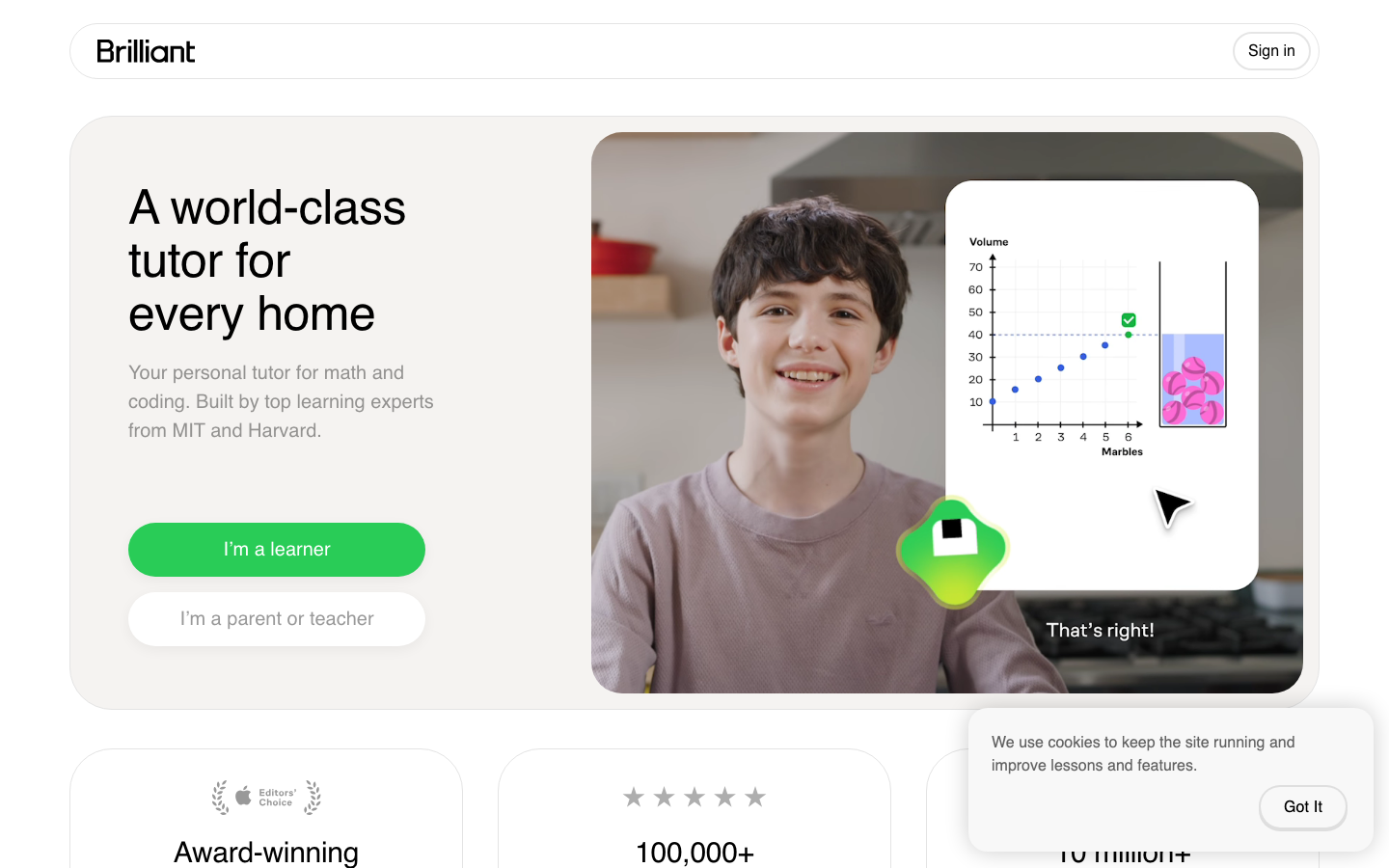
Brilliant specializes in interactive learning in math, science, and computer science, turning abstract concepts into actionable, interactive exercises. AI capabilities cover adaptive learning path planning, instant error diagnosis, and personalized difficulty adjustment. It has more than 10 million users worldwide and is used for employee technical training by companies such as OpenAI, NASA, and Meta.
BrilliantAI
Core parameters and statistics
| Parameter items | Data |
|---|---|
| Platform positioning | Interactive STEM learning platform |
| Product Form | Web + Mobile App (iOS/Android) |
| Global users | 10 million+ |
| Enterprise customers | OpenAI, NASA, Meta, Wayfair, etc. |
| AI capabilities | Adaptive path planning, instant error feedback, intelligent recommendations |
| Covering subjects | Mathematics, logic, physics, computer science AI, data science |
| Content format | Interactive exercises (not videos), puzzles, challenges |
| Latest version | 2026.06 (AI Adaptive) |
| Paid model | Free trial + monthly/yearly subscription |
Brilliant's product philosophy is completely different from mainstream MOOCs (video + quiz) - it replaces "passive viewing" with "hands-on". Each lesson is a series of interactive mini exercises. Users participate in solving problems by dragging, clicking, filling in the blanks, etc. instead of watching the instructor explain. This means that the core role of AI is not to "recommend videos", but to "diagnose in real time which step the user is stuck on and dynamically adjust subsequent questions."
User and market recognition
- C-side coverage: 10 million+ registered users worldwide, mainly from English-speaking countries (the United States accounts for 40%+), mainly high school students, college students and early career technical personnel.
- B-side penetration: Used by organizations such as OpenAI, NASA, Meta, Wayfair, Y Combinator, etc. for employee mathematics and logical thinking training. What corporate procurement values is the learning effect of "interactive exercises can ensure hands-on ability better than videos."
- Industry benchmarking: Brilliant has no direct competitors of equal size in the "interactive STEM learning" segment. Compared with Khan Academy, Brilliant has deeper content but narrower coverage (focusing on mathematics/CS, not covering humanities); compared with Codecademy, Brilliant does not teach specific programming languages, but teaches computational thinking and algorithm foundations.
- Academic Cooperation: Recommended by many universities (MIT, Stanford) as preparatory course materials to help new students establish a prerequisite knowledge base in mathematics and programming.
Cost advantage
C client/individual user layer:
- Free tier: 1–2 free interactive exercises per day, allowing you to experience the interactive style of the platform but not enough for systematic learning.
- Premium subscription:
- Monthly payment: approximately $24.99/month
- Annual payment: approximately $149.99/year (equivalent to $12.50/month)
- Premium unlocks all 10,000+ interactive exercises, full course paths, and AI adaptive features.
- HIDDEN COST: The free tier is extremely limited, making it almost impossible to complete any full course; the real learning value requires a Premium subscription. There is no certificate or credit certification, purely self-driven learning.
Developer/API Layer:
- Brilliant does not open an independent API. Enterprise users purchase through Brilliant for Teams in a unified manner, with quotations based on seats.
Enterprise/Team Level:
- Brilliant for Teams: For enterprise technology teams, used for skills training in algorithms, logic and data thinking. Pricing is determined by team size and usage time.
- Hidden Cost: Brilliant's content is biased toward "basic concepts and logical thinking" and is not a suitable tool for teams that require training on specific technology stacks (such as Python frameworks and cloud services).
Main functions
- AI Adaptive Path Engine: The user completes the diagnostic test when entering the course for the first time, and AI builds a personalized learning path based on signals such as accuracy rate, answer time, abandonment rate, etc. Each subsequent interaction will update the user's ability portrait and adjust the difficulty of subsequent content in real time. Causal chain: Diagnostic data → Ability portrait → Dynamic sorting → Matching of optimal difficulty → Reduce frustration and boredom.
- Instant error feedback: After the user submits the answer, the AI does not simply mark it red, but generates a step-by-step diagnosis - "You made a calculation error in step 3, did you consider the order correctly?" Acceptance focus: This kind of feedback covers common error patterns well, but may give less accurate tips for rare or combined errors.
- Intelligent Content Recommendation: After completing a course, AI recommends subsequent courses based on the dual dimensions of "what other users with similar learning patterns to yours have learned" and "what are the weak areas in your ability profile".
- Interactive exercise generation: Brilliant's courses are all designed by a professional content team (not UGC), but AI assists in generating variant questions and difficulty ladders of the same concept, ensuring that users will not develop habitual answers by repeating the same type of questions.
- Daily Puzzle: AI selects daily logic/mathematical puzzles that match the user's current learning progress, maintaining daily practice habits while strengthening the subject connection.
Model and version evolution
2023 and before: Purely content-driven
- Brilliant did not include AI features in its early days, and all course paths and exercise sequences were manually arranged by instructional designers. The unique interactive design of the interactive content itself (drag and drop, slider, graphic drawing) is the core selling point.
2024: AI recommendation integration
- In February 2024, an AI course recommendation system will be introduced to recommend the "next best course" based on collaborative filtering. This is Brilliant’s first step in the direction of AI.
2025: Instant feedback mechanism
- In May 2025, launch AI-driven instant error feedback, leveraging LLM to analyze user error patterns and generate diagnostic tips. This version marks Brilliant's transition from a "content platform" to an "AI tutoring platform" - its technical advantages shift from interaction design to real-time learning data analysis.
2026: Full-link adaptation
- In June 2026, the AI adaptive path engine will be fully launched, covering all major course paths. Currently, AI has gone through five sections: "diagnosis→recommendation→practice→feedback→adjustment".
Technical advantages
- Interactive content structure is better than video model: Each Brilliant course consists of 10–20 micro-interactions, each lasting 2–5 minutes. This structure is naturally suitable for AI to do "fine-grained status tracking" - AI can know which step and concept the user has made repeatedly, while the video platform can only determine whether the user has finished watching. This fine-grained data is the basic fuel for subsequent adaptive path planning.
- Error Pattern Classification Engine: The AI behind Brilliant maintains a library of error patterns distilled from 10 million+ user interactions. When the user submits an incorrect answer, the AI matches it to existing error pattern categories (such as "confused permutations and combinations" and "forgot the negative sign"), and then generates tutoring tips for the pattern. The matching accuracy for common errors is about 80-90%, and fallback to general prompts for rare errors.
- Adaptive Difficulty Curve: Different from linear courses where "everyone takes the same path", Brilliant's AI will generate a different difficulty curve for each user. If the user answers a certain concept correctly 3 times in a row, the difficulty level will be automatically upgraded; if the user answers a concept incorrectly 2 times in a row, the level will be reduced to a more basic variant. The goal is to keep users in a "slightly challenging but not frustrating" flow zone.
- Bandwidth Advantage Without Video: Brilliant's content features text SVG graphics and lightweight interactivity, with no video streaming required. This means smooth use in low-bandwidth environments, and the latency of AI inference (typically <1s) is not affected by video buffering.
How to use
- Web version: Visit https://brilliant.org/, register an account and complete subject/interest selection. AI will automatically generate an initial learning path.
- Mobile App: Search "Brilliant" on iOS/Android to experience the same interactive exercises as the web version.
- Learning Path Navigation: The home page Dashboard displays the next course and content to be reviewed recommended by AI. After logging in every day, complete the daily puzzle first and then advance along the path.
- Enterprise Access: Submit requirements through the Brilliant for Teams page, get quotes and SSO docking based on team size.
- Free Trial: New users typically have a 7–14-day free Premium trial period to fully experience the AI Adaptive Path feature.
Product Pricing
| Paid tiers | Price | Coverage |
|---|---|---|
| Free Tier | $0 | 1–2 random exercises per day, no course path access |
| Premium monthly | $24.99/month | All 10,000+ interactive exercises + AI adaptive paths |
| Premium annual | $149.99/year ($12.50/month) | Same as above, about 50% discount |
| Corporate Team | Business Pricing | Team Management Panel + Progress Analysis + Per-seat Quotation |
Boundary of human-machine collaboration: Learning path planning, difficulty adjustment and error feedback can be 100% automated by AI; however, Brilliant does not provide human tutor intervention or Q&A forums, and all learning support is limited to preset interactive feedback. For complex concepts that require in-depth explanation by a human tutor, the limitations of AI feedback will need to be compensated for by the user through external resources.
Application scenarios
- Technical Interview Preparation (Cost Reduction and Efficiency Increase Deduction): The traditional way to prepare for an algorithm interview with a large company is to brush LeetCode + watch the explanation video, which takes 15-30 minutes per question from setting the question to seeing the analysis; Brilliant's interactive algorithm course breaks down the concept into small steps to understand "why you should do this" rather than "memorize the solution to this question", and the time to master a single knowledge point is reduced from 2-3 days to 1-2 days. It is especially suitable for career changers who have a weak foundation but need complementary algorithm thinking.
- Mathematics/physics concept consolidation: When high school and junior college students learn calculus, linear algebra, and probability theory, it is difficult to intuitively understand the abstract formulas in traditional textbooks. Brilliant's interactive visualization (such as dragging a slider to observe function transformation) assists intuitive understanding, and combined with AI error feedback, can reduce repeated rework caused by "concept misunderstandings". The learning model changes from "rote memorization of formulas" to "intuitive understanding".
- Logic training for enterprise technology teams: AI and data teams need a strong foundation in logical thinking. Brilliant for Teams provides engineers with systematic thinking training of "logic + probability + algorithm". Compared with building internal training materials, Brilliant's out-of-the-box path planning can shorten the cycle from 4-6 weeks to 1-2 weeks for team skills to be covered.
Applicable people
- Computer Science Beginners/Career Changers: Groups who need to systematically supplement the basics of mathematics and CS, but do not need specific programming languages. Not suitable for the boundary: People who need practical project experience, language framework and tool chain learning, Brilliant does not have a code editor and project exercises.
- High School/College Lower School STEM Students: Replace boring formula derivation learning with interactive exercises. Prerequisite: Basic English reading ability is required. The Chinese interface is not currently supported.
- Technical interview preparers: People who need to consolidate the foundation of algorithms, probability and logic. Not suitable for the boundary: Using Brilliant for answering questions in the sprint phase of the interview is less efficient. It is recommended to use it as an auxiliary tool for laying the foundation and switch back to LeetCode during the sprint phase.
- Enterprise technical team training leader: Suitable for scenarios where the team's overall mathematical/logical literacy needs to be improved rather than the specific technology stack. Not suitable for the boundary: Scenarios where the team needs training in specific professional skills such as Python, cloud native, and system design.
Summary and Outlook
Brilliant has a differentiated product philosophy in interactive STEM learning - "doing" is more effective than "passively watching". The empowerment of AI has evolved from a "static multiple-choice exercise" to an "intelligent coach that diagnoses user stuck points in real time and dynamically adjusts the path." This fine-grained state tracking is a core differentiator that video platforms cannot replicate.
Current limitations: Content coverage is limited to mathematics, logical CS, and data science, and does not involve other subjects; AI feedback is effective for common error patterns, rare errors may only give generic tips; lack of non-English language support such as Chinese limits expansion in the Asia-Pacific market; no certificate/credit positioning makes it a lower priority in corporate training budgets than certifiable solutions.
Purchase/Adoption Risk Assessment: Individual users are recommended to use a 7–14-day free trial to evaluate whether the AI adaptive path matches their personal learning style. The cost-effectiveness of annual payment is significantly higher than that of monthly payment. Before purchasing, corporate teams need to confirm that "logical thinking training" is the team's current primary skill gap - Brilliant is not suitable as the only vocational skills training budget, but is more suitable as a pre-supplement to other technical training.
Related tools:  Khanmigo, quizlet
Business process integration and ROI analysis
As a productivity tool for enterprises or professional positions, the true value of Brilliant AI depends on the depth of integration with existing workflows and the quantifiable efficiency improvement effect. The following is a systematic analysis from three core dimensions.
System integration and data interoperability The ability to interoperate with existing business systems is a key prerequisite for productivity tools to be integrated into workflows. It is recommended to focus on evaluating the following integration dimensions: the openness and documentation quality of the RESTful/GraphQL API (whether a complete API reference and SDK examples are provided), the support scope of Webhook event notifications (which business event types are supported for automatic push), the number and depth of pre-built integrations with common collaboration SaaS tools (WeChat Enterprise, DingTalk, Feishu, Slack, Notion, Jira, etc.), and enterprise-level identity authentication support (SSO/SAML/OAuth and LDAP/AD directory integration). Products that lack integration capabilities are easily isolated into information islands, which in turn increases the cognitive cost and operational friction for teams to switch between different tools.
Efficiency Quantification and ROI Estimation Methodology Before purchasing decisions, it is recommended to quantify the input-output ratio through a structured method: Step 1, choose 3-5 Standardized tasks that are frequently repeated and time-consuming in each team are used as test samples; in the second step, the average time consumption of a single task before and after tool intervention, first-time pass rate or error rate, and the number of links requiring manual intervention are recorded under controlled conditions; in the third step, the saved manpower time is converted according to the comprehensive cost of the position (salary, benefits, management sharing), and soft benefits (increased employee satisfaction, standardization of work quality, and improvement in response speed to core business) are superimposed to obtain a comprehensive ROI estimate. It is recommended to continue tracking ROI trends on a monthly basis, as the value of a tool usually increases over time as team proficiency increases and workflows are optimized.
Phase-based implementation strategy and risk control It is recommended to adopt a three-stage implementation path of "pilot verification-gradual promotion-continuous optimization". In the pilot stage (1-2 weeks), a single team or a single business scenario is selected for small-scale verification. The core goal is to verify technical feasibility and user acceptance, and establish preliminary usage specifications and success standards; in the promotion stage (2-4 weeks), after the pilot verification is passed, the coverage is gradually expanded, and standardized activation processes and training materials are developed; in the optimization stage (continuous), the workflow configuration is continuously adjusted based on actual usage data and user feedback, and more high-value application scenarios are explored. Clear quantitative key result indicators should be set at each stage to avoid blindly expanding the scope of use without data support.
Version Info
- Brilliant AI Adaptive 2026 :Introducing an AI adaptive path engine to adjust the difficulty and order of subsequent courses in real time based on user response behavior.
- Brilliant AI 2025 :Launched an AI instant error feedback mechanism to provide step-by-step diagnosis of user answers instead of just showing correct/wrong. There is no official precise date yet.
- Brilliant Interactive 2.0 :Introduce an AI recommendation system to recommend the next best course based on the user's learning path after completing the course. There is no official precise date yet.
User Reviews