 Browserbase
Free
Browserbase
Free
Browserbase provides managed browser sessions, concurrency management and observability capabilities to help teams build stable web page automation agents.
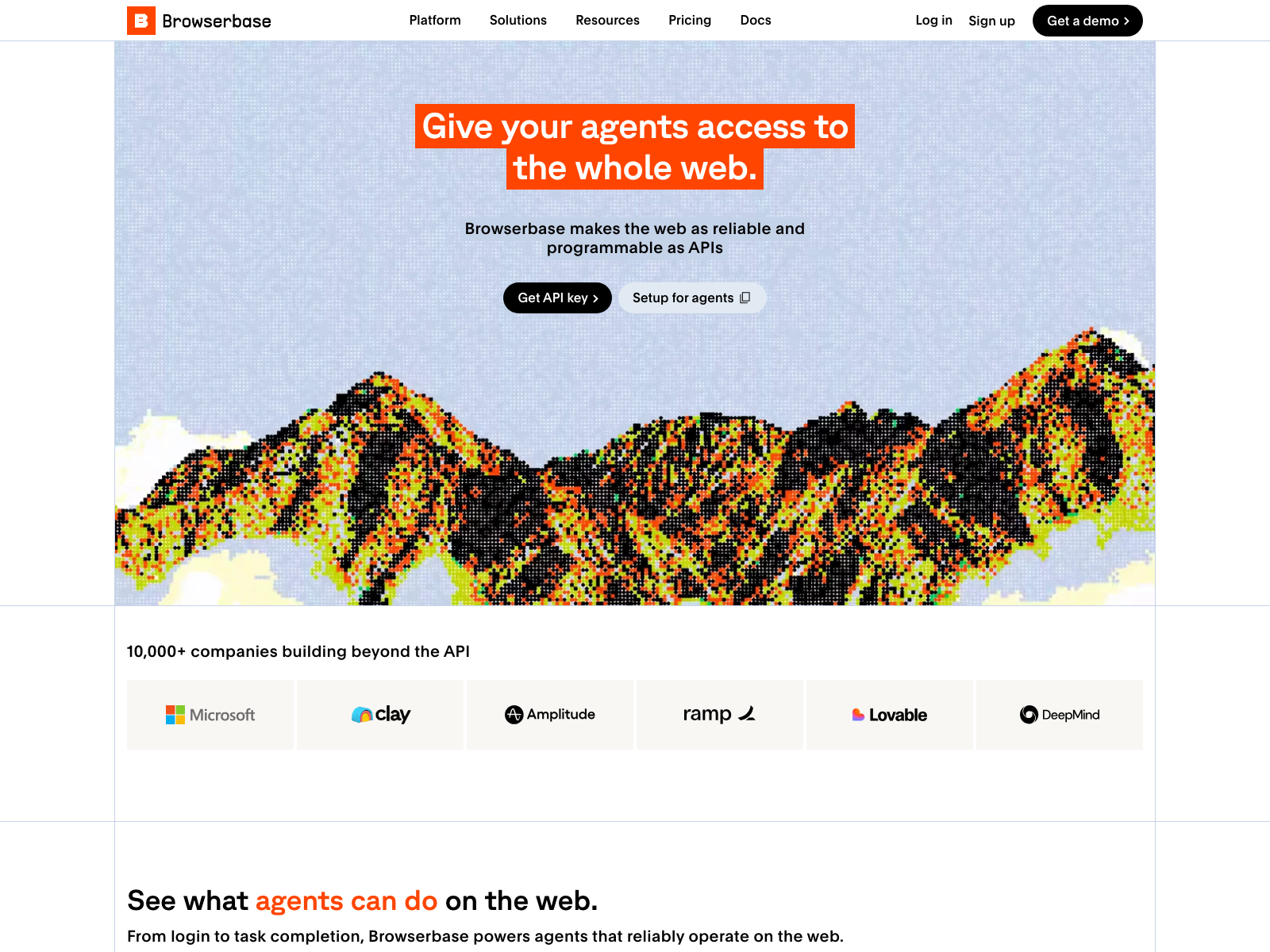
Browserbase: Cloud browser automation infrastructure for AI Agents
Tool introduction
Browserbase is a cloud browser infrastructure platform built for AI agents and web automation workflows. Its core value is not to "move the browser to the cloud", but to "engineer web page operations into programmable infrastructure" - allowing Agents to operate real browsers like calling APIs and handle login, dynamic rendering, form interaction, anti-crawling bypass and other scenarios that traditional headless browsers cannot stably handle.
As of July 2026, Browserbase has served more than 10,000 enterprise customers and 100,000 developers. Its open source project Stagehand (AI browser automation framework) has received 23,600+ stars on GitHub, MCP Server has received 3,400+ stars, and the weekly SDK downloads have reached 800,000 times. The platform handles over 200 million unique browser sessions monthly.
A brief comment: It is not a simple packaging of "browser as a service", but an execution layer base that upgrades browser execution from "script logic" to "infrastructure capabilities".
Classification Judgment: Browserbase's main delivery form is Agent / MCP / Automation Tool (providing web page interaction capabilities to Agent through Search/Fetch API and Browser-as-a-Service, and exposing standard tool interfaces to LLM through MCP Server). Secondly, it has the characteristics of Basic Large Model/API Infrastructure (providing Model Gateway unified large model access and Runtime execution context).
Core functions
Three core APIs
Browserbase designed a layered API around the link of "information acquisition → content extraction → action execution":
- Search API: Agent-oriented web search engine portal. A single POST request returns structured search results (title URL, abstract, publication date), supporting a rate limit of 120 RPM per item. Typical usage: When the Agent needs to search for the latest information from the Internet, it finds relevant pages through the Search API, and then passes the results to the Fetch API or Browser session.
- Fetch API: Convert arbitrary URL content to HTML, JSON or Markdown format, intelligently render JS dynamic content through a proxy network and return sanitized structured text. The free tier includes 1,000 calls, after which you are billed at $0.5~$1/1k calls ($4/1k in proxy mode).
- Browser-as-a-Service: Provides a complete real Chromium browser context for Agent, supporting CDP (Chrome DevTools Protocol) and WebDriver protocol access. Each session is allocated 2 vCPUs, runs in isolation, and supports cookie persistence, file upload and download, Chrome extension loading, request interception and custom proxy routing. The free tier includes 3 concurrent browsers and 1 browser hour.
Agent Identity (Agent Identity System)
This is one of the core differentiated capabilities of Browserbase, which solves the "identity wall" problem when Agent accesses real web pages:
- Automatic verification code solving: Built-in CAPTCHA recognition and automatic passing mechanism, no need for third-party verification code service integration.
- Hosted Proxy Network: Automatically rotates residential/data center proxy IPs, supports geo-targeting, and can be configured independently for each session.
- Credential Security Management: Securely store and inject login credentials with 1Password integration to avoid hard coding. Supports cookie and session state persistence across runs, so the Agent does not need to log in again every time.
- Stealth Stealth Mode: Basic version (Developer/Startup plan) and Advanced version (Scale plan) provide different levels of anti-detection fingerprint camouflage to reduce the risk of being identified as automated scripts by target websites.
Observability
Browserbase treats observability as a native capability of the platform rather than as a back-loaded component:
- Live View: Watch every step of the Agent's operation in the browser in real time, and support the team to share debugging links.
- Session Replay: Automatically record each browser session and play back to view the complete operation trace of the Agent.
- Structured Logging: Automatically captures network requests, console output, error messages, and execution timing per session, supporting filtering and retrieval across thousands of parallel sessions.
Runtime (Agent runtime)
Provides sandboxed Agent execution context and supports on-demand or scheduled deployment:
- Each Agent runs in a completely isolated context, stateless, and no cross-execution residue.
- Native support for concurrency scaling to thousands of parallel Agents without the need to provision a server cluster.
- Fault isolation: A crashed Agent will not affect adjacent tasks or shared state.
Model Gateway
Through the same Browserbase API Key, you can access mainstream large language models (such as Gemini, GPT-4o, Claude, etc.) and unify bill management. The free tier includes $5 model calling credit.
Expert View - Hidden Linkage Effect:
- Search → Fetch → Browser three-layer API is not an independent product, but constitutes a complete Agent web page interaction including: Search positioning information → Fetch quick filtering → Browser in-depth interaction and action execution. The linkage effect of the three is much greater than that of a single layer.
- Stagehand SDK, as an upper-level abstraction, intelligently decides when to use AI reasoning (processing unknown pages) and when to use cache/code (executing known processes), realizing a hybrid model of "AI-driven exploration + code-driven execution" to strike a balance between Token cost and execution certainty.
- MCP Server exposes this entire set of capabilities to LLM through 6 standardized tools, so that any client that supports the MCP protocol (such as Claude Desktop, VS Code, Cursor, etc.) can obtain web browsing capabilities with zero coding.
Pricing strategy
Four-tier pricing model (as of July 2026)
| Specifications | Free | Developer ($20/month) | Startup ($99/month) | Scale (custom) |
|---|---|---|---|---|
| Number of concurrent browsers | 3 | 25 | 100 | 250+ |
| Browser Time | 1 hour/month | 100 hours (over $0.12/hr) | 500 hours (over $0.10/hr) | By usage |
| Agent run times | 3 | 15 | 50 | Custom |
| Search API call | 1,000 | 1,000($7/1k overage) | 1,000($7/1k overage) | Custom |
| Fetch API call | 1,000 | 1,000 ($1/1k overage) | 10,000 ($0.5/1k overage) | By usage |
| Proxy Traffic | None | 1GB | 5GB | 5GB+ |
| Automatic solution of verification code | ❌ | ✅ | ✅ | ✅(Verified Agents) |
| Data Retention | 7 days | 30 days | 30 days | 30+ days |
| Model Gateway | $5 quota | Market price based on usage | Market price based on usage | Market price based on usage |
| Stealth Stealth Mode | None | Basic | Basic | Advanced |
| HIPAA/DPA | ❌ | ❌ | ❌ | ✅ |
| SSO Single Sign-On | ❌ | ❌ | ❌ | ✅ |
Cost Structure Breakdown:
- Customer/Small Teams: The Free plan is sufficient for proof-of-concept and experimental projects, but the 1 browser hour and 3 concurrent session limits means it cannot be used for any production-level tasks.
- Developer: The $20/month Developer plan is the real entry barrier. According to official estimates, 100 browser hours is equivalent to approximately 3,000 page-level tasks (typical web crawling <2 minutes/time), which is suitable for mid-term projects by single developers.
- Enterprise: The real value of the Scale plan is in advanced Stealth mode HIPAA compliance and SSO, not pure resource expansion. When purchasing, "unit task completion cost" rather than "single call unit price" should be used as the core evaluation indicator.
Hidden Cost Tip: The unit price per browser hour may not seem high ($0.10~$0.12), but the single execution time of complex interactive tasks (multi-step forms, in-depth page jumps, anti-crawl response) may be far longer than 2 minutes, making the actual cost of "one task" significantly higher than the estimated value of the price. It is recommended to establish a comprehensive cost model of "task success rate × average execution time × retry rate" in the production environment.
Advantages and Disadvantages Analysis
Advantages
- Full-stack web page interaction capability: From simple page grabbing to complex login, form filling, and file operations, one API Key covers the entire link, eliminating the need to piece together multiple tools.
- Agent native design: The API design revolves around the Agent workflow rather than manual operations, and the Search/Fetch/Browser hierarchy is naturally adapted to Agent frameworks such as ReAct.
- High community and ecological activity: Stagehand 23.6k Stars, MCP Server 3.4k Stars, 800k weekly downloads, it has become one of the de facto standards in the field of open source browser automation.
- Mature security compliance: SOC 2 Type II + HIPAA compliance, 2026 penetration test report available, enterprise-level security controls (data encryption, access control BCDR plan) have been implemented.
- Production-grade observability: Live View + Session Replay is crucial for troubleshooting the reasons for Agent execution failure. There is no need to rely on the inefficient Debug cycle of "adding logs and re-running".
Disadvantages
- Heavily dependent on the Browserbase platform: Although the Stagehand SDK can be used independently, complete Agent Identity, Runtime, Observability and other capabilities need to be bound to the Browserbase cloud service, which poses the risk of vendor lock-in.
- Nonlinear cost growth in high-concurrency scenarios: The number of concurrencies in the Scale plan (250+) requires a custom quote, and the unit price of Search/Fetch calls that exceed the basic quota is high. In large-scale data collection scenarios, the monthly bill may expand rapidly.
- Sensitive to changes in page structure: Although Stagehand's Self-healing (self-healing mechanism) and AI-driven selectors can alleviate the breakage caused by page changes, key operations that are deeply dependent on the DOM structure still require manual intervention when major page versions are updated.
- Not suitable for core transactions in strict compliance industries: For scenarios such as financial transaction execution and medical diagnosis decisions that require deterministic execution and a complete audit chain, Browserbase's "AI-driven + probabilistic output" model has not yet established enough trust.
Comparison with competing products
| Dimensions | Browserbase | Playwright (self-built) | Puppeteer + proxy | Browserless.io | Selenium Grid |
|---|---|---|---|---|---|
| Hosting Infrastructure | ✅ Fully Managed | ❌ Self-Build/Operation and Maintenance | ❌ Self-Build | ✅ Hosted | ❌ Self-Built |
| AI/Agent native | ✅ Search/Fetch/Stagehand | ❌ Pure automation framework | ❌ Pure automation framework | ❌ Pure browser hosting | ❌ Pure browser hosting |
| Anti-crawling/Stealth | ✅ Agent Identity + Verification Code Solver | ❌ Manual integration required | ⚠️ Additional services required | ⚠️ Basic agent | ❌ None |
| Observability | ✅ Live View + Replay | ❌ Need to be built by yourself | ❌ Need to be built by yourself | ❌ Basic log | ❌ Need to be built by yourself |
| MCP Support | ✅ Official MCP Server | ❌ None | ❌ None | ❌ None | ❌ None |
| Open Source | ⚠️ Stagehand Open Source, Core Closed Source | ✅ Fully Open Source | ✅ Fully Open Source | ⚠️ Commercial Closed Source | ✅ Fully Open Source |
| Getting Started | Free plan available | Free (requires building your own server) | Free (requires building your own infrastructure) | $0+ with free tier | Free (requires building your own cluster) |
| Scale Cost | Pay by usage, small and medium-sized has advantages | Depends on server cost | Depends on agent and server | Billed by session | Depends on server cost |
| Enterprise Compliance | SOC 2 + HIPAA | Depends on self-construction | Depends on self-construction | SOC 2 | Depends on self-construction |
Applicable scenarios
Dimensionality reduction strike scenario (most suitable)
- Agent-driven web page data collection: When the target site has no public API, requires login, has an anti-crawling mechanism, or contains a dynamic interaction process, Browserbase's Search → Fetch → Browser three-layer structure allows the Agent to independently complete the entire process of "discovery → extraction → interaction".
- Large-scale competitive product monitoring and price tracking: Use concurrent browser sessions to simultaneously monitor hundreds of competing product pages, e-commerce prices, and recruitment information, and cooperate with Runtime scheduled scheduling to achieve continuous monitoring. The official template library includes out-of-the-box use cases such as Amazon price comparison, Google trending keywords, etc.
- Form-intensive background operation automation: In scenarios such as supplier portals, government affairs platforms, and recruitment systems that require account login and repeated form filling, Browserbase's cookie persistence + verification code solving + MFA auxiliary processing can significantly reduce manual intervention.
- Agent end-to-end testing and quality monitoring: Continuously conduct Agent-driven regression testing on the product front-end, and automatically detect problems when page styles/interactions change. This scenario has been validated by customers such as Amplitude and Vercel.
- GTM and Sales Process Automation: Amplitude (Sales Demo Automation) and Ramp in customer cases demonstrate their value in replacing manual browsing in GTM scenarios.
Discourage/Inapplicable people
- Severe high-throughput pure data crawling: If the business needs to crawl millions of pages every day and the target site has no reverse crawling, the cost of using a self-built Playwright cluster + cheap proxy is much lower than Browserbase's pay-as-you-go billing.
- Financial/medical core transactions with absolute requirements for certainty: Scenarios such as stock transaction execution and medical prescription issuance require 100% certainty and a complete audit chain. AI-driven browser automation currently cannot provide such guarantees.
- Businesses covered by stable APIs: If the main business process (such as CRM data synchronization and ERP integration) already has a stable official API, Browserbase's marginal revenue will approach zero.
- Requires complete offline/privatized deployment: Browserbase currently does not provide privatized deployment options (the official FAQ confirms that on-prem is not supported), and government and enterprise customers with extremely high data sovereignty requirements cannot adopt it.
Efficiency improvement comparison
The following is a deduction (unofficial promised value) based on multiple public customer cases and industry benchmarks:
| Task scenario | Traditional manual time-consuming | Traditional script time-consuming | Browserbase Agent deduction time-consuming | Core efficiency lever |
|---|---|---|---|---|
| Price monitoring across 50 competing websites (daily) | 2-3 person-days | 4-6 hours (including maintenance) | 10-15 minutes (automatic retries + observability) | Concurrent browser sessions + automatic CAPTCHA solving |
| 100 supplier portal form filling and submissions | 1-2 man-days | 3-5 hours (including debugging) | 20-30 minutes (including failed retries) | Cookie persistence + Identity system |
| Cross-platform information registration for new product releases | 0.5-1 person-day | 2-3 hours (script development + debugging) | 5-10 minutes | Stagehand AI-driven exploration |
| Monthly tracking of competing product web page function changes | 3-5 person-days | 6-8 hours (requires selector maintenance) | 15-20 minutes | Self-healing + Session Replay |
| SaaS product front-end regression testing (20 core processes) | 4-6 man-days | 2-4 hours (script maintenance) | 10-15 minutes | MCP + Agent driver testing |
Critical Path to Efficiency Release: Browserbase does not "make automation a little faster", but by eliminating the three bottlenecks of "Contextual Construction (Runtime)", "Anti-crawling Confrontation (Identity)", and "Failure Troubleshooting (Observability)", it transforms web page automation from the "script development and maintenance" mode to the "define tasks and observe execution" mode. The team's focus shifted from "writing scripts" to "defining Agent tasks and analyzing failure reasons".
Automation Boundary
Can be 100% automated and organized
- Information acquisition from public web pages: Page crawling, search result extraction, and structured data collection that do not require login.
- Regular form filling: Multi-site form submission with defined fields and fixed processes (such as resume delivery in the recruitment system).
- Pure monitoring tasks: price change detection, page content change alarms, availability inspection.
- Standardized data export: Export reports, download statements and other repetitive operations from the SaaS backend with a login wall (provided that the login credentials are stable).
There are sections that require manual confirmation (Human-in-the-loop)
- Operations involving capital flow: payment confirmation, transfer initiation, verification after order submission - it is recommended to set up manual confirmation steps or run dry-run mode first.
- Irreversible account operations: For operations such as account cancellation, permission changes, data deletion, etc., AI should not have the final execution rights.
- High-value customer delivery process: Sending customized quotations, signing contracts, and other procedures involving legal validity require manual review before execution.
- Unknown page visited for the first time: When the Agent encounters a page layout it has never seen before, although Stagehand's AI mode can explore it, it is recommended to turn on Live View for human supervision during the first execution.
Technical constraints on automation boundaries
- Verification code evolution: Although Agent Identity has built-in verification code solving, CAPTCHA technology continues to evolve (such as the behavioral analysis of reCAPTCHA v3), and the 100% pass rate cannot be guaranteed. It is recommended to set up the back-up logic of "verification code failure→switch agent/identity→retry" in the Agent workflow.
- Deep interaction of single-page applications (SPA): The DOM of modern SPA (React/Angular/Vue) is dynamically generated, and Stagehand's AI selector has better support for this, but some extreme cases (such as the real-time updated Canvas-based interface driven by WebSocket) still require manual specialization.
- Long tail failure of multi-step processes: In complex operations with more than 10 steps, even if the single-step success rate reaches 99%, the overall success rate is only ~90%. Gradual checkpointing, rollback, and retry strategies must be designed into production.
Security and Compliance
Compliance Certification
- SOC 2 Type II: Passed 2025 annual audit, 2026 penetration test report is publicly available.
- SOC 2 Type I: Passed in 2024.
- HIPAA: Already compliant with Health Insurance Portability and Accountability Act requirements, Scale plans support a BAA agreement.
- DPA: Data processing agreement can be signed on demand.
Data security control
According to the Browserbase Trust Center (trust.browserbase.com) public information:
- Data Encryption: Both transport encryption (TLS 1.2+) and storage encryption are enabled.
- Access Control: Production bounded access rights are strictly limited, and unique identity authentication is enforced.
- Key Management: Controlled access to encryption keys, with secure injection of credentials through 1Password integration.
- Data retention and deletion: 7 days for Free/Developer plan, 30 days for Startup/Scale, data is deleted according to policy when customer exits.
- Penetration Testing: 2026 Third-party penetration testing completed.
risk assessment
Potential risks that need attention:
- Data residency and geographical restrictions: Browserbase has not disclosed the specific data center region list (subject to the answer to the official FAQ "What regions are you in,"). For customers with data localization requirements (such as the EU GDPR, China's "Data Security Law"), the geographical location of data storage and processing needs to be confirmed before purchasing.
- Credential leakage risk: Although Agent Identity manages credentials through 1Password, every page operation performed by the Agent will be recorded and played back, and the login credentials of sensitive pages (such as banking and medical background) may be exposed in clear text in the platform logs - it is recommended to evaluate such scenarios individually for compliance.
- Vendor lock-in: Stagehand SDK is open source but the core browser infrastructure is bound to the Browserbase cloud platform, resulting in higher migration costs. It is recommended that the team design an "abstraction layer" (such as encapsulating browser session creation logic through a custom Adapter) at the early stage of the project to reduce future switching costs.
- AI model data usage policy: Whether the data transmitted in the Model Gateway will be used for model training has not been officially stated clearly. For web content involving trade secrets or PII, it is recommended to avoid using the Model Gateway's default model or to clarify data usage boundaries in the procurement contract.
Integrated Ecosystem
SDK and framework support
| Category | Support |
|---|---|
| Official SDK | TypeScript/Node.js (64 Stars), Python (89 Stars) |
| Stagehand (main SDK) | TypeScript (23,600+ Stars, MIT license), supports natural language selector, self-healing mechanism AI/code hybrid mode |
| Stagehand Derived SDK | Python (497 Stars), Go (22 Stars), Ruby (9 Stars), Java/Kotlin (Alpha), C#/.NET (Alpha), PHP (Alpha) |
| Browser Automation Framework | Playwright (recommended), Puppeteer, Selenium |
| Agent framework integration | LangChain, CrewAI, Mastra |
| MCP Protocol | Official MCP Server (3,400+ Stars, Apache 2.0), supports two transmission modes: STDIO and SHTTP |
MCP Server Tool List
Browserbase MCP Server exposes the following 6 standardized tools to LLM:
| Tool name | Function | Parameters |
|---|---|---|
start |
Create or reuse a Browserbase browser session | (none) |
end |
Close the current browser session | (none) |
navigate |
Navigate to the specified URL | { url: string } |
act |
Perform an action on the page (click, type, etc.) | { action: string } |
observe |
Observe interactive elements on the page | { instruction: string } |
extract |
Extract structured data from the page | { instruction,: string } |
Architecture Link:
LLM (Claude/GPT/Gemini)
  ↓ MCP Protocol
Browserbase MCP Server (local or hosted)
  ↓ Stagehand SDK
Browserbase Browser API
  ↓ CDP/WebDriver
Chromium instance (cloud isolation sandbox)
  ↕ Data reflow
Observability (Live View + Replay + Logs)
3-Minute Quick Start Guide
Method 1: Hosted MCP Server (recommended, zero configuration)
Add in MCP client configuration:
{
  "mcpServers": {
    "browserbase": {
      "type": "http",
      "url": "https://mcp.browserbase.com/mcp"
    }
  }
}
If the client does not support SHTTP transport, use a remote proxy:
{
  "mcpServers": {
    "browserbase": {
      "command": "npx",
      "args": ["mcp-remote", "https://mcp.browserbase.com/mcp"]
    }
  }
}
Method 2: Self-hosted MCP Server (requires API Key)
{
  "mcpServers": {
    "browserbase": {
      "command": "npx",
      "args": ["@browserbasehq/mcp"],
      "env": {
        "BROWSERBASE_API_KEY": "<YOUR_API_KEY>",
        "BROWSERBASE_PROJECT_ID": "<YOUR_PROJECT_ID>",
        "GEMINI_API_KEY": "<YOUR_GEMINI_API_KEY>"
      }
    }
  }
}
Method 3: Using the Stagehand SDK Python example
from browserbase import Browserbase
from playwright.sync_api import sync_playwright
import os

bb = Browserbase(api_key=os.environ["BROWSERBASE_API_KEY"])

# Create browser session
session = bb.sessions.create()

with sync_playwright() as playwright:
    browser = playwright.chromium.connect_over_cdp(session.connect_url)
    page = browser.contexts[0].pages[0]

    # Navigate to target page
    page.goto("https://example.com")

    #Extract page content
    content = page.text_content("body")
    print(content[:500])

    page.close()
    browser.close()
Engineering Pitfall Guide
-
Dead-end loop and Token explosion control: When the Agent encounters a complex page, it may fall into an infinite loop of "repeated attempts → failure → retry", causing both the browser session length and LLM Token consumption to skyrocket. Solution: Set
max_steps(maximum number of execution steps, 20~50 steps recommended), single-step timeout (30-60 seconds recommended), repeated action detection (automatic interruption if the same URL/operation is repeated more than 3 times) in the Agent implementation, and control the session behavior through the--keepAliveand--browserWidth/Heightparameters when the MCP Server starts. -
DOM/Context Overload: The number of DOM nodes of large pages (such as SaaS Dashboard, e-commerce list page) may exceed 10,000, and directly passing in the LLM context will quickly exhaust the Token budget. Solution: Use Stagehand's
observe()tool to only return the Accessibility Tree of interactable elements instead of the complete DOM, or obtain the summary version through the Markdown conversion of the Fetch API before deciding whether to start a full browser session. -
Security and ultra vires governance: Agent may perform irreversible operations (such as deleting resources, submitting payments, publishing content) when unsupervised. Solution: Enable read-only mode (without injecting credentials) for Browserbase's browser session for rehearsal, set up independent confirmation steps (Human-in-the-loop) for operations involving fund/data changes, and use Context ID to isolate tasks with different permission levels.
Implementation suggestions
Team Adoption Path
Phase 1 (proof of concept, 1-2 weeks):
- Use the Free plan + Stagehand to quickly build an end-to-end Agent task (such as monitoring specific content changes on a specified web page).
- Verify core capabilities: API call success rate, anti-crawling scenario performance, and session observability are as expected.
- Output the "Task Success Rate × Single Execution Cost" baseline.
Phase 2 (Production Pilot, January-February):
- Upgrade to the Developer or Startup plan and choose 1-2 business scenarios with medium stability requirements (such as competitive product price tracking, form automation).
- Establish a grayscale release strategy: pilot with 20% traffic first, and gradually expand to 100%.
- Configure Observability alarms and manual takeover processes for Agent execution failures.
- Establish a continuous monitoring dashboard for "Unit Task Cost".
Phase 3 (scaling, on-demand):
- Evaluate the ROI of Scale initiatives, focusing on whether Advanced Stealth Mode and HIPAA compliance match business needs.
- Design abstraction layers to reduce the risk of vendor lock-in (e.g. encapsulating browser session creation via the Adapter pattern).
- Establish market/evaluation standards for Agent tasks to avoid "each team building its own Agent wheel".
Situations where immediate adoption is not recommended
- The team lacks basic web automation operation and maintenance experience (not even Playwright/Puppeteer). It is recommended to accumulate basic capabilities internally before moving to cloud hosting solutions.
- The business scenario is mainly data scheduling of stable API, rather than browser interaction.
- Data sovereignty or privatization is deployed as a hard compliance requirement.
Procurement Evaluation Checklist
| Evaluation Dimensions | Confirmation Items |
|---|---|
| Task success rate | Run 100 test tasks on the target website and calculate the success rate baseline |
| Unit task cost | (monthly fee + overage fee + model fee) ÷ number of tasks completed |
| Anti-crawling/human-machine verification | Test the success rate of solving the verification code on the target site |
| Observability satisfaction | Whether log + Replay meets troubleshooting requirements |
| Compliance matching | Whether SOC 2/HIPAA/SSO/data residency meets industry requirements |
| Migration cost | If you switch to another solution, code transformation cost estimate |
Summary and Outlook
The essence of Browserbase is to engineer "web page operations", a "technical activity" that originally belonged to the script layer, into observable, manageable, and scalable infrastructure capabilities. In the value chain of AI Agent, it assumes the role of "execution layer" - when the Agent needs to interact with a real web page, Browserbase provides a complete set of solutions from Search/Fetch (information layer) to Browser (interaction layer) to Runtime (deployment layer).
Technology Trend Judgment: As AI Agent evolves from Chatbot to execution Agent, the value of web pages as the "largest human interaction interface" will continue to increase. Through the dual strategies of Stagehand open source ecosystem and MCP standard protocol, Browserbase is becoming a potential standard for the infrastructure layer of "Agent operating web pages". But the competitive landscape is also evolving rapidly - Playwright's MCP, various cloud vendors' browser automation services, and Puppeteer's continued enhancements will all pose challenges to Browserbase in the next 12-18 months.
Unsuitable boundary reiterated: Highly dependent on deterministic financial core transactions, extremely cost-sensitive large-scale pure data collection, government and enterprise scenarios that require 100% privatized deployment - these three types of needs should give priority to the evaluation of non-Browserbase solutions.
Procurement/Adoption Risk Assessment: The biggest risk at the current stage is not the lack of technical capabilities (Browserbase's maturity is leading among similar products), but ① the degree of supplier lock-in - the core infrastructure is bound to the cloud platform, and the migration cost is high; ② the non-linear expansion of costs - the bill for large-scale concurrent scenarios may exceed budget expectations; ③ compliance transparency - the data residency region and AI model training data usage policy still need to be clear in the contract. It is recommended that after the enterprise team completes the POC, it brings the cost data of the actual scenario to business negotiations with sales for the Scale plan, and requires that the data usage restriction clause (data usage rider) and SLA standards be written into the contract.
Related tools:  CrewAI,
  LangChain
Main functions of Browserbase
- Core Processing Capabilities: Provides core AI capabilities in the corresponding scenarios to support users to quickly complete tasks.
- Multi-modal interaction: supports text input and result output, and some scenes support image or file upload.
- Workflow Integration: Can be embedded into existing workflows or linked with other tools through APIs to reduce context switching.
Application scenarios of Browserbase
- Personal Creation: Quickly generate or process content to improve daily work efficiency.
- Team Collaboration: Unify workflow and reduce repetitive manpower investment.
- Enterprise-grade deployment: Embed capabilities into on-premises systems via API or private deployment.
Browserbase’s applicable groups
- Individual Users: Content creators and knowledge workers who need AI assistance to improve their daily work efficiency.
- Developers: Technical teams who need to integrate AI capabilities into their own products or services through APIs.
- Enterprise: Organizations seeking to deploy AI at scale in their field.
Browserbase’s technical advantages
- Algorithm Optimization: Special optimization at the model or algorithm level has been carried out for the corresponding scenario to achieve a balance between response speed and result quality.
- Low-latency architecture: Adopts streaming or asynchronous processing architecture to reduce user waiting time and is suitable for high-frequency interaction scenarios.
Browserbase’s core parameters and statistics
Specific technical parameters (such as model size, context length, supported file formats, input and output restrictions, etc.) are subject to the official product page. It is recommended that users verify the latest technical specifications and system requirements before choosing to ensure that they match their own usage scenarios.
User and market recognition of Browserbase
Gradually build user awareness in the field, and product capabilities are used by content creators and teams to improve work efficiency. Some industry users have incorporated it into their daily workflow. It is recommended to refer to the latest official disclosures for specific user scale and industry adoption rate data.
Browserbase’s cost advantage
- C-side/Individual: Usually a free version is provided to experience the core functions, and high-frequency use requires a paid package subscription.
- API/Developer: Billed by call volume, suitable for development teams that can be flexibly integrated into their own systems.
- Enterprise/Privatized: Contact the business owner for customized quotation and deployment plan. The specific price is subject to the official real-time pricing page.
Browserbase’s model and version evolution
Continuous iterative updates, the latest version introduces performance optimization and new features. Historical version information can be viewed on the official release page. There is no complete public version evolution timeline yet. It is recommended to pay attention to the official announcement to understand the rhythm of feature updates.
How to use Browserbase
- Web client: You can use it by visiting the official website and registering an account. Most functions do not require installation.
- API access: Provides RESTful API, developers can obtain the API Key and integrate it into their own applications.
Browserbase Product Pricing
The pricing model is subject to the official real-time page. Usually a freemium or subscription system is used, and basic functions can be used for free. Advanced functions or high-frequency use require paid subscriptions, and users are advised to evaluate the optimal solution based on actual usage.
Version Info
- Browserbase July 2026 :Continuously optimize browser session stability, Agent Runtime sandbox execution environment, and expand the MCP toolset to integrate with Stagehand v3.7+. Specific capabilities are subject to official real-time release.
- Browserbase June 2026 :Introducing the Agent Identity function to enhance automatic verification code solving and agent IP management capabilities.
- Browserbase March 2026 :MCP Server officially released v3.0.0, supporting 6 standardized tools; Stagehand SDK reached 23.6k Stars.
- first public release :Early version information has not been fully disclosed, please refer to the official update log.
User Reviews