 Busuu
Busuu
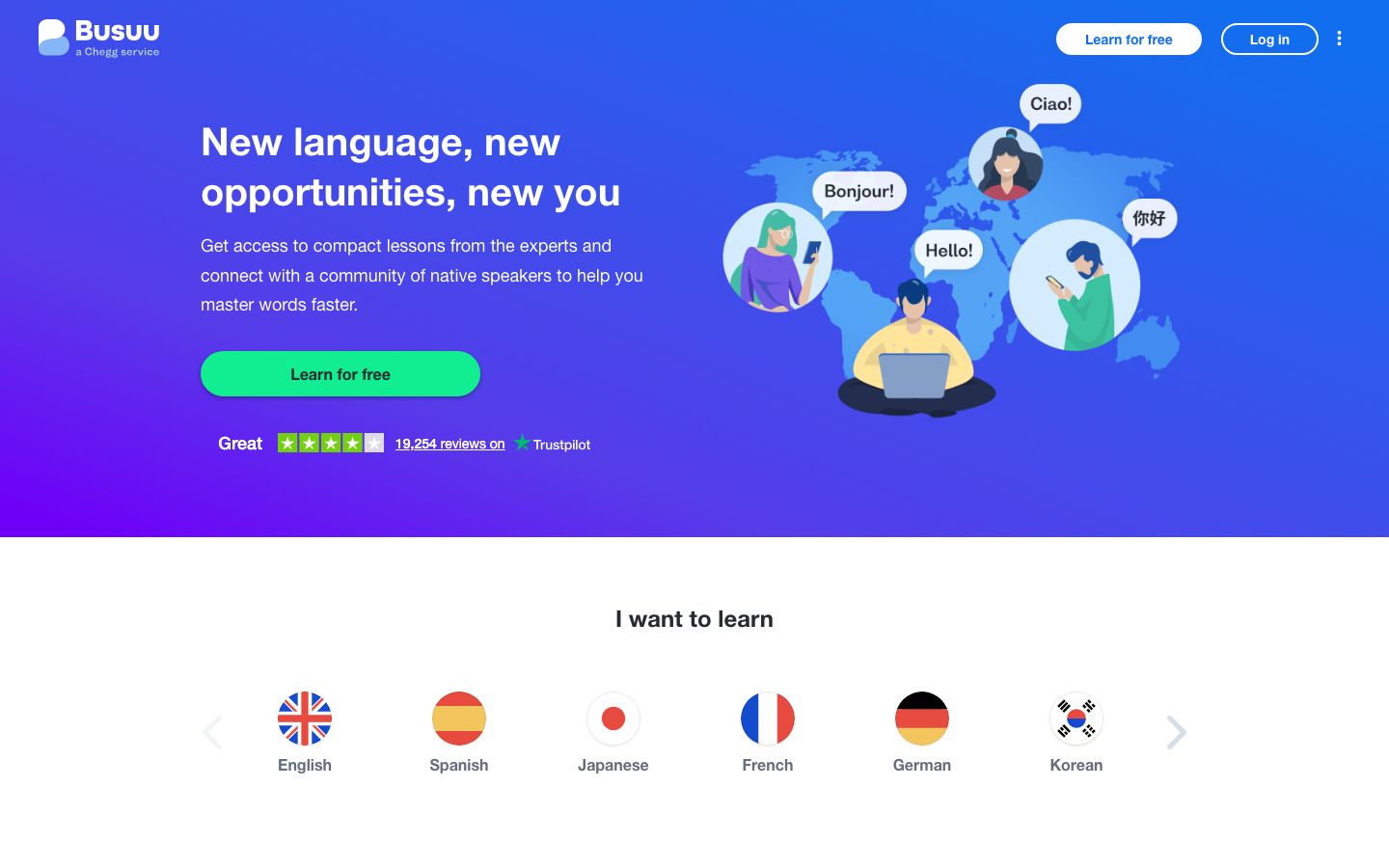
Busuu offers AI-powered language courses that engage with a global community of native speakers, covering 14 languages.
Busuu
Busuu’s core parameters and statistics
Busuu adopts a three-track strategy of "AI + community + real teachers" in the language learning market - it has structured courses and AI-driven exercises, as well as mutual evaluation by a global community of native speakers, and it also provides live classes with certified teachers for corporate customers. This hybrid model places it uniquely between Duolingo’s pure gamification route and Babbel’s traditional curriculum route.
| Projects | Public Information |
|---|---|
| Official positioning | AI language learning and community platform |
| Covered languages | 14 (English, Spanish, Japanese, French, German, Korean, Italian, Arabic, Russian, Chinese, Turkish, Portuguese, Dutch, Polish) |
| User scale | 120 million registered users worldwide |
| Enterprise customers | 600+ organizations (including PUMA, DHL, Unilever, Inditex, Carrefour, Uber, etc.) |
| AI capabilities | Pronunciation assessment AI dialogue practice, grammatical error correction, intelligent learning path planning |
| Community Features | Mutual criticism by native speakers, voice dialogue practice, and sharing of cultural insights |
| Teacher Services | Live Classes with Certified Teachers (Busuu for Business) |
| CEFR Alignment | The entire course is designed according to CEFR A1-C2 standards |
| Industry recognition | Google Play Editors' Choice, Apple App of the Year |
| Parent Company | Chegg Inc. (acquired in 2021) |
| Deployment method | Web, iOS, Android |
| Latest version | Busuu 2026 Spring (~2026-03) |
Core Difference: Different from Duolingo's pure gamification route, Busuu emphasizes "actual communication skills" - the course design refers to the CEFR international standard, and uses the triple mechanism of AI + real teachers + community mutual evaluation to make up for the limitations of pure AI in real-life language applications. Its enterprise business (Busuu for Business) serves 600+ global brands, covering retail, pharmaceutical, automobile, logistics and other industries. It is one of the few language learning platforms that takes into account both C-end consumers and B-end corporate training.
Busuu’s users and market recognition
User Scale: Busuu officially disclosed that there are more than 120 million registered users worldwide, and the daily/monthly active user data is not disclosed. Compared with Duolingo's 100 million+ MAU level, Busuu's activity may be lower, but the total number of registered users is close - reflecting that its CEFR structured path is more attractive to "serious learners" than casual users, but it also means that the proportion of natural growth in customer acquisition costs may be higher.
Industry Recognition:
- Google Play: Editors' Choice certification
- App Store: App of the Year Award-winning
- Academic Circle: Multiple third-party studies have verified the effectiveness of Busuu courses in improving CEFR levels (such as "The Impact of Busuu on CEFR Language Proficiency" published in peer-reviewed journals)
Enterprise Ecosystem: Busuu for Business serves 600+ organizations, and its customer list covers global brands such as PUMA, DHL, Uber, Unilever, Inditex (parent company of Zara), L'Oréal, Alstom, NTT Data, Carrefour, etc. The corporate customer retention rate has not been made public, but judging from the customer logos that continue to be displayed on the official website, relationship sales are still the main growth channel.
Capital Market Signal: Acquired by Chegg for approximately US$436 million in 2021, becoming the core asset of Chegg's language learning section. As an educational technology listed company (NYSE: CHGG), Chegg's revenue contribution from Busuu was not disclosed separately in its financial report. However, Chegg's overall business is in the AI transformation period, and Busuu is regarded by management as one of its strategic growth engines. After the acquisition, Busuu leveraged Chegg’s channel resources in the North American college market to expand its reach in the field of English learning.
Busuu’s cost advantage
Busuu's cost advantage needs to be viewed at three levels: the cost-effectiveness of subscriptions for C-end individual users, the team purchasing efficiency of B-end enterprises, and the hidden costs of the free version.
C-end price comparison (mainstream language learning platform annual payment plan):
| Platform | Free version | Paid version annual fee (approx.) | Paid version monthly average | AI function coverage |
|---|---|---|---|---|
| Busuu Premium | Limited course with ads | $72.99/year | $6.08/month | Grammar review, vocabulary review, pronunciation assessment |
| Busuu Premium Plus | Limited course with ads | $87.90/year | $7.33/month | AI conversation practice, enhanced pronunciation assessment, exclusive content |
| Duolingo Super | Unlimited courses with ads | $83.99/year | $7.00/month | No AI dialogue (unlimited health only) |
| Duolingo Max | Unlimited courses with ads | $167.99/year | $14.00/month | Role-playing AI explanation answers |
| Babbel (reference) | No real free version | ~$108/year (approx.) | $9.00/month | Speech recognition, review management |
Busuu's Premium pricing ($72.99/year) has the lowest annual payment threshold of the four, and Premium Plus ($87.90/year) is in the same price range as Duolingo Super, but comes with AI conversation capabilities - while Duolingo's AI conversation requires upgrading to Max ($167.99/year) to use it. From this perspective, Busuu Premium Plus’s AI functionality is significantly more cost-effective.
B-side enterprise cost: Busuu for Business pricing is not disclosed (need to contact sales), but enterprise customers can get:
- Centralized management backend (assign courses, track progress, generate reports)
- Live lessons from certified teachers (Private Lessons/Group Lessons)
- Industry customized courses (retail, medicine, automobile, logistics, etc.)
- Integration capabilities with existing LMS
- Dedicated customer success team support
Compared with traditional corporate language training (offline training costs about $50-100/person/class and requires travel costs), Busuu for Business’s large-scale online solution can reduce the cost per person by 1-2 orders of magnitude—provided the team has a self-driven learning culture and sufficient time investment.
The truth about the free version: Busuu’s free version has limited daily lessons and ads. The AI function is limited to basic pronunciation assessment. Advanced grammar explanation and AI dialogue are locked behind a paywall. Free users can only experience about 20% of the course content and cannot obtain CEFR certification.
Busuu’s main features
Busuu's functional system is designed around the learning process of "input → practice → feedback → reinforcement", in which the role of AI is to accelerate - rather than replace - real-person interaction.
-
AI-driven learning path: Based on the user's CEFR level (A1-C2) and learning goals, AI intelligently plans daily courses and dynamically adjusts the difficulty and review pace. Synergy effect: The learning path not only arranges new courses, but also automatically inserts strengthening exercises based on historical mistakes, forming an adaptive cycle of "learn new - make mistakes - review - consolidate", reducing manual planning time. Users can learn by opening the app every day without having to decide "what to learn today".
-
AI pronunciation assessment: After the user reads a word or sentence, AI analyzes the pronunciation accuracy based on deep learning speech recognition, gives feedback at the phoneme level, and marks which phonemes need improvement. Expert View: This is not a simple "correct/wrong" judgment, but a syllable-by-syllable positioning problem (for example, pointing out that "the [ð] sound requires placing the tip of the tongue between the upper and lower teeth"), which is closer to the teacher's pronunciation correction than Duolingo's rough scoring.
-
AI Conversation Practice (Premium Plus): Have an open-ended situational conversation with an AI character (such as restaurant ordering, hotel check-in, business meeting). The AI will respond based on the context and provide language evaluation after the conversation. Hidden linkage: Errors that occur during the conversation will automatically enter the review queue and be linked to subsequent grammar strengthening exercises - not an independent function, but a "checking point" in the learning process. Conversation scenarios are available in 14 languages, but there are more scenarios for popular languages (English/Spanish/French).
-
AI Grammar Explanation and Writing Feedback: When an error is encountered during practice, AI will immediately generate targeted grammar explanations instead of just telling you "correct/wrong". Writing exercises also support AI analysis to provide suggestions for improvements in wording, sentence structure, and structure. Expert opinion: This "make a mistake and get an explanation" mechanism is more in line with the principle of instant feedback of learning than the unit grammar summary of traditional textbooks - when the user makes a mistake, the brain's attention is strongest on the correct answer, and AI intervenes at this time to explain with the highest efficiency.
-
Live community mutual evaluation: Submit writing or pronunciation exercises to native speaker users for mutual review, and at the same time correct native language content for other learners, forming a collaborative learning relationship. Synergy effect: AI first performs preliminary screening and basic error correction to filter out "shallow problems" (spelling, basic grammar, pronunciation clarity). The real-life community focuses on areas where AI is still weak, such as naturalness of expression and cultural adaptability, reducing the correction burden on native speakers and increasing the response rate. Community members can also build social connections among themselves and increase motivation for learning.
-
Busuu for Business Teacher Live Classes: Live classes by certified teachers, providing Private (1 to 1) and Group (group) modes, covering general language and industry-specific content (such as medical English, automotive English, logistics English). Synergy effect: AI is responsible for daily practice and basic correction, live classes focus on actual oral practice and industry scenario drills, and community mutual evaluation supplements cultural insights—the three modes cover different depths of learning needs, forming a complete spectrum of practice from "high frequency and low intensity" to "low frequency and high intensity".
-
Offline Course Download: Supports downloading courses locally, and you can continue learning even when there is no network. It is user-friendly for commuting traffic. Daily learning goals can still be completed in subway, flight and other scenarios.
-
CEFR Certification Assessment: Provides official CEFR level stage test. After passing the test, you can obtain Busuu certification certificate (paid version), which can be used as an external reference for language proficiency - it can be used for resume LinkedIn or internal competency assessment of the company.
Busuu’s model and version evolution
Continuous iterative updates, the latest version introduces performance optimization and new features. Historical version information can be viewed on the official release page. There is no complete public version evolution timeline yet. It is recommended to pay attention to the official announcement to understand the rhythm of feature updates.
Busuu’s technical advantages
Busuu’s technical advantage lies not in single-point model performance, but in the system’s ability to integrate the three resources of AI, community, and teachers into a unified learning paradigm.
Layered feedback architecture: Busuu processes user output feedback in three layers—the AI layer performs real-time basic error scanning (pronunciation/grammar/spelling), the community layer provides manual feedback that expresses naturalness and cultural adaptability, and the teacher layer performs in-depth corrections and exercises in live classes. The advantages of this layered architecture are: AI handles high-frequency and low-complexity problems (fast correction and low cost), the community handles mid-frequency and medium-complexity problems (higher quality but with delays), and teachers handle low-frequency and high-complexity problems (highest quality but with class scheduling costs). The combination of the three is more reliable than a pure AI solution and more scalable than a pure manual solution.
Adaptive learning engine: Build user portraits based on the user's full behavioral data (correct/wrong answers, time taken, abandonment rate, review interval), and dynamically adjust the difficulty, type and frequency of subsequent questions. Its core mechanism is not a simple "correct answer = upgrade, wrong answer = downgrade", but refers to the cognitive science principles of spaced repetition (Spaced Repetition) and retrieval practice (Retrieval Practice) - triggering review when the user is about to forget a certain knowledge point, which is 2-3 times more efficient than regular review (deduced value, unofficial data).
AI + community content flywheel: After AI performs a preliminary screening of user exercises, community native speakers only need to focus on "soft" issues that AI cannot judge (cultural context, pragmatic naturalness, authenticness), which reduces the cognitive burden of correction for community participants, thereby increasing the response rate and community activity. The high-quality feedback produced by the community in turn becomes training data for the AI model, forming a positive cycle. This design solves the dual pain points of pure AI feedback lacking "human touch" and pure community feedback being slow to respond.
CEFR fully aligned curriculum system: Covering complete CEFR A1-C2 grading in 14 languages, the curriculum structure of each language is designed by linguistic experts rather than generated by pure AI, ensuring that the advanced path is "systematically" superior to purely data-driven methods. This is especially important for test preparation users (such as IELTS DELE, DELF) - learners can clearly know which level they are currently at and how far they are from the target level.
How to use Busuu
The usage paths of Busuu vary depending on the goals. The following table summarizes the entrances and characteristics of the three main usage methods:
| How to use | Entrance | Suitable for the crowd | Core competencies | Fees |
|---|---|---|---|---|
| Web version | busuu.com | Users who prefer desktop learning | All courses + AI exercises + Community | Free/Paid |
| iOS App | App Store | Mobile Learner | Full Features + Offline Download | Free/Paid |
| Android App | Google Play | Mobile Learner | Full Features + Offline Download | Free/Paid |
| Busuu for Business | business.busuu.com | Enterprise/Educational Institution | All + Teacher Live Classes + Management Backend + Industry Customized Courses | Need to Contact Sales |
Typical usage steps (C-end users):
- Choose a language and set goals: When registering, select the target language from 14 languages, set the initial level (completely zero foundation/some foundation/more foundation), select the learning purpose (travel/work/study/personal interests), and AI will generate a personalized learning plan accordingly.
- Daily Courses: Follow the recommended path to complete a 10-15 minute course combination (vocabulary + grammar + listening + speaking). The app will automatically record the progress and push review content the next day.
- AI Practice: Use the pronunciation assessment module for targeted oral training (read words → AI syllable-by-syllable feedback → stress improvement). Premium Plus users can also enter the AI dialogue module for situational oral output.
- Community mutual evaluation: Submit writing or speaking exercises to the community to obtain feedback from native speakers; at the same time, you can correct native language content for other learners and accumulate community credit points.
- Progress Check: Complete the phased CEFR assessment and obtain a certification (paid version), which can be used in the workplace or in further studies.
Typical usage steps (B-side enterprises):
- Contact the sales team to get a quote for demo and enterprise solutions.
- The administrator configures course assignments (select language + industry orientation + target level).
- Students obtain an account and learn according to their personal plan (self-paced + live classes + community interaction).
- Manage the background to track learning progress, completion rate and ability improvement data.
Busuu’s Product Pricing
The pricing model is subject to the official real-time page. Usually a freemium or subscription system is used, and basic functions can be used for free. Advanced functions or high-frequency use require paid subscriptions, and users are advised to evaluate the optimal solution based on actual usage.
Application scenarios of Busuu
-
CEFR Exam Preparation: Learners preparing for international language exams such as IELTS DELE (Spanish), DELF/DALF (French), TestDaF (German), etc. can choose the corresponding Busuu course path according to the target level (B1/B2/C1), and coordinate with the phased assessment to detect progress. Cost reduction and efficiency increase: Compared with training institutions (offline classes are about ¥3000-8000/session), Busuu's annual fee is only ¥500-600 (about $72-88), which reduces the cost by 90%+, but it requires self-driving support - from "passive class" to "active learning", which requires higher self-discipline.
-
Workplace English improvement (B-side scenario): For corporate employees in retail, medicine, automobile, logistics and other industries, Busuu for Business’s industry-customized courses can improve their job-related language skills. Cost reduction and efficiency increase deduction: PUMA’s global human resources director stated in the official case that Busuu helped improve the language communication and customer satisfaction of store employees. For corporate HR, the cost of single-person training has been reduced from thousands of yuan offline to hundreds of yuan online, and the learning progress can be tracked throughout the process. Human-machine collaboration boundary: Course learning and AI exercises can be 100% automated; live teacher classes require the participation of real certified teachers according to the schedule; corporate training plan formulation, student grouping and progress intervention require manual management.
-
Daily Speaking Breakthrough: For users who lack language skills, Premium Plus’s AI dialogue practice module can be used for high-frequency spoken output, and targeted improvements can be made based on feedback from community native speakers. Cost reduction and efficiency improvement deduction: 10-15 minutes of AI conversation practice per day + 2-3 community mutual reviews per week can significantly improve daily conversational fluency within 3-6 months - provided the frequency is maintained at a stable rate. Compared with hiring a one-on-one foreign teacher (about ¥200-400/hour), the cost of the annual fee of $87.90 is extremely low, but the efficiency depends on the frequency of user active output.
-
Basic preparation before travel: Before planning to travel to a non-native country, spend 2-4 weeks intensively learning basic vocabulary, sentence patterns and situational conversations (restaurants, hotels, transportation, shopping). Actual benefits: After completing the Busuu travel module, users can master about 200-400 high-frequency vocabulary and 50-80 practical sentence patterns, which are enough to cope with basic travel scenarios. AI conversation practice can simulate conversation scenarios you may encounter during travel and build confidence in advance.
-
Enterprise international language training: Multinational companies need to provide unified standard language training for employees located in different countries. Cost Reduction and Efficiency Increase Deduction: The HR team's transformation from "arranging foreign teachers one by one to centralized procurement management backend" can reduce the administrative hours of course procurement and tracking from 40 hours per month to less than 5 hours per month (deduction value). Human-computer collaboration boundary: Course assignment and progress report generation can be completed automatically by the system; however, course customization plan design, live broadcast teacher selection, and training effect evaluation require manual participation.
Busuu’s applicable groups
Recommended users:
- Systematic Language Learners: Users who need to systematically learn a new language from scratch and prefer structured courses (rather than pure gamification or pure free exploration). Busuu's CEFR fully aligned path is closer to the advanced logic of traditional classrooms than Duolingo, and is suitable for users with clear learning goals (such as passing grade exams).
- English workplace improver: Professionals who speak English as their second language and need to improve their business communication skills. Busuu's business English modules and industry-customized courses (B side) provide targeted training in work scenarios, and can quickly improve practical application capabilities with feedback from community native speakers.
- Corporate Training Leader: HR/Training Manager who needs to provide language training to multinational teams. Busuu for Business provides management backend, progress tracking and industry-customized courses, which is easier to scale than traditional offline training and the results are quantifiable.
- Those preparing for international language exams: Candidates who are preparing for CEFR corresponding level exams (such as IELTS DELE, DELF), Busuu's staged assessments and certificates can be used as an auxiliary reference for ability, and the effect is better when used in conjunction with mainstream exam preparation materials.
- Multilingual Learners on a Budget: Users who want to learn more than 2 languages at a low annual fee ($72-88), Busuu’s single subscription covers all 14 languages, eliminating the need to purchase separate courses for different languages.
Not Recommended/Low Suitable People:
- Short-term quick achievers: Users who expect to "master daily conversations within a week" or "speak fluently in 30 days". The objective laws of language learning determine that no app can produce a qualitative leap in a short period of time, and Busuu is no exception. Those language products that claim to be "quickly mastered" often just take advantage of the novelty effect.
- Pure leisure and entertainment users: Users who just want to use their fragmented time to "play casually" rather than study systematically. Duolingo's gamification design may be more suitable for this kind of needs - Busuu's courses are more "serious" and lack strong incentive mechanisms such as rankings and winning streak rewards. Learning motivation comes more from intrinsic goals rather than external stimulation.
- Users who want AI to replace all interactions: Users who are impatient with real-person feedback or prefer pure AI conversations (such as ChatGPT-like free chat). One of Busuu's value propositions is community mutual review. If you don't intend to participate in community interaction at all, its differentiation advantage will be greatly reduced - in this case, Duolingo Max or ChatGPT voice mode may be more suitable.
- Advanced learners of minor languages: For users who are learning rare languages (such as Arabic, Dutch, Polish) and have advanced C1-C2 needs, the depth of Busuu's advanced content may not be enough - these courses have the most complete coverage in popular languages (English, Spanish, French), and there is a gap in the quantity and quality of advanced courses in unpopular languages.
Summary and outlook of Busuu
Busuu's unique positioning among language learning apps is a four-layer hybrid model of "structured courses + AI exercises + real-person communities + teacher live broadcasts". It is not purely an AI learning tool, nor purely a social platform or online school, but a combination of the three - AI handles high-frequency basic feedback, the community handles mid-frequency expression optimization, and teachers handle low-frequency high-value guidance. This layered architecture is better than pure AI courses in maintaining learning motivation (community interaction provides a sense of social responsibility), is better than pure language exchange platforms in systematic terms (CEFR fully aligned courses avoid disordered learning), and is better than pure tool products in enterprise scenarios (management backend + industry customization provides organizational-level value).
Current Limitations:
- Unstable community response time: The response speed of native speakers' mutual comments depends on the activity of the community. Popular spoken languages (English-Spanish) respond faster, while small languages may wait from hours to days, affecting the consistency of the learning rhythm.
- AI dialogue depth is limited: Although Premium Plus's AI dialogue covers multiple scenarios, it still cannot replace a real teacher in terms of topic depth and dialogue strategies - especially when it is necessary to make follow-up corrections for specific errors of learners, the current "error correction granularity" of AI is not refined enough.
- Weak gamification incentives: Compared with mature gamification systems such as Duolingo's winning streak, rankings, and gem economy, Busuu's participation design is more "task completion" (complete the course → gain progress), which is less sticky for light users.
- Uneven Course Depth: Popular languages such as English, Spanish, and French have the richest course content (all C1-C2 is covered), while higher-level content in less popular languages such as Arabic, Dutch, and Polish is relatively weak. Users may face a gap of "no courses to learn" after completing B2.
- AI technology stack is opaque: Unlike Duolingo, which disclosed its Birdbrain AI model, Busuu did not disclose the underlying AI model supplier or technical details, making it more difficult for enterprises to assess data privacy and model controllability.
Follow-up attention direction:
- In-depth development of AI dialogue: Whether it can be upgraded from the current situational dialogue to an adaptive difficulty dialogue (that is, the complexity of the dialogue is adjusted in real time according to user errors), and whether it can support multiple rounds of error correction questioning.
- Improvement of the community incentive mechanism: Can gamification elements similar to Duolingo be introduced to increase community participation rate and response speed, and shorten the waiting time for feedback.
- Chegg ecological synergy: After being acquired by Chegg, whether it can use Chegg's learner resources and teaching material channels in the North American education market to achieve user growth and content sharing.
- Coverage of more scarce languages: Whether Asian languages such as Vietnamese, Thai, and Hindi will be added, as well as in-depth optimization of English learning for Chinese users.
- AI technology transparency: Will it follow Duolingo’s lead in disclosing more AI technical details and lowering the technical evaluation threshold for corporate procurement?
Acquisition/Adoption Risk Assessment: For individual users who want their system to improve their language skills, Busuu’s paid subscriptions (especially Premium Plus) offer the most cost-effective combination of “AI conversation + human feedback” on the current market—nearly half the price of Duolingo Max, and come with community and CEFR certification. Before purchasing, it is recommended to complete the free version of the core course experience (at least 2 weeks) and confirm that the teaching style matches the learning objectives before upgrading. Corporate procurement should focus on evaluating student participation rates: the biggest variable in language learning is always the user's own learning frequency and persistence. No tool can solve the problem of "not opening the app". It is recommended to conduct a small-scale pilot (2-3 months) in 1-2 departments first, compare the participation data and the language proficiency assessment results, and then decide to promote the whole company. For organizations that are sensitive to data privacy, further confirmation is required of Busuu's data processing methods (GDPR compliance is expected, as it is headquartered in the UK), and the risk of relying on third-party model suppliers for AI functions needs to be assessed.
Related tools:  Khanmigo, quizlet
How to use Busuu
- Web client: You can use it by visiting the official website and registering an account. Most functions do not require installation.
- API Access: Provides RESTful API, developers can obtain the API Key and integrate it into their own applications.
Version Info
- Busuu 2026 Spring :There is no official precise date yet. Enhanced AI pronunciation assessment and personalized learning paths.
- Busuu 2025 Fall :There is no official precise date yet. Introducing AI-driven grammar explanation and writing feedback functions.
User Reviews