 Butterfly Network
Butterfly Network is the world's leading portable ultrasound imaging company. Its core product, Butterfly iQ3, uses single-chip ultrasound technology to reduce the ultrasound probe to pocket size. AI-assisted functions cover automatic image optimization, anatomical structure recognition and guided acquisition, and realize remote consultation and AI analysis through Butterfly Cloud. It has been approved by the FDA and is available in dozens of countries around the world.
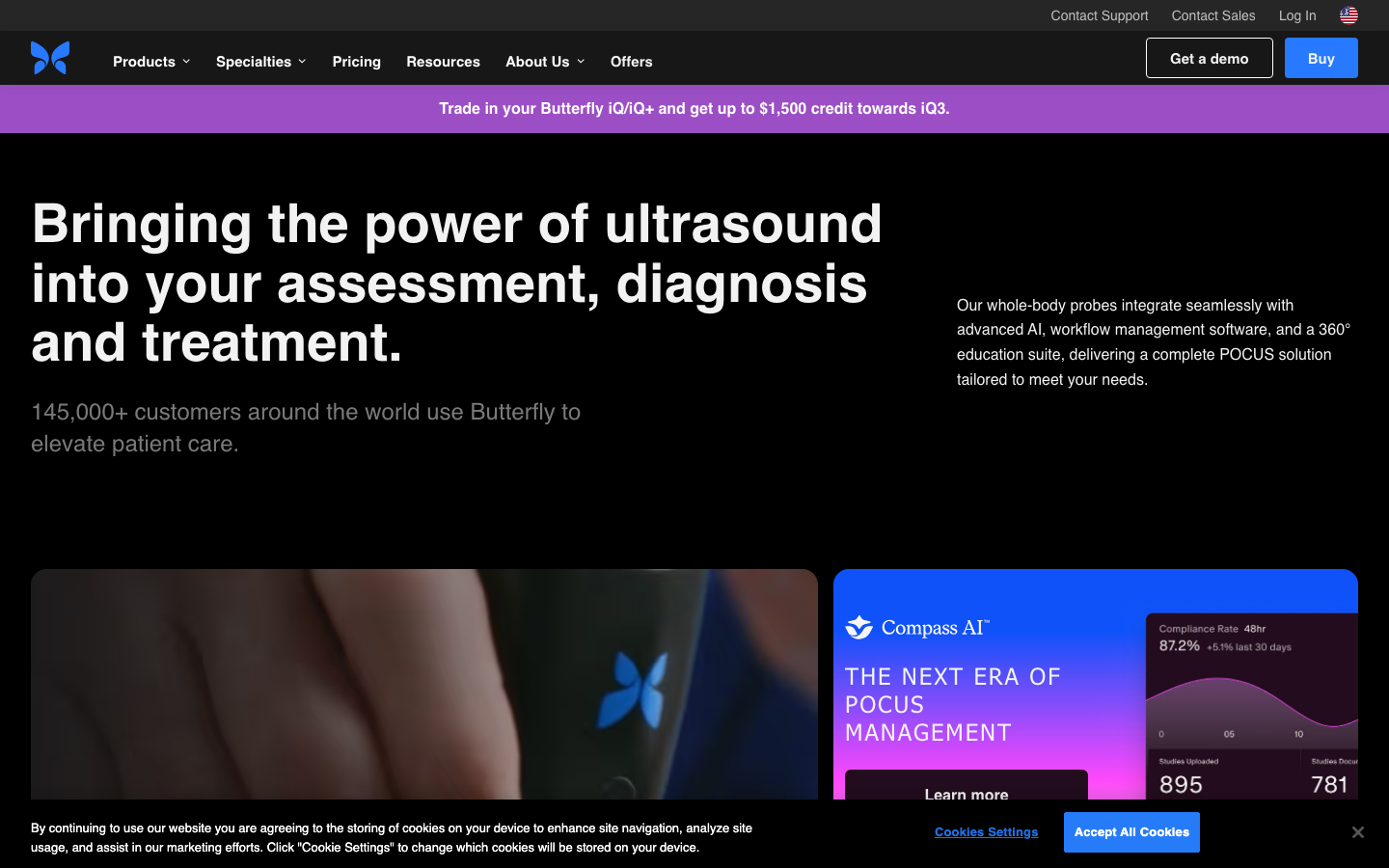
Butterfly Network tool text
Core parameters and statistics
| Parameter items | Public information |
|---|---|
| Product Positioning | Portable AI Ultrasound Imaging and Remote Diagnosis Platform |
| Core products | Butterfly iQ3 (handheld ultrasound device), Butterfly Cloud (cloud platform) |
| Core Technology | Ultrasound-on-Chip™ Single-chip Semiconductor Ultrasound |
| FDA Status | FDA 510(k) Approval |
| AI function | Automatic image optimization, anatomical structure recognition, guided acquisition Bladder AI |
| Platform Compatibility | iOS / Android Mobile Devices |
| Cloud services | Butterfly Cloud (storage, management, remote consultation) |
| Developer Platform | Butterfly Garden (Third-party AI application development) |
| Founder | Jonathan Rothberg (inventor in the field of DNA sequencing) |
| Established | 2011 |
The fundamental difference between Butterfly Network and traditional ultrasound manufacturers lies in the hardware architecture: semiconductor chips replace traditional piezoelectric crystal transducers. This allows the probe to be reduced in cost and size to pocket size, and ultrasonography can be expanded from a fixed device in the radiology department to any clinical scenario. AI capabilities further lower the operating threshold, allowing non-ultrasound professional doctors to complete standardized diagnostic-level examinations.
User and market recognition
- Hardware innovation recognized by the industry: Butterfly iQ is the first single-chip handheld ultrasound device approved by the FDA, creating a new category of "pocket ultrasound". The products cover dozens of countries around the world and are widely used in emergency department ICU, primary medical care, battlefield medical care, sports medicine and other scenarios.
- Supported by clinical research: Multiple independent studies have verified the accuracy of Butterfly iQ in emergency FAST examination, central venous catheter guidance, bladder urine volume measurement, early pregnancy assessment, etc. The results are well consistent with large desktop ultrasound equipment.
- AI functions gradually implemented: Butterfly continues to add AI auxiliary functions, including automatic image optimization (Auto B-mode), automatic marking of anatomical structures, Bladder AI (automatic bladder urine volume calculation), etc. These features reduce the learning curve for ultrasound operations, allowing more clinicians to complete targeted examinations independently.
- Developer Ecosystem: The Butterfly Garden platform allows third-party developers to build AI applications based on Butterfly's ultrasound data, expanding the possibilities of the device in specialist diagnosis.
Cost advantage
C client/individual: Butterfly iQ3 is sold as a device to individuals or small clinics. The price of a single device is about $2,000-$3,000 (subject to the official real-time pricing). Users need to purchase an additional Butterfly Cloud subscription plan to use cloud storage and advanced AI features. Compared with traditional desktop ultrasound equipment that costs $50,000-$200,000, the hardware threshold is significantly lower.
Developers/API: The Butterfly Garden developer platform allows third-party developers to develop AI applications on Butterfly devices. The developer plan and API pricing are not disclosed, and developers need to obtain qualifications and API keys through Butterfly’s developer application process.
Enterprise/Private: Healthcare systems can deploy Butterfly devices using a volume purchase + annual cloud subscription model. Contracts for large health systems often include device volume discounts, Cloud Enterprise Edition (with advanced analytics and management dashboards), and IT integration support. For health systems covering multiple campuses, Butterfly's portability allows ultrasound examinations to be completed in the emergency department, wards, outpatient clinics, and even patients' homes, reducing patient transport costs and radiology department occupancy.
Main functions
- Single-Chip Ultrasound Imaging: Butterfly iQ3 uses Ultrasound-on-Chip technology, which uses a single silicon chip to replace the hundreds of piezoelectric crystals of traditional ultrasound equipment. It supports multiple inspection modes throughout the body (abdominal, cardiac, pulmonary, obstetric, vascular, musculoskeletal, etc.), and a single probe can cover all application scenarios without the need to replace probes for different inspection depths.
- AI-assisted image acquisition: Needle Viz™ assists needle visualization Auto B-mode automatically optimizes image gain and depth Bladder AI automatically calculates bladder urine volume Cardiac AI assists cardiac section recognition. AI analyzes the image quality in real time in the background and guides the operator to adjust the probe position to obtain a standard diagnostic section.
- Butterfly Cloud Cloud Platform: After the inspection is completed, the image is automatically uploaded to the cloud (HIPAA compliant). Supports remote consultation, structured report generation, teaching annotation and cross-device data synchronization. Primary doctors can request ultrasound experts from higher-level hospitals for remote interpretation with one click.
- Butterfly Garden Developer Platform: Open SDK and API, allowing third-party developers to build AI diagnostic applications based on Butterfly's ultrasound data. Including lung ultrasound AI analysis, carotid artery intima thickness measurement, musculoskeletal assessment and other expanded applications.
- Remote medical education and training: Butterfly provides an online training platform (Butterfly Academy) to help clinicians master ultrasound operation skills. The AI guidance function further shortens the learning cycle from "zero basics" to "ability to complete standard inspections".
Model and version evolution
Hardware version
- 2018 — Butterfly iQ original: the first FDA-approved single-chip handheld ultrasound device, connected to iPhone, priced at about $2,000. Created the personal handheld ultrasound market.
- 2022 — Butterfly iQ+: The second generation product, improves the ergonomic design of the probe, extends to Android compatibility, and improves image processing performance.
- 2025 — Butterfly iQ3: The third generation product, the image quality is significantly improved, the AI function is enhanced (Needle Viz, Cardiac AI, etc.), and the probe design is further optimized.
Software and AI evolution
- Butterfly Cloud Release: Shift from local storage to cloud management, supporting remote consultation and data sharing.
- Butterfly Garden launched: open developer platform, third-party AI application ecosystem launched.
- AI functions continue to expand: From the initial automatic image optimization, it is gradually expanded to professional AI tools such as Bladder AI, Needle Viz, and Cardiac AI.
Technical advantages
- Mechanism — Effect — Scenario: Butterfly uses CMOS semiconductor technology to manufacture a miniature ultrasonic transducer array (approximately 9,000 micro MEMS transducing elements) on a single silicon chip. The chip electronically controls beamforming and focusing, eliminating the need for machining of traditional piezoelectric crystals. Effectively, this architecture reduces the cost of the probe by more than 10 times, reduces the size of the device to the size of a pocket, and supports multiple inspection modes throughout the body. Applicable scenarios: FAST trauma examination in the emergency department, daily lung assessment in the ICU, first visit screening in primary care facilities, and home monitoring in telemedicine.
- AI lowers the operating threshold: The learning curve of traditional ultrasound is as long as 6-12 months. The AI guidance function helps the operator quickly find the standard section through real-time feedback ("The probe is too left", "Please increase the pressure"). Effectively, non-ultrasound professional doctors (emergency department ICU, general practice) with short-term training can complete targeted ultrasonic examinations with diagnostic value.
- Cloud native data architecture: The check-and-upload design avoids the problem of images staying local in traditional ultrasound equipment. Centralized management of cloud data provides a data foundation for AI model training, quality control and multi-center research.
- Open ecological strategy: The open strategy of the Butterfly Garden platform differentiates it from the closed systems of traditional ultrasound manufacturers. Third-party developers can build vertical diagnostic applications on the device platform, accelerating the implementation of AI ultrasound in specialized scenarios.
How to use
- Web client: You can use it by visiting the official website and registering an account. Most functions do not require installation.
- API access: Provides RESTful API, developers can obtain the API Key and integrate it into their own applications.
Product Pricing
The pricing model is subject to the official real-time page. Usually a freemium or subscription system is used, and basic functions can be used for free. Advanced functions or high-frequency use require paid subscriptions, and users are advised to evaluate the optimal solution based on actual usage.
Application scenarios
- FAST trauma examination in the emergency department: After trauma patients arrive at the emergency department, emergency doctors use Butterfly iQ3 to complete the FAST examination (assessing whether there is free fluid/bleeding in the chest and abdominal cavity) at the bedside, without waiting for the radiology department and large ultrasound equipment. The AI guidance function ensures that operators can still complete standard sections under stressful circumstances. Key points for verification: Consistency with the official ultrasound examination results of the radiology department needs to be reviewed regularly at the department level.
- ICU Daily Lung Ultrasound: ICU patients often require daily assessment of lung conditions (pulmonary edema, pleural effusion, pneumothorax, etc.). Handheld ultrasound can be performed quickly at the bedside, eliminating the risk of patient transport to the radiology department. Bladder AI assists in bladder urine volume measurement and reduces unnecessary catheterization operations.
- Primary medical care and remote consultation: Doctors at community health centers use Butterfly iQ3 to complete basic ultrasound examinations, and the images are automatically uploaded to higher-level hospitals through the Cloud platform. Ultrasound experts remotely view images online and issue diagnostic opinions, realizing a hierarchical diagnosis and treatment model of "baseline examination, superior diagnosis".
Applicable people
- Emergency Department & ICU Physicians: Bedside rapid ultrasound assessment is a core skill in emergency and critical care medicine. Butterfly's portability and AI guidance function allow more doctors to complete targeted examinations independently. Prerequisite: Completion of Basic Ultrasound Training (online courses available through Butterfly Academy).
- Primary and General Practitioners: In community health care settings that lack the resources of radiologists and sonographers, Butterfly empowers general practitioners to complete basic ultrasound screenings. Not applicable: Scenarios requiring advanced ultrasound diagnostic capabilities (e.g. screening for fetal malformations, precise measurement of heart valves) still require referral to specialists.
- Medical System Procurement and Information Technology Department: Evaluate the impact of Butterfly batch deployment on radiology department workflow, including examination volume offloading, image storage compliance, and integration solutions with existing PACS/EHR.
Not Fit Boundary: The image quality of Butterfly iQ3 is still lower than that of high-end desktop ultrasound equipment and is not suitable for advanced diagnostics that require extremely high resolution (such as detailed assessment of fetal anatomy, myocardial strain analysis). For large radiology departments with an annual ultrasound volume of more than 10,000, Butterfly is intended as a complementary tool rather than a replacement.
Summary and Outlook
Butterfly Network has established a unique competitive position in the portable ultrasound market through the two-wheel drive of hardware subversion (single-chip ultrasound) and software value-added (AI assistance + cloud platform). The coverage of scenarios from the emergency department to telemedicine, as well as Butterly Garden's open ecosystem, give it a head start in the "democratization of ultrasound" trend.
Current limitations and uncertainties: There is still a gap between the image quality of handheld ultrasound and high-end desktop equipment; the verification data of AI-assisted functions in multiple groups of people is limited; the company's financial status is affected by market pressure after SPAC's listing; the pricing strategy and channel coverage in developing countries' markets still need to be improved. Procurement teams should conduct image quality validation in their own clinical scenarios and confirm that the Cloud platform's HIPAA compliance and data handling provisions meet local regulatory requirements before volume deployment.
Related tools:  Midjourney, stable-diffusion
How to use Butterfly Network
Butterfly Network's products serve users at different levels:
- Individual/Small Clinic Purchase: Order the Butterfly iQ3 probe online, download the supporting App to your iOS or Android device, and register for a Butterfly Cloud account to start inspection. No complicated installation or calibration required.
- Medical Institution Deployment: The medical system signs a bulk purchase and Cloud Enterprise Edition contract with the Butterfly business team. The IT team completes the integration configuration with the hospital EHR system (optional).
- Daily examination process: Connect the probe → Start the App → Select the examination mode (abdominal/heart/lung/musculoskeletal, etc.) → AI-guided image collection → Automatically upload to the cloud → Generate structured report → Optional remote consultation.
- Developer Access: Join the Butterfly Garden Developer Program, obtain SDK/API documentation and sandbox environment, and develop or deploy AI applications based on ultrasound data.
Comparison of competing products
| Comparison dimensions | Butterfly Network | Competitor A | Competitor B |
|---|---|---|---|
| Core Differences | — | — | — |
| Price | — | — | — |
| Target Users | — | — | — |
Note: The above comparison is based on product public information, and actual differences are based on user experience.
Version Info
- Butterfly iQ3 :The third generation of handheld ultrasound equipment has significantly improved image quality and enhanced AI assistance functions. There is no official precise date yet.
- Butterfly iQ+ :Second generation product, improved probe design and AI-assisted image acquisition function. There is no official precise date yet.
- Butterfly iQ :The first FDA-approved single-chip handheld ultrasound device, creating a new category of portable ultrasound. There is no official precise date yet.
User Reviews