 ByteDance Dolphin
Free
ByteDance Dolphin
Free
ByteDance Dolphin is ByteDance's open source document parsing model. It performs structure recognition, content extraction and Markdown/JSON output around PDF, scanned documents and complex layout documents. Its core advantage is the efficiency of two-stage document understanding and parallel parsing.
ByteDanceDolphin
Core parameters and statistics
[A brief comment in one sentence]: It is not "another OCR model", but a document structuring engine that splits layout understanding, reading order, element cropping and content parsing into two stages of execution.
[Publicity Verification]: The official warehouse describes Dolphin-v2 as a universal document parsing model. This statement is not an exaggeration, because it does clearly distinguish between digital-born and photographed documents, and adopts different parsing strategies for different document paths. However, "universal" does not mean "brainless, all-inclusive". Complex scanned documents, cross-page logic and extreme tables still require additional verification.
| Projects | Public Information |
|---|---|
| Current mainline | Dolphin-v2 |
| Parameter scale | v1/v1.5 is 0.3B, v2 is upgraded to 3B |
| Paper Status | ACL 2025 Acceptance |
| Open source portal | GitHub, Hugging Face, arXiv |
| Support output | JSON, Markdown, element-level results |
| Key capabilities | Layout analysis, reading order prediction, table/formula/code analysis, multi-page PDF |
| Public Performance | Dolphin-v2 metrics on OmniDocBench are significantly better than v1.5 and v1 |
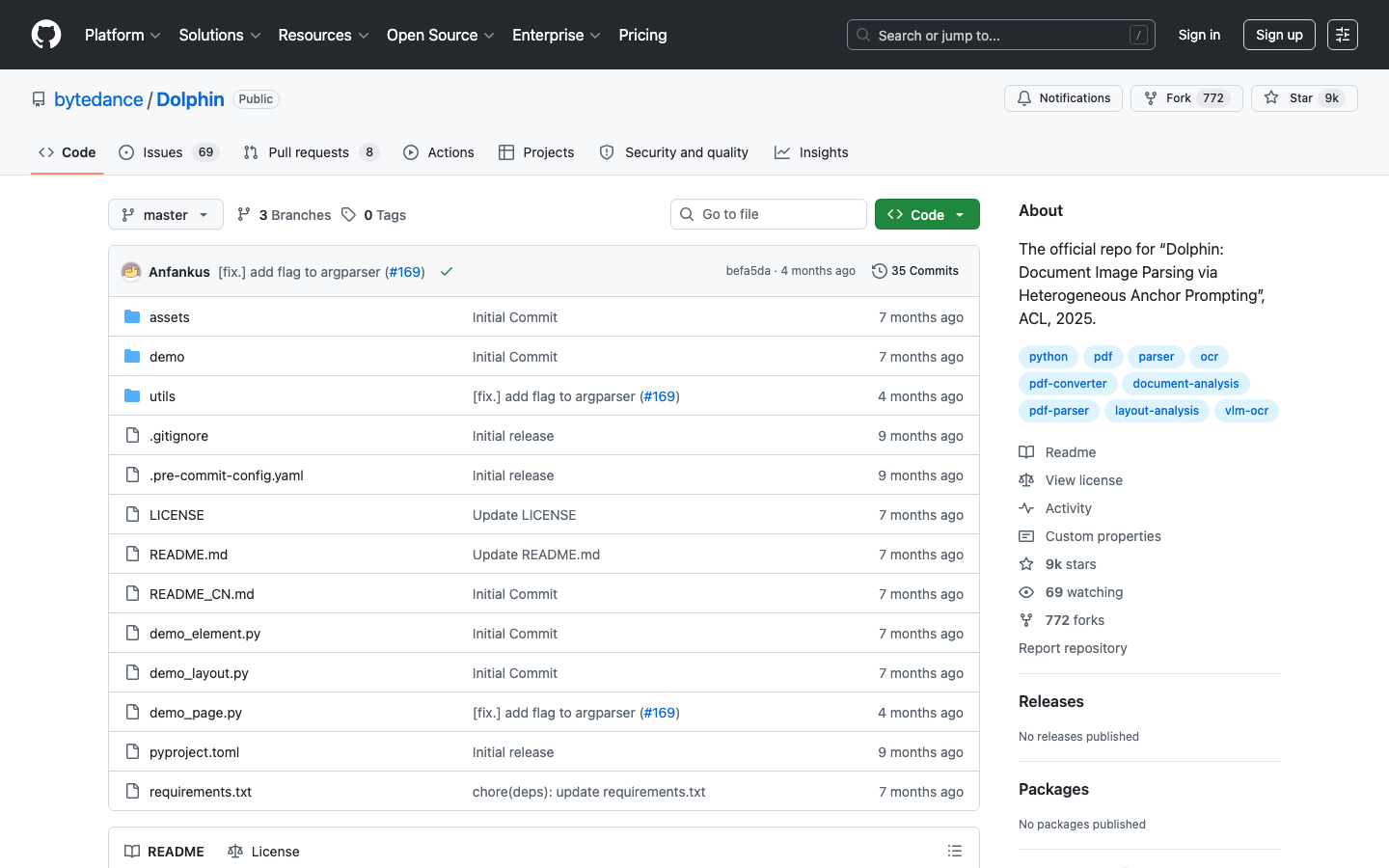
| Community size | GitHub about 9k stars, 772 forks |
Expert’s point of view: What is worth watching about Dolphin is not “competing with others”, but that it has made “understand the layout first, then analyze the content” an engineering route. This directly determines that it is easier to obtain structured and downstream consumable results in complex document scenarios than solutions that only do end-to-end OCR.
User and market recognition
Approximately 9k stars and 772 forks on GitHub indicate that Dolphin has received significant developer attention. For an open source model of document parsing, this size is enough to show that it is not a temporary project within the laboratory, but a tool chain component that will be tried out and re-integrated by real teams.
User and market recognition: The official also released the ACL paper Hugging Face model card and demo simultaneously, which means that it is targeted at both researchers and engineering teams. Especially for teams doing document digitization, knowledge base cleaning, and bill/report processing, this type of model that can implement JSON/Markdown is more practical than simply recognizing text.
Publicity Verification: If you interpret it as "replacing all commercial OCR suites", this is obviously too much; but if you position it as the core engine of the open source document parsing platform, the official capability boundaries are credible.
Hidden benefits: Compared with OCR that only returns a full page of plain text, Dolphin's structured output can significantly reduce post-processing rules and manual cleaning costs, which is especially obvious in long documents, tables, and formula scenarios.
Cost advantage
The truth about free: Dolphin is open source and free, but free does not mean low threshold. After v2 is upgraded to 3B, although the effect is stronger, the complexity of inference resources, model downloading and deployment will also increase. For teams doing only light OCR, the real comparison is "total system cost" rather than license price.
| Cost layer | Disclosure | What it actually means |
|---|---|---|
| C-side/personal | No independent consumer product | More like a R&D component than an ordinary user App |
| Developer/API | Open source and free, can be deployed by yourself | The cost lies in computing power, model download, inference framework and maintenance |
| Enterprise | No public commercial package | If you enter production, you need to complete the permissions, auditing, flexibility and SLA yourself |
Hidden costs: The first is model and inference framework selection. vLLM, TensorRT-LLM, and Transformers solutions each have engineering tradeoffs. The second is the cost of document pre-processing. Poor image quality, rotation, shadowing and multi-language mixing will amplify errors. The third is downstream schema alignment. Being able to identify the structure does not mean being able to write it directly and losslessly into the business system.
Hidden benefits: If the company is still using the old method of "OCR recognition of full text + hard demolition of a bunch of rules", structured models such as Dolphin can most save the cost of rule maintenance and manual rework.
Main functions
- Two-stage document parsing: first classify and do layout analysis, and then parse the content by element or entire page.
- Reading Order Prediction: Not only identifies elements, but also attempts to restore the natural reading order, which is especially important for Markdown output.
- Multi-granularity analysis: supports page-level and element-level processing methods.
- Complex element extraction: covering text, tables, formulas, codes and other elements.
- Multi-page PDF support: The official changelog has disclosed multi-page PDF parsing capabilities.
- Inference Acceleration Adaptation: Support for vLLM, TensorRT-LLM, etc. indicates that it is oriented to real deployment, not pure paper reproduction.
Expert point of view: The most critical hidden linkage here is "Layout -> Element Clipping -> Special Prompt Word Analysis". It means that different elements no longer share the same parsing tone and output template, which is the core source of improving the quality of complex documents.
Model and version evolution
Initial stage
Dolphin 1.0: 2025-05-20 The pre-training model and inference code are made public, establishing an open source entrance.
Lightweight enhancement stage
Dolphin-1.5: 2025-10-16 Improved parsing performance while maintaining the 0.3B architecture, indicating that the team has polished "lightweight usability" first.
Capability expansion stage
Dolphin-v2: Upgraded to 3B on 2025-12-12, adding 21 new element detection, attribute extraction, photo document capabilities, formulas and code special analysis. This is a key version from "lightweight and practical" to "more general and stronger structure".
Current limitation: The warehouse does not have a GitHub Releases mechanism, and version evolution relies more on the README changelog. It is suitable for pinning commits or branches before accessing, rather than blindly following the master.
Technical advantages
ByteDance Dolphin is a cross-type of [RAG / knowledge base / data center] and document parsing basic components. It is evaluated here by its main delivery form "document parsing infrastructure".
Data Boundary: The official clearly considers both digital-born and photographed documents, indicating that it does not only focus on the PDF text layer, but also targets more complex real-life document images. The advantage is that it can handle scanned documents and photographed documents; the limitation is that extreme blur, severe perspective distortion, and low-resolution scans will still cause significant quality loss.
Recall Pain Points: The real difficulty in document parsing is not only character recognition, but also multi-lingual mixing, professional terminology, spread of tables, nested formulas and layout breaks. Although Dolphin is stronger than traditional OCR in these sections, once it enters a RAG or knowledge base link, it is still recommended to use Hybrid Search, metadata filtering, and page-level and element-level mixed chunking to reduce retrieval bias.
Security Compliance: The official public warehouse does not disclose enterprise governance information such as RBAC, tenant isolation, and whether data is used for secondary training. The biggest benefit of open source self-deployment is that the data is controllable, but the biggest cost is that these governance capabilities must be supplemented by yourself.
How to use
The official repository has provided the core installation and reasoning paths.
git clone https://github.com/ByteDance/Dolphin.git
cd Dolphin
pip install -r requirements.txt
git lfs install
git clone https://huggingface.co/ByteDance/Dolphin-v2 ./hf_model
python demo_page.py --model_path ./hf_model --save_dir ./results --input_path ./demo/page_imgs/page_1.png
Entrance Description:
| How to use | Suitable for whom | Instructions |
|---|---|---|
demo_page.py |
Team that does full-page parsing | Directly output page-level structure results |
demo_element.py |
Team doing fine element extraction | Suitable for separate processing of tables, formulas, and codes |
demo_layout.py |
A team that does layout understanding and pre-analysis | Suitable for pre-layout diagnosis |
Boundary of human-computer collaboration: Batch extraction can be automated, but high-value contracts, medical documents, financial statements and complex academic PDFs still need to be reviewed by humans before going online, focusing on table alignment, missing formulas and broken cross-page relationships.
Product Pricing
Public pricing doesn't exist because it's an open source model, not off-the-shelf SaaS.
C-side/Individual: There is no purchase entrance for ordinary users.
Developer/API: The most important costs are model download, inference deployment, graphics memory and throughput optimization.
Enterprise: If you want to build an internal analysis platform, in addition to the cost of reasoning, you must also include permissions, caching, task queues, result verification, and log management.
The Free Truth: Open source saves license fees, not system costs. Once document parsing reaches production, computing power and data management will never be bypassed.
Application scenarios
- Knowledge base pre-processing: Structure PDFs, reports and papers first, and then send them to retrieval and Q&A links.
- Academic document and formula analysis: Especially suitable for scientific research materials with mixed formulas, tables and text.
- Enterprise document digitization: Structured extraction of contracts, technical documents, and business reports.
- Multi-page PDF batch processing: Convert large amounts of historical documents into indexable, downstream-consumable structured data.
Dimensionality reduction strike scenario: When the team has been severely tortured by traditional OCR due to tables, formulas and reading order issues, using it will have a very obvious improvement in structural quality.
Current Limitations: If a business only needs plain ticket OCR or single-column document text extraction, it may not necessarily be the most cost-effective option due to the higher engineering complexity.
Applicable people
- Platform team working on knowledge base/RAG: High-quality document preprocessing is required.
- Document AI Product Team: Want to upgrade OCR from plain text recognition to structure understanding.
- Research and Education Team: More valuable when dealing with papers, textbooks, test papers and materials with formulas.
Persuasion Scenario:
- People who just want low-barrier out-of-the-box use: It's more like model components, not off-the-shelf SaaS.
- Teams without GPU or model deployment experience: Deployment and acceleration configuration will bring a lot of barriers.
- Think of it as a "universal and error-free OCR" team: Complex document parsing still requires random inspection and downstream correction.
Summary and Outlook
The competitiveness of ByteDance Dolphin lies in its ability to advance document understanding from "full page literacy" to "structure first, content later". This is critical for knowledge bases, enterprise documents, and research material processing, because what really determines downstream usability is often not character accuracy, but whether tables, formulas, code blocks, and reading order remain true.
[Procurement/Adoption Risk Assessment]: The most important thing to evaluate before adoption is your document type, rather than just looking at the list score. If a large number of documents are complex academic PDFs, multi-page reports, mixed tables and formulas, Dolphin is valuable; if it is just light text OCR, the problem of "overcapacity and overengineering" may arise. What is worth continuing to observe in the future is the follow-up inference acceleration ecosystem of v2, the stability of photographed documents, and the speed of the community's replenishment around schema standardization and enterprise governance.
Version Info
- Dolphin-v2 :The latest mainline version disclosed in the official warehouse changelog has been upgraded to 3B parameters, adding 21 types of element detection, attribute field extraction, specialized formula and code analysis, and stronger photo document processing capabilities.
- Dolphin-1.5 :Significantly improving the parsing effect while maintaining the 0.3B lightweight architecture is an important node in moving from the first version to practical use.
- Dolphin 1.0 :The official disclosed the pre-training model and inference code for the first time, establishing a complete open source entrance for document parsing.
User Reviews