 cal.love
Free
cal.love
Free
Cald.ai is an AI office and efficiency tool that uses AI phone agents to automate inbound/outbound calls, covering scenarios such as customer service, data collection, and real-time alarms, and supports seamless human-machine transfer.
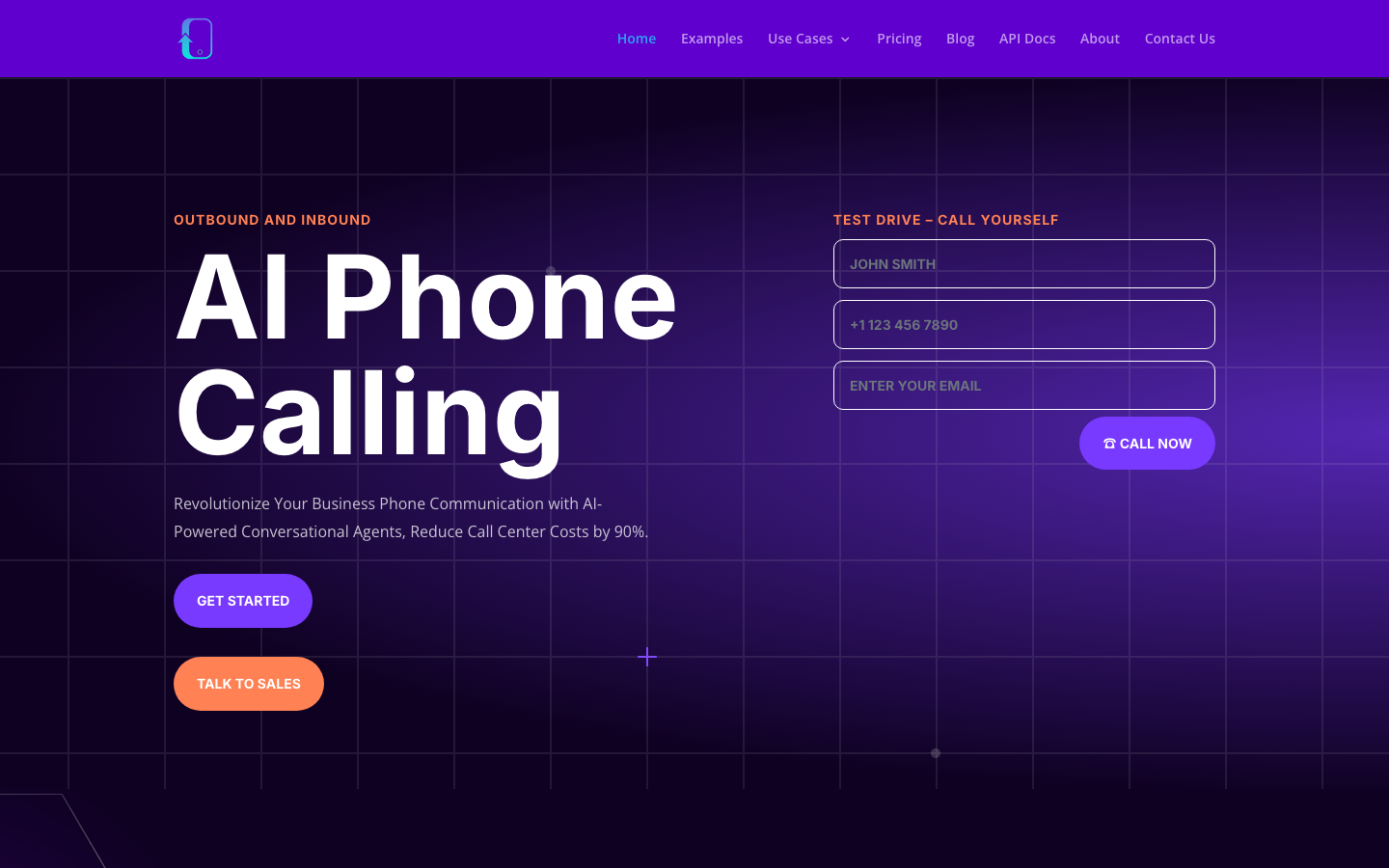
Cald.ai
Core parameters and statistics
| Projects | Public Information |
|---|---|
| Product Name | Cald.ai |
| Official entrance | https://cald.ai/ |
| Product Positioning | AI Phone Calling & Conversational Agents Platform |
| Core form | SaaS platform, supporting inbound and outbound two-way calls |
| Support Platform | Web, API |
| Supported languages | en-US (multi-language voice support) |
| Call Capacity | 10,000+ calls in a single day |
| Latency level | <1 second (ultra-low latency voice interaction) |
| Version visibility | The official unified semantic version number has not been disclosed |
Positioning Boundary: The essence of Cald.ai is an AI phone middle platform - it is not a general chatbot, nor a CRM system, but a vertical tool that specifically solves the specific problem of "how to use AI to replace or assist manual phone communication". Its value is highest in scenarios with intensive call volume and relatively standardized speaking skills. In scenarios that require deep emotional resonance, complex negotiations or highly personalized communication, it needs to be accompanied by manual support.
Brief review in one sentence: Cald.ai is a product that encapsulates the voice capabilities of a large model into a phone agent that can be dialed directly. The core selling point is not the model itself, but "out-of-the-box phone automation" - users do not need to build a voice pipeline or deal with the SIP protocol. They can configure speaking skills in the background of the web page to let AI make or answer calls for you.
User and market recognition
Public operation signal: The product official website is continuously accessible, the registration process is complete, a free trial channel is provided, and it is an active operation status. Officials claim to have served customers with more than 10,000 daily calls, but the specific list of corporate customers and case details have not been fully disclosed on the public page.
Market positioning: Cald.ai is in a fragmented competitive landscape in the AI phone agent track. There are both underlying communication API vendors such as Twilio, as well as competing products such as Retell AI, Bland AI, and Vocode. Cald.ai adopts an "end-to-end platform" strategy - from call configuration, number management, call execution to post-call analysis, all are completed within one interface, lowering the usage threshold for non-technical teams.
Industry Benchmarking: Compared with self-built solutions that directly call voice APIs, Cald.ai’s differentiation lies in out-of-the-box interrupt handling, end-to-end latency of less than 1 second, and in-depth optimization of call-specific functions such as live transfer and voicemail recognition. However, its brand awareness and breadth of ecological integration still lag significantly behind infrastructure vendors such as Twilio.
Cost advantage
C-side/individual users: 100 minutes of free quota are provided, and users can fully experience the AI call making and answering process without paying. The free credit is enough to complete a small-scale proof of concept (such as 50-100 test calls), but continued use requires upgrading to a paid plan. The hidden cost for individual users is the learning cost—the time it takes to configure speech templates and test call quality.
Developer/API integration: Cald.ai has not disclosed the precise unit price of API pay-as-you-go billing (such as the cost of calls per minute). Currently, it only shows the tiered package structure: free entry (100 minutes), usage discount (10,000 minutes/month) and enterprise customization. When integrating, developers need to pay attention to the additional costs beyond call minutes - monthly number rentals, concurrent channel fees, and excess rates beyond the package. These details need to be confirmed by the business.
Enterprise/Private: Enterprise-level plans come with customized quotes that include SLA guarantees, dedicated number pools, call data auditing and compliance terms. The official enterprise starting price has not been disclosed. When selecting a model, enterprises need to conduct an overall ROI deduction based on Call Center manpower savings (officially claimed to be up to 90%) and technology procurement costs. Please note: 90% cost reduction is usually based on the ideal model of "AI completely replacing manual customer service". In actual deployment, the labor costs of manual backup, exception handling, and system operation and maintenance need to be superimposed.
Cald.ai’s main features
Cald.ai's function stack is designed around three sections: "Pre-call configuration → Interaction during the call → Post-call analysis". The synergy between each section constitutes its core product barrier.
-
AI Conversation Agent (Core): Based on the fusion stack of first-class large language model and speech model, it drives the AI agent to complete natural and smooth phone conversations. Supports interruption processing (Interruptions) - when the user interrupts, the AI can pause or adjust the reply like a real person, instead of mechanically waiting for the input to be completed. This is the detail that most affects user experience in the AI phone scenario, and is also the shortcoming of many general voice APIs.
-
Ultra-low latency interaction: End-to-end latency is controlled within 1 second, matching the natural conversation rhythm of humans. Latency is a hard indicator of phone AI - a pause of more than 2 seconds will directly lead to the user repeating the question or hanging up. Cald.ai achieves near real-time response through optimized speech model links and edge processing architecture.
-
Real-time analysis and post-call insights: Output structured analysis data (conversation summary, sentiment analysis, keyword extraction, action item identification) immediately after the call ends, converting unstructured voice data into queryable and statistical business records. The value of this feature is particularly significant in scale scenarios—the cost of managing 1,000 human calls for quality inspection is much higher than the cost of AI automated summarization.
-
Human-in-the-loop: When the AI agent identifies scenarios that require manual intervention (such as complaint escalation, complex business consultation, and customers explicitly requesting transfer), the AI agent can transfer the call to the preset agent team with zero delay. This solves the trust problem at the heart of AI calling – “what if the AI messes up”.
-
Voicemail recognition and SMS integration: The AI agent can automatically recognize voicemail prompts and choose to leave a message or hang up according to the preset policy; text messages can also be sent simultaneously during the call to achieve a multi-modal touch of "call + text".
-
Multi-language voice support: Supports seamless communication in the user's preferred language, suitable for multinational customer service, multi-language data collection and other scenarios. Currently it mainly supports English, and the coverage of more languages is subject to the official real-time page.
Model and version evolution
Current main line
- Web Latest (~2026-06): Currently publicly available form. Semantic version numbers are not used, and feature updates are continuously iterated through the web front end. Suitable as a POC baseline.
Historical Milestones
- Public Beta (~2025-01): The platform is open to registration for the first time, and initially focuses on inbound customer service and simple outbound notification scenarios. There is no official precise date yet.
Version management strategy
Cald.ai is a SaaS service, and function iteration is controlled by the server, and the user does not need to manually upgrade the version. This means all users always have access to the latest features, but it also means there may be no advance notice window for key feature changes. When enterprises embed Cald.ai into core processes, it is recommended to track functional changes through the version identification returned by its API or the communication interface change log to avoid incompatible speech templates caused by updates.
Technical advantages
Mechanism: Cald.ai's technology stack consists of three layers - the bottom layer is a fusion inference engine of large models and speech models, which is responsible for understanding the conversation context and generating natural voice responses; the middle layer is the call state machine, which manages the call life cycle (connection, interruption, transfer, hang-up) and exception handling; the upper layer is the configuration and analysis layer, which provides speech templates, number management and call data analysis.
Effectiveness: The three-layer separation design allows model upgrades without affecting the call logic. There is no need to modify the code to adjust the speaking skills, and the analysis data is automatically associated with the complete context of each call. The direct effect is that the non-technical team can independently complete 80% of the daily configuration work (voice adjustment, number allocation, transfer rules), and the technical team only needs to focus on API integration and exception handling.
Applicable Scenarios: Most suitable for standardized scenarios where the speech structure is relatively fixed but the call volume is large. For example: e-commerce after-sales return visits (the speech skills are highly templated), logistics notifications (the message content can be parameterized), and customer satisfaction surveys (the questionnaire structure is stable). In these scenarios, Cald.ai’s “configure and go live” model can compress the go-live cycle from weeks to days.
Project pitfall tips:
- Interruption sensitivity tuning: Different scenarios have different tolerances for interruptions - customer service scenarios require high interruption sensitivity to quickly respond to customers, while notification scenarios require low interruptions to ensure complete broadcasts. Cald.ai's default interruption parameters may not be suitable for all scenarios. It is recommended to conduct A/B testing before going online.
- Blind spots in conversation coverage: When a user’s question exceeds the preset conversation range, the AI agent’s LLM underlying generation capability is the last line of defense. It is recommended to configure "confidential reply + manual transfer conditions" in the speech template instead of completely relying on the model to adapt to changes.
- Number compliance and operator restrictions: Compliance requirements for automated outbound calls vary greatly in different countries and regions (such as the U.S. TCPA, China's "Regulations on the Administration of Communications Short Message Services"). The number pool and compliance coverage of the Cald.ai platform need to be confirmed before purchasing, especially in cross-border outbound calling scenarios.
How to use
- Step 1 — Registration and Free Trial: Visit https://cald.ai/, click "GET STARTED FREE" to create an account, and get 100 minutes of free call quota without binding a credit card.
- Step 2 — Configure call scenario: Select the incoming/outgoing call mode on the background, configure the AI agent's speech template, voice style (speech speed, timbre, language) and transfer rules. HuaShu template supports variable placeholders (such as customer name, order number) to realize batch personalized calls.
- Step 3 — Number Binding and Testing: Assign a number provided by Cald.ai or bring your own number (BYOC). Make a test call to yourself through the "TEST DRIVE" function to verify the delay, interruption effect and speech coverage.
- Step 4 — Integration and launch: Connect Cald.ai with CRM, work order system or marketing platform through API to automatically trigger calls (automatic outbound calls and follow-up visits after placing an order). Set up a queue for manual agents to ensure smooth transfer of calls that cannot be handled by AI.
- Step 5 — Monitoring and Optimization: Use the real-time analysis panel to view core indicators such as call volume, answering rate, average call duration, transfer rate, etc., and iterate on speech templates and triggering strategies.
Product Pricing
| Package | Call minutes | Applicable scale | Description |
|---|---|---|---|
| Free | 100 minutes | Personal trial/POC | Free experience of core functions, you need to upgrade after the quota is exhausted |
| Volume Discount | 10,000 minutes/month | Small and medium-sized teams | Need to contact sales to activate, the specific unit price has not been disclosed |
| Enterprise | Customization | Large enterprise/high-frequency scenario | Includes dedicated number pool SLA, audit support, customized integration |
Pricing Strategy Analysis: Cald.ai adopts a “free trial + business ladder” pricing model rather than a public self-service subscription (such as a fixed package with a monthly payment of $99). This strategy lowers the decision-making threshold for small-scale trials, but medium- and large-scale purchases must go through business processes, which means that the actual price is not transparent and the procurement cycle will be lengthened. It is recommended to initiate business communication at least 2 weeks in advance and request SLA protection terms and excess rate explanations.
Application scenarios
-
E-commerce after-sales return visit and satisfaction survey: Automatically call customers after placing an order to complete satisfaction scores, return or exchange confirmation, or promotion notifications. Benefits: Compared with manual outbound calls, the cost of a single call can be reduced by 70-90%, and it can cover the whole day (AI agent works 7×24 hours). Key points to verify: Customer acceptance of AI calls - some users may hang up or give negative comments because "the person on the other side is a robot".
-
Data Collection and Market Research: Structured information is collected from target respondents through outbound calls, and AI agents guide the conversation based on preset questionnaires and record answers in real time. Benefits: Significantly reduces the labor cost of data collection and supports simultaneous multi-way calls (theoretically 10,000+ calls in a single day). Key points of verification: Respondent cooperation and data quality - whether AI can identify incorrect answers and guide them back on track.
-
Operation and maintenance alarms and real-time notifications: When a server goes down, a security incident or a critical work order is triggered, the AI agent automatically makes a call to notify the engineer on duty or VIP customers, ensuring that emergency information is not flooded by emails or text messages. Benefits: The reach rate of phone notifications is much higher than that of text notifications (90%+ vs. 60-70%), and AI can be used to confirm that the other party understands the content of the notification. Key points of verification: Latency definition - whether the time window from triggering to dialing meets the operation and maintenance SLA.
-
Logistics Delivery Notification: Automatically call the recipient when the package is about to be delivered or the delivery is abnormal, provide a delivery time window, confirm collection authorization, or reschedule delivery. Scenario Characteristics: The speech is highly templated and has a high repetition rate, making it one of the best adaptation scenarios for AI phone agents.
Applicable people
-
E-commerce and retail operations team: Faced with a large number of after-sales return visits, satisfaction surveys and promotion notification needs, Cald.ai was used to replace some manual outbound calls, directly reducing the Call Center manpower budget. Prerequisite: There is an existing CRM or order system that can be connected to the Cald.ai API, and the customer data compliance policy allows AI outbound calls.
-
Small and medium-sized SaaS and technology companies: lack a dedicated customer service team, but need to provide a telephone support entrance. Tier-1 common issues are handled through Cald.ai's AI inbound agent, while only upgrade work orders are handled manually, achieving "7×24 phone support" coverage at a very low cost. Prerequisite: The FAQ library is complete and can accept the delay of artificial intelligence transfer in complex scenarios.
-
Data companies and research institutions: Questionnaire data need to be collected in batches, and the traditional CATI (computer-assisted telephone survey) system has high labor costs and limited production capacity. Cald.ai’s AI agent can simultaneously initiate multiple calls and automatically record structured data, reducing the marginal cost of data collection to close to zero. Prerequisites: The informed consent process of the interviewees complies with the regulations, and the words have been approved by IRB (ethical review) or equivalent.
Unsuitable Boundary: Communication that requires deep emotional resonance (such as bereavement notification, psychological counseling, customer complaint escalation negotiation), complex sales negotiations with highly non-standard speaking skills, and industries with strong legal supervision (such as medical HIPAA compliance scenarios, financial services recording retention requirements) are not suitable to go online directly before confirming that Cald.ai has passed the corresponding compliance certification.
Summary and Outlook
Cald.ai’s value proposition is clear – turn large-model voice capabilities into direct-dialing phone automation products. It can significantly reduce costs in scenarios with large call volume, standard speaking skills, and repetitive processes (official data points to 90% Call Center cost reduction), and takes into account both efficiency and reliability through the hybrid architecture of "AI agent + manual backup".
Current Limitations: Public information coverage is limited - accurate API call unit prices, compliance certification details (SOC2, HIPAA, etc.), and enterprise-level SLA terms must be obtained through sales channels, which adds uncertainty to pre-purchase decision-making comparisons. The flexibility of the language configuration and the quality of the underlying LLM generation jointly determine the final service experience. There are mutual constraints between the two - the more open the language, the greater the room for free play of the model, and the higher the uncontrollable risks.
Follow-up observation points: Whether Cald.ai will put standardized subscription packages on the public cloud market (such as AWS Marketplace, Azure Marketplace), and whether it will support in-depth optimization in more languages (currently mainly English), will directly affect the speed of its expansion from small and medium-sized teams to large enterprises, and from the English market to the global market.
Procurement Risk Tip: Before embedding Cald.ai into core business processes, it is recommended to complete the following verifications: (1) Clarify the hidden costs beyond call minutes (monthly number rental, overage rates, concurrency charges); (2) Confirm whether the data storage location and compliance certification match your own industry requirements; (3) Test the latency and success rate of AI transfer manual through at least 500 real traffic calls; (4) Evaluate the SLA in the contract Does the compensation clause cover scenarios such as call interruption and excessive delay?
Related tools:
Version Info
- Cald.ai Web Latest :The official semantic version number has not been disclosed. It is recorded according to the public page status. There is no official precise date yet.
- Cald.ai Public Milestone :There is currently no official precise date for historical nodes, and the minimum version context is established based on public milestones.
User Reviews