 Calmo
Free
Calmo
Free
Calmo is an Agent-Native SRE platform for AI agents and operation and maintenance engineering scenarios. It emphasizes automatic investigation starting from the first alarm, verifying multiple root cause hypotheses in parallel, and connecting code, infrastructure, observability and SOP into the same investigation link.
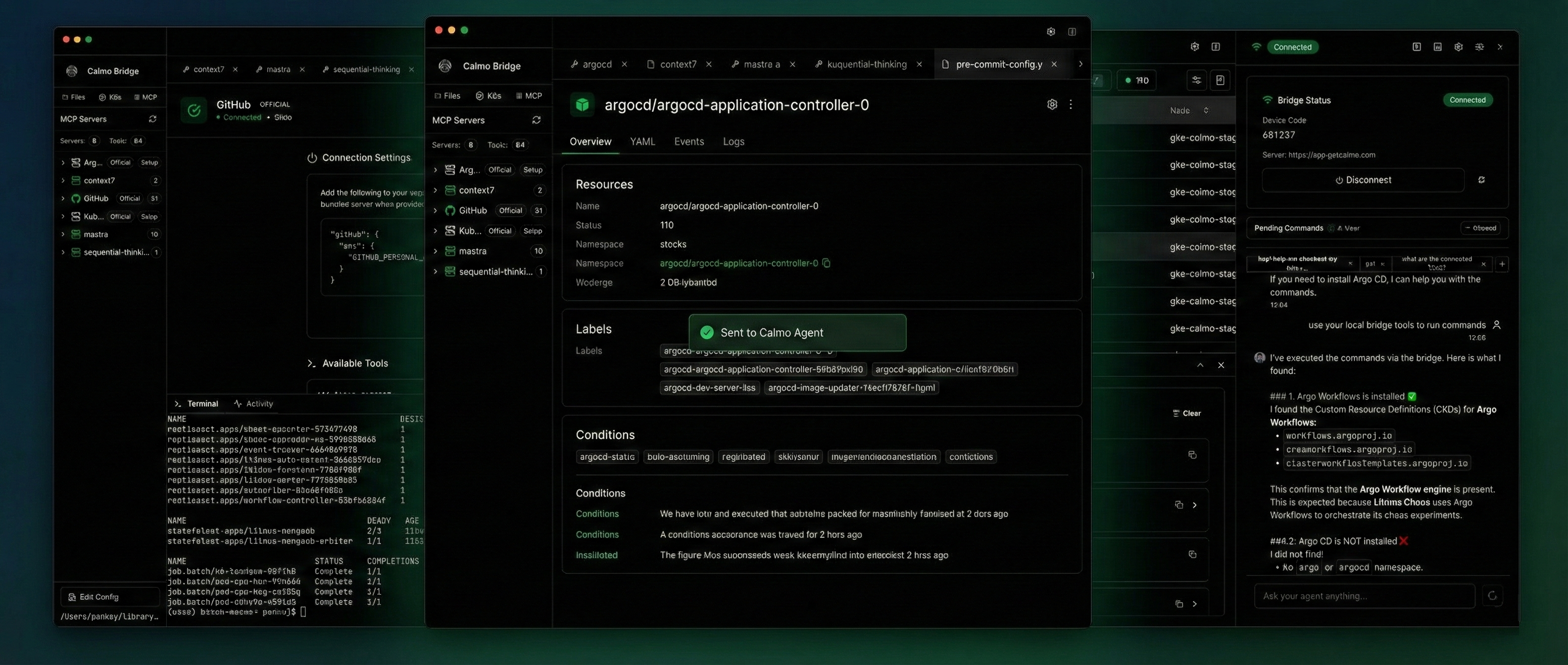
Calmo - Agent-Native SRE Platform
Core parameters and statistics
| Parameters | Details |
|---|---|
| Product Positioning | Agent-Native SRE Platform |
| Core tasks | Incident Investigation, Root Cause Analysis, Alert Triage, Remediation |
| Connected Objects | Code, Infrastructure, Observability Playbooks, SOPs, Team Collaboration Tools |
| Typical integrations | Datadog, Sentry, GitHub, Grafana, Kubernetes, Slack, Notion |
| Enterprise Features | European Storage BYO Model, On-Premise, Trust Center |
| How to get started | Web platform + CLI installation command |
A brief comment: Calmo’s selling point is not to “help you read alarms”, but to help the SRE team complete the first round of accident investigations, freeing people from “finding clues first” to “verification and decision-making”.
User and market recognition
The official website directly targets the product to SRE, DevOps and production engineering teams, and emphasizes that it can reduce alarm noise, shorten MTTR, and generate remediation plans and code/PR. What really has reference value for the team is not these slogans, but three types of verification:
- How long does it take from the first alarm to the preliminary judgment.
- How high is the access cost to real production?
- Whether automatic investigation results can be trusted and reused by engineers.
Cost advantage
The official website does not disclose the standard price, but provides a 14-day trial and ROI calculation scenario. The true cost is not only in the subscription, but also in the following three parts:
- Engineering time cost: Reduce SRE/platform engineers switching back and forth between logging, monitoring, and code.
- Accident downtime cost: shorten the positioning time and reduce the fault amplification window.
- Knowledge Loss Cost: Consolidate incident experience into SOPs and investigation assets.
Cost reduction and efficiency increase deduction (unofficial commitment):
- For teams that are frequently interrupted by high-frequency alarms, the first round of positioning time may be reduced from 30-90 minutes to a few minutes of candidate hypothesis verification.
- For new SREs, scenarios that used to rely on the verbal experience of senior engineers can be converted into SOPs and searchable survey knowledge, reducing the time of "finding someone to ask".
Main functions
- Autonomous Incident Investigation: Carry out automatic investigation after the alarm arrives.
- Parallel Hypothesis Validation: Validate multiple root cause hypotheses in parallel instead of serial guessing.
- Playbook & SOP Library: Index team fault handling experience into callable knowledge.
- Remediation Plans with Code Snippets and PRs: Generate remediation suggestions and code-level support leads.
- Infrastructure Integrations: Connect monitoring, code repository, collaboration and knowledge tools.
- CLI/Bridge IDE: Bring investigation capabilities into the actual working interface of engineers.
Hidden linkage: The strength of Calmo is to string "monitoring -> investigation -> evidence -> SOP -> repair suggestions" in one line, reducing the context break caused by multiple system jumps in traditional incident handling.
Model and version evolution
| Stage | Time | Change |
|---|---|---|
| Automatic investigation phase | ~2025-01 | Start with accident investigation and root cause analysis |
| Knowledge accumulation stage | ~2025-09 | Increase Playbook and SOP assetization capabilities |
| Agent-Native platform stage | ~2026-01 | Strengthen enterprise features such as CLI, Bridge IDE, BYO Model, On-Premise, etc. |
Technical advantages
- Parallel verification hypothesis: More consistent with the real rhythm of complex production incidents than serial troubleshooting.
- System-level context aggregation: read code, monitoring, deployment and knowledge assets simultaneously.
- Enterprise implementation awareness is strong: Publicly emphasize the European storage BYO Model, On-Premise and training without using customer data.
If you look at it from the Agent's perspective, Calmo's real actions are roughly: reading alarms and monitoring signals, querying logs and errors, correlating code repositories and changes, calling Playbook/SOP, and generating repair suggestions. The official standardized tool schema has not been made public, but the public page is enough to show that it is not a "single-round question and answer agent", but a systematic agent that organizes actions around investigation links.
The available text links can be summarized as:
Alert / Incident -> Calmo Agent -> Telemetry + Code + Playbook Context -> Hypothesis Validation -> Suggested Remediation -> Human ApprovalThis means that Calmo’s advantage is not to guess the root cause for you, but to first run through the engineer’s most time-consuming evidence aggregation and preliminary troubleshooting actions.
Human-machine collaboration boundary:
- Can be highly automated: alarm initial screening, signal aggregation, hypothesis generation, evidence collection, historical SOP calling.
- Manual confirmation is required: Production context change execution, rollback, traffic switching, permission upgrade, external customer influence decision-making.
- Not suitable for boundaries: If the team monitoring system is incomplete and the logs and metadata are chaotic, Calmo can only speed up the reading chaos, but cannot complete the observability foundation for you out of thin air.
Engineering pitfalls mainly focus on three points:
- Investigation context overload: When there are too many monitoring, log, and code signals, it is easy for the Agent to generate investigative conclusions that appear comprehensive but have the wrong priorities.
- Overtrusting auto-suggestions: Fix suggestions and PR drafts can only be used as starting points and cannot bypass production approval.
- Knowledge Base Pollution: If the SOP and Playbook themselves are out of date, Calmo will replay the old process with greater efficiency.
How to use
| Entrance | Description |
|---|---|
| Official website | https://getcalmo.com/ |
| Installation command | curl -fsSL https://getcalmo.com/get | sh |
| Product Portal | Run Investigations, Use Cases, CLI/Bridge IDE |
| Documentation | https://docs.getcalmo.com/introduction |
The official quick installation command is as follows:
curl -fsSL https://getcalmo.com/get | shSuggested implementation process:
- Connect with high-value portals such as Datadog, Sentry, Slack, and GitHub first.
- Then import the team Playbook, Runbook, and SOP to form a knowledge base.
- Use pilot incidents to verify the trustworthiness of automated investigations rather than direct full custody.
- Leave the repair suggestions in the "suggestion layer" and continue to go through the manual approval chain for production changes.
- Make it clear in the duty system which actions are only allowed to be read, which actions are allowed to generate suggestions, and which actions always require manual approval.
Product Pricing
The pricing model is subject to the official real-time page. Usually a freemium or subscription system is adopted, basic functions can be used for free, and advanced functions or high-frequency use require payment.
Application scenarios
- Production accident investigation: quickly gather evidence and preliminary root causes after the alarm arrives.
- SRE assistance for newbies: Make SOP and historical experience easier to call upon.
- Multi-system distributed troubleshooting: link logs, monitoring, code and knowledge in the same investigation link.
- Platform engineering efficiency improvement: shorten the time from discovering problems to proposing repair plans.
Applicable people
- SRE/Platform Engineering Team: Need to shorten MTTR and reduce on-call cognitive load.
- DevOps and Infra teams: Need to uniformly handle incident clues from multiple data sources.
- Project Manager: It is necessary to accumulate accident knowledge into organizational assets.
- Not applicable to the group: Teams with almost no production monitoring system, no SOP, and unwilling to transform the process.
Summary and Outlook
It provides competitive solutions in its field, and its core value lies in lowering the threshold for AI use in this field.
Current limitations: Some advanced features require paid subscription, and the free version has function or usage restrictions; specific technical details and performance benchmarks have not yet been fully disclosed.
Related tools:  CrewAI,
  LangChain
Version Info
- Agent-Native SRE Platform and Calmo Bridge IDE stage :The official website emphasizes that Calmo has been expanded from a simple investigation assistant to an Agent-Native SRE platform, supporting automatic investigation, parallel hypothesis verification Playbook/SOP knowledge base CLI installation entrance, as well as enterprise features such as BYO Model, On-Premise and European storage.
- Accident investigation and root cause analysis platform stage :The platform cuts into SRE scenarios with automatic accident investigation and root cause analysis as its core, and gradually extends to knowledge base CLI, integration and repair recommendation generation.
User Reviews