 Cerebras Inference
Free
Cerebras Inference
Free
Cerebras Inference is a high-speed inference service provided by Cerebras for generative AI applications. It provides OpenAI compatible API, Python/Node.js SDK, Cloud Console, Playground, shared public endpoints and enterprise Dedicated Endpoints, suitable for real-time chat, code generation agent workflow, batch processing and low-latency production services.
CerebrasInference
Core parameters and statistics
Relevant information has not been made public, please refer to the official real-time page.
User and market recognition
Cerebras Inference’s user profiles are biased toward developers, platform engineering teams, and enterprise AI application teams. The official Quickstart directly provides three access paths for Python, Node.js and cURL. The document also covers OpenAI’s compatibility with Cline, OpenCode, VS Code, LangChain, PydanticAI, LiveKit, Browserbase, Exa and other engineering scenarios, indicating that it is more like a layer of reasoning infrastructure that can be embedded in business systems.
Developer Approval: OpenAI is compatible with base URL, so existing OpenAI SDK projects can be migrated by replacing base_url and API key, reducing the cost of rewriting the client, message format and basic error handling. The independent release of Python SDK and Node.js SDK also facilitates the team to choose a dedicated SDK to obtain Cerebras-specific parameters.
Enterprise Approval: Dedicated Endpoints are for customers who need reserved capacity, stable throughput, private endpoints, custom weights, and production guarantees. The officially listed enterprise model family covers Qwen, OpenAI OSS, MiniMax, Gemma, Llama, Mistral, Z.AI, Moonshot, DeepSeek, StepFun, ByteDance and ServiceNow, etc., indicating that the product strategy is not to just bet on one model, but to package the wafer-level inference platform into a multi-model service layer.
Market Signal Boundary: Public information does not disclose the number of unique paying customers, revenue, retention rates, or industry distribution; therefore, the “speed narrative” should not be directly equated with production availability conclusions when evaluating. A more reliable way is to use the target model, target context length, target concurrency and target response format for stress testing, and then combine the rate limit, budget, error rate and official business terms to judge.
Cost advantage
The cost advantage of Cerebras Inference is not simply the “cheapest token”, but the faster generation speed to reduce the waiting cost of real-time products, and the use of shared endpoints or Dedicated Endpoints to match resource requirements at different stages. The official model catalog states that public endpoint models are free to use, but are subject to rate limits; the rate limits page of the documentation also lists the limit differences between Free Trial and Developer Pay as You Go.
| Usage level | Disclosure of cost/restriction information | Suitable scenarios | Notes |
|---|---|---|---|
| Free Trial | Public endpoints are free to use, limited by RPM, TPM, TPH, TPD | Prototype, model evaluation, low-frequency demo | For example, gpt-oss-120b Free tier public limit is 5 RPM, 30K TPM, 1M TPH, 1M TPD |
| Developer Pay as You Go | Developer tier is used on a budget basis, documentation lists higher RPM/TPM | Application development, early production, continuous evaluation | gpt-oss-120b Developer tier is exposed to limits of 1K RPM, 1M TPM |
| Batch API | Private preview, batch asynchronous processing, official description can bring 50% cost savings | Large-scale evaluation, data annotation, batch summary | Batch processing can take up to 24 hours to complete, SDK support is limited during the private preview stage |
| Dedicated Endpoints | Enterprise business communication, reserved capacity and private endpoints | High concurrency, low latency, stable SLA, private weight | Price SLA, capacity and data terms require business confirmation |
Three types of costs should be calculated separately during actual procurement: model inference token costs, product experience costs due to response speed, and engineering access and governance costs. For applications such as real-time voice and code completion agent tool chains, where "one second slower will significantly degrade the experience", the speed of Cerebras may be more critical than single-token quotation; for offline batch processing, the Batch API and asynchronous completion window are more worthy of attention.
Main functions
- Chat Completions and Completions: Provides an OpenAI-style chat and completion interface suitable for conversational assistants, code generation, summarization, retrieval enhancement, and multi-round workflows.
- Streaming Responses: Supports streaming output, suitable for real-time UI, voice links and interactive experiences that require fast first token feedback.
- OpenAI compatible: OpenAI Python/Node.js client can be used to connect to
https://api.cerebras.ai/v1to reduce migration costs. - Structured Outputs: Constrains the output format through JSON Schema and strict mode, suitable for connecting LLM to business databases, approval flows and automated pipelines.
- Tool Calling: Supports allowing the model to request external tool calls, and strengthens multi-round tool message verification in API v2.
- Reasoning Control: Documentation covering capabilities such as reasoning models, reasoning_effort, reasoning_format and reasoning_logprobs.
- Prompt Caching: Reuse repeated prompt prefixes to improve the time to first token for similar requests.
- Batch API and Files API: used for asynchronous large-scale request processing, suitable for evaluation, annotation, batch summarization and experiments.
- Cloud Console and Playground: Manage API keys, projects, usage, billing, organization access and interactive model testing.
- Dedicated Endpoints: Enterprise private high-performance endpoints, supporting reserved capacity, custom weight Management API, Prometheus metrics and service layer control.
Model and version evolution
The version evolution of Cerebras Inference is divided into three lines: API behavior version, model directory change SDK version. The current most important node for API behavior is Version 2: open for testing on 2026-01-21 and becoming the default version on 2026-07-21, affecting structured output, tool call reasoning logprobs and Unicode logprobs.
| Time | Change | Impact |
|---|---|---|
| 2026-06-01 | Dedicated Endpoints Added StepFun Step 3.5 Flash, Step 3.7 Flash | The enterprise model family continues to expand |
| 2026-05-01 | Projects GA | API keys, usage analysis rate limits and member access can be isolated by project |
| 2026-04-24 | Validation errors adjusted from 422 to 400 | SDK error type changed from UnprocessableEntityError to BadRequestError |
| 2026-04-22 | Added prompt_cache_key |
Improve prompt caching hit rate |
| 2026-01-21 | API v2 open testing | Preparing for migration on 2026-07-21 default switching |
| 2025-08-13 | gpt-oss-120b enters production support |
Becomes the current shared endpoint production model mainline |
| 2024-10-03 | Early public capability update | Llama 3.1 high-speed inference AutoGen integrated Playground login and parameter naming adjustment |
From the model directory, as of 2026-06-28, the production model sharing the public endpoint is gpt-oss-120b; the preview models include zai-glm-4.7 and gemma-4-31b. Dedicated Endpoints cover a wider model family and support customer-defined weights. This means that users cannot only look at "which model families are supported by Cerebras" when selecting models, but also distinguish between "shared public endpoints that can be called directly" and "Dedicated enterprise endpoints that can be deployed".
Technical advantages
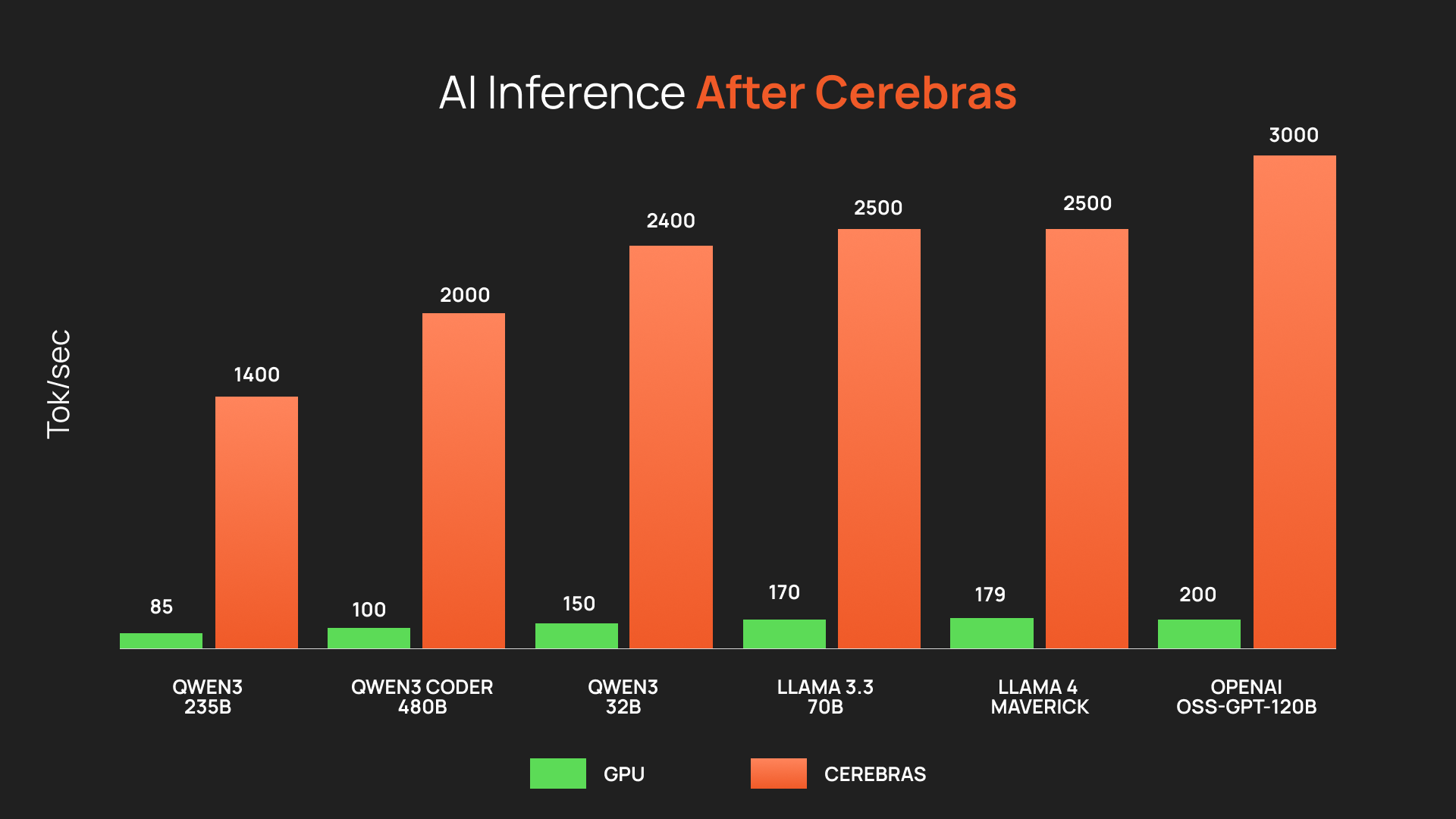
High-speed output and real-time product adaptation: The model directory shows that gpt-oss-120b is nominally about 3000 tokens/s, zai-glm-4.7 is about 1000 tokens/s, and Gemma 4 31B is about 1850 tokens/s. For code assistants, real-time customer service, voice agents, and interactive research assistants, the speed advantage directly affects whether users are willing to wait for the model to complete.
OpenAI compatible migration: Just change the base URL of the OpenAI client to https://api.cerebras.ai/v1, and then pass in the Cerebras API key to reuse a large number of existing message formats, streaming output and error handling logic. The lower the migration cost, the easier it is for teams to put Cerebras into A/B testing or multi-vendor routing.
Complete structuring and tool calling capabilities: Structured Outputs, Tool Calling, parallel tool calling, and reasoning control logprobs, prompt caching, and predicted outputs, making it not just a "chatting" endpoint, but can enter Agent orchestration, business automation, and evaluation pipelines.
Enterprise Endpoints and Observability: Dedicated Endpoints provides private reserved capacity Management API, Metrics API and Prometheus-compatible indicators, which can integrate high-throughput inference into the existing monitoring and release process of the enterprise. For production workloads that require stable latency and guaranteed capacity, this is more critical than shared endpoints.
How to use
The usage path is very straightforward: first register or log in to the Cloud Console and create an API key; then install the SDK or use cURL to access https://api.cerebras.ai/v1/chat/completions; finally observe the effect in the Playground, log rate limit header and project usage.
| Path | Entrance | Typical Steps | Suitable for Crowds |
|---|---|---|---|
| Python SDK | pip install --upgrade cerebras_cloud_sdk |
Set CEREBRAS_API_KEY -> Initialize Cerebras client -> Call chat.completions.create |
Python backend, data science, evaluation script |
| Node.js SDK | npm install @cerebras/cerebras_cloud_sdk@latest |
Set contextual variables -> Create client -> Call Chat Completions | Web backend Node service, front-end tool chain |
| OpenAI compatible | OpenAI SDK + Cerebras base URL | Replace base URL and API key -> Reuse existing OpenAI style code | Teams that already have OpenAI access |
| Cloud Console | https://cloud.cerebras.ai/ | Manage API keys, projects, bills, usage Playground | Product, engineering, platform teams |
| Dedicated Endpoints | Official website contact / Enterprise communication | Clarify model, throughput, delay, weight SLA, monitoring requirements -> Apply for dedicated endpoint | Enterprise production system |
The minimum viable pilot is recommended to select a delay-sensitive scenario, such as code completion, search summary or Agent tool calling link; use the same batch of prompts to compare response time, first token time, failure rate, output format stability and unit cost. If you use structured output or tool calls, you should use the API v2 header for compatibility testing in advance, because v2 will become the default after 2026-07-21.
Product Pricing
Official pricing information is scattered in the model directory rate limits, Batch and Dedicated Endpoints documents. The shared public endpoint model is free but limited; Developer Pay as You Go offers higher limits; the Batch API is for asynchronous scaling tasks; Dedicated Endpoints require contacting sales to confirm capacity and commercial terms.
| Product Form | Public Pricing/Restrictions | Key Values |
|---|---|---|
| Public Endpoints Free Trial | Free, subject to organization-level RPM/TPM/TPH/TPD restrictions | Quick trial, verification speed and model effect |
| Developer Pay as You Go | Document lists Developer rate limits, fees vary with budget and usage | Higher throughput, suitable for early product access |
| Batch API | Private preview, official description batch processing can save 50% cost | Non-real-time tasks such as evaluation, annotation, batch generation, etc. |
| Dedicated Endpoints | Enterprise customization | Reserved capacity, stable latency, custom weight, production SLA |
The public page does not provide a fixed token unit price list for all models, nor does it disclose the standard annual and monthly price of Dedicated Endpoints. Therefore, before formal purchasing, you should confirm: model ID, context length, input and output token unit price, free quota, budget upper limit rate limit, SLA, data retention, log visibility, region and compliance requirements.
Application scenarios
- Live Chat and Customer Service Assistant: Low-latency response can improve the multi-round conversation experience, especially suitable for web or app products that require streaming output.
- AI Programming Assistant: The documentation provides integration paths such as Cline, OpenCode, VS Code, etc., suitable for code generation, interpretation, repair and refactoring suggestions.
- Agent Workflow: Tool invocation, structured output reasoning control and high-speed models suitable for multi-step retrieval, search, browser automation and report generation.
- RAG and Trivia: Prompt Caching and
prompt_cache_keyare suitable for reusing long prefixes, knowledge base descriptions and system-level contexts. - Batch Evaluation and Data Processing: Batch API supports JSONL files, a 24-hour completion window for up to 50,000 requests, and is suitable for offline evaluation and large-scale content processing.
- Enterprise High Concurrency Inference: Dedicated Endpoints for customer-facing products, stable throughput pipelines, private weight deployment, and Prometheus monitoring.
Unsuitable scenarios also need to be clarified: if the team only needs offline low-frequency generation, is not sensitive to response time, or must use a model that is not yet provided by a shared endpoint, the advantages of Cerebras will be weakened; if strict enterprise compliance and private weights are required, Dedicated Endpoints and business confirmation must be used.
Applicable people
Developers and Startup Teams: For those who want to quickly replace or supplement existing inference providers with OpenAI compatible interfaces. Verify speed, output quality, and structuring capabilities with public endpoints before deciding whether to go down the paid or enterprise route.
AI Platform Team: Suitable for teams that need to uniformly manage API keys, projects, usage rate limits, error handling, and multi-model routing. Cerebras' strength lies in its speed, OpenAI compatibility and enterprise endpoint portfolio.
Agent and Automation Team: Suitable for building search agents, research agents, code agents, voice agents and tool calling links. High-speed response can reduce the total waiting time of multi-step links.
Enterprise Engineering Team: For organizations requiring reserved capacity, production SLAs, Prometheus metrics, private endpoints, custom weights, and higher throughput. Business users should focus on checking data processing, log retention, access control, service areas and support levels.
Use boundaries with caution: If the application relies heavily on models that are still in preview, API v2 validation rules that are about to change, or model aliases that need to be fixed for a long time, the migration plan and rollback strategy should be locked before going online. In particular, users of structured output and tool calls should complete v2 testing before 2026-07-21.
Summary and Outlook
The core value of Cerebras Inference is to package the high-speed computing capabilities of Cerebras into an inference API that developers can directly call: while being compatible with OpenAI workflows and lowering the migration threshold, it also serves enterprise-level low-latency and high-throughput production scenarios through Dedicated Endpoints. The current main line of shared endpoints is concentrated on gpt-oss-120b, the enterprise endpoint model family is wider, and the product strategy is clearly divided into two layers: "quick start with public endpoints" and "stable production of exclusive endpoints".
The next most noteworthy things are the default switching of API v2, the online rhythm of the shared public endpoint model catalog extension Gemma 4 31B Batch API from private preview to GA, the expansion of the model family of Dedicated Endpoints, and more fine-grained price and SLA transparency. For teams that are ready to adopt it, it is recommended to use real business prompts to do latency, throughput, format stability and cost stress testing, and then decide whether to put Cerebras on the main inference link, an alternative supplier, or specifically on the low-latency critical path.
Related tools:  Hugging Face, replicate
Core parameters and positioning
Cerebras Inference is Cerebras' inference API service for generative AI applications. It is not positioned as a single chatbot, but allows developers to build real-time applications with low-latency, high-throughput large model endpoints. The official website product page describes it as a high-speed inference API for generative AI, and the official documentation splits the entrance into Cloud Console, API Keys, Playground, model directory, capability document API reference, SDK and Dedicated Endpoints.
| Projects | Public Information |
|---|---|
| Official website | https://www.cerebras.ai/inference |
| Document entrance | https://inference-docs.cerebras.ai/ |
| API Base URL | https://api.cerebras.ai/v1 |
| Main interface | Chat Completions, Completions, Files, Batch, Models, Metrics, Customer Management API |
| SDK | Python cerebras-cloud-sdk, Node.js @cerebras/cerebras_cloud_sdk |
| Shared endpoint production model | gpt-oss-120b, 120B parameters, about 3000 tokens/s |
| Shared endpoint preview model | zai-glm-4.7, gemma-4-31b (Gemma annotation Coming soon) |
| Enterprise form | Dedicated Endpoints, reserved capacity, custom weights, Management API, Prometheus metrics |
| Latest public changes | 2026-06-01 Added StepFun Step 3.5 Flash and Step 3.7 Flash Dedicated models |
Its key boundaries are also clear: shared public endpoints are better for rapid development, evaluation, and lightweight production validation; enterprise Dedicated Endpoints are responsible for reserved capacity, predictable latency, production SLAs, private high-performance endpoints, custom weights, and higher-level governance. For Agents, code assistants, search Q&A and real-time voice links that require low-latency interaction, the value of Cerebras Inference is mainly reflected in the response speed and OpenAI compatible migration cost.
Version Info
- Cerebras Inference current cloud service and Dedicated model updates :Cerebras Inference is rollingly updated as a cloud API service; the latest public record in the official change log is 2026-06-01, adding support for StepFun Step 3.5 Flash and Step 3.7 Flash Dedicated Endpoints. API v2 has been open for testing on 2026-01-21 and is planned to become the default version on 2026-07-21; the current public version of the Python SDK is 1.67.0.
- API Version 2 Available for Testing :API v2 is open for testing, adding stricter structured output and tool call verification reasoning_logprobs fields and Unicode logprobs fixes; 2026-07-21 will become the default version.
- OpenAI GPT OSS 120B production support :Cerebras Inference change log records gpt-oss-120b entering production support; the current model catalog lists it as a production model sharing public endpoints with nominal speeds of ~3000 tokens/s.
- Cerebras Inference Early Public API Capabilities :The change log shows that early public capabilities already include Llama 3.1 series high-speed inference AutoGen integrated developer playground login optimization and OpenAI style parameter adjustment, laying the foundation for subsequent model, tool calling and structured output expansion.
User Reviews