 ChatGPT
ChatGPT is AI chat assistant launched by OpenAI, providing natural language conversation, writing, coding, search, file processing and multi-modal capabilities. Models, packages, and API billing are continuously iterated. Specific capabilities are subject to real-time public information on the ChatGPT product page, package page, and OpenAI API pricing page.
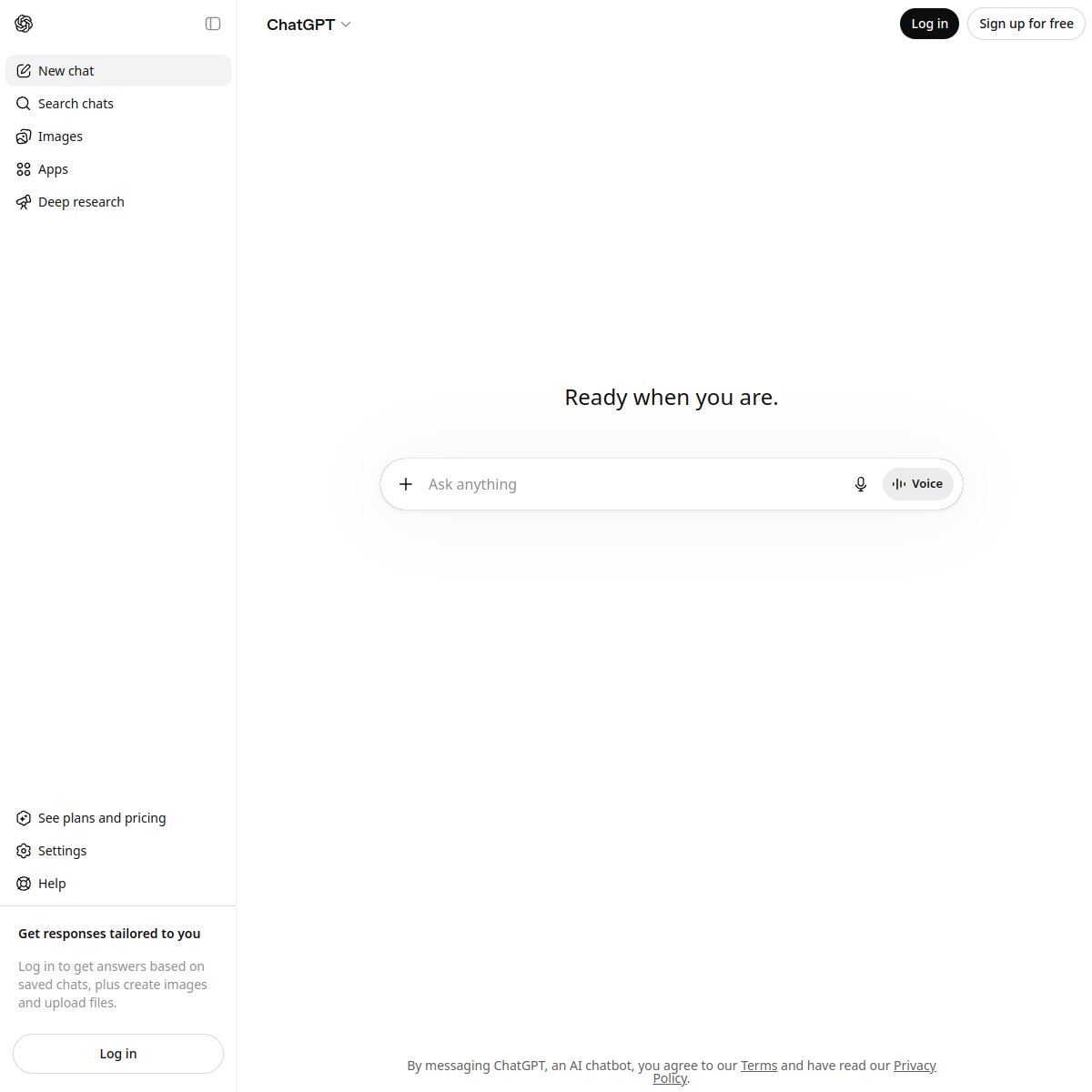
ChatGPT
Core parameters and statistics
Specific technical parameters (such as model size, context length, supported file formats, input and output restrictions, etc.) are subject to the official product page. It is recommended that users verify the latest technical specifications and system requirements before choosing to ensure that they match their own usage scenarios.
User and market recognition
ChatGPT has become the core product entrance of OpenAI. The OpenAI official website navigation also provides entrances to ChatGPT, Business, Enterprise, Education, download API platform, developer documentation, customer cases, etc., indicating that it has expanded from a single conversation product to a comprehensive AI work platform for individuals, teams, enterprises, and educational organizations.
Individual User
- Official verifiable information: ChatGPT official entrance and download entrance
- Instructions: For everyday conversations, learning, writing and office tasks
Team and Company
- Official verifiable information: Business, Enterprise pages
- Description: For organization-level collaboration, permissions and governance needs
Educational Scene
- Official verifiable information: Education page
- Description: For schools, teachers and student organizations
Developer Ecosystem
- Official verifiable information: API platform Playground, developer documentation
- Description: Support product integration, automation and workflow building
For market data such as user scale and number of companies, if OpenAI does not continuously disclose it publicly, it is recommended to treat it as "undisclosed" and not quote unverified second-hand statistics.
Cost advantage
OpenAI's cost advantage comes primarily from model layering, batch processing, cached inputs, smaller models, and service tier selection. For developers, API costs are usually determined by input tokens, output tokens, cached inputs, tool calls, and batch processing strategies; for ChatGPT product users, costs are determined by package permissions such as Free, Plus, Pro, Business, Enterprise, and Education.
C client/personal
- The Free tier is suitable for lightweight experience, while paid tiers such as Plus/Pro provide higher usage limits, stronger models or more complete tool capabilities; the package benefits of different regions and account types are subject to the ChatGPT pricing page.
- Hidden costs mainly come from available regions, account compliance, whether files/data can be uploaded, and whether key conclusions require manual review.
Developer/API
- API side costs vary with models, input and output tokens, tool calls, batch processing, caching and priority services. Repeated long prompt RAG and batch processing scenarios should prioritize evaluating cached inputs with the Batch API.
- If the task only requires classification, extraction, summary or batch light reasoning, give priority to testing lower-cost models; if the task involves complex planning, code and high-value analysis, use stronger models.
Enterprise/Privatization
- Business, Enterprise, Education and API Enterprise contracts focus not just on price, but also on data control, auditing, permissions, compliance SLAs and purchasing terms.
- Enterprise pricing, data retention and advanced governance terms usually need to be confirmed in conjunction with the official page and commercial contract.
Web Search
- Enter price: US$10.00 / 1,000 calls
- Cached input prices: N/A
- Output price: Search content token is free -Official positioning: retrieve the latest information from the web
GPT-Realtime-Translate
- Enter price: US$0.034/minute
- Cached input prices: N/A
- Output price: N/A -Official positioning: real-time voice translation
GPT-Realtime-Whisper
- Enter price: US$0.017/minute
- Cached input prices: N/A
- Output price: N/A -Official positioning: streaming speech to text
Cost strategy recommendations: Use the flagship model for complex tasks, and prioritize the mini model, cached input, and Batch API for daily high-frequency tasks. Priority processing services can be evaluated for production-critical links, and elastic processing can be evaluated for low-priority tasks.
Main functions
- Universal dialogue: supports Q&A, explanation, organization, reasoning and multiple rounds of contextual communication.
- Content Creation: Can be used for article outlines, summaries, emails, scripts, reports and marketing copy.
- Programming assistance: covering code generation, debugging, refactoring, test cases and technical documentation.
- Multi-modal capabilities: Combining GPT with real-time/image models to support text, voice, and image-related tasks.
- Web search: Get the latest information through the official web search tool and support answer citations.
- Document and knowledge processing: suitable for long document summarization, table analysis, knowledge base Q&A and corporate information organization.
- API and tool calls: Build production-grade workflows through the OpenAI API, Playground, batch, container and service layers.
Model and version evolution
Continuous iterative updates, the latest version introduces performance optimization and new features. Historical version information can be viewed on the official release page. There is no complete public version evolution timeline yet. It is recommended to pay attention to the official announcement to understand the rhythm of feature updates.
Technical advantages
The advantage of OpenAI lies not only in a single model, but in the combination of models, product APIs, tools and corporate governance capabilities.
Model layering: The flagship model mini model, real-time model and image model serve complex reasoning, high-frequency and low-cost, voice interaction and image tasks respectively.
Tool Ecosystem: Web search, containers, batch processing, priority processing and elastic processing allow developers to make trade-offs between accuracy, cost, throughput and stability.
Product Maturity: ChatGPT provides ready-to-use experience for individuals and teams, the API platform provides programmability capabilities for developers, and Enterprise/Education provides governance paths for organizations.
Cost control mechanism: Caching the input Batch API and model layering can significantly optimize the cost of repetitive tasks and batch tasks.
How to use
ChatGPT Web
- Official entrance: https://chatgpt.com/
- Suitable for the crowd: individual users, knowledge workers
- Focus of use: conversation, writing, file processing, search
ChatGPT Download
- Official entrance: https://chatgpt.com/download
- Suitable for: mobile and desktop users -Usage focus: cross-device use
Business
- Official entrance: https://chatgpt.com/business/business-plan -Suitable for: Teams
- Focus of use: collaboration and organizational management
Enterprise
- Official entrance: https://chatgpt.com/business/enterprise
- Suitable for the crowd: Enterprises
- Usage focus: governance, security and large-scale use
Education
- Official entrance: https://chatgpt.com/business/education
- Suitable for: schools and educational organizations
- Focus of use: teaching, learning and campus governance
API Platform
- Official entrance: https://platform.openai.com/
- Suitable for: developers and enterprises -Usage focus: Integrate into products, applications and workflows
Recommended process: First verify the task effect in ChatGPT, and then migrate the stable task to the API; use real samples to evaluate model quality, latency, cost, and safety boundaries before going online.
Product Pricing
ChatGPT product package prices should be based on the ChatGPT official pricing page; API costs should be based on the OpenAI API pricing page. Since subscription packages vary with region, account type and product strategy, this article does not include fixed amounts that may expire.
ChatGPT Free/Plus/Pro/Business/Enterprise/Education
- Official source: https://chatgpt.com/pricing
- Current processing method: subject to the real-time page of the official website
API model price
- Official source: https://openai.com/api/pricing/
- Current processing method: Public model unit prices have been sorted
Enterprise Level Solution
- Official Source: OpenAI Contact Sales/Enterprise Page
- Current processing method: Usually you need to contact sales, the price is not disclosed
Application scenarios
-Personal learning: concept explanation, language learning, material summary, study plan.
- Office efficiency improvement: emails, meeting minutes, report drafts, form analysis.
- Software development: requirements disassembly, code generation, testing, code review and document generation.
- Customer service and operations: FAQ, preliminary screening of work orders, content review and operation copywriting.
- Enterprise knowledge management: internal document Q&A, knowledge base organization, and data analysis within authority.
- Voice and real-time interaction: real-time translation, voice assistant, meeting transcription.
- Multi-modal creation: image generation, visual understanding, and image-text hybrid workflow.
Applicable people
- Individual users: need a general AI assistant to complete learning, writing, office and creative tasks.
- Developers: need to call models, tools and service levels to build applications.
- Content and Operations Team: Need to generate, rewrite and review content in bulk.
- Business managers: Need to incorporate AI into organizational collaboration, knowledge management, and automation processes.
- Educational organizations: looking to introduce AI into teaching, learning coaching, and campus services.
Unsuitable situations: Scenarios that require completely offline, local reasoning and do not accept cloud APIs; medical, legal, and financial decision-making scenarios that require the output of high-risk conclusions without manual review.
Summary and Outlook
The core value of ChatGPT is to package OpenAI’s GPT models, tool capabilities, and organizational-level products into an easy-to-use portal. The latest official API pricing page shows that OpenAI has advanced the model system to GPT-5.x and continues to expand capabilities such as real-time speech, image generation, web search, and containers.
There are three points worth paying attention to in the future: first, the opening pace of the GPT-5.
Related tools:  DeepSeek, ChatGPT
Compare with similar tools
The advantages of ChatGPT lie in product maturity, model level richness, and API ecological integrity; however, in terms of Chinese localization, domestic access convenience, and low-price strategy, it needs to be differentiated from similar products at home and abroad.
ChatGPT
- Main advantages: OpenAI has a mature ecosystem, complete models, tool APIs, and enterprise solutions; strong general capabilities
- Relative restrictions: Registration/access is limited in unsupported regions such as mainland China; high-end functions depend on package or API costs
- More suitable users: global users, developers, multinational teams, companies that value ecological maturity
Claude
- Main advantages: Outstanding performance in long text understanding, writing and safety alignment
- Relative limitations: The available regions and Chinese ecology are not as good as domestic tools; some advanced capabilities are more expensive
- Better suited for: Research, long document, legal/compliance, professional writing users
Gemini
- Main advantages: Close integration with Google Search Workspace and Android ecosystem
- Relative limitations: Functional opening is inconsistent in different regions; corporate procurement relies on the Google ecosystem
- More suitable users: Google Workspace users, search/office ecosystem users
DeepSeek
- Main advantages: open source model, Chinese inference API cost and more flexible local deployment options
- Relative limitations: The product ecosystem and international business tool chain are not as complete as OpenAI
- More suitable users: Chinese developers, cost-sensitive enterprises, privatization/open source model users
Bean bag
- Main advantages: Chinese experience, local content ecology and domestic access convenience
- Relative restrictions: International API ecology and enterprise-level governance capabilities need to be evaluated based on official opening conditions
- More suitable users: individual users in mainland China, Chinese content teams, and Byte ecosystem users
Selection suggestions: If the team needs global products, stable APIs, and rich tool chains, ChatGPT/OpenAI API is the priority; if it is mainly for Chinese users in mainland China, domestically available solutions such as DeepSeek, Doubao Kimi, and Tongyi should also be evaluated to avoid binding core processes to services that cannot be stably accessed.
Available regions and usage restrictions for Chinese users
The OpenAI Help Center clearly states: ChatGPT only supports access from the countries, regions and territories listed on it; accessing or providing access from unlisted regions may result in account ban or suspension. The official support list will be updated, please refer to the real-time page of OpenAI Help Center.
US, UK, most EU countries, Canada, Australia, New Zealand
- Current status: Common in official support list
- Tips for Chinese users: You can register and use directly according to local rules
Japan, South Korea, Singapore, India, Malaysia, Thailand, Vietnam, Philippines, Indonesia and other Asian regions
- Current status: Many items are visible in the official support list
- Tips for Chinese users: Chinese users in these areas can usually use local networks, mobile phone numbers and payment conditions.
Taiwan, China
- Current status: visible in official support list
- Tips for Chinese users: Can be used according to local conditions
Mainland China
- Current status: Not listed in the official support list
- Tips for Chinese users: It is not recommended to bypass regional restrictions through non-compliant methods; for stable use, you should choose official support for regional accounts or alternative tools available in China.
Hong Kong, China, Macau, China
- Current status: subject to the real-time list of OpenAI supported regions
- Tips for Chinese users: Please check the OpenAI supported countries page before use to avoid judging based on expired information.
Realistic limitations for Chinese users:
- Registration restrictions: If the location is not in the OpenAI support list, an unsupported country error may appear.
- Access restrictions: Even if you already have an account, you may not be able to log in if you are traveling or the network exit is in an unsupported region.
- Payment Restrictions: ChatGPT subscription and API billing may require payment methods and billing information for available regions.
- Data and compliance: Enterprises should evaluate data export, sensitive information, auditing and internal compliance requirements when using it.
Compliance for use:
- Individuals or teams located in officially supported regions, use local compliance networks, mobile phone numbers, and payment methods to register and subscribe.
- Enterprise users should first go to the official channels of OpenAI Business, Enterprise or API to clarify data, permissions, auditing and procurement responsibilities.
- If users in mainland China are unable to use official services stably, they can give priority to domestically available tools (such as DeepSeek, Doubao, Tongyi Kimi, etc.) to undertake the core production process, and use ChatGPT as a supplementary reference when accessible.
- It is not recommended to rely on unofficial access methods that are unstable, violate terms of service or organizational compliance requirements to handle critical business.
Comparison of competing products
| Comparison dimensions | The tool | Competitor A | Competitor B |
|---|---|---|---|
| Core Differences | — | — | — |
| Price | — | — | — |
| Target User | — | — | -- |
Version Info
- GPT-4o :The multi-modal flagship model released by OpenAI uniformly handles text, vision and speech-related tasks.
- GPT-4 Turbo :The cost- and context-optimized version of the GPT-4 series has served as an important node for API and product capabilities.
- ChatGPT 2026 continuous iteration version :ChatGPT is a cloud service that continues to iterate. Officials will update models, tools, search, file processing and multi-modal capabilities on product pages, package pages, release announcements and API pricing pages; there is currently no single fixed version number.
User Reviews