 Chili Piper
Chili Piper is a leader in the field of lead conversion acceleration. It provides intelligent lead routing, Instant Booker, instant meeting scheduling and form scheduling and other functions to help B2B sales teams shorten the lead-to-demo time from days to minutes.
ChiliPiper
Chili Piper’s core parameters and statistics
Chili Piper is positioned as the leading SaaS platform in the field of lead conversion acceleration (Conversion Acceleration). Its core value is to eliminate the time delay from lead submission to first contact in the B2B sales process. Industry benchmarks show that the conversion rate for leads responded within 5 minutes is more than 20 times higher than those responded after 30 minutes, and Chili Piper compresses this response time from "hours" to "seconds."
| Projects | Public Information |
|---|---|
| Official positioning | Lead conversion acceleration platform (Conversion Acceleration) |
| Core Competencies | Intelligent Lead Routing + Instant Meeting Scheduling + Form Scheduling |
| Deployment method | SaaS cloud (no self-hosted path) |
| Customer scale | 2000+ companies around the world, including Notion, Canva, GitLab, etc. |
| Calendar Integration | Google Calendar, Outlook, Exchange |
| CRM Integration | Salesforce, HubSpot, Microsoft Dynamics |
| Compliance Certification | SOC 2 Type II, GDPR |
| Supported platforms | Web, Chrome extension |
| Latest version | 2026 Spring Release (~2026-03) |
Product Boundary: Chili Piper does not replace CRM, nor does it do email marketing or customer success management. It only focuses on the funnel of "lead generation → immediate distribution → immediate meeting". Within this knot it goes extremely deep, but beyond this knot there is no coverage.
Integration dependency: Maximizing value requires the use of CRM (Salesforce/HubSpot) and calendar systems. Without these two infrastructures, its core scheduling capabilities cannot operate.
Chili Piper’s user and market recognition
The market's recognition of Chili Piper is characterized by top customers across multiple industries, rather than pure user numbers.
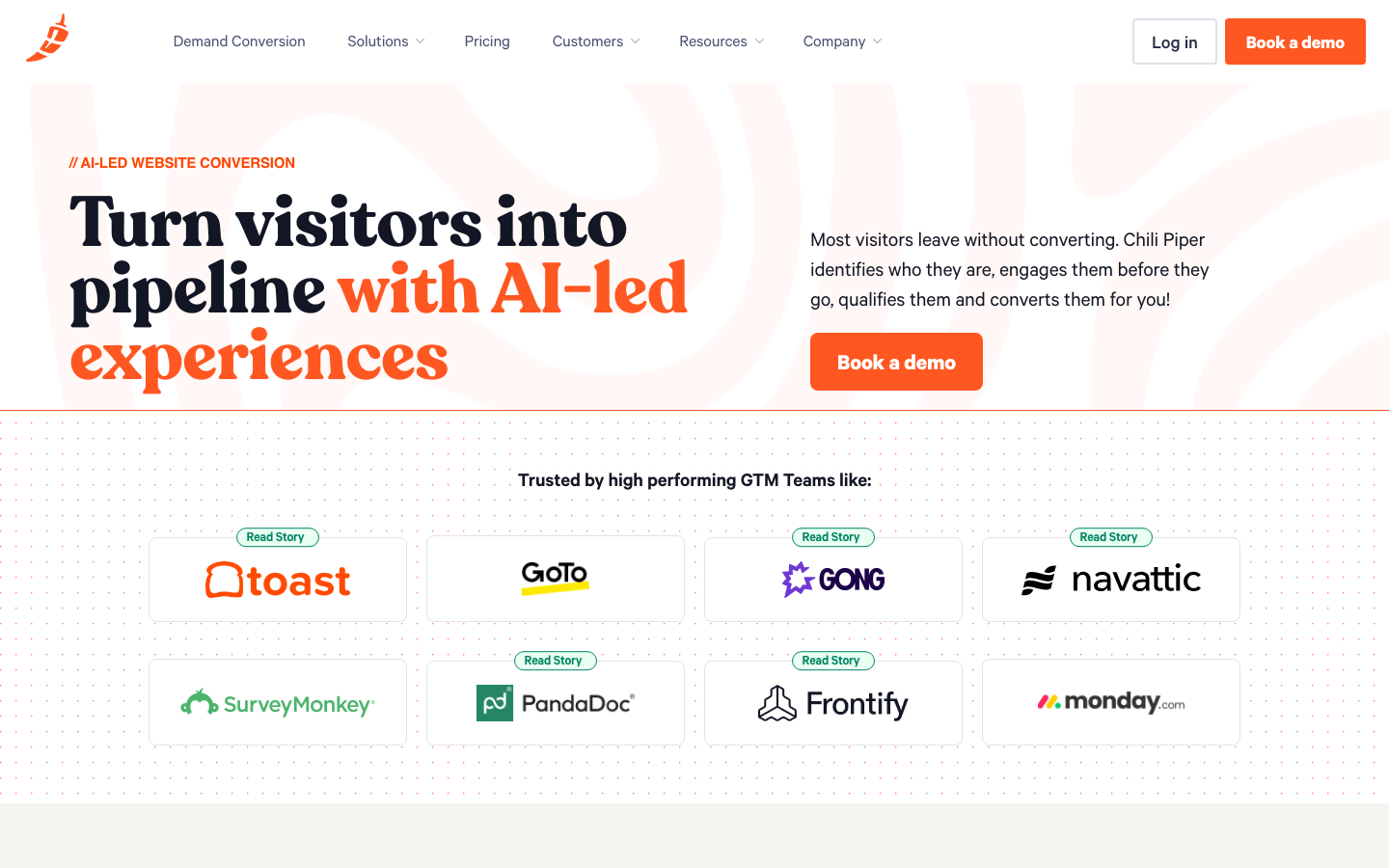
Customer Matrix: The customers publicly displayed on the official website include well-known SaaS companies such as Notion, Canva, GitLab, Twilio, Qualtrics, New Relic, and Gong, covering 2,000+ global customers. The core thing these customers have in common is a large volume of inbound leads. Demo conversion is the core of the growth engine.
Industry Evaluation: Chili Piper continues to receive high ratings in G2's Sales Intelligence and Meeting Scheduling categories. User feedback focuses on two core benefit dimensions: "increased response speed" and "improved sales representative efficiency." Its Instant Booker has been listed by multiple third-party reviews as one of the "must-have components" in a B2B sales tech stack.
Eco-Partnerships: Chili Piper is a certified partner of Salesforce AppExchange, HubSpot App Marketplace, and Marketo LaunchPoint, and this deep integration reduces procurement risk—teams don’t have to worry about data being out of sync.
Prerequisites: The value of Chili Piper is highly dependent on the standardization of the sales process. If the team does not yet have lead allocation rules, no clear division of SDR/AE responsibilities, or the quality of calendar and CRM data is poor, the improvement after go-live will be reduced.
Chili Piper’s Cost Advantage
Individual/Small Team
Chili Piper does not have a free personal version, and the market reference price of the Starter package is about $300-500/month (2-5 users), paid in advance on an annual basis. For individual sales or very small teams, the monthly fee threshold is high, and the functions are concentrated on basic Instant Booker without advanced routing capabilities. More economical alternative path: You can use Calendly ($10-16/month/person) for pure scheduling first, and then migrate to Chili Piper after the number of leads increases.
Team/Department (Growth layer)
The Growth package is the main layer of enterprise-level functions, with a market reference price of about $500-1000/month (5-10 users), including Distributions advanced routing engine and form scheduling. The true cost of this tier comes not only from the subscription fee, but also from the manual effort required to initialize the rules (defining routing dimensions, busy/busy policies, alternative allocation logic), which typically requires a 1-2 week implementation and A/B comparison period.
Enterprise (Enterprise layer)
Enterprise pricing requires business confirmation and includes custom routing rule API access, dedicated support and customized services. The core hidden costs of enterprise-wide procurement come from: debugging deep integrations with existing CRMs, governance of multi-department routing rules (coordination costs as departments compete for priority allocation), and usage caps and SLA terms in annual contracts.
Three-tier cost comparison:
| Cost Dimension | Starter | Growth | Enterprise |
|---|---|---|---|
| Monthly fee reference (annual payment) | $300-500 | $500-1000 | Business confirmation required |
| Applicable number of users | 2-5 people | 5-10 people | 10+ people |
| Hidden implementation costs | Low (base configuration) | Medium (rule design + A/B) | High (integration + governance + legal) |
| Contract flexibility | Monthly payment/annual payment | Annual payment is the main | Annual payment + customized terms |
Explicit and Implicit Costs: In addition to the subscription fee, the team also needs to factor in the cost of CRM integration debugging, routing rule design and iteration, sales rep training time, and usage audits at annual renewals. These hidden costs typically account for 30-50% of total TCO.
Chili Piper’s main features
Chili Piper's four major functional modules are organized around "lead generation → second-level allocation → instant meetings", and there are significant synergies between the functions:
- Instant Booker Instant Meeting Scheduling: After the lead submits the form on the official website or landing page, the system does not return the static confirmation page of "We will contact you later", but directly pops up the calendar interface to display the sales representative's actual free time of the day. After the lead selects a time, the meeting is automatically created, the calendar is synchronized, and a confirmation email is sent, without manual intervention in the entire process. Synergy: When linked with intelligent routing, the system has assigned the most suitable sales representative based on the lead attributes (region, product interest, customer size) before popping up the calendar. What the lead sees directly is the representative's calendar instead of a general free slot - this greatly reduces the communication cost of subsequent "reassignment".
- Distributions Intelligent Lead Routing Engine: Supports multi-dimensional distribution by region, product line, customer size, source channel, busy status and skill matching. There are three built-in modes: Round Robin, Least Recently Assigned, and Skills-Based. Synergy: When combined with queue management, when all matching sales representatives are busy, leads are not lost but enter the priority waiting queue. Once a representative is released, they are automatically allocated and follow-up reminders are triggered.
- Form Scheduling: Embed scheduling functions directly into marketing automation forms such as Marketo, HubSpot, and Pardot. After the clue fills out the form, it does not jump to a new page, but the scheduling interface pops up on the current page. Product Value: Reduce the bounce rate caused by page jumps - data shows that with each additional page jump, the form-to-meeting conversion rate decreases by 8-12% on average.
- Queue Management with Overflow Routing: When all sales reps matched by routing rules are unavailable, leads enter the waiting queue, sorted by priority (lead score / SLA level / waiting time), and released once a rep is available
Automatically assigned immediately. Support setting "overflow routing": if it is not assigned within 30 minutes, it will automatically be upgraded to the team manager or higher priority queue.
- Chrome Extension (Gmail Integration): When a sales rep composes an email in Gmail, the Chrome extension automatically detects whether the recipient is already associated with Chili Piper and displays the contact's available scheduling links in the sidebar of the email, inserting the email with one click. Synergy: Not only does it reduce manual copying and pasting, but more importantly, it allows sales representatives to "trigger" the scheduling process during email communication, instead of just relying on the official website form entry.
Function linkage key: The above functions are available independently, but the node that truly multiplies the value is the series connection of the three chains of "Instant Booker + Distributions + Queue Management" - leads enter → match the best sales representative in seconds → instantly present the representative’s calendar → queue up if busy → automatically allocate and notify after release. This set of linkages automates the entire process "from leads to meetings", rather than just automating one section.
Chili Piper version evolution
Chili Piper does not publish a detailed version release calendar, but the following milestones can be sorted out through the official website update log and product blog:
Trunk release
- 2026 Spring Release (~2026-03): The latest major version update adds AI intelligent routing optimization (automatically adjusts allocation weights based on historical conversion data), enhanced Round Robin allocation rules (supports weighted polling), and deeper Salesforce integration (supports custom object routing).
- 2025 Fall Release (~2025-09): Introducing Distributions advanced routing engine (multi-dimensional routing capabilities), Multi-Round Robin (cross-team polling) and multi-language meeting page support (English, French, German, Japanese, etc.).
- 2025 Spring Release (~2025-03): Released Instant Booker 2.0 - supports group calendar (Group Calendar), multi-time zone awareness and automatic buffer time (automatically reserve 5-15 minutes between meetings).
- 2024 (~2024): Launched Form Scheduling 1.0, deeply integrated with Marketo/HubSpot forms, and completed SOC 2 Type II compliance certification.
- 2023 (~2023): Chili Piper core product (Instant Booker + Basic Routing) is officially GA and obtained Salesforce AppExchange certification.
Iterative features
Chili Piper adopts the rhythm of "big version + continuous feature release" and does not have traditional semantic version numbers. New features are typically rolled out gradually over a few weeks, pushed out to existing customers through in-app notifications and the product blog. This means that production environments usually do not need a "version upgrade" operation - SaaS features determine that new features are available by default, but it also means that the team needs to pay attention to the change log and re-verify the stability of routing rules and integration links after each feature change.
Chili Piper’s Technical Advantages
Architectural logic of real-time routing engine
Chili Piper's core technology asset is its real-time routing engine. When a clue enters the system through form submission, the routing engine needs to complete the following judgment chain within 200-500ms:
- Lead deduplication and identification (new leads vs. existing contacts vs. existing customers)
- Rule matching (region, product line, customer scale, source channels, skill requirements)
- Availability scan (scan the calendars of all matching sales representatives to obtain available slots for the current and next 48 hours)
- Prioritization (Round Robin/Minimum Allocation/Skill Match Weight)
- Calendar locking and meeting creation (create event records in CRM and lock the period in the calendar)
Why it’s fast: This judgment chain is not implemented using workflow on a general CRM platform, but is based on a real-time calculation engine designed specifically for meeting scheduling. Automated rules for common CRM typically take 2-10 seconds to complete similar judgments. Chili Piper compresses latency to sub-second levels through optimized data indexing and pre-computed availability caching.
Two-way synchronization mechanism between calendar and CRM
Instead of "writing the calendar" in one direction, Chili Piper maintains a three-way real-time synchronization of Calendar ↔ CRM ↔ Chili Piper. When a sales rep manually moves or cancels a meeting in Google Calendar, Chili Piper detects the change, automatically adjusts the rep's availability slot in Instant Booker, and synchronizes activity status updates in CRM. This three-way synchronization avoids the most common "calendar appears to be available but is actually occupied" conflict problem.
AI route optimization (new feature in 2026)
The AI routing optimization introduced in the 2026 Spring Release is based on historical conversion data and automatically learns the correlation between different routing dimensions (such as industry, region, product line) and the final transaction rate, and adjusts the distribution weight accordingly. For example, the system might discover that "medical industry leads assigned to sales representative Alice have a 23% higher conversion rate than those assigned to Bob," and then automatically increase the weight of Alice in the assignment of medical leads. This is a key technical node for Chili Piper's upgrade from "rule-driven" to "data-driven".
How to use Chili Piper
Chili Piper is delivered in SaaS form. The usage entry and startup path are as follows:
| How to use | Suitable stage | Key operating steps |
|---|---|---|
| Web management background | Configuration and daily management | Log in to Chili Piper Dashboard → Connect calendar account → Integrate CRM → Configure routing rules → Deploy form scheduling code |
| Chrome extension | Daily office work for sales representatives | Install the extension → Log in to your Chili Piper account → Automatically display the scheduling link in Gmail |
| Form Embed Code | Marketing & Website Team | Paste the JavaScript snippet provided by Chili Piper in the Marketo/HubSpot form → Configure scheduling triggers |
| API / Webhook | Developer-customized integration | Implement custom routing logic, batch import leads, and obtain scheduling statistics through REST API |
Typical startup process (first two weeks):
- Day 1-3: Connect with CRM (Salesforce/HubSpot) and calendar system (Google/Outlook), import sales team member information and assign roles.
- Day 4-7: Configure basic routing rules (at least 2-3 dimensions, such as region + product line), and set up Instant Booker’s branding page (Logo, color, domain name).
- Day 8-10: Connect Form Scheduling on 1-2 forms with the largest number of leads, and turn on grayscale with small traffic (10-20% leads).
- Days 11-14: Do A/B comparison with Baseline (manual allocation without Chili Piper + traditional scheduling link), focusing on observing "form to meeting time" and "first meeting attendance rate".
Human-machine collaboration boundary: Chili Piper can 100% automate the "lead allocation + calendar display + meeting creation" link. However, the following sections still require manual confirmation: allocation approval for high-value customers (contract amount > a certain threshold), policy adjustment of custom routing rules, and escalation processing when encountering calendar conflicts (the system cannot automatically resolve the situation where two sales representatives are assigned at the same time).
Chili Piper Product Pricing
Chili Piper adopts a non-disclosure pricing policy, and all packages need to contact sales to obtain a quote. The following information is based on a cross-section of industry reports and publicly available third-party sources (unofficial commitment):
| Package | Reference price (annual payment/month) | Core capabilities | Applicable scale |
|---|---|---|---|
| Starter | ~$300-$500 | Instant Booker Basic + Simple Round Robin routing | 2-5 sales team |
| Growth | ~$500-$1000 | Distributions Advanced Routing + Form Scheduling + Queue Management | 5-10 Sales Team |
| Enterprise | Business confirmation required | Customized routing rules + API access + Dedicated support + SSO | 10+ people or multiple departments |
C-side/Personal: There is no independent free version or personal version, and the minimum threshold is the Starter package. If it’s just individual sales or a very small number of leads, it’s recommended to transition to Calendly ($10-16/month) or HubSpot Meeting Scheduler (free) first.
Team/Department: The Growth package is the workhorse tier for any team that needs routing capabilities. The true cost needs to be additionally included: human investment in rule design and A/B testing (about 1-2 weeks), CRM integration debugging (1-3 days), and the usage limit locked in the annual contract - if the number of leads increases beyond expectations, the overage billing rules need to be confirmed in advance.
Enterprise/Multi-department: The procurement decision-making chain of the Enterprise package is relatively long, and usually requires the participation of the sales operation leader, IT integration leader, and legal third parties for verification. Key terms confirmed include: data residence area SSO/SAML support API rate limits, and SLA in the annual contract (service availability ≥ 99.9% is the industry benchmark).
Chili Piper application scenarios
Second-level response to Demo request
Typical scenario: After a potential customer submits the "Reservation Demo" form on the official website, Chili Piper pops up the real calendar of the sales representative in the customer's corresponding area within 1-2 seconds. After the customer selects a time period, the meeting is automatically created and synchronized to the CRM. Benefit deduction: The response time is reduced from hours (manual follow-up) to less than 10 seconds, and the conversion rate from form to meeting can be increased by 3-5 times (cross deduction of industry data). The focus of the verification is to observe the change in the median time of "form submission → meeting confirmation" before and after going online.
Lead burst processing after large-scale marketing activities
Typical scenario: Within 24 hours after a webinar or industry trade show, the volume of inbound leads can reach 10-50 times the normal volume. Chili Piper's Distributions engine automatically distributes leads evenly to SDR teams based on preset rules (geography, product interest, language), and queue management ensures that overflow leads are not lost. Yield Deduction: Post-campaign manual distribution typically takes 2-3 business days to distribute leads, Chili Piper can compress this time to less than 30 minutes. The verification focuses on the "first contact rate" and "qualified meeting rate" of leads within 7 days of the event.
Complex routing for multiple product lines/multiple regions
Typical scenario: A SaaS company sells three product lines of CRM, marketing automation and customer service products at the same time. The sales team of each product line is divided into North America and Europe. Chili Piper supports dual dimension routing by "product line + region": customer service product leads from Europe are routed to the European customer service sales team, and CRM leads from North America are routed to the North American CRM sales team. Benefit deduction: Reduce the number of internal transfers due to allocation errors - increasing response time by an average of 4-6 hours per transfer. The focus of the verification is to track the indicator "number of transfers of leads from first assignment to final responsible person".
Form inline scheduling (reduce bounce rate)
Typical scenario: After the lead fills out the "Download White Paper" form on the Marketo page, the page does not jump to the "Thank You Page", but the scheduling interface pops up directly at the bottom of the current form. Benefit deduction: By reducing one page jump, the conversion rate from form to dispatch can be increased by 8-12% (industry deduction). The focus of the verification is to compare the changes in the conversion funnel of "form submission volume → meeting reservation volume" before and after embedded scheduling.
Chili Piper is suitable for people
The most suitable three types of teams
- Sales Development Team (SDR) at a B2B SaaS company: Processing a large number of inbound leads every day requires second-level allocation and automated scheduling to ensure response speed. Chili Piper's Distributions engine allows the SDR team to naturally form a workflow with "clear division of labor, no duplication, and no missed orders".
- Marketing Operations Team: Responsible for managing the marketing automation platform (Marketo/HubSpot) and form conversion links. Chili Piper's Form Scheduling embeds directly into existing forms, allowing marketing operations to automate the "post-form submission" process without modifying the CRM process.
- Revenue Operations Team: Need to optimize the efficiency of the lead-to-cash funnel from a global perspective. Chili Piper provides routing rule analysis and conversion funnel reporting to help revenue operations teams quantify the ROI of each routing rule.
Boundaries and inappropriate scenarios
- Outbound-heavy sales team: If the team's leads mainly come from SDR proactive outbound calls rather than inbound forms, Chili Piper's "instant response" value will be greatly reduced. In this scenario, a calendar management tool such as Calendly may be more cost-effective.
- Very large enterprises (200+ sales representatives): When routing rules involve hundreds of representatives, dozens of teams, and multi-level queues, the complexity of Chili Piper's rule governance increases exponentially, which may require Enterprise customization solutions and additional management manpower investment.
- Teams whose sales processes have not yet been standardized: If the team does not have clear lead allocation rules, no CRM data specifications, and no clear division of SDR/AE responsibilities, the process should be standardized first before considering the implementation of the tool, otherwise Chili Piper's routing rules will amplify the existing confusion.
- Budget-sensitive small teams (<5 people): The monthly fee of $300+ is too high for very small teams, and it is recommended to use Calendly or HubSpot Free Scheduler to transition first.
Summary and Outlook
Chili Piper's core competitiveness lies in "taking the link from lead to meeting to the extreme" - it is not a universal sales platform, but in this specific link at the top of the conversion funnel, its depth and degree of automation have no direct rivals in the current market. Its three-in-one link of Instant Booker + Distributions + Queue Management has been proven in the B2B SaaS industry as an effective infrastructure for improving demo conversion rates.
Current limitations: The functional boundaries are very clear - no email follow-up, no calling, no customer success, only covering the two actions of "lead routing + meeting scheduling". This means that after purchasing Chili Piper, the team still needs a Sales Engagement Platform (such as Outreach/SalesLoft) and CRM to complete the full chain. In addition, the opaque pricing and annual payment contract-based model has certain limitations on the flexibility of small and medium-sized teams.
Competitive Landscape: Key alternatives to Chili Piper include Calendly (light scheduling, no routing), Outreach Cal AI (included in the sales engagement suite), and HubSpot Meeting Scheduler (free but weak routing capabilities). The differentiation of Chili Piper lies in the binding ability of "deep routing + real-time scheduling", rather than simple point functions.
Procurement and Adoption Risk Assessment: It is recommended to use the Growth package to conduct small-traffic A/B testing (10-20% traffic) on 1-2 high-lead forms, focusing on observing the two core indicators of "Form → Median Meeting Time" and "First Meeting Attendance Rate"; confirm that the improvement is as expected before expanding to the entire team. Enterprises need to verify before purchasing: the usage limit and overage billing rule SLA terms in the annual contract (especially the calendar synchronization delay guarantee), as well as whether the data residency and compliance certification scope cover the target market. Overall, Chili Piper is a large-scale proven high ROI option on the market for B2B SaaS businesses with an "inbound lead-driven demo conversion" model.
Related tools:
Chili Piper’s model and version evolution
Continuous iterative updates, the latest version introduces performance optimization and new features. Historical version information can be viewed through the official release page. There is currently no complete public version evolution timeline.
Chili Piper How to use
- Web client: You can use it by visiting the official website and registering an account. Most functions do not require installation.
- API Access: Provides RESTful API, developers can obtain the API Key and integrate it into their own applications.
Version Info
- Chili Piper 2026 Spring Release :Added AI intelligent routing optimization, enhanced Round Robin assignment rules, and deeper Salesforce integration.
- Chili Piper 2025 Fall Release :Introducing Distributions advanced routing engine Multi-Round Robin and multi-language conference page support.
User Reviews