 Chroma
Free
Chroma
Free
Chroma is suitable for making the search layer into an observable and scalable infrastructure: it can be used for local prototyping and developer integration, as well as for cloud/self-built deployment of RAG, semantic search, full-text retrieval, metadata filtering and hybrid recall. Its value is not in "single point vector retrieval", but in putting vectors, full text, regular expressions and metadata into the same search system, and reducing operation and maintenance complexity through object storage, automatic tiering and Cloud/Enterprise options.
Tool text (please fill in completely)
Core parameters and statistics
Chroma is not positioned as a simple "vector library", but as a search infrastructure for AI retrieval systems. It puts vector retrieval, full-text retrieval, regular retrieval, and metadata filtering into the same set of product narratives, so it is more suitable for RAG retrieval layer, knowledge base backend and context routing, rather than just treating it as an embeddings storage box.
| Core items | Official information | Significance for implementation |
|---|---|---|
| Product positioning | open-source search infrastructure for AI | Suitable for making the search layer into a reusable component rather than scattered scripts within the project |
| Retrieval capabilities | vector, full-text, regex, metadata search | Facilitates hybrid recall and post-recall rearrangement, reducing the vulnerability of "relying solely on semantic similarity" |
| Data scale | Home page shows an example of a knowledge base with 1,277,467 records | Illustrating its main narrative bias towards production retrieval and multi-tenant data scale |
| Open source license | Apache 2.0 | Easy for local deployment, embedded products and enterprise procurement evaluation |
| Path to the Cloud | Chroma Cloud | For teams that don’t want to manage their own indexing, caching, and storage layers |
| Enterprise path | BYOC, multi-region replication, PITR, SOC 2 Type II | Suitable for organizations with higher compliance, disaster recovery and isolation requirements |
From an engineering perspective, Chroma's advantage lies in putting together the most easily broken pieces of a search system: retrieval types, storage tiering, index status, read consistency and enterprise deployment boundaries. It is not just about "faster vector similarity query", but also directly turns the issues of "how to determine the recall boundary, how to layer hot and cold data, and when to use full text/regular/metadata filtering" into product capabilities. For RAG, this is closer to real business than pursuing a certain embedding top-k score alone.
User and market recognition
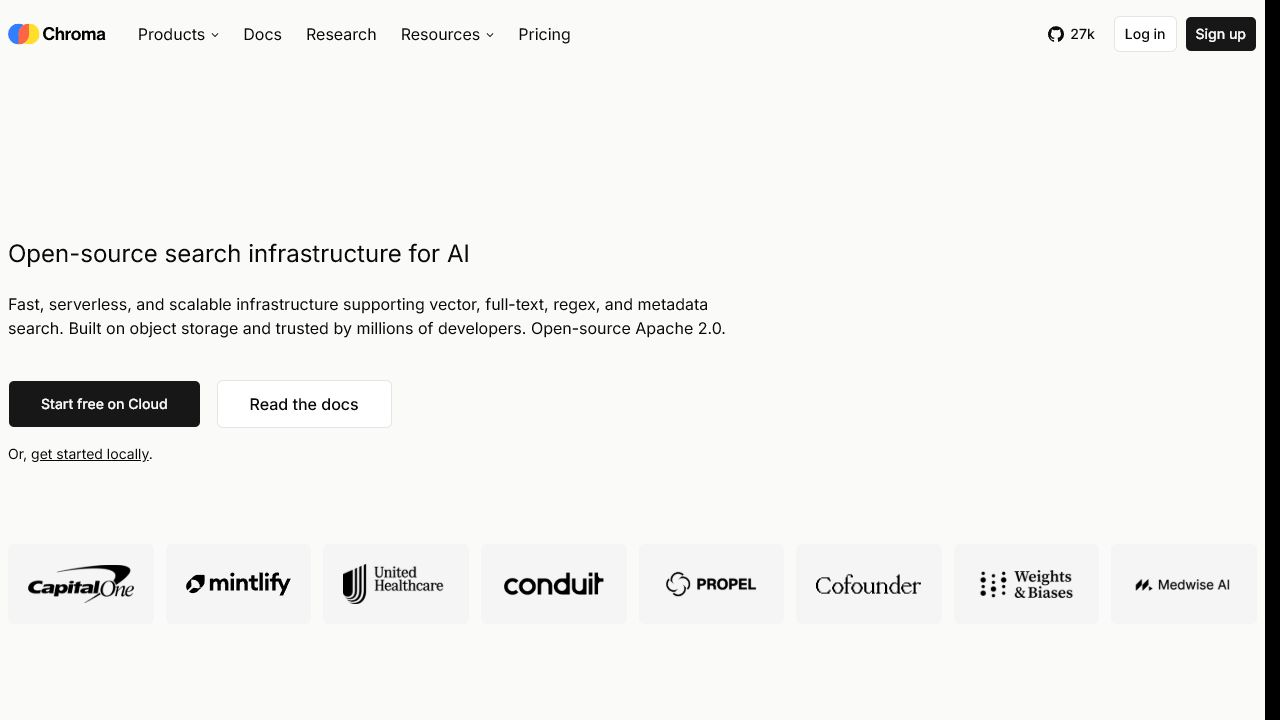
Chroma's user profile is relatively clear: on one end are developers who make prototypes and small and medium-sized applications, and on the other end are teams that need to embed the search layer into business systems. It directly displays customer/case identifications such as Capital One, UnitedHealthcare, Weights & Biases, Mintlify, Propel, etc. on its homepage, which shows that it has actual implementation in the fields of enterprise software and developer tools.
| Public Signal | Page/Portal | Description |
|---|---|---|
| GitHub stars | Official homepage display 27k | Used to measure the popularity of the developer community, suitable for treating Chroma as a developer-first product |
| Monthly downloads | Official homepage display 15M+ monthly downloads | Closer to ecological usage, not just GitHub popularity |
| Knowledge base example scale | The official homepage displays 1,277,467 records | Indicates that the product narrative is oriented to medium- and above-scale retrieval workloads |
| Security Compliance | Enterprise Page / Official Home Page | The home page clearly states SOC 2 Type II and BYOC paths |
User boundaries are also relatively clear. Individual developers will be attracted by its open source, quick startup and local deployment; product teams will value Cloud, Team packages and JS/Python SDK; enterprises are more concerned about private networks, single tenants, cross-region replication SLA and data residency control. In other words, Chroma's market recognition is not in the category of "universal large model application platform", but in the category of "search layer infrastructure".
Cost advantage
Chroma's cost strategy is typical: the open source version is responsible for entry and controllability, the Cloud version is responsible for saving operation and maintenance, and the Enterprise version is responsible for compliance and isolation. Its page directly shows the three levels of Starter, Team and Enterprise, as well as the usage-based structure of billing based on writing, storage, query and network access.
| Tier | Official price | Applicable objects | Cost meaning |
|---|---|---|---|
| Open source / local | Apache 2.0, self-hosted | Individual developer PoC, internal tools | The software itself has no license threshold, but you have to bear the infrastructure and operation and maintenance yourself |
| Starter | $0/month + usage | Early projects, small teams | Lower the trial threshold with free quota and pay-as-you-go billing |
| Team | $250/month + usage | Production Team | Get more databases, members, and Slack support for a fixed monthly fee |
| Enterprise | Custom | Regulated industries, larger organizations | Cost-for-security SLA, BYOC, single-tenant and custom support |
If we only look at the C-side, Chroma's "free" does not mean "no cost", because the real cost will be migrated to read and write traffic, storage volume and outbound network. Its advantage is that it makes these costs transparent and provides three implementation paths: self-construction, hosting, and enterprise. For technical leaders, this structure makes it easier to budget and risk assess than "free but locked in later."
Main functions
- Vector Retrieval: Suitable for semantic similarity recall embedding retrieval and RAG candidate set generation.
- Full text search: Suitable for exact keyword matching, title/paragraph level recall and hybrid retrieval.
- Regular Search: Suitable for structured text, pattern matching and log/field content retrieval.
- Metadata Filtering: Suitable for recall boundary control based on tenant, time, label, source and permissions.
- Forking: Suitable for data set version management, A/B testing and grayscale launch.
- CLI/SDK: suitable for local development, automation scripts and CI integration.
- Cloud Sync: Suitable for continuously connecting external knowledge sources such as web pages GitHub and object storage to the retrieval layer.
The combination of these functions determines that Chroma is not suitable for a single question and answer scenario, but for scenarios where "the retrieval layer must simultaneously serve search RAG, context engineering, and data version evolution." Especially when Forking and Sync appear together, it acts more like an iterable retrieval system than a static vector container.
Model and version evolution
Chroma’s version narrative revolves not around the model, but around the evolution of search capabilities and cloud infrastructure. In the latest rhythm, capabilities such as Cloud Sync, Metadata Arrays, Indexing Status, Read Level, Private Networking, GroupBy, and CMEK have been launched one after another, indicating that it is moving closer to "production-level search services."
| Version node | Date | Change point |
|---|---|---|
| Chroma Cloud Sync | 2026-03 | Add serverless ingestion of S3, GitHub, and Web |
| Introducing Chroma Cloud | 2025-08 | Cloud officially GA, hosting path stabilized |
| JavaScript Client V3 | 2025-06 | Client rewriting to reduce front-end/Node integration friction |
| Regex Search Support | 2025-06 | Introducing regular search capabilities to complete the mixed recall boundary |
| Introducing Chroma Sync | 2025-10 | Support automatic sharding, embedding, and indexing of GitHub repositories |
This evolution shows that it is not satisfied with the "vector database" label, but is productizing several typical pain points of retrieval systems one by one: index visibility, data ingestion, permission isolation, read consistency and cloud support. For developers, this means that the upgrade is not just an interface change, but also a change in retrieval strategies and deployment boundaries.
Technical advantages
The most important technical advantage of Chroma is to truly implement the object storage idea into the retrieval system. The homepage clearly mentions that it uses object storage, automatic tiering and caching to support large-scale retrieval, which is different from the traditional "local index + in-process state" route. For RAG systems where the amount of data is gradually expanding, the processing methods of hot data, warm data and cold data directly determine the cost and stability.
The second advantage is the unification of search forms. Many systems need to connect to vector libraries, search engines, and metadata databases at the same time, and Chroma tries to make vector, full-text, regex, and metadata work together in the same product. The advantage of this is that the recall boundary is easier to be defined by the business, rather than by glue code between different systems.
The third advantage is that cloud and enterprise capabilities are not hidden behind the scenes. Chroma directly puts the words BYOC, multi-region replication, PITR, CMEK, PrivateLink and SOC 2 Type II into the product path, which shows that it is not just for demo, but is clearly designed for production deployment.
How to use
| Entrance | Applicable people | Typical actions |
|---|---|---|
| Local SDK | Personal developer PoC | pip install chromadb or npm install chromadb |
| Docs | Developers & Architects | Check out API, Deployment, and Cloud Guides |
| Chroma Cloud | Product Team SaaS Team | Create database, access data sources, and use according to volume |
| Enterprise | Regulated Organization | Apply for Dedicated Line, Private Network SLA and Compliance Support |
The typical usage path is usually: first complete the minimum search experiment locally or on the document site, and then solidify the data model, filter conditions and recall strategy into the Cloud or Enterprise environment. For the RAG system, the most important thing to verify first is not "whether it can be searched", but "whether the recall boundary is correct, whether the filtering conditions are stable enough, and whether the data ingestion is sustainable."
Product Pricing
Pricing for Chroma Cloud is usage-based, plus Starter/Team/Enterprise plans. According to the official website, Starter is $0/month + usage, Team is $250/month + usage, and Enterprise is Custom; at the same time, there are separate billing items for writing, storage, query, and network.
| Package | Monthly fee | Billing method | Official applicable description |
|---|---|---|---|
| Starter | $0 | usage-based | Get started quickly, use the free quota first and then pay by volume |
| Team | $250 | usage-based | For production use cases, more databases and members available |
| Enterprise | Custom | custom quote | For organizations requiring greater security, scale, support and confidence |
The advantage of this pricing method is that the cost of early trial and error is low, but the disadvantage is that in high-throughput retrieval scenarios, the cost easily increases with the scale of writing, storage and query. For teams that use Chroma as the RAG backend, it is recommended to calculate the "monthly request volume, write volume, cold data retention period and network outflow ratio" together, otherwise only looking at the monthly fee will underestimate the true expenditure.
Application scenarios
- RAG knowledge base backend: suitable for enterprise knowledge bases that require vector recall, full-text recall and metadata filter.
- Developer Search Tool: Suitable for document sites, code base SDK searches and local retrieval prototypes.
- Context Engineering/Agent Retrieval Layer: Suitable for providing Agent with controllable recall range, versioned data sets and fast fork experiments.
In these scenarios, the real value of Chroma is not "having a database", but its ability to incorporate recall strategies, data access and deployment boundaries into the system design. The result is that it is easier for product teams to put search quality, compliance requirements and cost control on the same table.
Applicable people
- Individual Developer: Suitable for quickly making local prototypes, learning hybrid retrieval, and building RAG demos.
- Backend/Platform Developer: Suitable for connecting the search layer to business services and handling filtering, versioning and multi-tenant issues in a unified manner.
- Enterprise Architecture & Data Team: For organizations looking for cloud hosting, private network SLAs, BYOC and compliance capabilities.
Be clear about unsuitable situations: if you only need a simple pure vector storage and have no requirements for full text, regular metadata, or cloud management, Chroma may appear to be "too capable"; if your retrieval system is completely borne by off-the-shelf search engines, you may not need to introduce an independent layer of retrieval infrastructure.
Summary and Outlook
Chroma's core competitiveness is that it turns the most easily separated things in AI search into a coherent product language and deployment path. For developers, it is an easy-to-use open source search infrastructure; for teams, it provides a gradient from local to Cloud to Enterprise; for enterprises, it puts compliance, isolation, and high-availability options on the table in advance.
The current limitations are also clear: Chroma's capabilities may be overemphasized if teams don't need hybrid retrieval, data tiering, and enterprise governance; and once it enters large-scale production, cost, data lifecycle, and recall policy governance will become ongoing issues. The most noteworthy direction in the future is Cloud Sync's data source expansion, the continued enhancement of enterprise isolation capabilities, and how it further makes the "retrieval layer" a standard part of context engineering.
Related tools: perplexity, you-com
Version Info
- Chroma Cloud Sync :The official homepage update shows that Chroma Cloud Sync will be launched in March 2026, providing serverless data ingestion capabilities, which can automatically capture, segment and embed from S3, GitHub and Web data sources, strengthening cloud knowledge access and continuous indexing links.
- Introducing Chroma Cloud :The official Changelog shows that Chroma Cloud will enter GA in August 2025, marking the formal stabilization of the hosting path, which is suitable for teams that need to save infrastructure operation and maintenance and directly face production.
- JavaScript Client V3 :The official Changelog shows that JavaScript Client V3 will be released in June 2025, focusing on complete rewriting and smaller package size, reducing integration friction between front-end and Node developers.
User Reviews