 Civitai
Free
Civitai
Free
Civitai is an AI tool product for business and content teams, suitable for quickly verifying production capabilities and collaboration efficiency in real tasks.
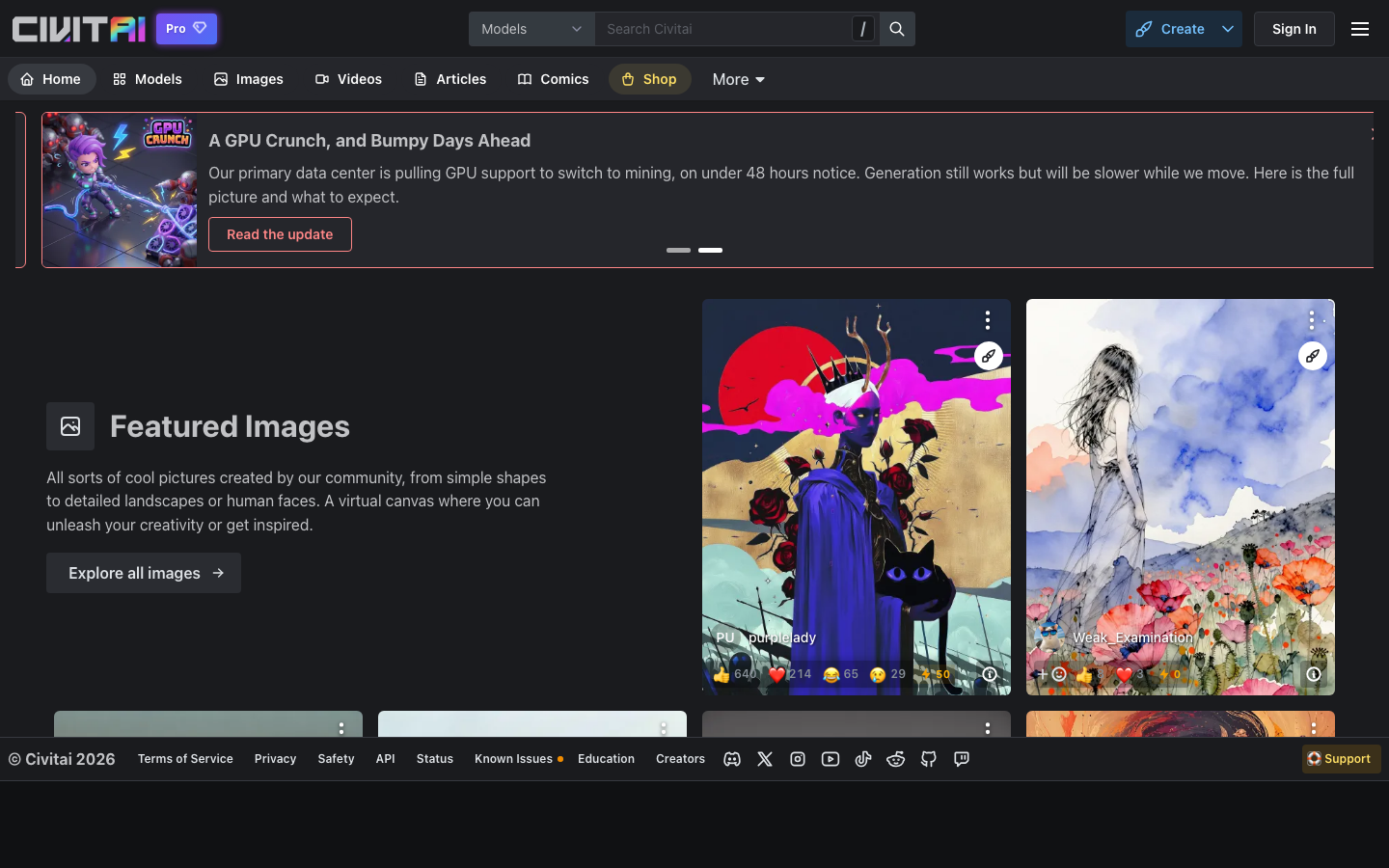
Civitai's in-depth review: How does the "GitHub" of the Stable Diffusion model community operate?
Civitai is not another "AI generation tool", it is the world's largest open source image generation model community and market - it can be understood as GitHub + Hugging Face in the AI painting world. Creators here share fine-tuned versions of basic models such as Stable Diffusion, Flux, Pony and other derivative assets such as LoRA, Embedding and ControlNet. At the same time, the virtual currency "Buzz" is used to generate images directly online through the built-in platform. Founded by Justin Maier in 2022 and headquartered in Boise, Idaho, it received investment from a16z in November 2023 and had average monthly visits of 23.2 million by April 2024. If you are doing AI image generation, there is a high probability that your workflow already relies directly or indirectly on Civitai.
Civitai’s core parameters and statistics
| Projects | Public Information |
|---|---|
| Official entrance | https://civitai.com/ |
| Product Form | Web Community Platform + REST API + Cloud Inference Engine |
| Core positioning | Generative AI model asset hosting, discovery, sharing and online reasoning market |
| Basic model support | Stable Diffusion 1.5 / SDXL / SD3, Flux, Pony, Anima, Krea, etc. |
| Asset Types | Checkpoint, LoRA, Embedding, ControlNet, VAE, Textual Inversion, Poses, Background 3D Models |
| User scale | Reaching 3 million registered users in November 2023; average monthly visits in April 2024: 23.2 million |
| Financing situation | Received investment from Andreessen Horowitz (a16z) in November 2023, the amount is undisclosed |
| Open source status | The core code of the platform is open source on GitHub (github.com/civitai/civitai) |
| Virtual economy | Buzz: can be obtained through purchases, daily rewards, and content creation, and can be used for online reasoning and rewards |
| Platform Support | Web |
| Home | US (Boise, Idaho) |
| Supported languages | en-US (community content is mainly in English) |
Parameter Interpretation: The core value of Civitai does not lie in "what" it can do, but in that it aggregates the world's largest open source Vincent graph model ecosystem. As of 2026, millions of model variations are hosted on the platform – from photorealistic photography to 2D animation, from character-specific LoRA to industrial design ControlNet. Its real barrier is not technology, but the network effect: the more creators, the more models, and the greater the downloads, the more new users are inseparable from this ecosystem. If you need to evaluate whether to introduce Civitai assets into your team workflow, the first thing to focus on is the model quality screening costs and content compliance risks, not the throughput capabilities of the platform itself.
Civitai’s user and market recognition
Industry status: Civitai is currently the world's largest open source image generation model market and has an almost monopoly position within the Stable Diffusion ecosystem. Hugging Face is more focused on NLP and academic models, while Civitai is entirely focused on the community of practitioners in the field of visual generation.
User Scale and Growth:
- Founded in 2022, reaching 100,000 registered users in January 2023.
- Reach 3 million registered users in November 2023 – 30x growth in 10 months.
- Average monthly visits in April 2024 reached 23.2 million (Nikkei Asia data).
- The platform has a comprehensive creator ranking system, covering more than ten subdivided tracks such as comprehensive, images, text, model bases, styles, characters, buildings, backgrounds, postures, vehicles, assets, tools, etc. The top creators’ cumulative Buzz income exceeds 100,000 levels, and the ecological activity is extremely high.
Capital Approval: November 2023 investment from a16z, a major bet from top tier VCs on generative AI content infrastructure. The entry of a16z shows that Civitai is regarded as a "content creation infrastructure" in the AI era rather than a simple model warehouse.
Developer Ecosystem: Civitai provides Site API (public REST interface for browsing models, versions, images, etc.) and Orchestration API (for submitting inference jobs), and has MCP (Model Context Protocol) integration support. A large number of third-party tools (such as the Civitai node of the ComfyUI download plug-in for Stable Diffusion WebUI) directly interface with its API.
Third-party evaluation and reporting:
- TechCrunch, VentureBeat, 404 Media, Engadget, Nikkei Asia and other mainstream technology and financial media have in-depth coverage.
- The academic paper "Moderating model marketplaces" (Gorwa & Veale, 2024) uses this as a typical case study of AI model intermediary platform governance.
- ACM Multimedia 2024 included the paper "Exploring the Use of Abusive Generative AI Models on Civitai", which reflects its attention in the academic community.
Adoption Suggestions: For C-side creators, Civitai has become the de facto standard and is almost impossible to bypass. For B-side teams, they need to be aware of the double-edged sword attribute of the Civitai ecosystem: the richness of models is unmatched, but loose content review may bring compliance risks. It is recommended to access through API or local download in a controlled environment rather than open community browsing directly to end users.
Civitai’s Cost Advantage
Civitai's cost structure needs to be analyzed separately from three dimensions: Consumers (Buzz economy), Creators (free publishing + tips), and Developers (API calls).
C-side/individual user cost
| Cost Item | Description |
|---|---|
| Browse and download | Completely free, no registration is required to browse, and model files can be downloaded after registration |
| Online reasoning (generating images) | Consumption of Buzz: Free users can receive about 100+ Blue Buzz every day, and paid members can receive Green Buzz every month |
| Paid membership | Bronze $10/month, Silver $25/month, Gold $50/month |
| Additional Buzz purchase | can be replenished through in-app purchases, and the unit price will have a bonus of 5%-20% depending on the membership level |
The truth about free: Civitai is indeed free to browse and download, but this is consuming the model assets produced by the creators. The real cost is not money, but the screening cost - the quality of the large number of models on the platform is uneven, with a large number of models having irregular naming, missing descriptions, and opaque training data. Users need to invest a lot of time in trial and error. The core value of paid membership is not in "more generation quota", but in experience optimization such as ad removal, priority generation queue, and private model space.
Creator Cost
- Model upload: completely free, uploading is deemed to agree to the platform ToS.
- Income model: The Buzz obtained can be converted into real income through the creator program. Buzz comes from user rewards and paid downloads.
- Hidden Cost: Once uploaded, the model enters the public pool, making it difficult to trace usage scenarios; the creator has little control over the model being used for inappropriate purposes.
Developer/API Cost
| API Type | Fee | Description |
|---|---|---|
| Site API (browse/search/metadata) | Free, requires API Token | Public REST interface, with frequency restrictions, the specific TPM/RPM is subject to the official real-time document |
| Orchestration API (online inference) | On-demand billing, consumption of Buzz | Submit the generation job to Civitai cloud GPU, the fee is settled in Buzz, the specific unit price is not fully disclosed |
Enterprise/Team Cost
Civitai does not currently have public enterprise pricing plans or private deployment options. If a team needs to use platform assets in batches and in a controlled manner, the usual path is:
- Obtain model metadata and download link through Site API.
- Build your own inference infrastructure (local GPU or third-party cloud), download the model file and use it offline.
- Cost structure = API calling fee (if any) + self-built GPU computing power cost + manpower screening and compliance review cost.
Comparative Analysis: Civitai vs. Alternatives
| Dimensions | Civitai | Hugging Face | Self-built model warehouse |
|---|---|---|---|
| Visual model richness | ★★★★★ The world’s largest | ★★★☆☆ Academic/NLP-oriented | Depends on team accumulation |
| Community activity | ★★★★★ | ★★★★☆ | No community |
| Content review intensity | ★★☆☆☆ Loose | ★★★★☆ Strict | Fully controllable |
| Online reasoning | Support (Buzz economy) | Support (Spaces/Inference API) | Need to build by yourself |
| Enterprise-level support | Undisclosed | Enterprise version available (HF Hub Enterprise) | Fully self-controlled |
| Model discovery efficiency | ★★☆☆☆ Large quantity and difficult to screen | ★★★★☆ Good structure | Depends on management |
Civitai’s main features
-
Model Asset Management Center: Supports uploading, version management, downloading and metadata annotation of all types of model assets such as Checkpoint, LoRA, Embedding, ControlNet, VAE, Textual Inversion, Poses, and Backgrounds. Each model has an independent page, including example images, trigger words, training parameters, download statistics and user comments. Synergy effect: The model page is not only a download entrance, but also a place for creators to display tuning skills and Prompt recipes - browsing a LoRA page, you get sample diagrams, recommended parameters and community feedback at the same time, forming a "read-and-use" experience.
-
Buzz-driven online inference engine: Users do not need a local GPU and directly use the model to generate images on the Civitai server, consuming the virtual currency Buzz. Hidden linkage: The inference results can be directly displayed as "community examples" on the model page, forming a positive cycle of "generate → display → encourage more generation". This is also the core focus of Civitai's commercialization - connecting model sharers and computing power consumers in the same economy.
-
Creation incentives and ranking system: There are 16 subdivided rankings including comprehensive, image, text, model base (Base Model), style, character, architecture, background, posture, vehicle, asset, tool, new creator, guardian, comedian, main generator, etc., updated hourly/daily/monthly. Expert View: The ranking is not a simple traffic distribution tool, it is Civitai's "invisible review mechanism" for content quality control - the content on the list will naturally be exposed, outstanding creators will be rewarded by Buzz, and low-quality content will naturally sink to the bottom, forming a self-purifying community.
-
Bounties bounty system: Users can publish bounty tasks, specify generation goals (style, characters, scenes, etc.), and creators submit works to compete for bounties. Engineering Interpretation: This is essentially a crowdsourcing Marketplace that directly connects the demand side and the supply side. It solves the long-tail demand of "I want to generate X but there is no suitable model/Prompt". The bounty system upgrades the platform from a "passive model warehouse" to an "active creative demand matching engine".
-
MCP integration and developer API: Civitai provides Site API (public REST) and Orchestration API (inference job submission), and supports MCP (Model Context Protocol) integration, allowing AI Agents to discover, download and call models directly through the MCP protocol. Deep Deduction: MCP integration means that Civitai is evolving from a "human-oriented model market" to an "AI Agent-oriented model infrastructure" - in the future, your AI workflow can automatically search LoRA, download, load and complete an inference in Civitai, without human intervention in the entire process.
-
Content community function: In addition to models, the platform also supports UGC content types such as image display, video 3D models, articles, comics, challenges, etc. Positioning change: Civitai is evolving from a "model warehouse" to a "complete social platform for generative AI creators", benchmarking DeviantArt's community status in the digital art era.
Civitai’s model and version evolution
Platform development context
| Time nodes | Milestone events | Description |
|---|---|---|
| 2022 | Civitai Founded | Justin Maier Founds Platform in Boise, Idaho |
| January 2023 | Registered users exceeded 100,000 | Rapid growth with the explosion of Stable Diffusion open source |
| November 2023 | Registered users exceeded 3 million | Growth 30 times in 10 months |
| November 2023 | Received investment from a16z | The amount is undisclosed, an iconic venture capital investment site |
| November 2023 | Launch of Bounties reward system | Triggering deepfake controversy, 404 Media in-depth report |
| December 2023 | OctoML terminates cooperation | Controversy due to platform content involving CSAM |
| April 2024 | Average monthly visits reached 23.2 million | Nikkei Asia data report |
| From 2024 | Continuous expansion of platform capabilities | Support video generation, 3D model Comics, MCP integration, etc. |
Version strategy
Civitai adopts the continuous delivery (Rolling Release) model and has no fixed semantic version number. The official release log is via https://civitai.com/changelog. Version governance recommendation: If you need to use Civitai assets in a production environment, you should lock the hash of a specific model version through the Site API instead of relying on the platform's front-end display.
Key version observation points:
- Parameter adjustments of the Buzz economic model (daily free quota, generated unit price) directly affect user costs.
- The depth of access to the MCP protocol determines Civitai’s position in the AI Agent ecosystem.
- Changes in content moderation policies (especially controls on NSFW content) directly impact usability and compliance risks.
Civitai’s technical advantages
Platform architecture positioning
Civitai is not a big model, but a model asset platform. The key to its technology stack is:
-
Model Version Management and Distribution System: Each model can have multiple versions, and each version corresponds to a set of files (model weights, configuration file VAE, sample diagrams), which are uniformly addressed through AIR (AI Resource Identifier). This allows downstream tools (Stable Diffusion WebUI, ComfyUI) to accurately reference specific versions of assets.
-
Cloud Inference Orchestration (Orchestration API): Users can submit generation jobs to Civitai's cloud GPU cluster through the API without requiring a local GPU. The orchestration layer is responsible for queue management, resource scheduling and result return. Why this matters: It upgrades the platform from a "model download station" to a "model as a service (MaaS)", lowering the consumption threshold, but also introducing dependence on Civitai's computing infrastructure.
-
Buzz Virtual Economic System: Buzz is the economic anchor of the platform - users obtain Buzz through subscriptions, purchases, daily rewards, and content creation, and consume Buzz for reasoning, rewarding creators, or participating in bounties. Engineering Perspective: This is a two-layer Token system - Green Buzz (received from subscription, high value) and Blue Buzz (received for free, low value), which balances the platform's computing resource allocation by distinguishing high-quality users from free users.
-
MCP (Model Context Protocol) integration: Supports large model Agents to directly interact with Civitai through the MCP protocol to perform operations such as model search, version query, and file download. Architecture link diagram:
LLM/AI Agent
    ↓ MCP protocol (tool call)
Civitai MCP Server
    ↓ REST API
Civitai platform (model library + inference engine)
    ↓
Output: model metadata / generated image / download link- Open Source Core: The platform front-end and core logic are open source on GitHub (github.com/civitai/civitai). This means:
- The community can review the code and increase trust.
- Self-hosting is theoretically possible (but the actual deployment complexity is high, and there is no official one-click deployment solution).
- Security vulnerabilities can be discovered and fixed by the community.
Why it’s faster/more economical/more stable
- Faster: Distribute model files through CDN, and the download speed of popular models is guaranteed; cloud inference uses GPU pooling to reduce queuing time.
- More savings: Users do not need to build their own GPU infrastructure to complete inference; the Buzz economy allows computing power consumption to be paid on-demand instead of a fixed monthly fee.
- More stable: The platform has been verified by large-scale traffic in 2023-2024, and the infrastructure is relatively mature; there is an independent status page (status.civitai.com) to announce service availability.
Civitai usage path
Civitai provides multiple access methods covering different usage scenarios:
| How to use | Entry | Typical users | Main limitations |
|---|---|---|---|
| Web browsing | https://civitai.com/ | All users | Online reasoning requires Buzz |
| Site API (Public REST) | https://civitai.com/api/v1/ | Developers, third-party tools | API Token required, frequency limit |
| Orchestration API | developer.civitai.com/orchestration/ | Developers who need cloud inference | On-demand billing (Buzz) |
| MCP protocol | developer.civitai.com/site/mcp/ | AI Agent developer | MCP client needs to be configured |
| Download the model locally | Model page → Download | Users with local GPU | Need to build the inference context by themselves |
Typical usage steps
Scenario A: Online generation by individual creators
- Visit civitai.com and register an account.
- Browse "Featured Models" or "Top Creators" to find the model of interest.
- Click the model to enter the details page and view sample images and trigger words (Trigger Words).
- Click the "Generate" button, enter Prompt, select parameters, and consume Buzz to generate images.
- Save or share satisfactory results to the community.
Scenario B: Developer integrates model search via API
# Search for LoRA models (no authentication required)
curl "https://civitai.com/api/v1/models、limit=5&types=LORA&query=portrait"

# Get authenticated user information (requires Bearer Token)
curl -H "Authorization: Bearer $CIVITAI_TOKEN" \
  "https://civitai.com/api/v1/me"
API Token is generated on the user settings page. For frequency limit and error handling details, please refer to the official documentation at https://developer.civitai.com/site/.
Scenario C: AI Agent discovers and loads models through MCP
- Add Civitai MCP Server in the Agent's MCP configuration.
- Agent calls the
civitai_search_modelstool to search for models. - Agent calls
civitai_get_model_versionto obtain version details and download URL. - Agent calls
civitai_download_modelto download the model to local storage. - The Agent loads the model into ComfyUI/WebUI to perform generation during inference.
Scenario D: Local Stable Diffusion WebUI User
- Find the desired Checkpoint or LoRA on Civitai.
- Click Download (login may be required).
- Put the downloaded file into the corresponding directory of WebUI (models/Stable-diffusion/, models/Lora/, etc.).
- Restart WebUI or refresh the model list to select it during generation.
Civitai Product Pricing
Member Subscription Plan
| Plan | Monthly Fee (USD) | Green Buzz/month | Buzz Purchase Bonus | Daily Blue Buzz Bonus | Number of Private Models | Number of Generations Per Task | Number of Queues | Priority | Support Level | Advertising |
|---|---|---|---|---|---|---|---|---|---|---|
| Free | $0 | 0 | None | 1x | 0 | 4 | 4 | Normal | — | Yes |
| Bronze | $10 | 10,000 | 5% | 1.5x | 3 | 8 | 8 | High Priority | Priority | None |
| Silver | $25 | 25,000 | 10% | 2.5x | 10 | 10 | 10 | High Priority | Premium | None |
| Gold | $50 | 50,000 | 20% | 4x | 100 | 12 | 10 | High Priority | VIP | None |
Extra Benefits (all paid plans): Civitai Link synced assets, dedicated Discord channel, early access to new features, Creator Program (Buzz monetization), enhanced model creator controls.
Buzz Economic Interpretation
Buzz is a dual Token economy within the Civitai platform:
- Green Buzz: obtained through subscription, has higher value and can be used to exchange for inference credits at a 1:1 ratio.
- Blue Buzz: obtained through daily rewards, with lower value and higher consumption in some scenes.
Free Quota: Free users can get about 100+ Blue Buzz through Daily Rewards every day, which is enough for a small amount of trial play, but not enough to support high-frequency production.
Hidden Cost Analysis:
- The actual unit price of online inference for free users is higher than that of paid users (no bonus, no high-priority queue).
- The best value for money for Buzz purchases is with Gold membership (20% bonus), but the monthly fee of $50 may not be cost-effective for light users.
- Insufficient transparency of inference costs: The official calculation formula for each generated Buzz consumption is not disclosed, making it difficult for users to accurately estimate the cost. This can be an obstacle for teams that need to manage budgets.
Enterprise/Team Plan
Civitai currently has no public enterprise-level pricing plans. If an enterprise needs to use it in batches, the usual path is:
- Get the model via the Site API (free).
- Build your own reasoning environment, using local GPU or third-party cloud computing power.
- Cost = self-built GPU + human screening + compliance review.
Procurement Risk Tip: The lack of standardized enterprise contract SLA, data governance clauses and privatized deployment options is the biggest shortcoming of Civitai's current implementation on the B-side.
Application scenarios of Civitai
Scenario 1: Inspiration exploration and rapid verification of individual creators (quantitative cost reduction and efficiency increase)
- Task: Find LoRA/Checkpoint suitable for a specific style and quickly generate concept sketches.
- Traditional method: Search on multiple platforms, download one by one, manually load to WebUI test - it takes about 30-60 minutes to complete a round of links from "Inspiration→Download→Test".
- Civitai method: Search directly in Civitai, judge the suitability through page sample images and Trigger Words, and quickly generate samples through online reasoning - about 5-10 minutes.
- Deduction benefits: A single iteration is reduced from 45 minutes to 8 minutes, and the efficiency is increased by approximately 5.6 times. For creators who need to do 5-10 Prompt rounds per day, this can save 3-6 hours per day.
- Human-machine collaboration boundary: Model selection judgment still relies on personal aesthetics and experience. Civitai cannot replace the decision-making of "human beings know what style is suitable for the current project". 100% Automation Risk: Style Mismatch.
Scenario 2: Mass production of materials by the e-commerce/marketing team
- Task: Generate 100 marketing materials of different products/styles for big promotions.
- Traditional method: Hire a designer to produce each piece one by one - 100 pieces × 2 hours/piece = 200 working hours, cost about $2,000-5,000.
- Civitai method: Find a basic model + product LoRA that suits the product style, and submit inference jobs in batches through the Orchestration API - 100 photos × 2 minutes/photo ≈ 3-4 hours.
- Deduction benefits: reduced from 200 man-hours to 4 hours (about 50 times efficiency improvement), material cost reduced from $2,000+ to Buzz consumption (about $50-100 Buzz cost + human review time).
- Human-machine collaboration boundary: Model screening Prompt writing and result screening require human intervention; Copyright compliance review before final delivery must be completed by humans because the copyright ownership of AI-generated content is still unclear in various jurisdictions.
Scenario 3: Model infrastructure for AI application developer/Agent workflow
- Task: Dynamically select the image style model that best suits user needs in an AI application.
- Implementation Path: Through Civitai MCP Server, AI Agent can search, evaluate, download and load models at runtime, achieving end-to-end automation of "requirements → model matching → inference".
- Deduction benefits: Upgrading from "manual maintenance model library" to "automatic discovery on demand", the manpower investment in model management is reduced from 20 hours/week to nearly zero.
- Human-machine collaboration boundary: Model copyright review, content generation outside the scope of Civitai policies, and the risk of models being used for inappropriate purposes require the setting of manual confirmation checkpoints. It is recommended to establish a whitelist mechanism for models obtained through Civitai MCP, and only allow models that have passed compliance review to enter the production environment.
Scenario 4: Design and Creative Education
- Task: Teaching to demonstrate the impact of different models/parameters on generated results.
- Civitai Advantages: Students do not need to deploy GPU locally. They can switch between different models, adjust prompts and parameters directly in the browser, and see the effect changes immediately.
- Deduction Benefits: Reduce teaching context construction costs from $1,000-3,000/student (GPU workstation) to $10/month (Bronze Member).
Applicable groups of Civitai
-
Personal AI painting creators/enthusiasts: If you are a Stable Diffusion/Flux user, Civitai is your first stop for model acquisition. Almost all major publicly fine-tuned models are released first on Civitai. Recommendation: Register an account to join the community, follow Top Creators in the field of interest, and discover high-quality models through their works.
-
AI Generated Content (AIGC) Entrepreneurship Team: Need to quickly build visual content production capabilities. Product direction can be quickly verified through Civitai API or locally downloaded models + self-built inference. Recommendation: Establish model copyright and compliance review SOPs in the early stages of project establishment to avoid facing infringement or content security issues after commercialization.
-
E-commerce/Marketing/Social Media Operations Team: Requires high-frequency and batch production of materials. Civitai's online inference + Buzz economical pay-as-you-go model is suitable for medium and low-frequency material production; for high-frequency scenarios, it is recommended to download the model to local/private cloud inference for lower long-term costs. Recommendation: First use a paid membership to test run for 1-2 weeks, calculate Buzz consumption and labor costs, and then decide whether to switch to local deployment.
-
AI Agent/Workflow Developer: Civitai’s MCP integration and Site API make it an ideal backend for AI Agent vision model provisioning. Recommendation: Use the MCP protocol to realize automatic discovery and loading of models, but model version locking and compliance filtering must be embedded in the Agent logic.
Unsuitable people (Guidelines for persuading people to quit):
- Enterprises that require deep privatization deployment: Civitai has no enterprise privatization plan, and all data (including download behavior) is within the awareness of Civitai servers. Organizations with strict requirements on data sovereignty are not suitable for direct use.
- Industries with strict compliance/auditing requirements (such as medical, finance, government): Civitai platform content review is relatively loose, the source of model training data is opaque, and it cannot meet strict compliance requirements.
- Professional designers who pursue the ultimate in original visual design: A large number of models on Civitai are fine-tuning of basic models, with high stylistic similarity but limited originality. For design teams that require fully customized brand visual assets, it is recommended to use ControlNet + own data set training.
- Content purchasers who need commercial licensing guarantees: Most of the models on Civitai adopt open source licenses (such as CreativeML Open RAIL-M), but the platform does not force verification of the actual license compliance of each model, and purchasers need to check the copyright by themselves.
Summary and Outlook of Civitai
Core Competencies: Civitai's moat is the network effect driven model ecosystem - no other platform can provide such a rich set of open source visual generation model assets, plus the Buzz economy binds creators, consumers and computing power providers within the same economy, forming a flywheel effect that is difficult to replicate. MCP integration further upgrades it from a "human-oriented model market" to an "AI Agent-oriented model infrastructure". This dual identity will allow it to occupy a key ecological niche in future AI workflows.
Current Limitations:
- Content Moderation and Compliance Risk: This is Civitai’s biggest structural weakness. From the CSAM controversy in 2023 to the deepfake Bounties controversy, the platform's relaxed attitude towards content governance has promoted community freedom and growth, but it has also brought about continued regulatory and legal risks. Enterprise users must establish an independent compliance audit layer when introducing it into their workflow.
- Lack of B-side capabilities: The lack of enterprise-level pricing SLA, privatized deployment and data governance terms severely limits its penetration in the enterprise market. In comparison, the enterprise version of Hugging Face (HF Hub Enterprise) is more mature in these aspects.
- Search and discovery efficiency: The model size is huge but the search and filtering mechanisms are relatively primitive. A large number of model names are not standardized and metadata is incomplete, resulting in a high cost of "finding the right model". Platforms need to invest more in AI-driven model recommendation and semantic search.
- Insufficient transparency in commercialization: Buzz’s consumption calculation formula is not public, and it is difficult for companies to accurately budget reasoning costs. This is a real hurdle for teams that need cost control.
Procurement/Adoption Risk Assessment:
- Short term (1-2 years): Civitai’s dominant position in the C-side and open source communities is difficult to shake. For teams and individuals, connecting to the Civitai ecosystem now is a low-risk, high-reward decision. It is recommended to start with a paid membership or Site API to lock in active creators and high-quality models for controlled use.
- Medium term (2-3 years): The main risk comes from the regulatory level. If countries tighten copyright policies on AI training data or strengthen labeling obligations for AI-generated content, Civitai's model upload and distribution model may face compliance adjustments. It is recommended to continue to pay attention to the platform’s content review updates and safety policies (safety.civitai.com).
- Long term (3-5 years): If Civitai can complement its enterprise-level capabilities (private deployment, enterprise contracts, compliance certifications), it could become the "Adobe Stock + Getty Images" of the AI era - a visually generated content platform integrating community, market and infrastructure. If you fail to solve the shortcomings in B-side capabilities, you may be marginalized in the commercial market by Hugging Face or other enterprise-level platforms.
Recommendation: For most teams, the current correct strategy is "Shallow access, deep control" - leveraging Civitai's model ecosystem and API for rapid verification and prototype development, but building the core production pipeline on self-owned or auditable model assets to isolate content compliance and copyright risks.
Related tools:  Midjourney, stable-diffusion
Version Info
- Civitai Web Rolling Release :The official update of online services is through continuous delivery. There is no official precise semantic version number and release date yet.
- Civitai Public Launch :There is no official precise date yet, but historical milestones are recorded according to the publicly accessible stage.
User Reviews