 Clari
Clari
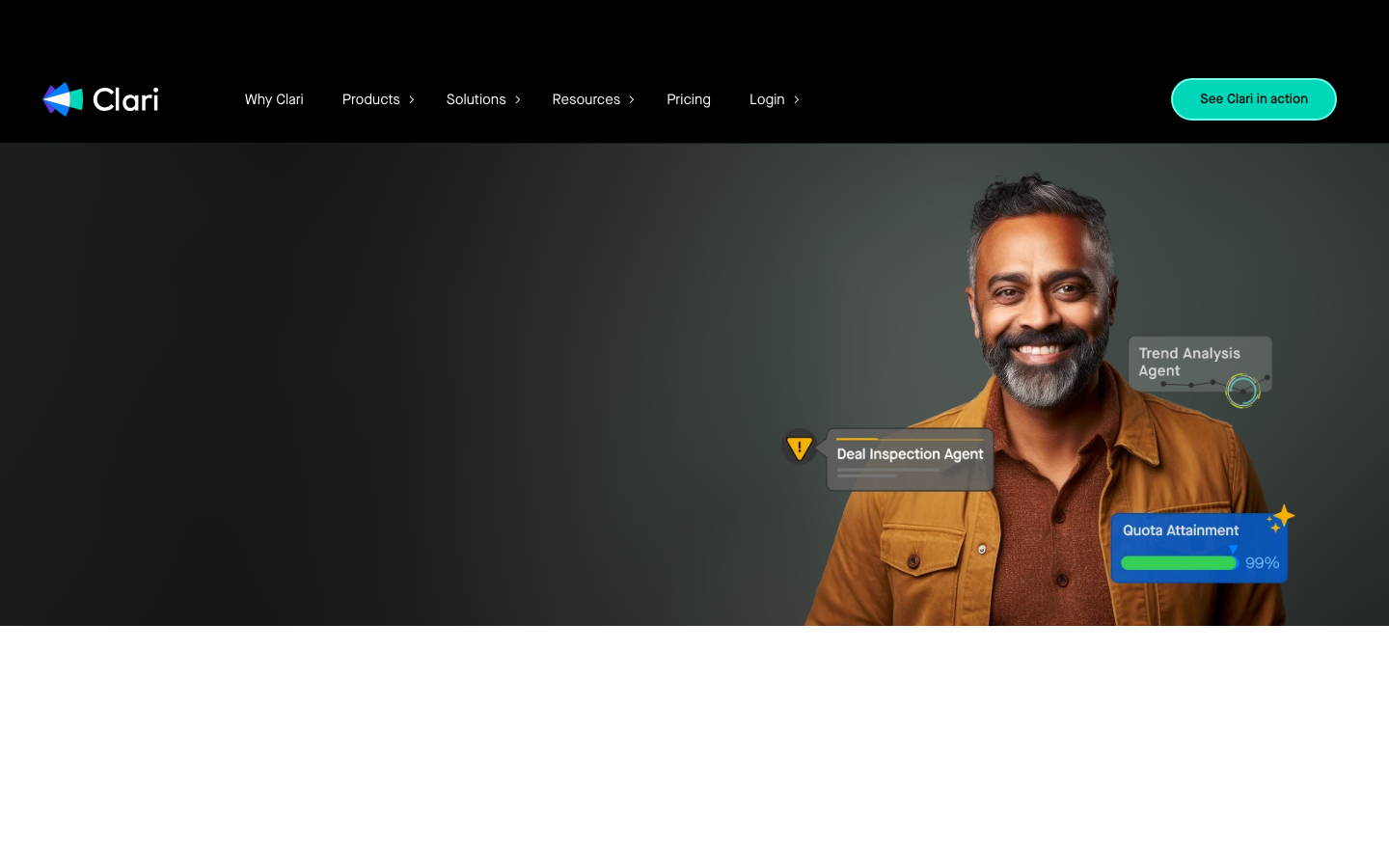
Clari is the pioneer in the Revenue Intelligence category, using AI to analyze CRM, email, calendar and call data to automatically generate sales forecasts, pipeline health scores and risk alerts.
clari
Core parameters and statistics
Clari is the pioneer and definer of the Revenue Intelligence category. After merging with Salesloft at the end of 2025, it will further integrate sales interaction capabilities to form a revenue orchestration platform covering the entire link of "data access → predictive analysis → action execution". The following are core product specifications:
| Parameter item | Value |
|---|---|
| Product Positioning | Predictive Revenue System (Predictive Revenue System) |
| Deployment method | SaaS cloud |
| Customer scale | 1,500+ enterprise customers, managing over $5T in revenue |
| Data source access | CRM, email, calendar, call Slack, CPQ, contract, bill |
| Forecast dimensions | Revenue forecast, pipeline health, single business opportunity transaction probability, customer retention risk |
| AI Capabilities | RevAI (AI Agent Suite), Clari Copilot, AI Deal Scoring, AI Forecast |
| Integrated Systems | Salesforce, HubSpot, Microsoft Dynamics, Outreach, Salesloft, Gong, ZoomInfo, LinkedIn, Slack, Google Workspace, Microsoft Teams and more 200+ |
| Compliance Certification | SOC 2 Type II, GDPR, ISO 27001 (subject to the official security page) |
| Latest version | 2026 Spring Release (~2026-03) |
Positioning boundaries: Clari does not replace CRM. It is built on top of CRM to connect behavioral data such as emails, calendars, calls, etc., and use AI models to "translate" fragmented signals into revenue forecasts and pipeline risks that managers can make decisions on. It doesn’t replace sales execution either—it makes execution results quantifiable and predictable.
Clari’s users and market recognition
Clari's market recognition is in a leading position in the Revenue Intelligence category. The following data are from the official public page and third-party authoritative reports.
Customer scale and coverage: Officially disclosed that it serves 1,500+ enterprise customers, covering leading companies in various industries such as Adobe, IBM, 3M, Zoom, Okta, Unity, UiPath, Checkout.com, etc. Customer industries cover technology, finance, medical care, manufacturing, business services, etc., and Fortune 500 has a high penetration rate.
Third Party Authoritative Approval:
- Gartner Magic Quadrant for Revenue Action Orchestration (2025): Clari is named a Leader and Salesloft is named a Visionary in the first-ever RAO Magic Quadrant report. The report defines a new category for the AI era—unifying sales engagement, revenue intelligence and SFA into a system for predictable growth.
- Forrester Total Economic Impact™ (TEI) Research: Clari achieves 398% ROI (official pricing page shows 448%), and typical enterprise customers gain quantifiable benefits in the following dimensions - a 30% increase in first-round meeting bookings, a 15% shortening of transaction cycles, a 90% reduction in sales operation forecasting time, and a 22% reduction in new employee training time.
- G2 Best Sales Software (2025): Clari was named the 2025 G2 Best Sales Software Winner (Winter/Spring Choice).
Quantitative verification of customer cases:
- Checkout.com: Forecast accuracy increased by 10 times, with a quarterly deviation of 3-4% for two consecutive years, and Bookings grew by more than 70% year-on-year.
- UiPath: Reduce lost orders by 10-15%, and increase renewal rate by 5-10%.
- Unity: The win rate increased by 29.9%, lost orders decreased by 30.2%, and the average selling price increased by 209%.
- Black Swan Data: Save 20+ hours per week of manual reporting time.
- Fortune 100 Manufacturer: Increased renewal rates by 20% and reduced reporting time by 90%.
- Drata: Achieved 100% forecast accuracy in week 7 of the first full quarter.
Market landscape background: Clari and Salesloft completed their merger in December 2025. The combined company serves thousands of corporate customers and doubled its R&D investment to build the industry's first Predictive Revenue System. This merger marks the deep integration of the two categories of Revenue Intelligence and Sales Engagement, and also means that Clari's positioning in the revenue technology stack extends upward from the "analysis layer" to the "execution layer."
Cost advantage: three-tier cost structure and ROI deduction
Clari's cost structure shows typical "enterprise-level SaaS pricing" characteristics - no public price, quotation based on scale and module combination, and mainly annual payment contracts. The following is dismantled from the three dimensions of C-side/API developer/enterprise:
C-side/Personal Users: Clari is not sold to individual users. Clari services cannot be purchased individually by individual sales practitioners, and the minimum starting unit is at the team/department level. This means that individual users cannot have the same zero-cost experience as with ChatGPT or DeepSeek, and evaluating Clari must go through an enterprise PoC (proof of concept) process.
API developer/integrator: Clari provides a public API (developer.clari.com) for data access and custom integration, but API calls are packaged according to enterprise contracts, and there is no independent API pricing system. Developers need to use the API indirectly through partner enterprise customers, or access through the Partner Program.
Enterprise customers (core): Clari quotes based on the combination of "platform subscription + number of users + data volume", which requires business confirmation. The official pricing page has no digital display and only provides the "Get a quote" entry. The following is a deduced cost structure based on public information and industry practices (unofficial data, for reference only):
| Cost Dimensions | Estimate Range | Description |
|---|---|---|
| Annual Subscription (Basic) | Undisclosed (Typically starting from $50K-150K/year) | Includes Forecast + Pipeline + Basic Reports |
| Annual Subscription (Enterprise Edition) | Undisclosed (Typically $150K-500K+/year) | Includes Copilot, RevAI, RevDB, Groove |
| Implementation and Integration Services | Undisclosed (typically 20-50% of annual fee) | Includes CRM integration, data cleaning, training |
| Hidden costs | Upfront investment in data governance | When CRM data quality is poor, it takes 4-8 weeks for data cleaning and process standardization |
Quantitative deduction of cost reduction and efficiency increase (Rule D mandatory): Based on Forrester TEI and customer case data, the impact of Clari on working hours for different positions is deduced as follows (marked as a deduction, unofficial commitment):
- Sales Operations (RevOps): Forecast and report preparation time is reduced from 8-12 hours per week to <1 hour (a drop of about 90%), and the freed man-hours can be turned to pipeline strategy analysis and process optimization.
- Sales Representative (AE): Manual data entry and CRM updates reduced by approximately 30-40%, closing cycle time shortened by approximately 15% as AI automatically captures call/email signals and updates pipeline stages.
- Sales Manager (VP/Sales Director): Forecast Review preparation time is reduced from 2-3 days per month to instant viewing of Dashboard, and the basis for decision-making is changed from "estimate + Excel" to "model prediction + AI risk labeling".
- Customer Success (CS): Renewal risk identification changes from passive response (intervening only after the customer raises the issue) to proactive warning (AI triggers a reminder when it detects a drop in participation), increasing the renewal rate by 5-20%.
Main functions
Clari's functional system will complete the transition from "intelligent revenue analysis" to "predictive revenue system" in 2025-2026. The core module covers the complete link from data capture to action execution.
-
Forecast & Pipeline: This is Clari’s starting capability. The AI model automatically aggregates the business opportunity stage, historical transaction patterns, email interaction frequency and external signals (such as ZoomInfo's corporate information changes) in the CRM, outputs the transaction probability and expected amount for each business opportunity, and summarizes it into a rolling forecast for the team/region/product line. Key point of difference: Clari is not a simple summation - when an opportunity stays in a certain stage for a long time and customer engagement declines, it automatically adjusts the forecast weight downward and flags the cause of risk, rather than waiting for the sales representative to make manual adjustments.
-
RevAI (AI Agent Suite): Core Increment 2025-2026. RevAI includes multiple dedicated AI Agents - Deal Scoring Agent (automatically assesses the health of business opportunities), Forecast Agent (real-time forecast updates), Risk Agent (loss order/renewal risk warning), and Workflow Booster (automatically triggers follow-up actions). Expert View: The synergy of RevAI is that after the Risk Agent detects a risk, instead of just pushing an alert, it automatically triggers the Workflow Booster to create a follow-up task, sends an email to remind the AE, and generates a risk summary on the Dashboard. Create a link from "alarm" to "action" to reduce cross-system switching.
-
Clari Copilot (Conversational Intelligence and Coaching): The result of the merger of the original Groove's Conversational Intelligence capabilities. Automatically transcribe and analyze sales calls, extract key information such as customer pain points, competitor product mentions, and commitment terms, and automatically backfill them into CRM fields. Managers can provide targeted coaching to sales representatives based on call analysis. Hidden value: The "competitive product mention frequency" and "customer sentiment changes" extracted during the call can be used as external feature inputs for the prediction model, directly improving the accuracy of Forecast - the data is no longer isolated in the "Conversation Analysis" module, but flows into the entire prediction engine.
-
Revenue Database (RevDB): A unified layer that aggregates CRM, CPQ, contract, billing and sales interaction data. Provides a panoramic view of revenue across systems, eliminating the reconciliation dilemma of "CRM reports one number, and the contract system reports another number." The key capability of RevDB is that it is not just a data warehouse, but an income data center with permission management and real-time synchronization. The API can expose a unified data surface to the outside world.
-
Sales Engagement (Groove): A fusion of capabilities from Salesloft. Email templates, call sequences, task orchestration, customer interaction tracking - putting "predictive analysis" and "sales execution" on the same platform, management can see forecast data in Clari and directly adjust sales interaction strategies without having to switch to Salesloft or Outreach.
-
Data Analysis and Reporting (Analyze): Supports drag-and-drop custom reports and Dashboards, oriented to RevOps teams with in-depth analysis needs. You can compare pipeline conversion rates in different time periods, forecast deviation analysis, team performance comparison, etc. Implementation Tips: The initial standard Dashboard can usually meet the needs of VP-level review, but the customized analysis needs of the RevOps team may require 1-2 weeks of Dashboard design and tuning.
Clari version evolution
As a SaaS product, Clari's version iteration is carried out in a "seasonal release + continuous feature push" model. The following is a version summary based on official public information:
2024 and before: Revenue Intelligence category defining period
- 2021-2024: Clari continues to iterate on its forecasting algorithms and pipeline analysis capabilities, gradually establishing itself as a leader in the Revenue Intelligence category. During this period, it completed multiple rounds of financing, with a valuation reaching billions of dollars, and the number of customers grew from hundreds to 1,500+.
- 2024: Introduce AI-driven Deal Health Score and automatic risk labeling capabilities, and upgrade the prediction model from "time series prediction based on CRM stage" to "machine learning prediction of multi-signal fusion".
2025: AI Agent introduced and merged with Salesloft
- 2025-S2 (2025 Fall Release): Introducing Groove dialogue intelligent integration, pipeline risk prediction model upgrade, and enhanced automated report generation capabilities. This was an important addition to Clari's pre-merger capabilities - incorporating conversation data into predictive signal sources.
- 2025-12-03: Clari and Salesloft announced their merger. CEO Steve Cox said in the official blog that "this is a category-defining moment." After the merger, the company doubled its R&D investment and began to build a predictive revenue system.
2026: Predictive Revenue System is launched
- 2026 Spring Release (~2026-03): Added Clari Copilot AI assistant (natural language query revenue data), enhanced Deal health score, deeper Salesforce data integration. RevAI suite is officially launched, including multiple dedicated AI Agents.
- 2026 Follow-up Roadmap: The official has not disclosed the specific version plan. Directions speculated based on public information include: MCP Server support (forecasting-execution MCP server has been jointly released with Salesloft), deeper two-way synchronization of CRM data, and customized training capabilities for industry vertical models.
Version Notes: The above dates are public milestones. For specific function release dates, please refer to Clari Release Notes and official blog. Feature rollouts for SaaS products are usually incremental and are not necessarily tied to Major Releases.
Technical advantages: mechanism, effect and applicable boundary
Clari's technical advantage lies not in a single algorithm indicator, but in the synergistic effect of the three-layer architecture of "data breadth + signal fusion + prediction closure".
Signal Fusion: Clari's core technology asset is its accumulated cross-system revenue signal library. Traditional CRM only records the stages and amounts filled in manually by sales representatives. On this basis, Clari overlays email interactions (open/reply/forward), calendar activities (meeting frequency and duration), call analysis (customer sentiment and competitive product mentions), and external signals (ZoomInfo’s corporate updates, LinkedIn’s personnel changes). Mechanism: Multi-source signals are integrated into a unified "Revenue Context™" through timing alignment and event correlation models, and each business opportunity is transformed into a multi-dimensional feature vector. Effectiveness: Clari's multi-signal fusion can improve prediction accuracy by 30-50% (estimated based on customer cases) compared to predictive models that rely solely on CRM data. Applicable Boundary: The value of signal fusion is highly dependent on the access integrity of the data source - if the enterprise prohibits email/calendar access or limits call recording, Clari's signal density will decrease significantly.
Forecast Engine: Clari's forecasts are not simple weighted sums or linear regression. It uses an ensemble learning strategy - running multiple prediction models (based on time series, based on business opportunity attributes, based on historical sales representative behavior) at the same time, and then dynamically determines which model has a higher weight in each scenario through a "selector model". Mechanism: The selector model continuously learns from prediction bias: if an AE is frequently overly optimistic, Clari will automatically apply an "optimism bias correction factor" to his predictions. Effectiveness: Checkout.com cases show that forecast deviations are consistently controlled within 3-4%. Applicable Boundary: For new teams (<6 months of historical data), there is insufficient model training data and the prediction bias correction effect is limited.
Predictive Revenue System: This is the architectural upgrade direction in 2026. Insert the AI Agent layer into the traditional "Analysis → Reporting → Manual Decision" link - AI not only tells you "the pipeline is risky", but also automatically recommends "decision maker B should be contacted and case C provided". Mechanism: Combining LLM (Large Language Model) and traditional ML models, LLM is responsible for generating readable risk explanations and action recommendations, and traditional ML is responsible for numerical predictions and risk scoring. Effect: From "data visibility" to "action executability", it reduces the psychological friction for managers from insight to action. Applicable Boundary: The accuracy and contextual relevance of the recommendations generated by LLM still require manual acceptance, and high-risk scenarios (such as pricing adjustments for large contracts) cannot rely entirely on AI recommendations.
Data Security and Compliance Architecture: Clari supports SOC 2 Type II, GDPR and ISO 27001 (subject to official security page). In an enterprise-grade deployment, the data plane resides entirely within the customer cloud instance, and Clari does not access the original call recording or email body (only metadata). Industries with high data compliance requirements (finance, medical, government affairs): It is necessary to focus on confirming whether Clari's data processing agreement (DPA) covers local data residency requirements and whether it supports field-level permission isolation.
How to use
As an enterprise-level SaaS, Clari's usage path is fundamentally different from that of personal-level tools - there is no "register-and-use" model, but a Demo + PoC + implementation and deployment process.
| How to use | Suitable stage | Features | Prerequisites |
|---|---|---|---|
| Official website Demo application | Early stage of evaluation | After submitting the form, the sales team will arrange a 1:1 demonstration, covering core scenarios | None |
| Product Tour (interactive tour) | Self-guided exploration | The official website provides guided product tour to quickly understand the interface layout | None |
| PoC (Proof of Concept) | Procurement Assessment | Connect to enterprise Salesforce instance to verify forecast results within 4-8 weeks | CRM data governance almost complete |
| Formal deployment | After procurement | Professional service team assists with data cleaning, integration configuration and team training | Contract signing + data access authorization |
| API integration | Deep customization | Access public APIs through developer.clari.com and customize data flows | Enterprise contracts include API permissions |
Typical landing path (phased):
- Phase 1 (Demo & Evaluation, 1-2 weeks): Submit a demo request, communicate with the Clari sales team about business pain points, and confirm core scenarios (forecasting, pipeline analysis, Copilot, etc.). Acceptance Index: Confirm whether Clari's signal source access range covers the systems already used by the enterprise.
- Phase Two (PoC Validation, 4-8 weeks): Connect to the enterprise Salesforce sandbox or production instance and configure basic integration. Clari automatically captures historical data and generates an initial prediction model. Acceptance Index: Compare the deviation rate of Clari predictions vs. manual predictions to evaluate the improvement in prediction accuracy.
- Phase 3 (official launch, 4-12 weeks): full data access, permission configuration Dashboard customization, and team training. RevOps teams learn to use the Analyze module to do custom analysis. Acceptance Metrics: Team adoption rate, shortened forecast review meeting length, and reduced manual reporting workload.
- Phase 4 (Deepen Expansion): Enable RevAI Agent, Copilot and Groove (Salesloft) sales interaction capabilities to upgrade Clari from an "analytic tool" to an "execution platform". Acceptance indicators: Action execution rate, change in order loss rate, and change in renewal rate triggered by AI Agent.
Notes: Clari’s value realization presupposes that the enterprise has relatively standardized CRM usage habits—the business opportunity stage is updated on time, the amount field is accurate, and the contact information is complete. If the CRM data quality is not up to standard, Clari's prediction effect will be compromised. It is recommended to conduct 4-8 weeks of data governance before launching the PoC.
Product Pricing
Clari continues the "non-public pricing" strategy of enterprise-level SaaS, and the official website only provides the "Get a quote" entrance. The following is a breakdown of the cost structure based on industry practices and public clues:
Enterprise subscription (three-tier structure):
| Tier | Typical included capabilities | Reference annual fee range (unofficial) | Typical applicable scale |
|---|---|---|---|
| Revenue Intelligence | Forecast + Pipeline Management + Basic Analyze | $50K-150K/year | 50-200 sales team |
| Enterprise | Above + RevAI Agent + Clari Copilot + RevDB | $150K-500K/year | 200-1,000 sales team |
| Enterprise Plus | Above + Groove (Salesloft) + Dedicated CSM + Custom Integration + SLA | $500K+/Year | 1,000+ People Sales Team |
Hidden costs and contract terms (need to be verified before purchasing):
- Data volume billing: Some contracts are graded based on the revenue and number of business opportunities managed in the CRM. Price adjustments may be triggered when the revenue scale increases.
- Billing by number of users: Usually billed by Named User, inactive users also occupy seats.
- Implementation Fee: Initial implementation fee is typically 20-50% of the annual fee and includes data cleaning, integration and training.
- Renewal Increase: Enterprise SaaS contracts typically include renewal increase provisions of 5-10% per year, which need to be confirmed in the MSA.
- Data Export: The data export permissions and format when the contract is terminated must be agreed in advance to avoid the risk of vendor lock-in.
Cost comparison with competing products (deduction, subject to official real-time quotation):
| Comparative Dimensions | Clari | Gong (Revenue Intelligence) | Salesforce (Native Forecasting) |
|---|---|---|---|
| Core Values | Forecasting + Pipeline + Execution Integration | Conversation Intelligence Mainly | CRM comes with basic forecasting |
| Typical annual fee (mid to large enterprises) | $150K-500K | $100K-300K | Included in Salesforce seat fee |
| Deployment cycle | 4-12 weeks | 2-4 weeks | No additional deployment required |
| Improved forecast accuracy | Customer cases show a deviation of 3-4% | Not focused on forecasting capabilities | Basic forecasts, large deviations |
| Implicit data governance requirements | High (CRM data quality is sensitive) | Medium (call data is relatively independent) | Low (native data) |
Application scenarios
Typical application scenarios of Clari focus on business segments that require "a unified view of revenue data across multiple systems" and "sensitive prediction accuracy":
-
Quarterly/Monthly Sales Forecast Review: This is the most classic usage scenario of Clari. The Sales VP opens the Dashboard, and the system has automatically completed predictions based on CRM+email+call signals. All business opportunities are color-coded according to health (green=normal, yellow=needs attention, red=high risk). Review meetings are no longer used to "check numbers" but directly to discuss "rescue strategies for red business opportunities". Rehearsal Benefits: Review meeting length is reduced from 2-3 hours to 45-60 minutes, saving the VP and RevOps team approximately 2-3 days of preparation time each quarter.
-
Pipeline Risk Management and Intervention: Clari automatically scans all business opportunities in the pipeline and marks those risk items that "stay in the stage for too long, reduce customer participation, and key decision-makers are not involved". AE receives early warnings and recommended actions pushed by Risk Agent (such as "It is recommended to arrange a CTO-level technical exchange"). Deduction benefits: The lost order rate is reduced by 10-15% (refer to the UiPath case), and the intervention time is advanced from "review after lost order" to "warning 4-6 weeks before lost order".
-
Sales Operation Automation (RevOps Efficiency Improvement): RevOps teams are liberated from the weekly manual data export→Excel pivot→PPT production process. Clari's Analyze module supports drag-and-drop reports, and the data is updated in real time, eliminating the need to spend 8-12 hours a week on data transfer. Reduction Benefits: RevOps teams save 30-40 hours per month and can shift their efforts to pipeline strategy optimization and predictive model tuning.
-
Customer retention and renewal management (Post-Sales): The CS team uses Clari to monitor the engagement indicators of existing customers—Support ticket frequency, product usage activity, and quarterly business review participation. AI automatically calculates renewal risk scores and generates "retention action plans" when triggered by high-risk customers. Deduction benefits: The renewal rate increases by 5-20% (refer to Fortune 100 manufacturer case), and the CS team changes from reactive response to proactive management.
-
Newcomer training and coaching acceleration: Clari Copilot's call analysis function can automatically identify the communication patterns of excellent AEs (how to start, how to handle objections, how to promote the next step), and managers can use these patterns as training materials. New AEs accelerate upskilling by comparing their call analytics to best practices. Deduction benefits: The training time for new employees is shortened by 22% (data from the official pricing page), and the time for independent order formation is reduced from 6 months to 4-5 months.
Applicable people
Clari's core users are enterprise roles "requiring revenue visibility and forecast reliability across systems" rather than users of personal sales tools:
-
Sales Manager (VP of Sales/Sales Director): The most direct beneficiary of value. Clari gives them a real-time revenue dashboard that "doesn't rely on Excel or manual reporting." Forecast Review changes from "guessing numbers" to "risk discussions based on AI models". Prerequisite: Managers need to have data-driven management habits. If they tend to "judge based on experience" rather than "make decisions based on data", the value of Clari will be partially offset.
-
Sales Operations Team (Revenue Operations/Sales Operations): The user group that operates most frequently. The RevOps team is responsible for the daily maintenance of Clari (data source access to Dashboard configuration, permission management), and is also the role that has the most significant cost reduction and efficiency improvement - after the report production time is reduced by 90%, the team can focus on higher value analysis work. Not Fitting the Boundary: If the enterprise RevOps team is small (1-2 people) or the RevOps function has not yet been established, the operational maintenance of Clari may become an additional burden.
-
Sales Representative (Account Executive/SDR): indirect user. AE uses Clari to get opportunity health scores and AI-recommended next best actions, reducing manual CRM updates. The Groove module (Salesloft) provides email templates and call sequences to help standardize the sales process. Prerequisite: AE needs to be willing to accept "AI-assisted work" - if the team culture excludes the action suggestions recommended by the system, Clari's adoption rate will be affected.
-
Finance & Revenue Operations (FP&A / Revenue Controller): Clari's Revenue Data Lake (RevDB) provides finance teams with a unified view of revenue across CRM, CPQ and billing systems, significantly reducing "data fights" in the revenue recognition and reconciliation process. Not suitable for boundaries: If the enterprise's financial system (such as ERP, Billing) is not in Clari's preset integration list, it will need to be customized through API development, which will increase the integration cost.
-
Customer Success: Renewal risk management is a core pain point for the CS team. Clari's AI risk warning allows the CS team to shift from "passive firefighting" to "active prevention." Prerequisite: The CS team needs to define clear "Customer Health Score Rules" for Clari model calibration.
Not applicable to crowds and scenarios:
- Individual Salesperson or Independent Consultant - Clari's minimum starting unit is the team/department level and cannot be purchased by individuals.
- Businesses that have not standardized their CRM usage processes - If opportunity stages are not updated and amount fields are inaccurate, Clari's predictive capabilities are compromised.
- Enterprises that only need basic reports (<50 employees) - lightweight CRM with built-in reports or Excel is enough to meet the needs, Clari's investment-output ratio is low.
Summary and Outlook
Clari's core value lies in advancing enterprise revenue management from the "manual Excel era" to the "AI prediction era". It's not a replacement for CRM, but an "intelligent enhancement layer" to CRM - allowing management to truly see what's going on in the pipeline, what's going to happen, and what to do.
Core Competencies:
- Category Definer Advantage: Revenue Intelligence categories are defined by Clari, and 1,500+ enterprise customers, $5T in revenue under management, and Gartner Leader status create significant first-mover advantage and network effects.
- Data flywheel effect: The more revenue data is accessed, the more accurate the signal fusion is; the more accurate the forecast, the more dependent the management is; the deeper the dependence, the more willing it is to access more data sources. This flywheel is difficult for competing products to copy in the short term.
- Execution layer integration: After merging with Salesloft, Clari has been upgraded from an "analytics tool" to an "analytics + execution integrated platform". This is a differentiated capability that conversational intelligence tools such as Gong currently do not have.
Current Limitations and Uncertainties:
- CRM Data Quality Dependence: Clari's prediction accuracy is highly dependent on CRM data quality. Enterprises need to do a data governance inventory before evaluation - if more than 30% of the business opportunity stages in the CRM are lagging for more than 2 weeks and have not been updated, it is recommended to govern first and then PoC.
- Low pricing transparency: No public pricing means that the evaluation cost for small and medium-sized enterprises is high (you must go through the entire Demo-PoC process to obtain a quotation), and there is information asymmetry during the negotiation process.
- Merger integration risk: The merger of Clari and Salesloft is still in the integration stage, and it will still take time to unify the data models and UI integration of the two products. Initial integration is already underway in the 2026 Spring Release, but the full unified experience may not be available until 2026-2027.
- Pressure of Alternatives: Salesforce's own Einstein AI prediction capabilities continue to improve. For companies that are deeply bound to the Salesforce ecosystem and do not have extreme prediction accuracy requirements, Einstein may constitute a "sufficient" alternative.
Procurement and adoption risk assessment (final paragraph of summary): Clari is suitable for companies with mature CRM data governance, a sales team of more than 100 people, and management with the habit of data-driven decision-making. Before purchasing, it is recommended to focus on confirming the following terms: ① The linkage relationship between the data volume/number of users charging gradient and revenue growth in the contract; ② The specific scope of the implementation service package (whether it includes historical data cleaning and CRM field standardization); ③ The data export format and time limit when the contract is terminated; ④ The commitment period of technical support for existing functions in the merged product roadmap. For businesses with less than $50M in annual revenue or sales teams of less than 50 people, it’s recommended to prioritize evaluating lightweight options (Salesforce Einstein or Gong) versus lower-cost alternatives with limited effectiveness.
Related tools:
Version Info
- Clari 2026 Spring Release :Added Clari Copilot AI assistant, enhanced Deal Health Score, and deeper Salesforce data integration.
- Clari 2025 Fall Release :Introducing Groove conversation intelligence integration, pipeline risk prediction model upgrades and automated report generation.
User Reviews