 Cleanlab
Free
Cleanlab
Free
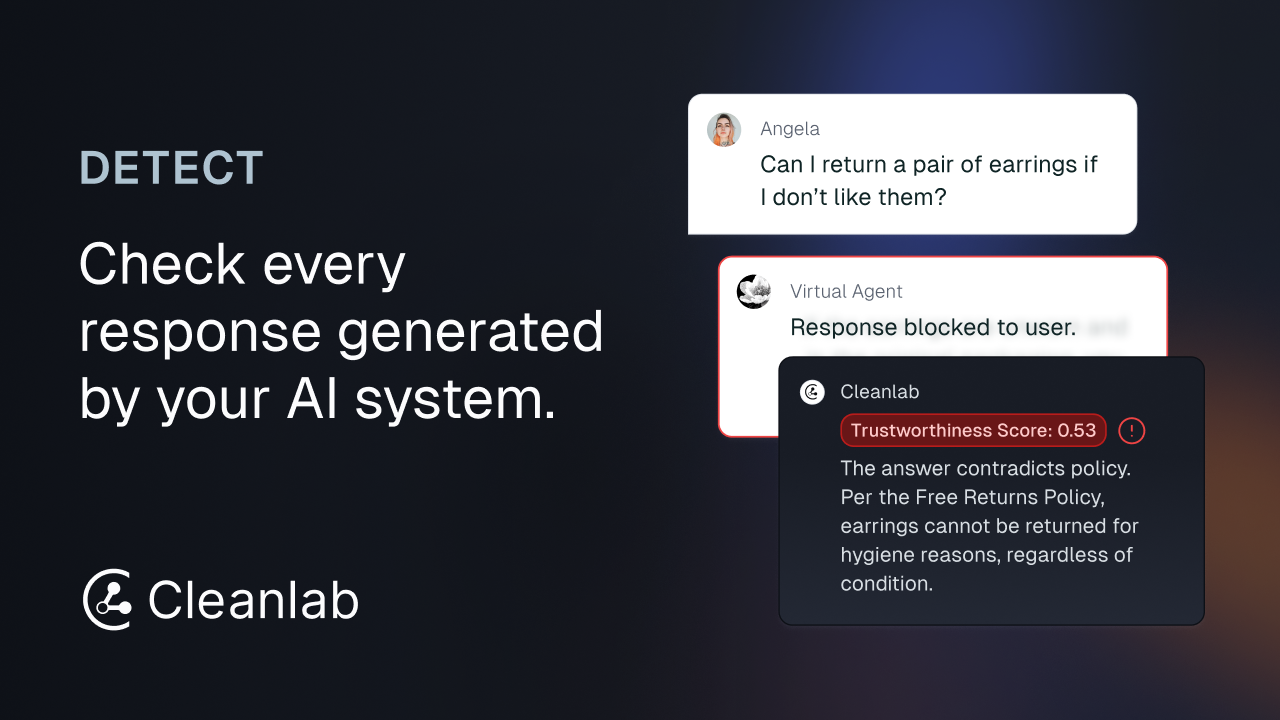
Cleanlab is an AI data quality and reliability platform founded by a team of MIT PhD students. Its core products are Detect (real-time hallucination detection and credibility scoring) and Remediate (expert correction workflow). Its open source data-centric AI library cleanlab has been downloaded over one million times and is used by more than 100 Fortune 500 companies. Acquired by Handshake AI in January 2026.
Cleanlab
Cleanlab’s core parameters and statistics
Cleanlab is the world's leading AI data quality and reliability platform, founded in 2021 by a team of MIT computer science PhDs. What it provides is not another LLM chat interface, but a "reliability layer" for AI Agent production context - real-time detection while AI generates content, and rapid correction by human experts (SME) after problems are discovered, forming a "detection-repair-optimization" system.
| Projects | Public Information |
|---|---|
| Official positioning | AI Agent reliability platform to ensure the safety, accuracy and compliance of AI output |
| Core products | Detect (real-time detection) + Remediate (expert repair) |
| Open source components | cleanlab data-centric AI library (Apache-2.0 license) |
| Deployment method | SaaS cloud (AWS/Azure/GCP), VPC private deployment |
| Community size | GitHub 11.6k stars, 909 forks, 54 contributors |
| Open source downloads | Over 1 million downloads, over 1 billion AI data points processed |
| Latest open source version | v2.9.0 (2026-01-14) |
| Supported Platforms | Web Console REST API |
| Corporate Clients | 100+ Fortune 500 Companies |
| Industry Recognition | Forbes AI 50 (2024), CB Insights AI 100 (2024) |
Product Boundary: Cleanlab does not provide LLM inference capabilities directly, but serves as an independent safety layer layered on top of any AI system - it monitors AI output, assesses credibility, and triggers human corrections when issues are detected. This means it won’t replace your LLM or RAG pipeline, but rather make your existing AI system more reliable. For teams that do not need the reliability guarantee of AI Agent, or that rely entirely on manual review, Cleanlab's core value is not great.
Cleanlab’s users and market recognition
Cleanlab's market recognition comes from three paths: the technical influence of the open source community, endorsement from authoritative industry awards, and actual adoption by Fortune 500 companies.
Open source community influence: cleanlab is the most downloaded data-centric AI open source package on the Internet, with 11.6k stars and 909 forks in the GitHub repository. It is widely used in data cleaning, label correction, and dataset quality analysis. The Confident Learning algorithm invented by founder Curtis Northcutt was publicly evaluated by Andrew Ng as "one of my favorite breakthroughs" (publicly quoted on LinkedIn). This algorithm was published in the JAIR journal and won the IJCAI-JAIR Five-Year Time Test Award. It is the theoretical foundation of the data-centric AI field.
Industry Recognition: Named to Forbes AI 50 (the world's 50 most innovative AI companies) and CB Insights AI 100 (the world's 100 most promising AI companies) in 2024. Named "Top AI Hallucination Detection Tool" by Analytics India Magazine. These third-party endorsements mean that Cleanlab’s technical roadmap and product direction have been independently verified by industry authorities.
Enterprise Adoption: Official public customers include BBVA (BBVA), Tencent Amazon, Oracle, Red Hat, Google, Databricks, iRobot, and more. More than 100 Fortune 500 companies use Cleanlab’s open source libraries or commercial platforms. This covers finance, technology, cloud services, consumer electronics and other industries, indicating that its products have cross-industry versatility.
Financing & Acquisitions: Cleanlab received investment from top institutions such as Menlo Ventures, Bain Capital Ventures, TQ Ventures, Databricks Ventures, Samsung Ventures and more. On January 28, 2026, Handshake AI acquired Cleanlab, aiming to combine its AI research capabilities with Handshake’s 20 million talent network to create the highest quality data annotation capabilities for cutting-edge model training. After the acquisition, the open source library continues to be maintained under the Apache-2.0 license.
Cleanlab’s Cost Advantages
Cleanlab's cost structure revolves around the three layers of "open source free verification + SaaS pay-as-you-go + enterprise private deployment". The core advantage is to reduce the "hidden failure costs" of AI Agent production - that is, customer complaints, brand damage and manual remediation costs caused by AI output errors.
Open source layer (C-side/individual/researcher): cleanlab open source library is completely free and adopts Apache-2.0 license. Individual developers, researchers, and small teams can use its data quality detection capabilities at zero cost: detect labeling errors, outliers, and duplicates in datasets with a single line of code. Officially provides complete documentation and Jupyter Notebook examples. Hidden costs: Open source libraries require users to provide their own ML models for inference. For teams that do not have ready-made models, additional computing resources and time are required for model training.
SaaS platform (Detect + Remediate): The commercial platform adopts the "contact sales to get a demo" model, and the specific pricing details are not disclosed on the official website. Extrapolating from the tiered model, costs are related to:
- Detections: Number of AI responses processed per month
- Evaluation Model: 15+ evaluation model options, different models correspond to different detection accuracy and cost
- Quality Settings: 5 levels of quality settings, high-precision mode consumes more computing power
- Number of Seats: Number of SME accounts using the Remediate module
Enterprise/Private Deployment: Supports VPC (Virtual Private Cloud) deployment, data remains completely within the customer infrastructure. Explicit costs at the enterprise level include platform subscription fees and infrastructure resource consumption; implicit costs include SME training for initial integrated development and custom development to connect Cleanlab's detection results with the enterprise's existing alarm/work order system. Purchase Suggestion: For teams planning to deploy AI Agents in production, Cleanlab’s implicit benefits (reducing customer upgrades caused by AI failures and reducing manual review workload) often far exceed its explicit subscription costs. It is recommended to first use an open source library to verify the scale of data quality problems, then use a SaaS trial to evaluate the detection effect, and finally decide whether to enter an enterprise contract based on ROI.
Main functions of Cleanlab
Cleanlab's product system consists of two major modules and an open source library. The three cover the complete link of "detecting problems → correcting problems → preventing problems".
-
Detect real-time detection module: conducts real-time credibility scoring for each output of the AI Agent. It uses a combination of Self-reflection, Consistency, Probabilistic Measures and two types of proprietary uncertainty methods (Aleatoric & Epistemic) to output a credibility score between 0-1. When the score falls below a set threshold, responses are automatically intercepted and escalated to manual processing. Synergy: Detect does not just simply label, its scoring results directly drive the priority queue of the Remediate module - low-scoring responses are automatically sorted, and SME does not need to manually filter.
-
Remediate Expert Remediation Module: Provides remediation workflows for non-technical domain experts (SMEs) without engineering support. SMEs can directly view the marked AI responses in the Cleanlab console, provide correct answers, and the system will automatically inject corrections into the knowledge base to intercept similar problems in the future. The official benchmark test shows that after the introduction of SME correction, the AI Agent accuracy rate increased from 72% to 90%, and the number of correct responses increased by 92%. Synergy effect: Detect problems found → Remediate automatic collection → SME one-time correction → permanent improvement of the knowledge base, forming a system of continuous self-optimization.
-
Datalab data quality analysis (open source): The core component of the cleanlab open source library, you can perform multi-dimensional problem detection on the data set with one line of code, including label errors, outliers (Outliers), duplicates (Duplicate), distribution shifts (Distribution Shift), category imbalance, etc. Supports comprehensive detection of text, image, audio and tabular data. Synergy: Datalab's analysis results can directly guide the data cleaning process, improve the quality of training data, thereby reducing the generation of model illusions and erroneous outputs from the source - forming a full-link quality management "from training to inference" with Detect/Remediate.
-
Multiple types of hallucination detection: Cleanlab's detection capabilities cover the four most common failure modes of AI Agents - Hallucination (AI creates something out of nothing), Wrong Context (Wrong Context: Retrieve irrelevant documents), Knowledge Gaps (Knowledge Gaps: Missing information in the knowledge base), Policy Violations (Policy Violations: Violation of security/compliance rules). This classification granularity allows teams to pinpoint system weaknesses.
-
15+ evaluation models and 5 levels of quality configuration: Users can choose a combination of evaluation models based on latency and cost requirements, and the response time can be optimized to as low as 300ms. The high-speed mode is suitable for high-frequency customer service scenarios, and the high-precision mode is suitable for financial compliance review. This flexibility allows the same platform to simultaneously serve different lines of business that are both latency-sensitive and accuracy-sensitive.
Cleanlab’s model and version evolution
Cleanlab's product line is divided into two independent version tracks: open source libraries (cleanlab Python package) and commercial platforms (Codex / Detect + Remediate). The former has a clear version number system, while the latter continues to iterate online.
Open source library version mainline
The cleanlab open source library has iterated nearly 20 official versions since its early version was released in 2021:
| Version | Release Date | Key Changes |
|---|---|---|
| v2.9.0 | 2026-01-14 | The latest official version, extended Python 3.10-14 support, improved CI build |
| v2.8.0 | ~2025-09 | Continuous improvement of Datalab problem type detection, no official precise date yet |
| v2.7.0 | ~2025-06 | Introducing more Datalab question types and enhancing multi-modal support |
| v2.6.0 | ~2025-03 | Enhanced data quality assessment for multi-label classification and regression tasks |
| v2.5.0 | ~2024-12 | Improve label quality assessment for visual tasks such as object detection, image segmentation |
| v2.4.0 | ~2024-09 | Expand Datalab functions and add new problem type detection |
| v2.3.0 | ~2024-06 | Enhanced label error correction support for token classification (entity recognition) |
| v2.2.0 | ~2024-03 | Improved consensus inference and annotator quality assessment in multi-annotator scenarios |
| v2.1.0 | ~2023-12 | Improve the data quality assessment capabilities of regression tasks |
| v2.0.0 | ~2023-09 | Major architecture upgrade, introducing Datalab unified problem detection framework |
Business platform version context
The commercial platform (currently branded as Codex and divided into two modules: Detect and Remediate) is continuously delivered in the form of SaaS and does not provide a version number in the traditional sense. The following is a summary based on publicly available milestones:
- 2026-01: Handshake AI acquires Cleanlab, CEO said it will focus on AI research on "cutting-edge model data quality"
- 2025: Launch the Detect and Remediate dual modules, and release the AI Agents in Production report (AI Agents in Production 2025)
- 2024: Release of Trustworthy Language Model (TLM), recognized by Forbes AI 50 and CB Insights AI 100
- 2023: Complete Series A financing ($30M), launch enterprise-level platform
- 2021: The company was established, founded by three MIT CS PhDs, and released the open source cleanlab library
Version selection suggestions
For open source users, it is recommended to fix a major version (such as v2.9.0) for production data cleaning and pay attention to breaking changes in GitHub Release Notes. For platform users, the SaaS model means continuous access to the latest features without having to worry about version upgrades; however, it is recommended to confirm with the official whether functional changes will affect existing workflows in key business scenarios.
Cleanlab’s technical advantages
The technical barrier of Cleanlab is not the amount of model parameters or training computing power, but the engineering solution to the meta-problem "how to use AI to evaluate AI".
Theoretical basis of Confident Learning: Cleanlab’s core algorithm Confident Learning is the first label noise estimation framework with theoretical guarantees. It does not require knowledge of the true noise transformation matrix, but instead estimates the label error through the joint distribution of model predicted probabilities and given labels. Published in JAIR (2021), this theory won the IJCAI-JAIR Five-Year Time Test Award—peer validation at top AI academic conferences. Effect: This means that Cleanlab can reliably detect data problems without a "standard answer", relying only on the uncertainty signal of the model itself, and this process is guaranteed by strict mathematical proof.
Fusion mechanism of a single credibility indicator: Unlike most solutions that only do a binary classification of "whether it is an hallucination or not", Cleanlab integrates self-reflection, multi-response consistency checking, vocabulary-level probability analysis and two types of proprietary uncertainty methods (random uncertainty and epistemic uncertainty) into a continuous credibility score between 0-1. Effect: A single score allows the AI Agent to make granular decisions - responses higher than 0.95 can be output directly, 0.7-0.95 requires manual sampling, and responses lower than 0.7 are automatically upgraded. This grading strategy significantly reduces user complaints caused by "AI hard answers" in customer service scenarios.
Leading detection accuracy: In the hallucination detection effect evaluation against four RAG benchmarks (CovidQA, DROP, FinanceBench, PubmedQA), Cleanlab's AUROC (area under the curve) reached 0.91, significantly better than LLM-as-a-judge (0.78), RAGAS Faithful (0.70) and other solutions. In a broader LLM reliability benchmark, Cleanlab's precision/recall is 34% higher than other methods, and across six RAG applications, Cleanlab's precision/recall is 3x higher than that of mainstream real-time evaluation models. Mechanism: This advantage stems from the fact that Cleanlab does not use a single detection method, but fuses multiple complementary uncertainty signals - the self-reflective signal captures the "explicit uncertainty" of the model, the probabilistic metric captures the "implicit uncertainty", and the proprietary method further strengthens the detection robustness under long-tail distributions.
Non-invasive integrated architecture: Cleanlab is deployed as an independent security layer (Reliability Layer) without making any changes to the existing AI system. It receives input and context for AI responses via a REST API, returning a credibility score and issue classification. Supports integration with mainstream observation platforms such as Arize, Langfuse, Langtrace, mlFlow, and NVIDIA. Effect: The team can "insert" a reliability checkpoint into the existing AI pipeline without modifying the Agent code or introducing a new framework.
How to use Cleanlab
Cleanlab provides three usage paths, corresponding to the needs of different roles:
| How to use | Suitable for people | Key steps | Cost |
|---|---|---|---|
| Open source library cleanlab | Data scientist ML engineer | pip install cleanlab → Load data → Call Datalab.find_issues() |
Free (Apache-2.0) |
| Detect API | Back-end development AI engineering team | Obtain API Key → Send AI response through REST API → Receive credibility score | Pay-as-you-go billing, need to contact sales |
| Remediate console | Domain experts (SMEs), business teams | Log in to the web console → Review marked AI responses → Submit revised answers | Platform subscription fee included |
| Enterprise private deployment | Enterprises with high compliance requirements | Contact sales to confirm VPC deployment → Configure network and identity authentication → Connect internal systems | Business contract |
Open Source Library Quick Start: The following Python code shows how to use cleanlab to detect label errors in a dataset:
from cleanlab import Datalab
import pandas as pd

# Load the data set (text, image, table, etc. are all acceptable)
data = pd.read_csv("your_dataset.csv")

#Initialize Datalab and specify the label column
lab = Datalab(data=data, label_name="ground_truth")

# Get predicted probabilities and feature embeddings using any ML model
# Assume that pred_probs and features have been obtained through the model
lab.find_issues(pred_probs=pred_probs, features=features)

# Generate data quality report
lab.report()
Detect API Integration: In production environments, attach a credibility check to every AI response via the REST API:
curl -X POST https://api.cleanlab.ai/v1/tlm \
  -H "Authorization: Bearer <YOUR_API_KEY>" \
  -H "Content-Type: application/json" \
  -d '{
    "prompt": "User question content",
    "response": "AI generated answer content",
    "context": "Optional retrieval context text",
    "quality_preset": "best"
  }'
The response will contain trustworthiness_score (a confidence score between 0-1) and issues (a list of detected issue types).
Implementation path: It is recommended to follow a "three-stage advancement": the first stage uses open source libraries to conduct quality audits on training data to confirm the proportion of label errors and problem distribution in the data; the second stage integrates the Detect API on non-critical AI Agents (such as internal knowledge question and answer assistants), adjusts thresholds and evaluates model selection; the third stage deploys Detect + Remediate in full production and trains SMEs to use the correction workflow.
Cleanlab product pricing
Cleanlab's pricing system is divided into two distinct levels: the open source layer is completely free, and the commercial layer adopts a "contact sales to get a quote" model.
Open Source Library (cleanlab Python package): Completely free, Apache-2.0 licensed. There is no limit on the number of uses, no limit on the amount of data, and no limit on the number of users. This is the lowest threshold path for individual developers, academic researchers and PoC stage teams to enter the Cleanlab ecosystem.
SaaS platform (Detect + Remediate): The official has not published a standardized price list, but uses "Request Demo" as the entrance. Based on the pricing models of similar platforms in the industry, the hierarchical comparison of cost structures is as follows:
| Cost Dimension | Open Source Layer | SaaS Platform Layer | Enterprise/Private Deployment Layer |
|---|---|---|---|
| Subscription fee | Free (Apache-2.0) | Billed by detection volume/model/seat, please contact sales | Business contract, usually includes annual fee |
| Infrastructure | User's own responsibility (local or cloud) | Vendor hosting (AWS/Azure/GCP) | Self-managed or vendor-managed within VPC |
| Integration investment | Documentation + Notebook examples | API integration, days to weeks | Custom development, weeks to months |
| SME training | Not applicable | Console out-of-the-box, lightweight training | Same as SaaS + permission configuration |
| Data control | Complete autonomy | Vendor hosting | Complete autonomy (within VPC) |
| Suitable stage | PoC, academic research, personal trial | Small and medium-scale production deployment | Large-scale, strong compliance production context |
Enterprise/private deployment: VPC deployment and privatization solutions require separate business negotiation. Contract terms should focus on: data isolation standards (physical or logical isolation), SLA availability commitments (usually 99.9%+), data retention and deletion terms, and data migration plans after termination of cooperation.
Hidden cost reminder: Cleanlab's core value comes from "reducing the losses caused by AI errors". This part of the benefits is difficult to accurately quantify before purchasing. It is recommended to set up a controlled experiment during the trial period - let one business line use Cleanlab detection, and the other does not use it, and record the error rate, customer upgrade rate and manual intervention time of the two groups to build an ROI model.
Application scenarios of Cleanlab
The value of Cleanlab is most obvious at the node of "production deployment of AI Agent" - when AI moves from demonstration to business line, and the consequences of incorrect output escalate from "poor experience" to "customer complaints, compliance risks, and brand damage," reliability assurance becomes a rigid requirement.
-
Customer Service AI Agent Reliability Guarantee: The customer service scenario is Cleanlab’s most typical high-frequency application. The output of AI customer service directly faces customers, and a wrong reply (such as informing customers of the wrong return policy, providing non-existent discounts) may lead to the escalation of customer complaints or even legal disputes. Cleanlab calculates a credibility score before the AI response reaches the customer, and requests with low scores are automatically transferred to human customer service. Actual benefits: Official data shows that after the introduction of SME correction, the accuracy rate increased from 72% to 90%, and the number of correct responses increased by 92%. For a business that handles an average of 100,000 customer service conversations per day, this means thousands of fewer incorrect responses per day.
-
Enterprise knowledge Q&A system quality audit: The AI knowledge assistant within the enterprise (employee manual query IT support, compliance policy Q&A, etc.) also faces the problem of illusion - wrong interpretation of internal policies may lead to employee decision-making errors. Cleanlab's credibility score can help enterprises identify coverage gaps and document inconsistencies in the knowledge base, and back-inject the results of SME revisions into the knowledge base. Implementation Tips: It is recommended to start the pilot project from the knowledge area where "frequent questions are asked but the quality of answers is unstable", and then expand to all knowledge areas after confirming Cleanlab's detection coverage.
-
AI Agent development and testing quality gate control: In the AI Agent's CI/CD pipeline, Cleanlab can be used as a quality gate control - after each Agent update, batch testing is run using the standard test set to compare the changes in the credibility distribution of the previous and later versions. If the credibility of a new version drops below a threshold under certain scenarios, release is automatically blocked. Actual benefits: Move reliability verification to the development stage and reduce "shock releases" in production.
-
Financial Compliance and Risk Control Review: The financial industry has extremely high requirements for the accuracy and traceability of AI output. Cleanlab’s issue classification capabilities, specifically Policy Violation detection, can identify statements in AI output that violate compliance requirements while providing detailed scoring rationales to meet audit trail needs. Implementation Tips: In financial scenarios, it is recommended to use the best quality settings and cooperate with the manual review process. Cleanlab acts as a "risk indicator" rather than a "decision maker" in this scenario.
-
Data cleaning and training data optimization: Through the open source Datalab library, ML teams can conduct systematic quality audits of training data to automatically detect label errors, outliers, and duplicate samples. Google, Amazon, and others are already using this capability in production to improve the quality of model training data. Real benefit: Correcting 1% of training label errors results in measurable accuracy improvements on benchmarks like ImageNet.
Cleanlab is suitable for people
Cleanlab's positioning determines that its core audience is teams that have put or are putting AI Agents into production, rather than early explorers of AI.
-
AI Engineering and MLOps Team: They are responsible for the production deployment and maintenance of AI Agent, and are most directly exposed to the pressure of "uncontrollable output after the model goes online". Cleanlab’s Detect API can be seamlessly embedded into existing inference pipelines, providing a plug-and-play reliability monitoring layer. Unfit Boundary: If the team is still in the model selection or PoC stage and has not yet defined a clear "line of responsibility" (that is, who is responsible for AI errors), the introduction of Cleanlab may be premature - at this time, it should focus on basic model selection and prompt engineering.
-
Customer service and operations managers: They manage the daily operations of AI customer service and are most sensitive to customer complaints caused by "AI said things it shouldn't have said." Cleanlab’s Remediate module allows non-technical operators to modify AI behavior directly without relying on an engineering team. Not suitable for the boundary: If the customer service team has no digital operation foundation at all (not even a basic work order system), Cleanlab's learning curve may be too steep, and it is recommended to start with process digitization.
-
Data Scientists and ML Researchers: They use the cleanlab open source library for data quality analysis, label debugging, and experimental validation. For academics working on data-centric AI, weakly supervised learning, and label noise, cleanlab provides a reproducible standard toolchain. Not suitable for the boundary: If you need to process extremely large-scale data sets (tens of billions of samples), the single-machine processing capability of the open source library may become a bottleneck, and a distributed expansion solution needs to be considered.
-
Compliance and Risk Management Leader: In highly regulated industries such as finance, medical, and legal, they are concerned about the auditability and compliance risks of AI output. Cleanlab’s problem classification and scoring mechanism can provide a structured chain of risk evidence. Not suitable for boundaries: Cleanlab provides detection signals rather than compliance endorsements - it cannot replace the manual review of the compliance team, but makes the review more accurate and efficient.
-
Enterprise IT and procurement decision makers: They need to make selection decisions among multiple AI reliability solutions. Cleanlab's two-tier strategy of open source foundation + commercial platform allows technical verification at the open source layer first, and then large-scale procurement at the platform layer, reducing decision-making risks. Misfit Boundary: If the enterprise requires completely offline deployment and no GPU resources, Cleanlab's private deployment threshold (at least an inference server is required) may exceed the current infrastructure capabilities, and it is recommended to evaluate the SaaS model first.
Summary and Outlook of Cleanlab
Cleanlab is uniquely positioned in the market in that it competes with neither LLM providers nor Agent frameworks, but instead embeds a "reliability layer" between the two - a capability gap that is overlooked by most AI teams but increasingly critical in production deployments.
Core Competitive Advantages: The theoretical basis of Confident Learning remains at the forefront of cutting-edge AI research; the closed design of Detect + Remediate seamlessly connects "error discovery" and "error correction" without relying on the intervention of the engineering team; the over one million downloads of the open source library and the adoption of Fortune 500 provide evidence for the feasibility of the technical route.
Current major limitations: Pricing is not transparent - the "contact sales" model at the commercial level makes it difficult for small and medium-sized teams to independently evaluate budget matching; Chinese support has not yet been made public - for teams in the Chinese market, the interface and documentation are all in English, and localization adaptation is uncertain; revenue depends on SME participation - the effect of the Remediate module is highly dependent on the continued investment of domain experts, and if SME resources are insufficient, the revision process may be interrupted; Handshake The product roadmap may change after the acquisition - although the open source library is promised to continue to be maintained after the acquisition, there is a risk of adjustment in the direction and pricing strategy of the commercial platform.
Procurement and Adoption Risk Assessment: For teams that have deployed AI Agents and are facing output reliability issues, Cleanlab deserves an immediate evaluation. The recommended evaluation path is: use open source libraries to conduct offline quality audits on the training data and post-launch AI response collections in the first week to confirm the scale of the problem; apply for SaaS Demo in the second to fourth weeks, conduct Detect integration verification on a non-critical business line, and record the false positive rate and recall rate; introduce Remediate in another business line in the fifth to eighth weeks to evaluate the actual input-output ratio of the SME workflow. If all three rounds of evaluation meet the standards (detection AUROC > 0.85, SME single correction time < 5 minutes, accuracy improvement > 15%), you can enter corporate business negotiations. Special attention needs to be paid to Handshake's product strategic direction after the acquisition - confirm a product roadmap and pricing commitment to sales for at least 12 months before signing to avoid the risk of major direction adjustments caused by mergers and acquisitions.
Version Info
- Cleanlab Open Source v2.9.0 :The latest version of the open source library continues to improve data quality detection and label error correction capabilities, and expands support for Python 3.10-14.
- Cleanlab Open Source v2.8.0 :There is no official precise date yet. According to the public release record, the data quality problem detection capability will be continuously iterated.
- Cleanlab Open Source v2.7.0 :There is no official precise date yet, and richer Datalab problem type detection support will be introduced.
- Cleanlab Open Source v2.6.0 :There is no official precise date yet to enhance support for multi-label classification and regression tasks.
- Cleanlab Open Source v2.5.0 :No official precise date yet, improve label quality assessment for vision tasks such as object detection and image segmentation.
- Cleanlab Open Source v2.4.0 :There is no official precise date yet. Datalab functions are expanded to support more types of data problem detection.
User Reviews