 Cognigy
Cognigy is Germany's leading conversational AI platform, supporting low-code NLU engine construction and multi-channel release, focusing on enterprise-level customer service and automation scenarios.
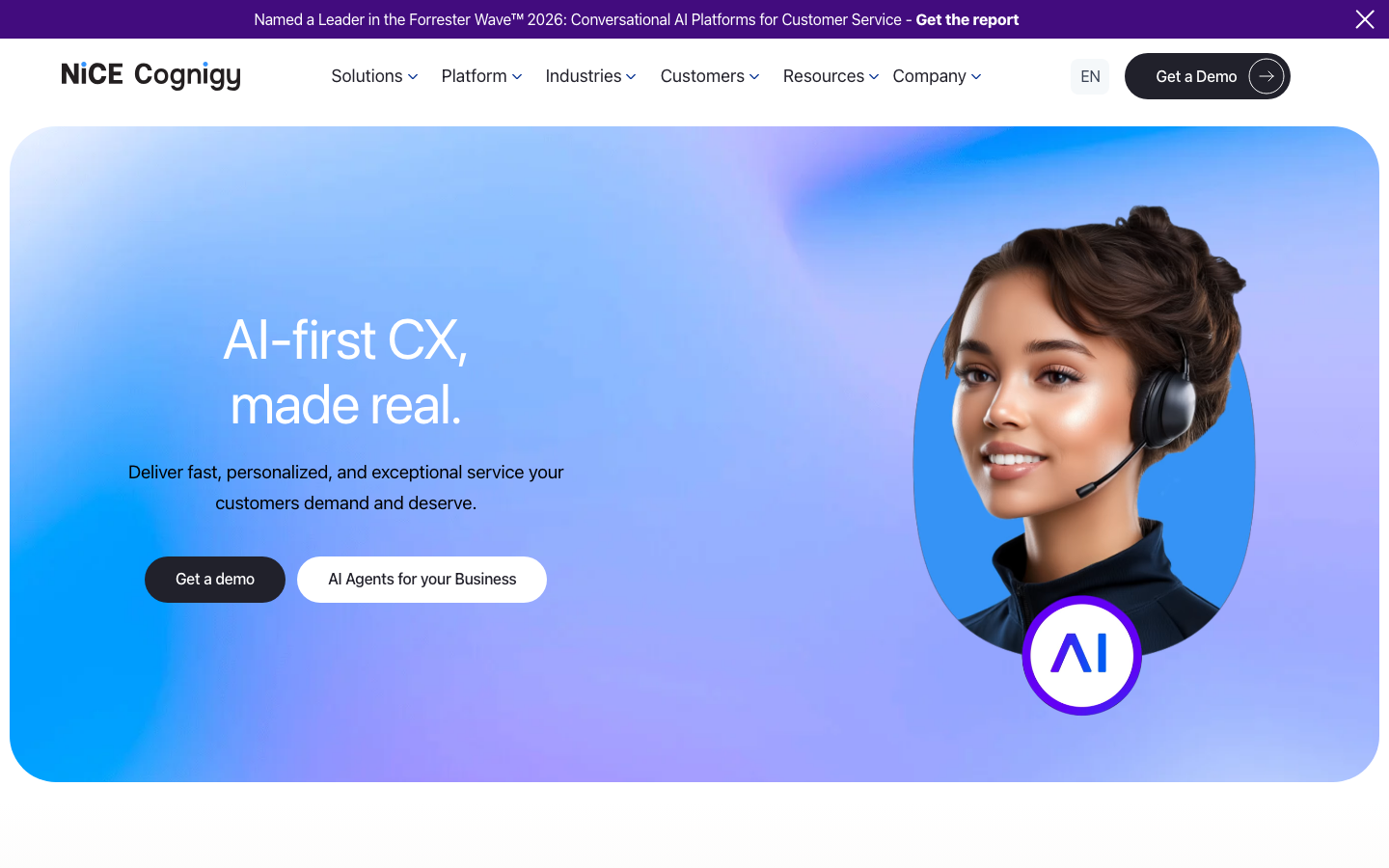
Cognigy (NiCE Cognigy) — Enterprise-level conversational AI and agent orchestration platform
Tool introduction
Cognigy (now NiCE Cognigy) is a representative of German enterprise-level conversational AI platforms. After being acquired by global CX giant NiCE (NASDAQ: NICE) in 2024, it became an independent brand under NiCE, focusing on AI-driven customer experience automation. The Cognigy.AI platform is positioned as an "AI-first CX platform". Its core is to build, deploy and orchestrate enterprise-level AI agents (AI Agents) through low-code methods, covering customer service scenarios in multiple channels such as voice, text, and messaging.
- A brief comment in one sentence: It is not another chatbot platform, but a complete "AI customer service workforce" orchestration system - from agent creation, knowledge injection, multi-channel release to performance monitoring and AI Ops, throughout the entire customer service automation life cycle.
- Publicity Verification: Cognigy officially claims to "process over 1 billion interactions per year", "Forrester Wave™ 2026 Leader", "70% AHT reduction" - these data are supported in its official website cases (Lufthansa, Toyota Frontier Airlines) and are not exaggerated propaganda.
As of 2026, the latest version of Cognigy.AI is v4.8 (~2026-05), which introduces enhanced LLM integration and knowledge graph capabilities, and achieves real-time visibility of agent operation and maintenance through AI Ops Center.
Core functions
Cognigy.AI is a full-stack platform driven by Cognigy Nexus Engine (multi-layer AI core), whose functions cover the entire life cycle of AI agents:
1. Agentic AI (intelligent AI)
Cognigy has evolved from a traditional conversational bot to an Agentic AI platform. AI agents can not only understand user intentions, but also reason autonomously, decompose complex tasks, and call enterprise tools to complete end-to-end operations.
- Progressive Reasoning: Use LLM to decompose multi-step requests in real time and dynamically plan the optimal solution path.
- Context Memory: Supports short-term memory (within a single conversation) and long-term memory (across sessions), meeting compliance requirements through configurable storage policies.
- Autonomous Tool Call: The agent can call security tools such as authentication, payment, reservation, and record update to complete transactional operations.
- Multi-modal interaction: Support rich media interactions such as text, voice, pictures, biometrics, electronic signatures, and location sharing through xApps.
2. AI Agent Studio (low-code agent studio)
Enterprise-level visual agent construction and orchestration engine supports cross-functional team collaboration:
- AI-Assisted Design: Automatically generate the intelligent persona, communication style and knowledge base through language prompts.
- Pre-built tool library: 100+ pre-built connectors for CRM, work orders, payments, etc., ready to use out of the box.
- Real-time preview and debugging: Real-time conversation preview without refreshing, supports Live Debug to track real interactions.
- One-Click Publishing: Build once and have multiple channels (web chat, voice SMS, WhatsApp, Facebook Messenger, etc.) go online at the same time.
- Automated QA: Large-scale automated regression testing scripts, automatically verified before going online.
3. NLU (Natural Language Understanding)
Cognigy's NLU engine is the core intelligence layer of the platform, using Hybrid NLU architecture - combining traditional intent classification with LLM deep semantic understanding.
- Intent recognition success rate: Officially claimed 99.7%.
- 100+ Language Support: Multi-language NLU out-of-the-box, supporting automatic localization translation.
- 20,000+ pre-built NLU resources: covering 500+ user intents and 100+ pre-built conversation flows.
- Few-Shot Learning: A high-precision intent model can be trained with a small number of samples.
- LLM Generate Training Data: Use GenAI to automatically generate example sentences and dictionary entities.
- Intent Analyzer: Real-time feedback on NLU model quality.
4. Knowledge AI (Knowledge AI — RAG Engine)
Enterprise knowledge question and answer module based on retrieval enhanced generation (RAG):
- Multi-source knowledge injection: Supports multiple document formats such as PDF, Word, slides, web pages, pictures, etc.
- Vector Search + LLM Summarization: Retrieve the most relevant snippets from the enterprise knowledge base and use LLM to generate precise answers.
- Data traceability: Each answer can be traced back to the original source of knowledge, solving the "black box" problem.
- LLM free choice: can be connected to OpenAI, Anthropic, open source models or self-hosted models.
5. Voice Gateway
Enterprise-level voice AI agent connector supports docking with any CCaaS/CPaaS infrastructure:
- 25,000+ concurrent calls: Enterprise-level high concurrency support.
- 1,000+ synthesized voices: Supports multiple voice styles (customized for aviation, retail, logistics, finance, medical, etc. scenarios).
- Advanced Call Control: Supports Barge-in, DTMF, call recording, seamless manual transfer, outbound calls + answering machine detection (AMD).
- Real-time translation: The agent and the customer can use different languages respectively, and the system translates in real time.
6. Insights (omni-channel conversation analysis suite)
Complete data system from real-time dashboard to in-depth root cause analysis:
- Real-time business dashboard: Global/regional traffic, session volume, and agent performance are visible in real time.
- Goal Dashboard: Quantify the actual impact of AI on the business (time saved, cost reduced, revenue increased).
- Path Analysis: Visualize the customer journey and locate churn points and bottlenecks.
- OData interface: Analysis data can be exported to third-party BI tools such as Power BI and Tableau.
7. Live Agent (online customer service workbench)
AI-enhanced omni-channel human customer service workbench:
- Omni-channel access: WhatsApp, Facebook, iMessage, website, mobile App, etc.
- Intelligent Routing: Automatic allocation based on skills, load, and domain name.
- Agent Copilot: Monitor conversations in real time and proactively push knowledge base answers and suggested replies.
- Automatic summary and backfill: Generate conversation summary and update CRM with one click.
8. AI Ops Center (AI Operation and Maintenance Center, newly released in October 2025)
A control layer designed specifically for enterprise large-scale AI agent operation and maintenance:
- Real-time monitoring and alerting: Detect dependency issues such as LLM API delays and third-party service failures.
- Root Cause Analysis: Quickly locate the source of the fault and reduce MTTR (Mean Time to Recovery).
- Proactive Prevention: Identify bottlenecks and automatically trigger plans before they impact customers.
9. xApps (multimodal microweb applications)
Embed rich interactive micro-applications (such as identity authentication, payment forms, electronic signatures, location sharing) in the conversation to complete complex operations without leaving the chat interface, and support complete white label customization.
Pricing strategy
Cognigy adopts an enterprise subscription system, and all plans need to be communicated and confirmed with the sales team. As of July 2026, the officially disclosed pricing tiers are as follows:
| Plan level | Pricing model | Applicable objects | Core benefits |
|---|---|---|---|
| Essentials | Billing by plan | Small and medium-sized teams | Core AI Agent builds NLU, standard channel connectors |
| Enterprise | Annual Quotation | Large Enterprise | Full Features + Private Deployment + Advanced Security Compliance + Dedicated Support |
| Managed Cloud | Annual contract quotation | Data compliance-sensitive enterprises | Deployed in EU/German data centers, data does not leave the country |
Pricing Transparency: Cognigy’s official website does not publish specific prices. All plans need to apply for a demo to obtain a quote. According to industry analysts, Cognigy's pricing is usually based on a combination of monthly active users (MAU), number of concurrent sessions, number of channels, and additional modules (Knowledge AI, Voice Gateway, Insights, etc.).
C client/individual: There is no free version, and there is no public free trial entrance.
Developer/API: Undisclosed standalone API pricing plan. Cognigy provides an open REST API and CLI, but access must be obtained in the Enterprise or Managed Cloud plans.
Comparison with competing products: According to Gartner Peer Insights and industry feedback, Cognigy's total cost of ownership (TCO) is at a mid-to-high level among similar enterprise-level conversational AI platforms, but its "one-time purchase + multi-channel reuse" model can reduce implementation costs by about 3 times compared to self-built solutions (official case data).
Advantages and Disadvantages Analysis
Strengths
- Enterprise-level compliance moat: Full compliance with GDPR, SOC2, HIPAA, ISO 27001, ISO 9001, and CCPA, supporting privatized deployment of EU data centers, and is the first choice for large European enterprises.
- Low code + high flexibility: AI Agent Studio supports non-technical personnel to build agents through prompt words and drag-and-drop operations. It also provides CLI, REST API, and built-in IDE to meet developers' in-depth customization needs.
- Omni-channel consistency: 30+ channel connectors + xApps multi-modal capabilities ensure that the same agent can run consistently on web pages, voice WhatsApp, mobile apps and other channels.
- Agentic AI capability leadership: Forrester Wave™ 2026 highest score in the Strategy category, Gartner Magic Quadrant™ 2025 leader, strong analyst recognition.
- Mass Production Verification: Lufthansa handles 16 million+ automated conversations annually, Toyota has 25+ AI agents online at the same time, and Frontier Airlines achieves 100% call coverage, verifying enterprise-level reliability.
- AI Ops Center operation and maintenance issues: The new operation and maintenance control layer added in 2025 solves the "last mile" operation and maintenance problem after large-scale AI deployment. This is a differentiated capability that most competing products have not yet covered.
Weaknesses
- Untransparent pricing: There is no public quotation, the entry barrier is high, and it is difficult for small and medium-sized enterprises to evaluate the actual cost.
- Limited global coverage: Although acquired by NiCE, the support capabilities and partner ecosystem in the Asia-Pacific region (especially China and Southeast Asia) are still significantly weaker than those of North American competitors (such as NICE CXone, Google Contact Center AI).
- Learning Curve: The platform has rich functions but high complexity. Non-technical business personnel need a training cycle of 2-4 weeks to independently complete the construction of the agent.
- NLU support for low-resource languages: Although it claims 100+ languages, the actual NLU accuracy rate of small languages (such as Southeast Asian and African languages) has not been disclosed and needs to be verified by actual testing.
- Integration with NiCE products is still in progress: After being acquired by NiCE, the integration of the product roadmap may result in incompatible changes to some legacy APIs/features.
Comparison with major competing products
| Dimensions | Cognigy.AI | Google Dialogflow CX | NICE CXone |
|---|---|---|---|
| Core positioning | Enterprise-level Agentic AI orchestration | Multi-round dialogue NLU engine | Full-stack customer service center platform |
| Low-code capabilities | ⭐⭐⭐⭐⭐ AI Agent Studio | ⭐⭐⭐ Flow Builder | ⭐⭐⭐ Studio |
| Agentic AI (autonomous reasoning) | ⭐⭐⭐⭐⭐ Native support | ⭐⭐ Additional development required | ⭐⭐⭐ Limited support |
| Voice Capabilities | ⭐⭐⭐⭐⭐ Voice Gateway | ⭐⭐⭐⭐ Phone Gateway | ⭐⭐⭐⭐⭐ Native |
| Private Deployments | ⭐⭐⭐⭐⭐ EU/Local Data Centers | ⭐⭐ Google Cloud Only | ⭐⭐⭐ Partially Supported |
| Compliance Certification | GDPR/SOC2/HIPAA/ISO | SOC2/GDPR | SOC2/GDPR/HIPAA |
| 100+ Languages | ⭐⭐⭐⭐ Supported | ⭐⭐⭐⭐⭐ Best | ⭐⭐⭐ Limited |
| Pricing transparency | ⭐ Business quotation required | ⭐⭐⭐ Pay-as-you-go billing | ⭐⭐ Quotation required |
| China market availability | ❌ No direct service | ✅ Google Cloud HK access | ⭐ Partial |
Applicable scenarios
Classified by industry
- Aviation and Tourism: Lufthansa uses Cognigy to handle flight changes and refund inquiries, with more than 16 million automated conversations per year; Frontier Airlines achieves 100% AI coverage of incoming calls, and AHT reaches a record low.
- Automotive Industry: Toyota deployed 25+ AI agents, covering customer care and in-car voice assistants, with 98% customer satisfaction and 95% AI appointment acceptance rate.
- Consumer Goods/Retail: Henkel uses 25 AI agents to handle 5 million customer interactions, covering 7 channels and 12 languages; DTC brands such as Fabletics and Justfab use Cognigy to handle after-sales and subscription management.
- Utilities: Salzburg AG’s AI agents save 2,500 phone calls per month; Germany’s Rentenbank uses Cognigy Live Agent for omnichannel customer service.
- Financial Services: ERGO Insurance Group uses Cognigy to handle insurance inquiries and claims guidance.
- Medical and Health: Medical institutions such as Personify Health and Lincare use AI agents to handle patient consultation and appointment management.
- Telecommunications: Operators such as Nuuday and Mobily are used in high-frequency scenarios such as package changes and fault reporting.
Classified by role
- Customer Service Operations Leader: Automate 60-80% of repeated consultations through AI agents, reduce labor costs, and improve CSAT.
- Conversation Designer/Business Analyst: Quickly build agents using low-code AI Agent Studio’s visual and prompt-word-driven approach.
- Developer/System Integration Engineer: Deeply embed Cognigy into the enterprise IT ecosystem through CLI, REST API, and Extension Framework.
- Data/Analytics Team: Obtain omni-channel session data through Insights and OData interfaces to drive continuous optimization of CX.
Summary
Cognigy (NiCE Cognigy) is one of the most noteworthy European platforms in the current enterprise-level conversational AI/Agentic AI track. Its core differences are reflected in three levels:
- Depth of Compliance: GDPR + SOC2 + HIPAA + ISO 27001 full-stack compliance, coupled with the privatization deployment of EU data centers, gives it irreplaceable advantages in data-sensitive industries (finance, medical, government, aviation).
- AI Agent Maturity: From NLU -> RAG (Knowledge AI) -> Agentic AI (autonomous reasoning and tool invocation) -> AI Ops Center, a complete intelligent agent full life cycle management system has been formed, and it has achieved leadership status in the evaluations of both Gartner and Forrester.
- NiCE ecological blessing: After being acquired by NiCE, Cognigy has obtained the channels, customer resources and continuous investment of one of the world's largest CX vendors, accelerating its globalization process. The launch of AI Ops Center and MCP (Model Context Protocol) support in 2025 further solidifies its technology leadership.
Not suitable for boundaries: Cognigy is not the best choice for the following scenarios - ① small projects with plain text, single channel, low concurrency (there are lighter competing products); ② requiring deep localization of Chinese NLP (Cognigy supports Chinese, but is not as accurate as domestic manufacturers in Chinese semantic understanding); ③ teams that are budget-sensitive and cannot accept opaque pricing.
Procurement/Adoption Risk Assessment:
- Compliance Risk: Very low. Cognigy has passed mainstream compliance certification, and NiCE itself, as a listed company (NASDAQ: NICE), has a complete compliance governance system.
- Vendor lock-in risk: Moderate. Cognigy supports docking with multiple LLMs (OpenAI, Anthropic, open source models) and open API/CLI, but the core orchestration layer is bound to the platform, and migration costs exist in process design and integration assets.
- Ongoing Operating Risk: Low to Moderate. NiCE's financial strength ensures continued product iteration; however, attention needs to be paid to the direction of product line integration after the acquisition (NiCE owns competing products such as CXone), and there may be competition for internal resource allocation.
- Regional Availability Risk: Support in the Asia-Pacific region is limited, and there is no direct service in China. It is recommended to choose a hosting solution on AWS/Azure or a local partner for implementation.
Efficiency improvement comparison
The following data is based on Cognigy's official customer cases and industry analysis (those marked "based on industry analysis" are reasonable calculations and are not official commitments):
| Indicators | Traditional manual customer service | Cognigy AI agent assistance | Improvement rate |
|---|---|---|---|
| Average Handling Time (AHT) | 8-12 minutes/pass | 2-4 minutes/pass | 60-70% shorter (official case: Frontier Airlines AHT hits record low) |
| First Time Resolution Rate (FCR) | 60-70% | 85-95% (combined AI + human) | 15-25 percentage points improvement |
| Manual agent processing volume | 40-60 passes/day/person | AI filtering 60-80% of common problems, manual focus on complex cases | Manual efficiency increased by about 3 times |
| 7x24 service coverage | Three shifts required, high labor costs | AI agents are online around the clock | Zero additional labor costs |
| Multi-language support | Requires multi-lingual agent team | 100+ languages real-time translation | Reduce 80-90% multi-lingual labor costs (according to industry analysis) |
| Online cycle (first agent) | N/A | 6 weeks to 3 months | Official case: Greyhound 30x acceleration, new agent online 6 hours after disaster |
| Concurrent session upper limit | Limited by the number of agents | 25,000+ concurrency (voice), unlimited (text) | Flexible expansion, zero waiting |
| Annual Cost Savings | N/A | Customer Story: Essent saves €2 million annually | ROI typically achieved within 6-12 months (according to industry analysis) |
Cost structure comparison (using a medium-sized customer service center as a model, with an average of 100,000 interactions per month)
| Cost items | Traditional call center | Cognigy AI assistance | Cognigy fully automated |
|---|---|---|---|
| Agent labor cost (monthly) | ¥400,000-800,000 (20-40 people) | ¥150,000-300,000 (8-15 people) | ¥50,000-80,000 (3-5 people, handling upgrade cases) |
| Software license fee (monthly) | ¥20,000-50,000 (CRM/work order system) | ¥80,000-150,000 (Cognigy Enterprise Edition, estimated based on industry analysis) | ¥150,000-250,000 (including all modules) |
| Infrastructure/communication fees | ¥30,000-80,000 | ¥20,000-40,000 | ¥20,000-40,000 |
| Training cost (year) | ¥100,000-200,000 | ¥30,000-50,000 | ¥10,000-20,000 |
| Total monthly cost (estimate) | ¥450,000-930,000 | ¥250,000-490,000 | ¥220,000-370,000 |
| Deduction Savings | Baseline | ~40-50% | ~50-65% |
⚠️ The above cost deduction is based on public case data and industry analysis. Actual costs vary significantly depending on different scenarios, scale, and negotiation terms.
Automation Boundary
Scenarios that can be 100% automated
- Information Query Category: Bill query, order status, balance query FAQ type standard questions and answers (Knowledge AI best adapted).
- Standard transaction processing: password reset, address change, package upgrade/downgrade, appointment management, simple return and exchange application.
- Authentication: Biometric (Face ID / Touch ID) or multi-factor authentication via xApps.
- Grade IVR: Incoming call intent identification and diversion, replacing the traditional button-based IVR menu.
- Active outbound calls: payment reminders, appointment confirmations, satisfaction return visits, and early collection reminders.
- Multi-language real-time translation: Customers and agents each speak one language, and AI translates each other in real-time.
Scenarios requiring human intervention (Human-in-the-loop)
- Complex Complaint Handling: Involving compensation negotiations and highly emotional customers (artificial empathy intervention required).
- Irreversible operations: high refunds, account deletion, legal contract signing, final approval of insurance claims.
- Compliance-sensitive calls: Financial transaction confirmation, changes in medical information, and special scenarios involving regulatory compliance recording archiving.
- Upgrade and Transfer: When the AI recognizes a complex problem beyond its capabilities, it triggers "Warm Handover" (smooth transfer with complete context).
- New Business/Unknown Scenario: The first edge case, when AI cannot determine the correct process, manual labeling and training will be performed.
- Personalized marketing/high-value customers: Scenarios that require in-depth relationship maintenance such as large-amount purchase negotiations and contract renewal communication for VIP customers.
Cognigy’s human-machine collaboration mechanism
- Warm Handover: Seamless transfer between AI and human agents, completely conveying the conversation context, customer portrait, and emotional state.
- Agent Copilot: During manual agent processing, AI monitors and recommends knowledge base answers, best replies, auto-complete summaries and CRM updates in the background in real time.
- Graded Automation: The automation threshold can be set through configuration (for example: order amount < ¥500 will be processed automatically, > ¥500 will be transferred to manual approval).
Security and Compliance
Cognigy invests significantly in security compliance, consistent with its positioning of primarily serving large European enterprises.
Certification and Standards
| Certifications/Standards | Status | Description |
|---|---|---|
| GDPR | ✅ Compliance | Full compliance with the EU General Data Protection Regulation, supporting data storage and processing within the EU |
| SOC 2 Type II | ✅ Certification | Service organization control report Type II, covering security, availability, confidentiality |
| HIPAA | ✅ COMPLIANCE | U.S. Health Insurance Portability and Accountability Act for Medical Customers |
| ISO 27001 | ✅ Certification | International Standard for Information Security Management System |
| ISO 9001 | ✅ Certification | Quality Management System |
| CCPA | ✅ Compliance | California Consumer Privacy Act |
| EcoVadis | ✅ Ratings | Corporate Social Responsibility Sustainability Ratings |
Data security measures
- Data encryption: Data encryption at rest (database level) + encryption in transit (TLS 1.2/1.3).
- Data Masking: Built-in PII (Personally Identifiable Information) detection and masking engine, supporting automatic masking of sensitive fields before NLU processing.
- Fine-grained access control: Role-based access control (RBAC), supports SSO (SAML/OIDC).
- Data localization: Supports privatized deployment (Managed Cloud) in German/EU data centers, and data does not leave the country.
- Conversation data isolation: Conversation data between customers is strictly isolated, and the multi-tenant architecture is isolated by the underlying Kubernetes.
- AI Security Guardrails: Built-in content auditing and jailbreak attack protection (Secure Guardrails), supporting custom security policies.
Data Governance
- Data retention policy: Configurable conversation data retention period, automatic cleanup after expiration.
- Response traceability: Each AI answer can be traced back to the source of knowledge cited for easy auditing.
- Model training data: According to the official website statement, customer conversation data will not be used for secondary training of the model. However, it is recommended that the specific terms be confirmed in the contract.
For more details, please visit Cognigy Trust Center: https://trust.cognigy.com/ (Source: Cognigy official website security page)
Integrated Ecosystem
Cognigy provides a multi-layered, open integration architecture that can be deeply embedded into an enterprise's existing technology stack.
Channel Connectors (30+ out of the box)
- Web Chat: Webchat component (can be white-labeled)
- Voice: Connect to any CCaaS / CPaaS through Voice Gateway
- Message Apps: WhatsApp, Facebook Messenger, Instagram, Apple Messages for Business, LINE, Telegram, WeChat (compatibility needs to be evaluated)
- SMS: Twilio, Vonage, etc.
- Enterprise collaboration: Slack, Microsoft Teams
- Custom Channels: Connect any channel via API or Extension Framework
Enterprise system integration (100+ pre-built connectors & MCP)
- CRM: Salesforce, Microsoft Dynamics 365, HubSpot, Zendesk Sell
- Customer Service Ticket: Zendesk, Freshdesk, ServiceNow
- E-commerce/ERP: Shopify, Magento, SAP
- CCaaS Platforms: Amazon Connect, 8x8, Five9, Genesys Cloud CX
- LLM & AI Services: OpenAI, Anthropic, Google Vertex AI, Azure OpenAI, self-hosted models
- Voice Services: Google STT/TTS, Azure Speech, Amazon Polly, Nuance
- Authentication/Payment: Stripe, Adyen, Okta, Auth0
- Analysis and BI: Connect with Power BI, Tableau, and Looker through OData interface
Developer Tools and Extensibility
- REST API: Covers all functions of the platform and supports automated management and CI/CD integration. API documentation: https://api-trial.cognigy.ai/openapi (Source: Cognigy official website)
- CLI (Command Line Tool): Supports version control of agent projects, batch import and export CI/CD pipeline integration.
- Built-in IDE: Write JavaScript/TypeScript code directly in the AI Agent Studio process editor.
- Extension Framework: Public repository provides hundreds of free plug-ins and code samples (Source: Cognigy Support - Extensions Overview)
- MCP (Model Context Protocol): Supports connecting third-party agent tools and services through the industry standard MCP protocol.
- Webhooks: Support outbound/inbound Webhooks to trigger business processes.
Implementation suggestions
Deployment recommendations
Cognigy supports three deployment models, which enterprises should choose based on data compliance requirements, budget, and internal technical capabilities:
| Deployment mode | Applicable scenarios | Reasons for recommendation |
|---|---|---|
| SaaS Cloud | Medium and large enterprises with no data localization requirements | Lowest operation and maintenance costs, automatically obtain the latest features |
| Managed Cloud (EU) | GDPR strict compliance, data does not leave the country | Data is stored in German/EU data centers |
| Privatized Deployment | Highly regulated industries (finance, healthcare, government affairs) | Full control of infrastructure, highest security level |
Recommended startup path:
- Phase 1 (1-2 months): Choose a high-frequency, low-complexity use case (such as FAQ automated answering) to quickly validate ROI through the SaaS model.
- Phase 2 (2-4 months): Expand to voice channels + Knowledge AI to cover more query types.
- Phase 3 (3-6 months): Introduce Agentic AI autonomous operation capabilities (booking, payment), and configure the Warm Handover mechanism.
- Phase 4 (6-12 months): Scale to omni-channel, connect to AI Ops Center to achieve centralized operation and maintenance, and comprehensively measure business impact.
Team training suggestions
| Role | Training focus | Recommended training cycle |
|---|---|---|
| Dialogue Designer/Business Personnel | AI Agent Studio low-code operation NLU training, dialogue flow design | 2-3 weeks |
| Developer/Integration Engineer | CLI, API, Extension Framework, CI/CD Integration | 1-2 weeks |
| Operation/Platform Administrator | AI Ops Center, RBAC, logging and monitoring, security configuration | 1 week |
| Customer Service Agent | Live Agent workbench uses Agent Copilot to interact | 2-3 days |
Tip: Cognigy provides an official training certification program (Cognigy Academy) and partner implementation services. It is recommended to complete certification training for at least 2 core members before large-scale promotion.
Best Practices
- Start small and win quickly: Prioritize high-frequency, low-complexity use cases (such as password resets, order inquiries) to quickly build internal confidence and promotional materials.
- Establish an NLU continuous optimization process: Cognigy Insights + Intent Analyzer should be embedded in daily operations. Review unrecognized intentions and user churn points every week, and continuously iterate training data.
- Design elegant degradation strategies: AI agents should always know what they "don't know". When the confidence level is lower than the threshold, Warm Handover is automatically triggered to prevent customers from repeatedly hitting the wall in the robot cycle.
- Human-machine collaboration rather than replacement: The initial goal is to "handle 60% of common queries" instead of pursuing 100% automation. The remaining 40% of complex cases are handled manually, with Agent Copilot assisting in improving efficiency.
- Reshape IVR with xApps: Replace traditional button-based IVR and greatly improve the self-service experience through voice + visual interface (such as xApp display options on mobile phones).
- Safety first: Before enabling any Agentic AI autonomous operation, fully test the tool call boundaries in a sandbox environment and configure Secure Guardrails to prevent jailbreak or misoperation. Set manual confirmation points for all irreversible operations.
- Continuously measure business value: Use Insights’ Goals Dashboard to directly link the performance of AI agents to business KPIs (CSAT, AHT, FCR, cost savings), and regularly report ROI to management.
Cognigy’s main features
- Core Processing Capabilities: Provides core AI capabilities in the corresponding scenarios to support users to quickly complete tasks.
- Multi-modal interaction: supports text input and result output, and some scenes support image or file upload.
- Workflow Integration: Can be embedded into existing workflows or linked with other tools through APIs to reduce context switching.
Cognigy application scenarios
- Personal Creation: Quickly generate or process content to improve daily work efficiency.
- Team Collaboration: Unify workflow and reduce repetitive manpower investment.
- Enterprise-grade deployment: Embed capabilities into on-premises systems via API or private deployment.
Cognigy’s applicable groups
- Individual Users: Content creators and knowledge workers who need AI assistance to improve their daily work efficiency.
- Developers: Technical teams who need to integrate AI capabilities into their own products or services through APIs.
- Enterprise: Organizations seeking to deploy AI at scale in their field.
Cognigy’s technical advantages
- Algorithm Optimization: Special optimization at the model or algorithm level has been carried out for the corresponding scenario to achieve a balance between response speed and result quality.
- Low-latency architecture: Adopts streaming or asynchronous processing architecture to reduce user waiting time and is suitable for high-frequency interaction scenarios.
Cognigy’s core parameters and statistics
Specific technical parameters (such as model size, context length, supported file formats, input and output restrictions, etc.) are subject to the official product page. It is recommended that users verify the latest technical specifications and system requirements before choosing to ensure that they match their own usage scenarios.
Cognigy’s user and market recognition
Gradually build user awareness in the field, and product capabilities are used by content creators and teams to improve work efficiency. Some industry users have incorporated it into their daily workflow. It is recommended to refer to the latest official disclosures for specific user scale and industry adoption rate data.
Cognigy’s Cost Advantage
- C-side/Individual: Usually a free version is provided to experience the core functions, and high-frequency use requires a paid package subscription.
- API/Developer: Billed by call volume, suitable for development teams that can be flexibly integrated into their own systems.
- Enterprise/Privatized: Contact the business owner for customized quotation and deployment plan. The specific price is subject to the official real-time pricing page.
Cognigy’s Summary and Outlook
It provides competitive solutions in its field, and its core value lies in lowering the threshold for AI use in this field. With technology iteration, products are expected to continue to improve in functional coverage and performance.
Current limitations: Some advanced functions require paid subscription, and the free version has function or usage limits; Specific technical details and performance benchmarks have not yet been fully disclosed, and it is recommended to fully verify them through trials before purchasing.
Cognigy’s model and version evolution
Continuous iterative updates, the latest version introduces performance optimization and new features. Historical version information can be viewed on the official release page. There is no complete public version evolution timeline yet. It is recommended to pay attention to the official announcement to understand the rhythm of feature updates.
How to use Cognigy
- Web client: You can use it by visiting the official website and registering an account. Most functions do not require installation.
- API access: Provides RESTful API, developers can obtain the API Key and integrate it into their own applications.
Cognigy’s Product Pricing
The pricing model is subject to the official real-time page. Usually a freemium or subscription system is used, and basic functions can be used for free. Advanced functions or high-frequency use require paid subscriptions, and users are advised to evaluate the optimal solution based on actual usage.
Related tools:  CrewAI,
  LangChain
Version Info
- Cognigy.AI v4.8 :There is no official precise date yet. Enhance LLM integration and knowledge graph capabilities.
- Cognigy.AI v4.7 :There is no official precise date yet. Introducing AI Agent Copilot and dialogue simulation testing.
User Reviews