 Cognite
Cognite is the leading AI and data platform in the industrial field. It unifies, contextualizes and activates complex industrial data (IT/OT/ET) through the AI data processing platform Cognite Data Fusion®, and realizes the large-scale implementation of Agentic AI in industrial scenarios with the low-code industrial AI agent workbench Cognite Atlas AI™. Serving the energy, chemical, manufacturing, power and other industries, it is rated as a leader in industrial DataOps and industrial AI analysis by IDC and Verdantix.
Cognite
Core parameters and statistics
Cognite consists of three core products to form an industrial AI and data platform matrix:
| Features | Cognite Data Fusion® | Cognite Atlas AI™ | Cognite Flows™ |
|---|---|---|---|
| Product positioning | Industrial data operation platform | Low-code industrial AI agent workbench | AI native industrial workflow engine |
| Core Competencies | Data unification, contextualization, activation | Agent construction, orchestration, deployment | Workflow design, automation, orchestration |
| Data Connectors | 90+ out-of-the-box extractors and connectors | Based on Data Fusion knowledge graph | Trigger Data Fusion and Atlas AI capabilities |
| AI integration method | Provide industry-ready data for AI | Connect to any LLM and build Agent | Orchestrate AI + manual hybrid process |
| Deployment Method | Public Cloud / Private Cloud / Hybrid | Cloud Native, Multi-Tenant | Cloud Native |
| Target Users | Data Engineers, Digital Teams | Domain Experts, Digital Teams | Operations Teams, Process Engineers |
| Industry Certifications | SOC2, GDPR, EU AI Act Compliant | Aligned with Data Fusion | Aligned with Data Fusion |
Platform Scale Data: Cognite customers report 465% ROI, three-year risk-adjusted NPV of $29.4 million, and payback period of less than 6 months in a Forrester Total Economic Impact™ study. Deployment to measurable business impact takes an average of just 7 weeks, and scaling to 9 facilities takes just 4 months.
Industrial Knowledge Graph: The core of Cognite Data Fusion is its Industrial Knowledge Graph, which unifies time series data, events, documents, visual data streams, and even 3D and engineering models into a contextualized data model. This is the underlying data base for all subsequent AI capabilities.
User and market recognition
Cognite's market recognition covers three levels: third-party analyst evaluation, industry customer adoption, and ecosystem partner collaboration:
Analyst Leadership: Cognite is named a Leader in both the Verdantix Green Quadrant for Industrial AI Analytics (September 2025) and the Green Quadrant for Industrial Data Management (January 2025). This is also the only manufacturer in the Verdantix Hengping that ranks among the leaders in both the industrial AI analysis and industrial data management quadrants. In addition, Cognite was recognized as a leader in the IDC MarketScape Industrial DataOps Platform assessment, specifically for its data lifecycle management, diverse ecosystem partner network, and implementation of customer success support capabilities.
Customer Adoption: Typical customers of Cognite include global industrial groups such as Aker BP, NOVA Chemicals, Celanese, Koch Industries, Hess Corporation, ADNOC Offshore, Idemitsu, Tokuyama, HMH and others. Among them, Aker BP achieved >70% efficiency improvement through Root Cause Analysis Agent; Celanese accelerated digital transformation by 50% through Enhanced Troubleshooting Agent.
Ecological Partners: The platform adopts a completely open strategy, and partners include Microsoft, AWS, NVIDIA, SLB, Rockwell Automation, Capgemini, Radix, Tridiagonal.ai, Pinnacle, etc. Cognite also works with System Integrator and ISVs to embed platform capabilities into third-party solutions through Cognite Embedded.
Forrester TEI Quantification: Independent Forrester research shows that over three years Cognite delivered customers:
- Incremental profit from production optimization: $10.7 million
- Field staff efficiency improvements: $10.5 million
- Reduction in unplanned outages: $14.5 million
Cost advantage
As an enterprise-level industrial platform, Cognite's cost structure is clearly stratified for different roles:
C-side/Individual: Cognite does not provide products for individual consumers. Its tools are delivered in an enterprise subscription model, and individual users can learn platform knowledge and obtain development resources for free through the Cognite Hub community and Cognite Academy.
API/Developer: Cognite Data Fusion provides a complete REST API, Python SDK, and .NET SDK, and developers can pay based on data volume and API calls. The pricing is based on the official business quotation, and the standardized unit price has not been disclosed. Cognite Hub provides a free Developer Sandbox for trials and PoC.
Enterprise/Private: This is Cognite's primary delivery model. Enterprises typically pay on an annual subscription basis, with pricing based on data size, number of connectors, user seats, and required AI capability module combinations. Private cloud/hybrid deployments require additional infrastructure fees. Cognite also offers the Cognite Quick Start program, which helps enterprises onboard data and deliver first use cases in 6-12 weeks for a fixed price.
Purchasing Tips: Enterprise customers should focus on verifying the data magnitude estimate, connector coverage, and on-site system compatibility of the AI Agent's industry adaptability before purchasing. It is recommended to verify ROI through Quick Start or Proof of Value projects before expanding to enterprise-wide deployment. The official real-time page and business quotation shall prevail.
Main functions
Cognite's functional system is designed around the three-layer data value link of "Unify → Contextualize → Activate":
- Data Unify: Extract data from PI System, OSIsoft, SAP, ERP, historians, SCADA and other industrial systems through 90+ pre-built extractors and connectors, breaking down IT/OT/ET data silos. Supports real-time data flow and batch data access, and provides monitoring and alarming for data extraction pipelines.
- Data contextualization (Contextualize): This is Cognite's core differentiating capability. Through the industrial knowledge graph, heterogeneous data such as time series P&ID, 3D models, event logs, documents, etc. are associated into a unified digital twin context. Expert View: Contextualization is not a simple aggregation of data, but the establishment of semantic associations across data types - such as automatically associating sensor alarm events to corresponding equipment drawings, maintenance records and operation logs to support in-depth reasoning of AI.
- Data activation (Activate): Based on contextualized data, Cognite provides three types of activation paths: pre-built industrial tools (Industrial Canvas visual exploration Field Operations field operations Maintain intelligent maintenance); AI agents (built through the Atlas AI low-code workbench); workflow automation (Cognite Flows orchestrates complex business processes).
- Low-code AI agent construction (Atlas AI): Domain experts can configure AI Agents through natural language without writing code. The platform provides pre-built Agent templates (Root Cause Analysis, Work Package Generation, Time Series Analysis, etc.) and supports access to any LLM. Agents interact seamlessly across applications and maintain context continuity.
- Open Ecosystem and Interoperability: Supports Any Cloud (AWS/Azure/GCP), Any Data, and Any LLM. The complete Agent API enables AI Agents to be embedded in any application or workflow. Meets the highest EU AI Act compliance standards and is available in multiple clusters around the world.
Model and version evolution
The relevant information has not been made public, please refer to the official real-time page.
Technical advantages
Cognite’s technical barrier lies in its ability to deeply combine industrial domain knowledge with AI/data engineering. The core mechanism is as follows:
Industrial Knowledge Graph - Data contextualization engine: Different from general knowledge graphs, Cognite's graph deeply models domain-specific semantics such as equipment hierarchy, process topology, signal relationships, and document structures in industry. It automatically discovers and connects relationships across data sources, such as automatically linking abnormal readings from a pressure sensor to corresponding P&ID drawings, recent maintenance work orders and operations logs. Mechanism → Effect: This contextualization allows the AI Agent to no longer face isolated numbers, but to reason within the complete industrial context, fundamentally improving the accuracy and interpretability of AI output.
90+ Industrial Connector Ecosystem: Cognite covers the major industrial data source systems on the market (including SCADA, DCS, historians, CMMS, ERP, etc.). These connectors are not only one-way data pipelines, but also have data quality detection, format conversion and metadata extraction capabilities. Effect → Scenario: Enterprises can achieve data integration without replacing existing systems during deployment, significantly reducing the risks and costs of data migration.
LLM-agnostic architecture: Cognite Atlas AI is not bound to a specific large model and supports access to OpenAI, Anthropic, open source models or enterprise private models. This gives customers the flexibility to choose between data sovereignty, cost and performance. The platform also has built-in industry-specific SLM/LLM Benchmark reports to help customers choose the model most suitable for industrial scenarios.
Any Cloud Deployment and Edge Collaboration: Cognite runs on AWS, Azure, GCP, and supports private cloud and hybrid deployments. Edge computing capabilities enable data preprocessing and local reasoning to be performed in on-site environments with disconnected networks or low bandwidth, meeting the needs of special scenarios such as oil platforms and mining areas.
How to use
The entrance to Cognite differs based on roles and needs:
| Entrance | Applicable objects | How to obtain | Fees |
|---|---|---|---|
| Cognite Data Fusion | Data engineers, digital team | Contact sales on the official website or through partners | Enterprise subscription system |
| Cognite Atlas AI | Domain experts, operations team | Enabled based on Data Fusion | Add-on module licensing |
| Cognite Flows | Process Engineers, Operations Team | Enabled with Data Fusion | Add-on Licensing |
| Cognite Hub | Developers, community users | Free registration hub.cognite.com | Free (including sandbox quota) |
| Cognite Academy | Learners, Implementation Partners | Free registration learn.cognite.com | Free |
| Cognite Quick Start | New Customer PoC | Official Website Contact Sales | Fixed Price Package |
Typical enterprise adoption paths:
- Quick Start Assessment (6-12 weeks): Cognite consultants assist with initial data onboarding, contextualization, and delivery of a predefined use case.
- PoV verification: Verify ROI through actual business scenarios (such as unplanned downtime analysis, root cause troubleshooting).
- Scale: Expand the platform to more facilities and use cases, typically up to 9 facilities within 4 months.
- AI agent deployment: Build and deploy industrial AI agents through Atlas AI on top of the Data Fusion data base.
Product Pricing
Cognite adopts an enterprise-level subscription pricing model and does not provide a public standard price list. The official business quotation shall prevail. Pricing frameworks generally include the following dimensions:
- Data Size: Based on the amount of data accessed (GB/TB) and/or the number of time series points.
- Number of connectors: Billed based on the number of connected industrial systems or data source types.
- User Seats: Billed based on the number of active users on the platform (data engineers, field experts, etc.).
- AI Capability Module: Advanced features such as Atlas AI, Flows, etc. are priced as add-on modules.
- Deployment method: SaaS cloud subscription includes infrastructure fees; privatized/hybrid deployment requires additional hardware and operation and maintenance fees.
Free resources: Cognite Hub provides a developer sandbox (including free quota), suitable for technical evaluation and prototype verification. Cognite Academy offers free training courses and certifications.
Enterprise Notes: It is recommended that enterprises require suppliers to provide a 3-year total cost of ownership (TCO) estimate based on their own data volume when purchasing, and clearly include the Quick Start delivery scope and subsequent expansion unit prices.
Application scenarios
Cognite covers multiple scenarios from data foundation to AI applications in asset-intensive industries:
- Unplanned shutdown analysis and prediction: Through contextualized industrial data, AI Agent can analyze equipment operating trends, alarm history and maintenance records in real time, identify fault precursors in advance and reduce unplanned shutdowns by 30-80%. Key points for verification: The quality and coverage of historical data need to be confirmed, otherwise the accuracy of the model will be affected.
- Root Cause Analysis: When a production abnormality occurs, Atlas AI Agent can complete retrospective reasoning across time series P&ID, maintenance logs and other data sources within seconds, replacing the traditional manual troubleshooting that requires multiple experts for hours. Aker BP reports >70% efficiency improvement for this scenario.
- Field operation efficiency improvement: Field engineers can directly query equipment information, maintenance instructions and historical data through Natural Language Search, shortening the average 10-hour data search task to less than half a day (>50% efficiency improvement). Note: There is a certain dependence on the stability of the mobile network, and the edge caching capability needs to be verified in advance.
- End-to-end supply chain optimization: Integrate procurement, inventory, production, and logistics data, and optimize inventory levels and production scheduling plans through AI models. This is a typical multi-system collaboration scenario, and the integrity of data access directly affects the optimization effect.
- Intelligent inspection and robot integration: Cognite's Robotics tools support integration with autonomous inspection robots, automatically integrating the visual data collected by the robot into the knowledge graph to achieve the integration of "automated collection → AI analysis → work order triggering".
Applicable people
- Digital Transformation Leader/CTO/CDO: Cognite provides a complete path from data foundation to AI application, suitable for senior managers who formulate and execute industrial digital transformation strategies. Prerequisites: A clear data governance framework and enterprise-level AI adoption roadmap are required; if a basic IT/OT data collection system has not yet been established, infrastructure investment needs to be completed first.
- Operations Team (Process/Equipment/Maintenance Engineers): Get actionable insights directly through AI Agent and Natural Language Search, reducing reliance on data engineers. Adaptation Boundary: Suitable for domain experts who are familiar with industrial processes but lack programming capabilities; not suitable for advanced AI researchers who need to customize underlying algorithms or fine-tuning models.
- IT/Data Engineering Teams: Cognite Data Fusion provides complete API, SDK and data pipeline management capabilities for technical teams responsible for building and maintaining industrial data platforms. Note: If the company already has a mature self-developed data platform, it needs to evaluate the overlap with Cognite's knowledge graph capabilities.
- ISVs and System Integrators: Through Cognite Embedded and open APIs, partners can embed Cognite's data and AI capabilities into their own industry solutions. Suitable for independent software vendors building vertical industry applications.
- Not suitable for people: Cognite is not suitable for small, medium and micro enterprises that require pure GenAI conversational products (such as general chatbots), lightweight data analysis tools, or do not have industrial data infrastructure. The minimum effective deployment scale typically requires at least one plant/facility-level data volume.
Summary and Outlook
Core Competencies: Cognite's core advantage lies in the organic combination of deep knowledge in the industrial field (90+ connectors in the domain knowledge map, industry templates) and cutting-edge AI capabilities (Agentic AI, LLM-independent architecture, low-code Agent workbench), forming a complete package from data to value. Its dual leader status with Verdantix and IDC and Forrester 465% ROI quantification provide independent validation of the platform's value.
Current limitations and uncertainties: Cognite’s product pricing does not disclose a standardized price list, enterprise procurement needs to rely on business negotiations, and hidden costs (data migration, system integration, change management) are not easy to estimate in advance. As a newer product line, Cognite Flows’ competitive landscape with existing low-code/no-code platforms is not yet fully clear. In addition, the stability of Atlas AI's Agent capabilities in complex multi-step, cross-system industrial scenarios still needs to be verified by more customer cases.
Implementation Suggestions: It is recommended that large industrial enterprises adopt the three-stage strategy of "Quick Start → PoV → Scale" to conduct pilot projects. Start with 1-2 high-value scenarios (such as root cause analysis or unplanned outage prediction), take 6-12 weeks to complete the first batch of data entry and use case delivery, and then expand to full facility deployment after verifying ROI. Before purchasing, enterprises need to focus on confirming: data magnitude estimation, connector and field system compatibility, AI Agent's industry adaptability, and three-year TCO estimation. For teams that need to deeply customize algorithm models or have mature self-developed data platforms, it is recommended to first evaluate the degree of platform overlap before making a decision.
Version evolution of Cognite
Cognite's product versions evolve in the form of annual major releases (Data Fusion R series) plus independent updates of functional modules (Atlas AI, Flows). The process is as follows:
Main line of data fusion platform
- Cognite Data Fusion R5 (~2022-Q3): Expands time series analysis capabilities, enhances edge computing support, and improves data extraction pipeline reliability.
- Cognite Data Fusion R6 (~2023-Q2): Introducing Industrial Canvas interactive data exploration and visualization, enhanced 3D/P&ID support.
- Cognite Data Fusion R7 (~2024-Q1): Deepen cloud ecosystem integration with Microsoft, AWS, and NVIDIA, and launch an AI solution library.
- Cognite Data Fusion R8 (~2025-Q3): Knowledge graph capabilities are greatly enhanced, connectors are expanded to 90+, and data contextualization efficiency is significantly improved.
AI and Agent capability lines
- Cognite Atlas AI Initial Release (~2024-Q3): The first release of Atlas AI™, a low-code industrial AI agent workbench that supports building industrial agents through natural language.
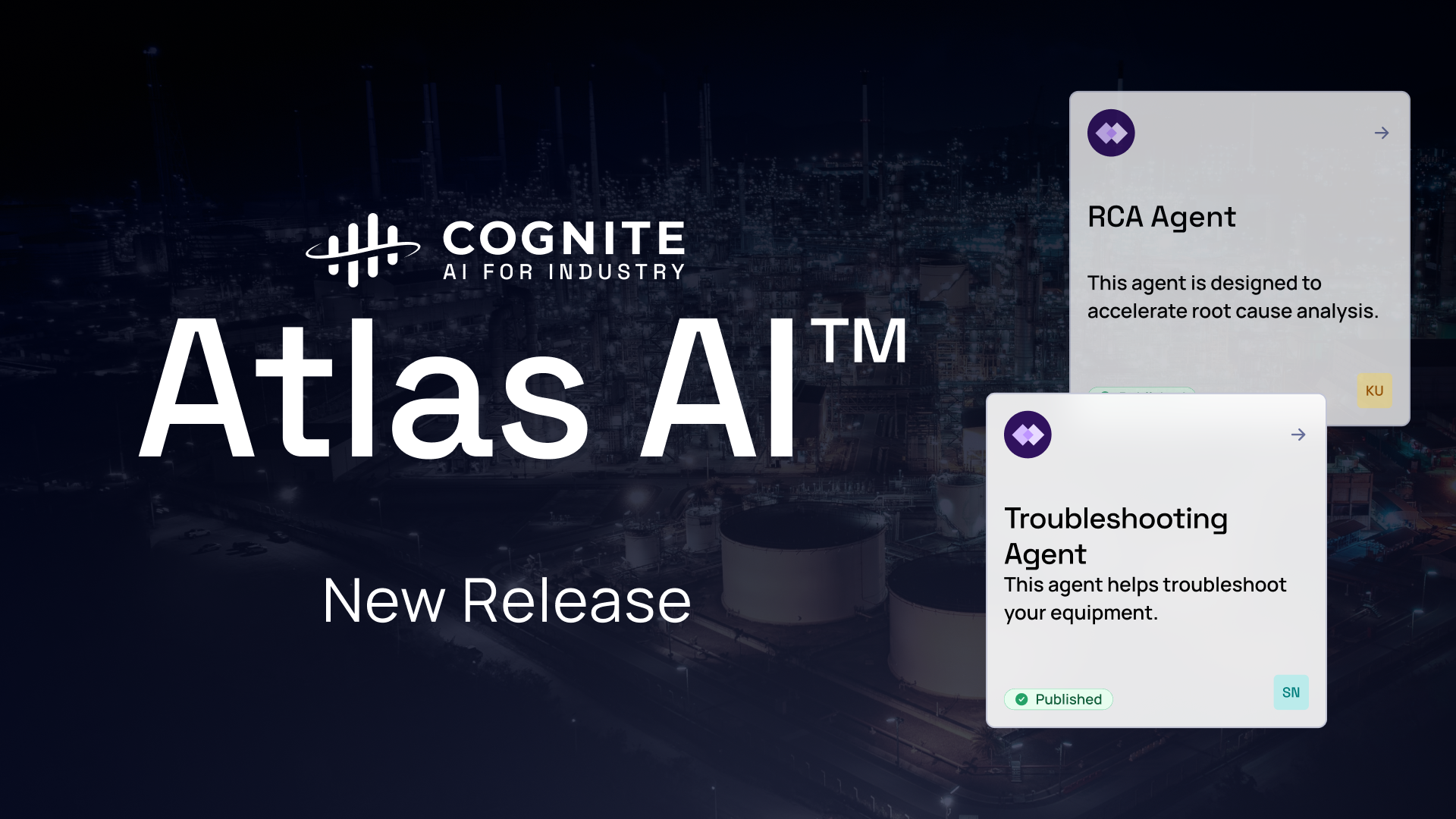
- Cognite Atlas AI Major Release (2025-Q4): Major update, adding pre-built industrial agents such as Root Cause Analysis, Work Package Generation, Time Series Analysis, etc. Agent orchestration and low-code capabilities have been significantly enhanced. This release was rated by Verdantix analysts as "a leap in closing the gap from pilot to production."
Flows workflow engine
- Cognite Flows™ (~2025-Q3): A newly launched AI-native industrial experience layer that enables building and scaling production-ready workflows 100x faster.
Version Info
- Cognite Atlas AI Major Release :Atlas AI has a major update, adding pre-built industrial AI agents such as Root Cause Analysis, Work Package Generation, and Time Series analysis, and significantly enhancing its agent orchestration and low-code workbench capabilities.
- Cognite Data Fusion R8 :Enhance industrial knowledge graph capabilities, expand 90+ data connectors, and improve data contextualization and AI-ready data delivery efficiency. There is no official precise date yet.
- Cognite Atlas AI Initial Release :Cognite Atlas AI™ is released for the first time, launching a low-code industrial AI agent workbench that supports the construction and deployment of industrial AI agents in natural language. There is no official precise date yet.
- Cognite Data Fusion R7 :Deepen integration with Microsoft, AWS, and NVIDIA, launch AI solution library, and enhance the scalability and security of industrial data foundation. There is no official precise date yet.
- Cognite Data Fusion R6 :Introducing the Industrial Canvas interactive data exploration tool to enhance the visualization capabilities of 3D models and P&ID. There is no official precise date yet.
- Cognite Data Fusion R5 :Expand time series analysis capabilities, enhance edge computing support, and improve data extraction pipeline reliability and monitoring. There is no official precise date yet.
User Reviews