 Comet ML
Free
Comet ML
Free
Comet ML is an AI training model platform for model R&D teams. It covers experiment tracking, training indicator visualization, hyperparameter comparison, data set and model version management, model registration, production monitoring and LLM evaluation. It is suitable for R&D organizations that need to reproduce, collaborate and manage the machine learning training process.
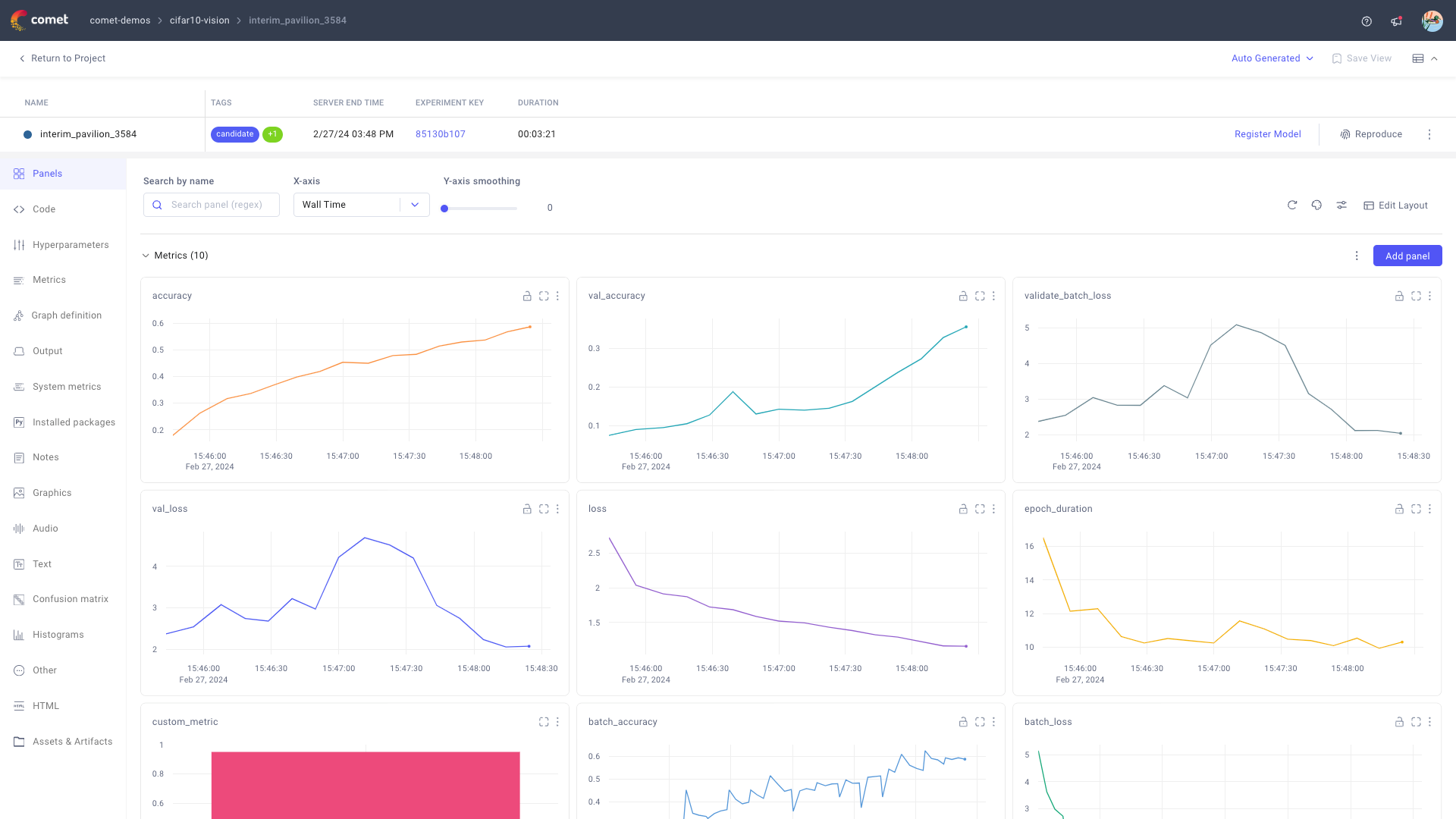
Comet ML machine learning experiment tracking and model training management platform
Core parameters and statistics
| Project | Content |
|---|---|
| Product positioning | MLOps experiment management, model training tracking and model life cycle platform |
| Core objects | Experiment, Project, Workspace, Artifact, Model Registry, Production Model |
| Main entrance | Web console Python SDK, Java SDK, R SDK, JavaScript SDK, REST API |
| Python SDK latest version | 3.58.3, release date 2026-06-16 |
| Python running requirements | >=3.8 |
| Typical record content | Indicators, hyperparameters, code, model configuration, system indicators, images, audio, video, curve HTML, remote data |
| Deployment form | Comet Cloud, enterprise self-hosting, open source Opik self-deployment |
The parameter focus of Comet ML is not the large model context length or the upper limit of generated tokens, but the traceable granularity of the training process. For the model development team, indicators, parameters, code differences, data set versions, and model stage labels will directly affect experimental reproduction, problem location, and online handover efficiency; after these objects are stably recorded, the team can compare the true differences between multiple trainings, instead of only retaining a set of final scores.
User and market recognition
The audience of Comet ML is mainly B-side and research teams, covering machine learning engineers, data scientists, MLOps teams, and enterprise AI teams that need to audit the model training process. Product disclosure emphasizes the use of existing workflow access, usually just initializing the experimental object in the training script, and then recording the indicators, parameters, code and visual assets into the project workspace. For C-side individual researchers, it is more like experimental notes and training boards; for B-side teams, it is responsible for collaboration, reproduction, permissions, model handover and production monitoring.
Market recognition is mainly reflected in the completeness of the product line and deployment options: Comet also provides experimental management Artifacts, Model Registry, Model Production Monitoring, and Opik for LLM application tracking and evaluation. The pricing page also lists enterprise compliance capabilities such as SOC 2, ISO 27001, ISO 9001, HIPAA, and GDPR, indicating that its target procurement scenarios are not limited to individual experiment records, but are geared toward organizational-level AI engineering governance.
Cost advantage
| Plan | Applicable objects | Public price and quota | Cost judgment |
|---|---|---|---|
| Free | Individual users, lightweight experiments | $0; 1 platform user; includes training run tracking, data set management, model registration and LLM evaluation | Suitable for low-risk verification training tracking process |
| Pro | Small team collaboration | $19/user/month; up to 10 users; includes 1500 training hours | Suitable for R&D groups that start to form team collaboration and experimental traces |
| Enterprise | Enterprise AI Team | Customized pricing; unlimited users and training hours | Value focused on self-hosting, secure SSO, support SLA and production monitoring |
| Opik Open Source | LLM application team | $0, can be downloaded and self-deployed | Suitable for teams who want to self-control LLM observation and evaluation data |
The cost advantage comes from two levels: first, the free tier can cover the core experimental records of individuals or small-scale teams, without the need to invest in platform fees before purchasing; second, Pro and Enterprise integrate the training process, model registration and LLM evaluation into the same platform, reducing the team's cost of splicing data between experiment dashboards, model asset libraries, production monitoring and evaluation tools. Real purchasing judgment should focus on training hours, storage, retention periods, number of users, self-hosting and compliance requirements, rather than just comparing monthly subscription prices.
Main functions
- Experiment Tracking: records training indicators, hyperparameters, code, command line parameters and system indicators, suitable for research and engineering teams that need to reproduce the model training process.
- Experiment Comparison and Analysis: Compare the indicator curves, configurations, code differences and products of different experiments in the project to help locate whether performance changes come from data, parameters or code.
- Artifacts and Dataset Versions: Incorporate training data, model files and related assets into versioned management to reduce the risk of repeated experiments caused by "files with the same name but different contents".
- Model Registry: Save, mark, share and advance the best-performing model versions to different life cycle stages, suitable for R&D handover to engineering or platform teams.
- Production model monitoring: Compare online model performance with the training baseline, paying attention to drift, degradation, and model quality changes in the production stage.
- Opik LLM Evaluation: records the LLM application call chain Agent execution path, test set and assertions, suitable for evaluating retrieval enhancements, tool calls and multi-step Agent behavior.
- Multi-language and integration: Python is the main usage path, while R, Java, JavaScript, REST API and common machine learning framework integration are provided to facilitate embedding into existing training contexts.
The combined value of these functions is to convert "temporary results in training scripts" into "engineering assets that can be retrieved, compared, and handed over by the team." For model projects with frequent iterations, experimental comparison and model registration are usually more critical than single training records, because they determine whether the team can explain why a certain model version is selected to go online.
Model and version evolution
The version evolution of Comet ML can be divided into two lines: platform capabilities and SDK capabilities. The platform side has expanded from experiment tracking to model management Artifacts, production monitoring and LLM application evaluation; the SDK side continues to iterate around Python training script access, automatic logging, asset uploading, offline experiments and API operations. PyPI records show that the early public version of the comet-ml package dates back to 2017-09-14, and the latest 3.58.3 was released on 2026-06-16.
| Time | Version or node | Change focus |
|---|---|---|
| 2017-09-14 | 0.1.12 | Early Python SDK publicly distributed, recording training results around Experiment objects |
| 2021-03-18 | 3.6.0 | 3.x series mid-term version, the SDK size and dependency system are obviously mature |
| 2026-06-08 | 3.58.1 | 3.58 series maintenance version, continuing to support Python >=3.8 |
| 2026-06-11 | 3.58.2 | 3.58 series subsequent maintenance version |
| 2026-06-16 | 3.58.3 | The latest public Python SDK package, providing wheel and sdist |
Version information has direct significance for team selection: if the training environment is still stuck in an older Python version, SDK compatibility needs to be confirmed first; if the team requires auditable builds, the SDK version should be fixed and the version number should be included in the training environment record to avoid unexplainable changes caused by SDK differences in different experiments.
Technical advantages
The technical advantage of Comet ML is to uniformly encapsulate multiple types of metadata during the training process into experimental objects, and allow them to be compared, filtered, shared and reproduced in web projects. The SDK can automatically record indicators, parameters and visualizations of common frameworks, while allowing developers to manually record custom indicators, files, curves, images, audio, video HTML and remote data. Therefore, it can not only cover the standard training process, but also serve different tasks such as computer vision, speech, tabular LLM applications, etc.
On the engineering side, Comet ML also emphasizes deployability and governance boundaries. The enterprise version supports flexible deployment, service accounts, read-only users, single sign-on, dedicated support and SLA; the self-hosting capability allows teams with data compliance requirements to keep experimental records and model assets internally. For large teams, these types of capabilities are often more important than single-point dashboards, as model training data, experimental conclusions, and production quality signals gradually become organizational assets.
How to use
| Entrance | Applicable tasks | How to use |
|---|---|---|
| Web console | View projects, experiments, charts, model registration and team collaboration | Create workspaces and projects, browse experiment details, compare results and manage model versions |
| Python SDK | Training script access and automatic recording | Install comet_ml, log in to your account, and call comet_ml.start() or Experiment() in the training code |
| REST API | Platform integration and automation | Read or write project, experiment, model, and asset data with API |
| Self-hosted deployment | Enterprise intranet and compliance scenarios | Deployed internally by the platform or MLOps team and connected to the identity, storage and monitoring system |
The typical usage process is: register an account and obtain the API Key; install the SDK in the training environment; use comet_ml.login() to initialize the identity; create an experiment at the beginning of the training code; record hyperparameters, indicators and model assets; after training, enter the web console to view a single experiment, and do Diff comparison with historical experiments. In the official quick start example, developers can record accuracy and loss step by step in the loop, and view all training metadata on the experiment page.
Product Pricing
The current public price of Comet ML divides MLOps and Opik into different tiers. The free tier of MLOps includes 1 platform user, training run tracking, dataset management and versioning, model registration, and free LLM evaluation; the Pro tier is $19/user/month, up to 10 users, and includes 1,500 training hours, email support, and higher storage limits; the Enterprise tier is customized pricing and provides unlimited users, unlimited training hours, self-hosting, model production monitoring SSO, service accounts, read-only users, dedicated support SLA and compliance capabilities.
In terms of Opik, the open source version can be downloaded and deployed by yourself; the free cloud version is suitable for individuals, and the public quota includes up to 10 team members, 25k spans per month, and 60 days of data retention; the Pro Cloud is $19/month, and the public quota includes up to 50 team members, 100k spans per month, and 60 days of data retention; the enterprise version supports custom usage, retention periods, compliance, and flexible deployment. When choosing, you should make it clear whether you are buying traditional ML training management, LLM observable evaluation, or an AI engineering platform that combines the two.
Application scenarios
- Computer Vision Model Training: Record training curves, prediction results, image samples and code differences to help the team compare performance changes brought about by different data enhancements or network structures.
- Recommendation and search ranking experiment: Track offline indicators, feature versions, hyperparameters and model files to facilitate backtracking whether a certain indicator improvement comes from features, data sets or training configurations.
- LLM application evaluation: Track the call chain Agent execution path, test set assertions and evaluation results through Opik, suitable for RAG, tool invocation and multi-round Agent scenarios.
- Enterprise model online handover: Use Model Registry to manage candidate models, stage labels and version notes, allowing R&D, platform and business teams to collaborate around the same model record.
- Production Model Monitoring: Compare online model performance and training baseline to assist in discovering drift, quality degradation, and changes in data distribution.
What these scenarios have in common is that "the outcome is not a one-off." As long as the team needs to answer "Why is the model better this time?" "Which training product is online?" "Is the training data and code traceable?" Comet ML can converge the information scattered in scripts, folders, and chat records into an auditable project view.
Applicable people
- Personal Data Scientists and Researchers: Suitable for people who need to save experimental curves, parameters and model products for a long time. The free tier is enough to complete lightweight experimental management.
- Machine Learning Engineer: A position suitable for high-frequency training, parameter adjustment and comparative experiments, which can reduce the time of manually organizing logs and screenshots.
- MLOps and Platform Teams: For organizations requiring model registration, permissions, deployment, monitoring, compliance, and team collaboration, with a focus on Enterprise capabilities.
- LLM Application Team: Suitable for teams that are building RAG, Agent or evaluation pipelines, and can be combined with Opik to manage traces, test sets and evaluation results.
- Unfit Boundary: If you only occasionally call a finished AI application, and there is no training process and model asset management requirements, the learning cost of Comet ML may be higher than the benefits; if the team already has a deeply customized MLOps platform, it also needs to evaluate the migration cost and data governance boundary.
Summary and Outlook
The core competitiveness of Comet ML is to advance model training from a "single script run" to a "recordable, comparable, reproducible, and manageable" engineering process. Its coverage of experiment tracking, dataset versions, model registration, production monitoring, and LLM evaluation makes it more suitable as a collaboration base for AI engineering teams rather than a simple indicator dashboard.
The current boundaries that need to be evaluated are team size, training hours, storage and data retention, self-hosting needs, compliance requirements, and existing tool chain integration costs. Follow-up observations include the depth of integration of Opik with traditional MLOps capabilities, the enterprise self-hosting experience, the interpretability of model production monitoring, and the speed at which Agent evaluation and cost governance are implemented in engineering teams.
Related tools:  Hugging Face, replicate
Version Info
- comet-ml Python SDK :The latest public package of Python SDK, which requires Python >=3.8, is used to create experiments, record training indicators, parameters, model assets and experiment metadata, and link with the Comet Web workspace.
- comet-ml Python SDK :The 3.58 series of maintenance versions continue to support Python >=3.8, and are updated for experimental records and SDK compatibility.
- comet-ml Python SDK :The 3.58 series of early maintenance versions are used for the continuous iteration of Comet experimental tracking SDK.
- comet-ml Python SDK initial public package :The early public version of PyPI traceability marks the start of public distribution of the Comet Experimental Tracking SDK.
User Reviews