 CometAPI
Free
CometAPI
Free
CometAPI aggregates multiple model services through a unified API gateway, which is suitable for R&D teams that require model routing and cost management.
CometAPI
Core parameters and statistics of CometAPI
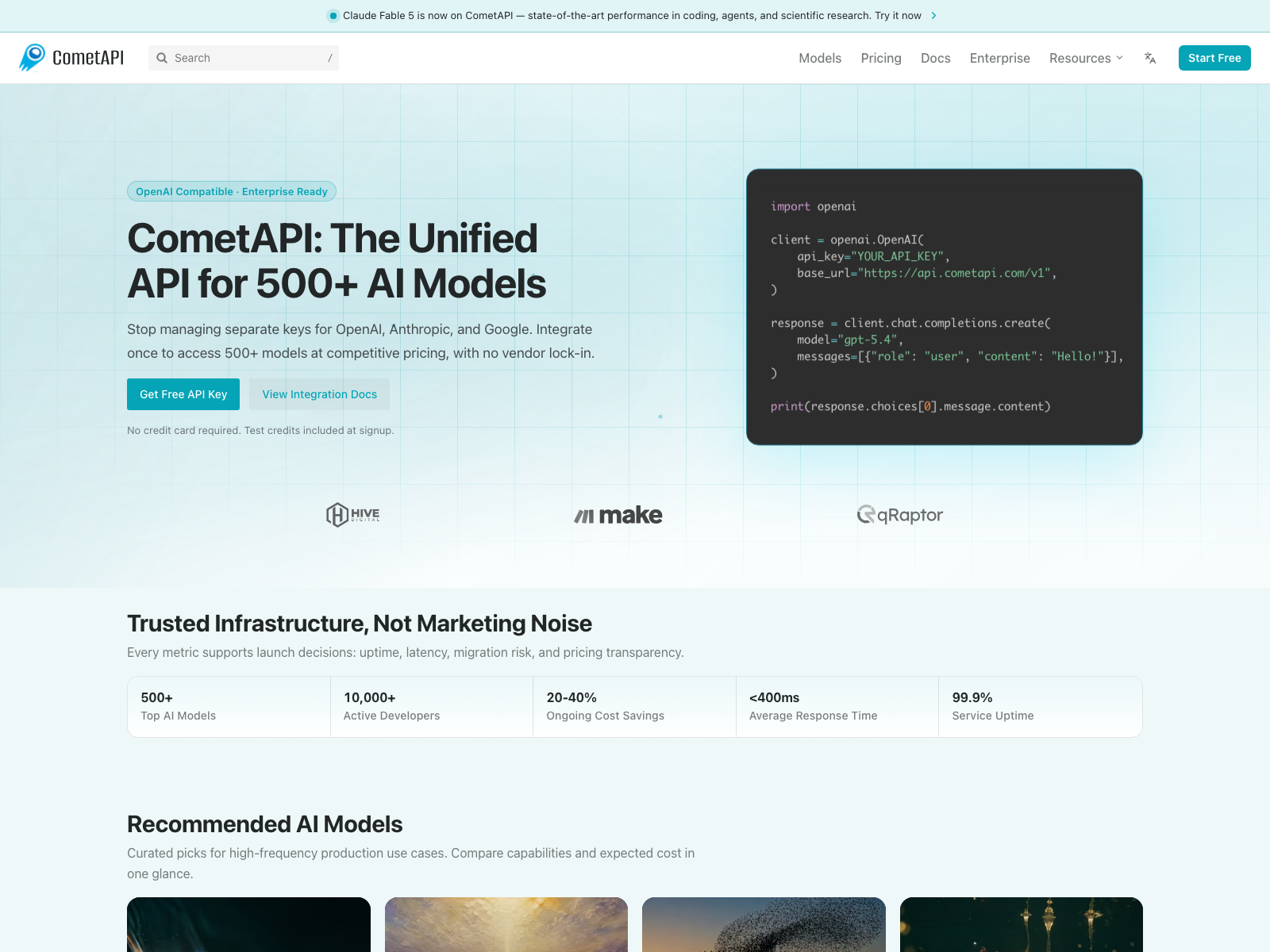
The official positioning of CometAPI is "Unified API for 500+ AI Models". Its essence is not a model capability provider, but a multi-model supply chain management layer - through a set of OpenAI-compatible API gateways, it aggregates reasoning capabilities from multiple model suppliers to provide unified authentication, routing, observation and cost management for the R&D team.
| Projects | Public Information |
|---|---|
| Official positioning | Unified API for 500+ AI Models |
| Access form | OpenAI compatible interface + multi-model supplier aggregation |
| Model coverage | 500+ models (including mainstream closed source and open source models) |
| Official performance caliber | <400ms average response 99.9% availability |
| Settlement mechanism | Pay-as-you-go |
| Developer scale | 10,000+ (official disclosure) |
| Home | US |
| Support Platform | Web, API |
| Latest version | v2026.06 (2026-06-11) |
A brief comment: CometAPI does not solve the engineering pain point of "not enough models" but "too many models and too chaotic management".
Publicity Verification: The real value of the "500+ models" selling point on the official website is not in the quantity itself, but in the three things of unified authentication, unified billing and unified routing - so that the team does not need to maintain a set of SDKs and bills for each supplier. However, the specific coverage of 500+ (whether experimental/deprecated models are included, and the available areas of each model) must be subject to the real-time list on the official website.
Access form: CometAPI does not provide its own basic model, and all capabilities come from upstream suppliers. This means that its quality ceiling is subject to the actual performance of the upstream model. The gateway layer is mainly responsible for routing compatibility and cost optimization, rather than inference acceleration.
User and market recognition of CometAPI
Developer Side Approval: The official disclosure of 10,000+ developer scale shows that it has passed the early proof-of-concept stage and has a certain penetration rate among small and medium-sized teams. However, there is no large-scale public data on its public community form (GitHub warehouse, forum activity, open source contributors). The continuous verification of developer reputation is recommended based on the frequency of questions in the technical community and the recruitment market demand.
Enterprise side recognition boundary: The public page has limited disclosure of the list of major customers, industry share, and certification compliance (SOC2/GDPR/HIPAA). When judging enterprise-level maturity, it is recommended to directly ask sales for: P50/P99 latency quantile data of existing customer industry distribution, cross-region multi-active architecture description, and historical fault review SLA compliance rate.
Verifiable conclusion: CometAPI is more like a platform mid-end component than a terminal application product. Word-of-mouth focuses on team feedback on stability and operational efficiency, rather than brand awareness or feature exclusivity. Its competition barriers come from the continuously accumulated model adaptation surface and governance function depth, rather than a single technological breakthrough.
Cost Advantages of CometAPI
The cost logic of CometAPI is to "use the management overhead of a layer of gateway in exchange for the bargaining space and switching flexibility of multiple suppliers." When evaluating costs, you need to look at both explicit savings and implicit increases.
Manifest benefits
- SDK maintenance cost zero: Each access to a supplier means one more set of SDK adaptation, certification and upgrade work. CometAPI converges this part into an OpenAI compatible interface, and the team only maintains a set of calling codes.
- Unified bills reduce reconciliation burden: Multiple suppliers mean multiple monthly bills, multiple pricing models, and multiple currency settlements. After unified billing, financial reconciliation changes from "house-by-house reconciliation" to "one report", and budget management only needs to be completed in one panel.
- New model launch speed reduced from weeks to hours: After the upstream releases a new model, as long as CometAPI completes the mapping access, the business side can switch the call target without modifying the code, which is of obvious value for A/B testing and cost optimization scenarios.
Hidden costs
- Troubleshooting link extension: After adding the gateway layer, possible reasons for a call failure include: business side parameters, gateway routing policy, upstream supplier current limit, and upstream model degradation. The troubleshooting link changes from "client → model" to "client → gateway → model", and each layer requires observation data.
- There is a time difference in the synchronization of new upstream features: New features of the model released by the upstream supplier (such as new parameters, changes in structured output format, and context length extension) are not available until the mapping adaptation is completed on the CometAPI side. The pace of feature adoption is subject to the gateway’s adaptation speed.
- Compliance audit changes from single layer to dual layer: After data flows through the gateway, the audit scope covers both the gateway's log retention policy and the upstream supplier's data processing policy. In highly regulated industries such as finance and medical care, the compliance costs of double-layer audits need to be included in the total cost assessment.
Cost comparison reference
| Dimensions | Direct connection to multiple vendors | Via CometAPI gateway |
|---|---|---|
| SDK maintenance | One set for each supplier, version synchronization | One set of compatible interfaces, gateway side upgrade |
| Bill management | Multiple bills, multi-currency reconciliation | Unified bill, single pricing model |
| New model access | Development-testing-deployment, several days | Available immediately after gateway mapping |
| Troubleshooting | End-to-end direct connection, short link | Adding gateway layer requires three-layer observation |
| Compliance Complexity | Single Vendor Audit | Gateway + Supplier Dual-tier Audit |
C-side/personal cost
CometAPI does not target individual consumers directly. Individual developers can register to obtain API Keys and use them on a pay-as-you-go basis, with no fixed subscription fee. Specific free quota and trial restrictions.
Developer/API Cost
Billing is based on call volume (Pay-as-you-go), and pricing details are subject to the official website pricing page. Total cost includes:
- Calling fee: The unit price per million tokens, which varies greatly at different model levels (open source/closed source/flagship/lightweight).
- Gateway surcharge: CometAPI may add a certain percentage of gateway service fee to the model unit price. You need to compare the direct connection cost to confirm whether it is cost-effective.
- Retry and Error Cost: Retry calls caused by upstream current limiting or timeout are also billed and should be included in the budget model.
Enterprise/Privatization Costs
Enterprise-level pricing requires business negotiation and usually includes: SLA guarantee, audit log export, network isolation (dedicated line/VPC), and dedicated technical support. Large-traffic customers can negotiate tiered unit prices or fixed annual subscription plans. It is recommended that the complete billing details (including whether there is a minimum consumption, overage penalty rate, and data retention fee) be confirmed item by item at the contract stage.
Main functions of CometAPI
The capabilities of CometAPI are designed around "turning chaotic multi-model access into operational gateway management". The core functions can be summarized into the following five categories:
- Unified Key Access: One set of API Key manages model calls from all suppliers. Teams no longer need to create and manage credentials for each vendor individually, reducing key exposure surfaces and permissions management burdens. Key rotation also only needs to be done once on the gateway side.
- Model Routing and Switching: Supports dynamic switching of target models or suppliers on the same calling link. Typical uses include: downgrade by priority (low-cost models are used first, automatically switching to alternative models on timeout/failure), offloading by region (different geographical areas are routed to different providers for lower latency), A/B comparison (distributing traffic between two models to evaluate quality differences).
- Price Comparison and Cost Panel: Centrally displays the unit price, cumulative call volume and estimated cost of each model from different suppliers. It facilitates operation and maintenance and financial teams to make dynamic trade-offs among quality, latency, and cost without the need to switch back and forth between multiple consoles.
- Call Observation and Budget Management: Unified visualization of call volume, success rate P50/P95 delay, error distribution and other information. Supports setting budget upper limits and alarm thresholds to prevent model calling costs from getting out of control.
- Multi-language SDK and compatibility layer: Provides an OpenAI-compatible REST API interface and supports SDKs for mainstream languages such as Python, Node.js, Go, and Java. Projects with existing OpenAI SDKs have extremely low migration and transformation costs.
Hidden linkage (expert perspective): The above functions alone are not original, but the linkage of route switching, cost observation and retry strategy can transform model selection from "one-time decision before going online" to "continuous operation strategy". For example: when the cost panel detects price fluctuations of a certain supplier, it automatically triggers routing weight adjustment; when the observation system finds that the P95 delay of a certain model continues to increase, it automatically switches traffic to an alternative supplier. This closure requires a lot of custom development in direct mode, but CometAPI condenses it into a configuration item.
CometAPI model and version evolution
CometAPI is a platform service, and public changes usually appear as capability updates rather than traditional client versions. It is recommended to track its evolution in three layers:
Gateway layer capability update
Such updates directly affect usage patterns and governance capabilities, including: new routing strategies (such as cost-based automatic routing, location-based intelligent scheduling), observation panel upgrades (such as new token usage predictions, budget overrun warnings), authentication mechanism enhancements (such as temporary key IP whitelists), and API compatibility expansion (such as supporting more streaming formats).
Upstream model mapping update
The value density of CometAPI depends on the breadth and update speed of its model library. When the upstream releases a new model (such as GPT-5, Claude 4, Llama 4, etc.), CometAPI needs to complete mapping access, pricing synchronization, and compatibility verification. The update speed of model mapping directly affects whether users can quickly switch during the new model release window.
Compatibility update
The OpenAI style API specification itself continues to evolve (such as structured output, cache control Assistant API, etc.), and CometAPI needs to keep up with specification changes while maintaining backward compatibility. Such updates typically do not break existing calls, but the availability of new features on the CometAPI side may differ from the native API.
Version context:
| Version | Type | Description |
|---|---|---|
| v2026.06 | Stable version | Continuously optimize stability and developer experience, specific capabilities are subject to official real-time release |
| Initial public version | Early version | Early version information has not been fully disclosed, it is recommended to refer to the official update log |
Implementation Tips: The rollbackable model whitelist version should be fixed before going online to avoid upstream changes from directly impacting production. It is recommended to verify the compatibility and output quality of the new model mapping in the staging environment before pushing it to production traffic in grayscale.
Technical advantages of CometAPI
OpenAI compatible access
The core interface of CometAPI is aligned with OpenAI's Chat Completions API, including parameter naming (model, messages, temperature, max_tokens, stream), return format (choices, usage) and error code conventions. This means:
- For projects that already have OpenAI SDK, you only need to modify
base_urland API Key to complete the access. - Existing Prompt templates, tool chain integration, and monitoring scripts can be directly reused without adjusting the calling logic.
- The cost of migration and transformation is concentrated on gateway configuration and routing policy settings, rather than code layer reconstruction.
Flexible routing mechanism
CometAPI's routing layer supports multi-level downgrade strategies: when the preferred model times out or returns an error, it can automatically switch to an alternative model or alternative provider. This mechanism forwards model call uncertainty to the gateway layer for processing, instead of writing retry and degradation logic separately in each business service. Actual results depend on:
- Health check sensitivity: Can the routing layer quickly distinguish between "upstream temporary jitter" and "upstream continuous unavailability".
- The convergence speed of the fallback strategy: how long it takes to try to recover after the circuit breaker, and whether large-scale cascading failure can be avoided.
Governance centralization
Costs, current limits, and alarms are unified into the gateway plane, and the platform team does not need to establish an independent observation and budgeting system for each supplier. This is the core appeal of middle-end operation and maintenance: when the number of model calls increases from tens of thousands to millions of times per day, the cost of decentralized governance will increase linearly, while the cost of centralized governance will increase much less than linearly.
Why is it more stable?
The stability logic of CometAPI is not "gateway is faster than direct connection", but "gateway can shield upstream changes". In direct connection mode, upstream model version update API behavior changes and current limiting policy adjustments will directly interrupt the business; gateway mode converges these changes to the mapping layer on the gateway side, and the business code does not need to be modified repeatedly. The premise is that the gateway itself has been fully verified by chaos engineering - assuming the gateway itself fails, whether there is a backup control plane and whether the data plane can be taken offline.
Performance and Throughput
| Indicators | Official caliber | Description |
|---|---|---|
| Average response latency | <400ms | Does not include upstream inference time, only gateway forwarding + processing latency |
| Availability SLA | 99.9% | Subject to official real-time status page |
| Frequency control limit | Undisclosed | TPM/RPM specific values |
| Number of concurrent connections | Undisclosed | Enterprise plan can be negotiated |
Note: The prerequisite for gateway delay <400ms is that the upstream supplier interface is normal. The actual end-to-end delay consists of three parts: "gateway forwarding + upstream inference + network transmission". When selecting a supplier, a comprehensive evaluation is required. You cannot just look at the delay commitment of the gateway layer. TTFT (Token First Delay) and end-to-end delay data are subject to the official real-time page or actual PoC test.
Adaptation boundary
- Best in: Parallel use of multiple models, cost-sensitive calls, medium-sized or above teams that require unified observation and budget management.
- Weakest at: Fixed use of a single model, real-time scenarios with zero tolerance for additional gateway delays (such as voice conversations), and scenarios that require in-depth customization of upstream model parameters (such as custom stopping criteria, logit bias).
How to use CometAPI
Access entrance
| Method | Suitable for the crowd | Description |
|---|---|---|
| API Key direct connection | Developer/Team | Obtain the API Key after registration, modify the endpoint to call |
| Enterprise business access | Enterprise/medium and large teams | Business confirmation required such as SLA, audit, dedicated line and other terms |
Typical access steps
- Register and obtain API Key: Complete registration on the CometAPI official website and obtain a unique API Key. It is recommended to create independent keys for different contexts (development/test/production) to facilitate isolation and auditing.
- Modify the calling endpoint: In the original OpenAI SDK code, point
base_urlto the gateway address of CometAPI, and replaceapi_keywith the Key of CometAPI. Take Python as an example:
from openai import OpenAI

client = OpenAI(
    base_url="https://api.cometapi.com/v1",
    api_key="<YOUR_COMETAPI_KEY>"
)

response = client.chat.completions.create(
    model="gpt-4o", # or the mapped model name
    messages=[{"role": "user", "content": "Hello, please introduce CometAPI"}],
    temperature=0.7,
    max_tokens=1024,
    stream=True
)

for chunk in response:
print(chunk.choices[0].delta.content or "", end="")- Configure route degradation policy: In the CometAPI control panel, set the main model and alternative model for key business links. For example: the main model uses
gpt-4oand automatically downgrades toclaude-3.5-sonnetorgemini-2.0-flashwhen the request times out or fails continuously. - Set budget cap and alarm: Configure the monthly budget cap and set an alarm to be triggered when usage reaches 80%/100% to prevent costs from getting out of control.
- Grayscale launch and acceptance: Select 2-3 low-risk business links (such as content summaries, non-critical classification tasks) to be connected first, and run in parallel with the original direct links for at least 1 week. The acceptance indicators include:
- Call success rate: Target >99.5% (excluding the upstream supplier's own faults).
- P95 Latency: The added delay at the gateway layer is <200ms, and the end-to-end delay is not significantly degraded.
- Cost per request: Verify that cost savings are in line with expectations compared to changes in direct connect mode.
- Manual intervention rate: The frequency of manual intervention caused by gateway routing problems.
API call example (Curl)
curl https://api.cometapi.com/v1/chat/completions \
  -H "Content-Type: application/json" \
  -H "Authorization: Bearer <YOUR_COMETAPI_KEY>" \
  -d '{
    "model": "gpt-4o",
    "messages": [{"role": "user", "content": "Hello, world!"}],
    "temperature": 0.7,
    "max_tokens": 256,
    "stream": false
}'Note: The base_url, model name mapping rules, and authentication methods in the above code are subject to the latest version of the CometAPI official documentation page. <YOUR_COMETAPI_KEY> needs to be replaced with the actual API Key.
Product Pricing for CometAPI
CometAPI's pricing adopts a pay-as-you-go billing model, with an overall three-tier structure of "free trial → pay-as-you-go → enterprise commerce". The complete billing schedule is subject to the real-time display on the official website pricing page.
| Level | Billing method | Suitable scenarios | Precautions |
|---|---|---|---|
| Trial/Free | Free quota of the official real-time page | Function verification and compatibility testing | The number of calls, concurrency limits, and available model range of the free quota need to be confirmed |
| Pay-as-you-go | Billing by call volume | Teams with large demand fluctuations | Pay attention to the sum of the model layer unit price + gateway surcharge |
| Enterprise solutions | Business negotiations | Large-scale production and large traffic | Focus on SLA, auditing, network isolation, and exclusive support terms |
Cost Assessment Tips: Since the call cost of CometAPI includes the unit price of the upstream model and the gateway service fee, it is recommended to compare the CometAPI quotation with the total cost of directly connecting to each supplier before accessing, especially in high call volume scenarios to verify whether the gateway surcharge is within the acceptable range. At the same time, retry, alarm processing, and operation and maintenance duty costs are included in the total cost assessment to avoid deviations caused by looking only at the unit price of calls.
Application scenarios of CometAPI
High matching scenario
- Production system with mixed calls from multiple suppliers: core scenario. When the business needs to switch between different models (such as the flagship closed-source model for high-precision tasks and the low-cost open-source model for batch tasks), CometAPI's routing and governance capabilities can avoid the team from maintaining multiple sets of call links.
- Customer service/content/retrieval applications that are budget-sensitive and have a large number of calls: The typical characteristics of this type of scenario are that they have a large number of calls and are cost-sensitive, but have a certain tolerance for the delay of a single call. Through CometAPI's cost panel and route downgrade, the average monthly call cost can be significantly reduced without significantly reducing quality.
- Multi-region model access for overseas products: Different geographical regions may require different suppliers (some models are unavailable or have high delays in some regions). CometAPI's regional routing capability can simplify the management of such cross-region calls.
General adaptation scenarios
- Unified model layer for process orchestration platform: If the team is already using process orchestration tools such as n8n and Activepieces, using CometAPI as a unified model call layer can further simplify connector management.
- The middle office team provides model capabilities for multiple business lines: The middle office team can use CometAPI's observation and budget management capabilities to allocate independent call quotas and routing strategies to each business line, while maintaining a unified management perspective.
Not suitable for the scene
- A single model is used fixedly and the number of calls is less than thousands per day: In this case, the management overhead of the gateway layer may exceed the convenience it brings, and direct connection to the model supplier is simpler and more direct.
- Real-time interaction scenarios with zero tolerance for gateway delay: In scenarios such as voice conversations, real-time translation, etc., the additional forwarding delay at the gateway layer (even <400ms) may be unacceptable.
- Requires deep customization of upstream model parameters: such as customizing advanced parameters such as
logit_bias,stopsequence,response_format, etc. The gateway layer may not be able to fully transparently transmit all upstream features. - Strongly regulated industries with unclear compliance terms: Financial, medical, government affairs and other industries require clear data flow paths and audit capabilities, and should be carefully evaluated before CometAPI has not disclosed relevant compliance certifications.
Applicable groups of CometAPI
- Platform Engineering and AI Infrastructure Team: Core audience. Teams that need to uniformly manage multi-vendor model invocations, reduce integration complexity, and centralize governance costs and observations.
- Cost Governance and FinOps Teams: When model invocation fees become one of the team's major cloud expenses, CometAPI's budget dashboard and routing degradation capabilities can help control costs. However, the accuracy of its budget alarms and automated routing needs to be confirmed.
- Overseas product technical team: For teams that need to handle multi-region and multi-vendor model calls, CometAPI's regional routing and unified billing can reduce operation and maintenance complexity.
- Middle office/platform team: The middle office team that provides model capabilities for multiple business lines can use CometAPI's permission isolation and quota management to achieve multi-tenant governance.
Not suitable for the crowd:
- Individual developers or small projects with a single model, low-profile usage, and no middle-end governance requirements. In this case, it is simpler to connect directly to the model provider, but the gateway layer adds unnecessary complexity.
- Organizations that have strict requirements on data sovereignty and CometAPI has not passed compliance certification. Data flowing through the gateway means that the compliance capabilities of the gateway and upstream suppliers need to be evaluated at the same time, and there are risks when compliance certification is unclear.
- Scenarios that require complete offline/private deployment. CometAPI is a SaaS/API service. If your business needs to run in a completely isolated network environment, you need to confirm whether there is a privatized deployment solution.
Summary and Outlook
The core value of CometAPI is to transform "multi-model chaotic access" into "operable gateway governance". It is not a model capability provider, but the management of the model supply chain - for teams that have entered the multi-model parallel stage, it can significantly reduce engineering friction and the risk of budget loss; for teams that are still in the single-model exploration stage, it is recommended to verify the business value before introducing the gateway layer.
Current Limitations and Uncertainties:
- The status of enterprise-level compliance certification (SOC2/GDPR/HIPAA, etc.) is not disclosed, and sales confirmation is required before purchasing in highly regulated industries.
- The mapping update speed of new upstream models/new features has not been disclosed, and there is uncertainty about whether popular models can be quickly accessed after they are released.
- The actual proportion of the gateway surcharge is not quantified and disclosed on the official website, and the total cost in high-volume scenarios needs to be verified through PoC.
- Complete information on privatized deployment options and network isolation capabilities needs to be obtained from the business.
Procurement/Adoption Risk Assessment:
- It is recommended to start a small-scale PoC with 1-2 low-risk business links, focusing on verification: API compatibility, route degradation reliability, actual delay increment, and cost saving ratio.
- The PoC cycle is recommended to be 2-4 weeks, covering at least 1 short-term failure event of the upstream supplier, and verifying whether automatic downgrade works properly.
- If the PoC acceptance indicators (call success rate >99.5%, P95 delay increment <200ms, actual cost optimization >15%) meet the standards, it can be gradually expanded to more business links.
- Before purchasing, the terms that need to be confirmed with sales include: monthly minimum consumption, overage billing rules, SLA compensation standards, audit log retention periods, data deletion strategies, and contingency plans for platform failures. If the gateway itself becomes a single point of failure, its recovery time objective (RTO) and recovery point objective (RPO) must be clearly written into the contract.
Version Info
- first public release :The early version information has not been fully disclosed. It is recommended to refer to the official update log.
- CometAPI June 2026 :Continuously optimize stability and developer experience. Specific capabilities are subject to official real-time release.
User Reviews