 Compass
Free
Compass
Free
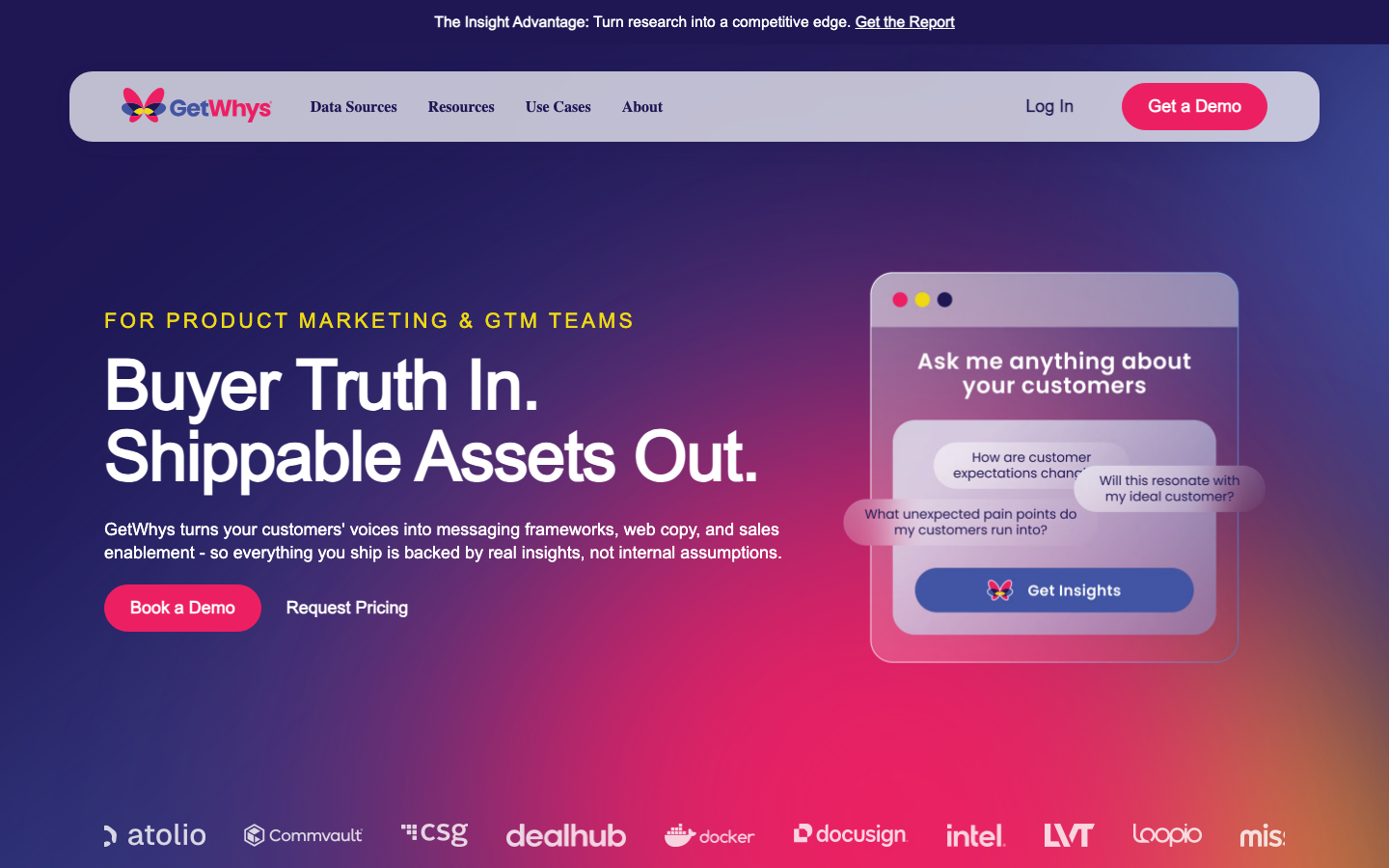
Compass (getwhys.io) is an AI-driven causal analysis platform that helps users discover "why" from data - that is, causation rather than correlation between events. It combines statistical analysis and AI reasoning to automatically identify key factors that affect business indicators, and is suitable for marketing attribution, user behavior analysis and operational optimization scenarios.
Compass
Core parameters and statistics of Compass
Brief review in one sentence: Compass is not a general BI or data analysis tool, but a "buyer insight-driven GTM verification engine" - it does not help you draw charts, but helps you know whether buyers will buy the content before it goes online.
| Projects | Public Information |
|---|---|
| Product Positioning | AI-driven B2B Buyer Insights and GTM Content Verification Platform |
| Core capabilities | Buyer corpus AI content verification, real-time customized research MCP integration Slack collaboration |
| Platform | Web, MCP (integrated Claude/ChatGPT/Copilot), Slack |
| Place of Attribution | US (Company Name: Get Whys, Inc.) |
| Business model | SaaS subscription (Demo inquiry, no public self-service channel) |
| Financing status | 2026-04 Received $5.2M seed round |
| Compliance Certification | SOC 2 Type II (2025-06 Certification) |
| Typical customers | CDW, Commvault, Dataiku, Docusign, Docker, Intel, Loopio, Veracode, Verizon |
Keywords: The core difference of Compass is that it is not "analyzing what happened in the past", but "predicting what will impress buyers in the future" - using real buyer interview data to verify product marketing information, sales rhetoric and product positioning, ensuring that each GTM output has been tested by real buyers before being sent out.
User and market recognition of Compass
- Enterprise customer lineup: It has served more than ten well-known B2B technology companies such as CDW, Commvault, Dataiku, Docusign, Docker, Intel, Loopio, Veracode, Verizon, CSG, Navattic, and Mission. Customers cover multiple departments such as product marketing, sales empowerment, and growth, indicating that its value proposition has been initially recognized in enterprise-level market verification.
- Funding and growth signals: Completed a $5.2M seed round of financing in April 2026. The funds will be used to expand the buyer corpus (Proprietary Buyer Corpus) and accelerate product iteration. Obtaining this scale in the seed round reflects investors' confidence in the "buyer verification" track and the team's execution ability.
- User Testimonials: Tyler Vock, director of product marketing strategy at Commvault, commented that "GetWhys has gone from a useful tool to an indispensable part of my technology stack"; Natalie Marcotullio, head of growth and product marketing at Navattic, said it "acts as our autonomous buyer research function"; Vincent Lo, senior director of product marketing at Loopio, pointed out that "In a sea of B2B homogeneity, GetWhys helps us stand out."
- Compliance Endorsement: Passed SOC 2 Type II certification in June 2025, meeting enterprise-level security and privacy compliance requirements. This is a critical pass for large purchasers requiring supplier security assessments.
Keywords: Compass’s customer list covers almost all the leading brands in the B2B technology field, which is extremely rare in early-stage products. This shows that its value proposition of "verifying the validity of the message before going online" accurately hits the immediate needs of the product marketing team - it is not "icing on the cake", but "must be used".
Cost Advantages of Compass
Compass adopts a team-oriented SaaS subscription model with no public self-service pricing and business communication through Demo appointments.
| Dimensions | Compass | Traditional buyer research company | Self-service questionnaire tool (Typeform/SurveyMonkey) |
|---|---|---|---|
| Single survey cost | Included in subscription fee (unlimited times) | $5K–$20K/time | $0–$200/month (but you need to recruit respondents yourself) |
| Survey cycle | Immediately (corpus) or within 10 days (new survey) | 2–6 weeks | 1–2 weeks (but relies on owned channels) |
| Sample size and coverage | Thousands of B2B interviews + more added | Typically 10–30 people/time | Depends on own network |
| Quotability of results | Each item has an original interview quote | Usually no verbatim quotes | No quotes |
| Tool integration | MCP/Slack/Gong/Web | None | There is API, but no AI verification function |
| Content verification | Supported (Scratchpad + AI verification) | Not supported | Not supported |
Quantitative deduction of cost reduction and efficiency improvement (unofficial commitment, deduction based on product capabilities):
- Message writing framework for product marketing managers (PMM): The traditional method requires 2–3 days to do desktop research + customer interviews → Compass compresses the "verification → iteration" cycle to 15–30 minutes. Down from 3 days to 0.5 hours.
- Sales Enablement Team Preparation Guide: The traditional method requires cross-department collection of customer feedback + manual analysis of call records → Compass automatically extracts buyer signals through corpus + Gong integration. Down from 5 days to 1 day.
- Campaign pre-check: The traditional method is to observe 1-2 weeks of data after going online and then optimize → Compass completes message verification before going online. Feedback loop has dropped from 2 weeks to instant.
FREE FACT: Compass does not have a free tier. Its business model is aimed at medium and large B2B companies and focuses on annual contracts. You can get a chance to experience it by making a demo appointment, but the full functionality of the product requires a paid subscription.
Hidden costs: ① Product effectiveness is highly dependent on the industry and role coverage of the buyer corpus - if your target buyers are not fully represented in the corpus, the 10-day waiting period for customized research still needs to be included in the time budget; ② The team needs to establish a new workflow habit of "verify first and then publish"; ③ Although MCP integration reduces switching costs, the team still needs to configure access to the corresponding AI tools (Claude/ChatGPT/Copilot).
Hidden benefits: ① Reduce campaign rework due to inaccurate information - the cost of creative production, media procurement, and sales follow-up involved in a wrongly positioned campaign is much higher than the Compass annual subscription fee; ② Establish a credibility culture in which "every output has a quote from a buyer interview" to enhance the credibility of the PMM team in front of executives and customers; ③ Share the same set of buyer insights across departments (PMM, Sales, Marketing), eliminating the information island where "everyone speaks his own words".
Main features of Compass
The core functions of Compass are built around three major sections: "Buyer Insight Acquisition→Content Verification→Workflow Integration", forming a strong synergy between each function:
- Proprietary Buyer Corpus: Thousands of in-depth B2B buyer interview data, covering multiple industries and purchasing roles. Every conclusion the AI outputs comes with a quote from the original interview—a killer distinction in the context of the current "unverifiable source" nature of AI tools. Applicable tasks: Quickly obtain first-hand knowledge of the target buyer group.
- AI Content Verification and Scratchpad: Enter a title Pitch or Campaign Brief, and AI will instantly evaluate its resonance with target people, brand consistency, information credibility, and attach source interviews with buyers. Supports conversational interactive revision, automatically saves version history, and can roll back at any time. Applicable tasks: Final verification of any external output content (product release news, official website copywriting, sales emails) before going online.
- MCP Integration Layer (2026-07 major update): Embed Claude, ChatGPT, GitHub Copilot via Model Context Protocol. When team members create content in the AI tool, they can call Compass buyer data for message verification without switching windows. Synergy effect: Switch "creation → verification" from cross-system switching to completion within a single window, and the psychological threshold of PMM verification is reduced from "opening another tool" to "smoothly@".
- Slackbot Integration: Ask "What do target buyers think of a feature" directly in Slack, or paste a message to request verification. The bot returns interview-based insights instantly. Synergy: The Sales team can instantly obtain buyer insights during the ordering process without waiting for the PMM team's "research schedule" - downgrading cross-department dependencies to self-service queries.
- Gong Call Integration: Connect to Gong call records to automatically extract signals from historical customer conversations into the verification layer. Synergy: Buyer signals that used to lie dormant in call recordings are activated into searchable, quoteable structured insights that are cross-validated with external interview data.
- Artifact Management: Creation
Create structured documents such as competition briefings, message frames, and portraits, and support PDF export. All artifacts are uniformly visible across conversations and version management is supported. Applicable tasks: Precipitate "one-time insights" into "reusable team knowledge assets".
- Continuous Customized Research Service: Submit a new research request and the Compass research team completes new interviews for specific personas within 10 days. Synergy effect: The missing market segment information in the corpus is supplemented through customized research, forming a double-layer coverage of "general corpus + customized supplement" - enjoying the immediacy of existing data without being restricted by the coverage boundaries of existing data.
Model and version evolution of Compass
Compass maintains a high-speed iteration rhythm. The following key version nodes are based on the official Changelog:
| Time | Version/Event | Core Changes |
|---|---|---|
| ~2024-06 | v0.1 Launch | Product initial launch, basic buyer survey and question and answer function for PMM |
| ~2025-09 | v1.0 Current | Mature version, integrating Internet data and internal data of the organization, supporting cross-analysis of multiple data sources |
| 2025-06 | SOC 2 Type II | Complete security compliance certification and meet enterprise procurement access thresholds |
| 2025-11 | Projects released | Organize research data according to project dimensions and adapt to PMM actual workflow |
| 2026-04 | $5.2M Financing | Seed round to expand corpus and team |
| 2026-05 | Gong integration + Artifact PDF | Connect call recording data; support artifact export to PDF and permission management |
| 2026-07 | MCP + Scratchpad + Slackbot | Major version: Embedded AI creation tools, instant content verification and Slack native collaboration - evolving from an independent application to a "GTM verification layer" |
Keywords: The evolution path of Compass clearly presents the three-stage evolution of "from research tool → verification platform → AI native verification layer". July 2026 marks a watershed moment: MCP integration’s strategic significance goes far beyond the feature update itself—it transforms Compass from a “tool you need to actively use” to “infrastructure that quietly works as you create.”
Technical advantages of Compass
Compass's technical route is not "stronger algorithms", but "more real data + deeper integration". Its technical barriers are built on three core assets:
- Exclusive buyer corpus (data moat): Unlike mainstream AI products that rely on public web crawling, Compass builds thousands of one-on-one in-depth interviews with B2B buyers. The interviews are continuously updated (new ones are added daily) and cover a variety of industries and procurement roles. Each AI output is accompanied by original interview quotes, fundamentally solving the trust problem of "AI-generated content cannot be verified". This is a technical and operational barrier—competitors can imitate algorithms, but replicating thousands of real interviews takes time and budget.
- MCP Integrated Architecture: Compass is one of the first products to embed mainstream AI tools through the Model Context Protocol. Its architectural links are:
AI tool (Claude/ChatGPT/Copilot) ↔ MCP protocol ↔ Compass verification engine ↔ Buyer corpus. Control flow: user inputs creative content → AI calls Compass verification → returns verification results with references → user reference modification. Data reflow: Each verification result is anonymized and can be used to optimize the quality of the verification engine. The key value of this architecture is "integration and use" - users do not need to learn a new UI, they only need to continue working in familiar AI tools. - Multi-channel signal fusion: Unify buyer interviews (structured corpus), Gong call recordings (semi-structured audio), Slack conversations (unstructured text), and internal organizational data into the verification engine. This kind of "triangulation verification" capability cannot be achieved by traditional survey tools - they either only have interview data or only call data, lacking the dimension of cross-validation.
- Citation traceability mechanism: Each verification result is automatically linked to the source of the original buyer's remarks (interview recording/transcript), ensuring that the PMM team provides a complete "evidence chain" when presenting the analysis results to executives or customers. This is a critical trust signal in the context of internal corporate compliance audits and supplier evaluation scenarios.
Keywords: The core technical logic of Compass is to "use the voices of real buyers to calibrate the output of AI" - not to make a "smarter AI", but to make a "documented data layer". At a time when the credibility of AI-generated content has become a bottleneck for enterprise-level adoption, this "source traceability" design is closer to actual business needs than any algorithm optimization.
How to use Compass
Compass provides multiple usage portals to adapt to the existing workflow habits of different teams:
| Entrance | Typical usage scenarios | Core operations |
|---|---|---|
| Web Application (getwhys.io) | In-depth research, project management Artifact creation | Search corpus, create/edit Artifact, submit customized research request |
| MCP Integration (Claude/ChatGPT/Copilot) | Instant content verification during AI creation | Trigger Compass validation in AI conversations and get quoted feedback |
| Slackbot | Quick query during the sales follow-up process | Ask questions directly in the Slack Channel or paste a message to request verification |
| Gong integration | Automatic extraction of customer call signals | Configure Gong to automatically synchronize call data to the verification layer after connecting |
Typical Workflow Example:
- Product launch message verification flow (PMM is most commonly used): Draft a new function release message in Claude → Compass MCP automatic verification → Return "resonance score of the message with the target buyer CDO + specific modification suggestions (attached to 3 buyer interview quotes)" → modify according to the suggestions → verify again and confirm → publish. Time taken: down from traditional 2–3 days to 15–30 minutes.
- Competitive Intelligence Research Flow: Log in to the web application → Select the name of the competing product and focus dimensions (pricing strategy/functional evaluation/brand recognition) → Search the corpus to obtain buyers’ real evaluations of competing products → Export as a competitive briefing PDF → Synchronize to the Sales team. Time taken: Down from 1 week to 1–2 hours gathering information across departments.
- Sales real-time empowerment flow: Sales asked in Slack before the follow-up meeting, "What are the main concerns of VP Engineering in the manufacturing industry about cloud migration?" → Slackbot immediately returned a list of key pain points based on interviews (with quotes) → Sales entered the meeting with targeted words. Time consuming: reduced from half a day waiting for PMM reply to immediate.
Product Pricing for Compass
Compass uses a SaaS subscription model and is sold to teams and enterprises with no public self-service pricing page. Pricing requires a Demo appointment to obtain the business plan. Pricing logic deduction based on public information:
- Charging model: Annual subscription based on seats
- Core Benefits: Full access to the buyer corpus, unlimited customized survey requests (delivered within 10 days), MCP integration with Slackbot, Gong integration, project management Artifact, PDF export, SOC 2 compliance guarantee
- Enterprise Add-ons: Custom buyer research, dedicated customer success manager, privatized deployment options (business confirmation required)
- Free Trial: No self-service free trial available. Make an appointment through Demo to experience the core functions of the product
Keyword: The pricing anchor of Compass is not "SaaS tool", but "replacement of traditional research institutions". A traditional custom survey costs $5K–$20K, while Compass’ annual subscription fee includes unlimited survey requests—within this frame of reference, Compass’s cost-efficiency advantage holds true as long as a team requires more than 2 custom surveys per year. The ROI calculation logic of a tool-based PMM team should be: (annual subscription fee) ÷ (number of traditional surveys × unit price + labor time cost) < 1, which means it is worth purchasing.
Compass application scenarios
- Product Marketing Message Verification: When launching new features or products, the PMM team uses Compass to verify how well the core message resonates with target buyers. Task type: Write message→Verify→Iterate→Publish. Actual benefits: From the traditional 3-round iteration of "writing messages based on experience → viewing data after going online → modifying back and forth" to one round of "writing messages → Compass verification → fine-tuning → going online", the probability of deviation after going online is significantly reduced.
- Competitive intelligence analysis and positioning: Use the buyer corpus to understand the real evaluation of competing products among target buyers (rather than official website propaganda), and formulate differentiated positioning. Task Type: Search for interviews related to competing products → analyze buyers’ cognitive preferences → formulate positioning strategies. Actual benefits: From the multi-source integration of purchasing Gartner reports + manually scraping social media + doing user interviews, to instant insights from a unified search interface.
- Sales empowerment and wording optimization: The Sales team uses Slackbot to instantly verify assumptions about customer pain points during the order follow-up process, ensuring that every communication is based on real buyer perceptions. Task Type: Ask questions→Get insights→Adjust your words→Communicate. Actual Benefits: From "sales guessing what customers care about based on experience" to "using buyer data to guide each round of communication", the speed of newcomers to sales has been significantly improved.
- GTM Campaign pre-launch pre-check: Before large-scale launch, use Compass to verify whether the Campaign title CTA, value proposition and other information resonate with target buyers. Task Type: Verification before delivery→Modify→Confirm→Delivery. Actual benefits: Avoid the waste of "finding no one cares after going online", and the sunk cost of media placement changes from "unrecoverable" to "pre-controllable".
- New market entry strategy (GTM Strategy) formulation: Before entering new market segments or new regions, use Compass customized research to quickly obtain the cognitive map and decision-making preferences of the target group. **
Task type: Submit research requirements → Obtain results within 10 days → Develop positioning/pricing/channel strategies. Actual Benefits**: Traditional GTM market research takes 6–8 weeks, Compass compresses the "from zero to strategy ready" time to less than 2 weeks.
Compass is suitable for people
- Product Marketing Manager (PMM): Core user group. Daily needs to verify message frames, write competitive briefings, and understand buyers' true perceptions. Compass upgrades it from "writing messages based on intuition" to "data-driven verification messages", while significantly reducing the communication cost of cross-department research.
- Sales Enablement Team: Need to provide buyer insights and speaking guidance to frontline sales. Compass’ Slackbot allows sales to instantly verify assumptions on the single line, reducing reliance on the PMM team’s “research and scheduling.”
- Product Manager (PM): Requires an external buyer perspective to validate internal assumptions when defining feature priorities and product positioning. Compass' corpus and custom surveys provide "first-hand, authentic feedback from your target buyers."
- Growth/Marketing Team: Responsible for Campaign output and brand messaging, need to verify the validity of the information before going live. Compass’ Scratchpad allows you to quickly test multiple message versions during the creative phase.
- GTM Leader/CEO: Need to ensure that the external output of the entire organization (PMM, Sales, Marketing) remains consistent with buyer perceptions. Compass' MCP Usage Dashboard shows you from a global perspective "how much content has been improved, how much your score has improved, and which frameworks have had the greatest impact."
Not suitable for the boundary: Compass is specially designed for B2B technology companies. Purchase is not recommended in the following scenarios - ① B2C companies: The consumer purchasing decision-making mechanism is completely different, and Compass's B2B buyer corpus cannot be directly migrated; ② Teams that do not need to verify the message: Internal tool and infrastructure products do not communicate market-oriented to end buyers, and the value of Compass cannot be exerted; ③ Small teams with limited budget: No free package, annual subscription may be too costly for early start-up teams; ④ Only basic data analysis: If you only need to look at "conversion rate trends" rather than "why buyers buy/why they don't buy", traditional BI tools are more suitable.
Summary and Outlook of Compass
Compass's core competency lies in "using real buyer interview data to drive AI verification" - in the current context of explosion of AI-generated content but doubtful credibility, it accurately hits the deepest anxiety of B2B product marketing teams: "Can the message I write really impress buyers?"
Unique positioning: Compass is not another AI writing tool (such as Jasper/Copy.ai), nor is it a traditional questionnaire research platform (such as SurveyMonkey/Typeform), nor is it a BI analysis tool (such as Tableau/ThoughtSpot). It creates a new category - the "GTM verification layer" - where AI generates the content and Compass verifies whether the content actually impresses buyers. The MCP integration in July 2026 further strengthens this positioning: verification is no longer a stand-alone step, but an invisible quality gate in the creative process.
Current Limitations: ① Corpus Coverage: Product effectiveness is highly dependent on the coverage of the target industry and role by the buyer corpus - if the target buyer is not fully represented in the corpus, you need to rely on customized research (although there is a 10-day SLA, it is not as ideal as instant response); ② Pricing Threshold: There is no self-service package and free version, and the entry cost for small and medium-sized teams is higher; ③ Ecological Dependence: Deep integration dependence The ecological maturity of third-party tools such as Claude/ChatGPT/Copilot, Gong, and Slack; ④ Product maturity: As a product that will be launched in 2024 and is still rapidly iterating in 2026, the functional integrity and system stability still need time to be tested.
Follow-up observation points: ① The speed of industry vertical expansion of the buyer corpus (whether it can cover traditional B2B industries such as finance, medical care, and manufacturing); ② API open strategy and third-party integration ecological construction; ③ Whether to launch a lightweight entry-level version to lower the customer acquisition threshold; ④ Internationalization and multi-language support progress (currently only en-US); ⑤ From GTM Validate capabilities extending upstream (product pricing, feature prioritization) and downstream (post-sales customer success).
Procurement/Adoption Risk Assessment: Before adopting Compass, it is recommended to comprehensively evaluate the following factors - ① Corpus Match: Ask the sales team to provide demo verification for your target industry/role to ensure that the corpus has sufficient coverage; ② Workflow Readiness: The effect of the tool depends on the team's habit of changing from "release first" to "release later" - if the organizational culture tends to "rapidly release and then optimize", the ROI of Compass will be diluted; ③ Compliance and Security: SOC 2 Type II has reached the standard, but when it comes to accessing the organization's internal data (Gong calls, internal documents), the internal security team still needs to conduct a data flow review; ④ Budget and ROI Anchor: It is recommended to use "the full cost of an incorrectly positioned Campaign (creative + media + personnel + opportunity cost)" as a reference system to evaluate the subscription fee - if the annual subscription fee is lower than the loss of an incorrect Campaign, the decision-making risk is lower; ⑤ Alternatives Check: Before purchasing, confirm whether there are open source or lightweight alternatives (such as a self-built verification process based on LLM) that can meet the core needs - the core irreplaceability of Compass lies in the "buyer corpus + citation traceability", not the AI verification capability itself.
Version Info
- current :Current version.
- launch :Product goes online.
User Reviews