 Connected Papers
Free
Connected Papers
Free
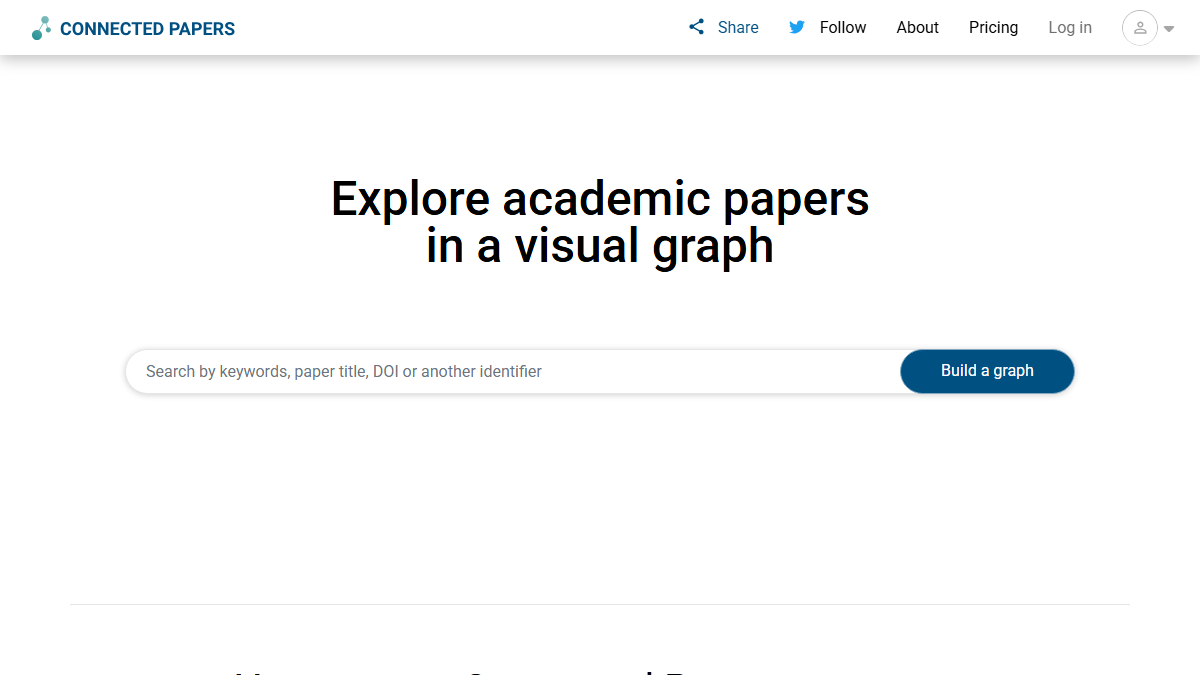
Connected Papers is a visual exploration tool for academic literature based on semantic similarity. Enter the paper title DOI or URL to generate a force-directed graph that clusters related papers by similarity and supports tracing the field's foundational work (Prior Works) and tracking the latest derivative research (Derivative Works). The database relies on the Semantic Scholar paper corpus (ODC-BY license), covering hundreds of millions of papers, and is suitable for academic scenarios such as literature review, topic research, and interdisciplinary exploration.
Core parameters and statistics of Connected Papers
Connected Papers is positioned as a visual exploration assistant for academic literature rather than a traditional paper search engine. Its core deliverable is a Force-Directed Graph, which clusters semantically similar papers in a two-dimensional space. The following are the key parameters and specifications:
| Parameters | Data |
|---|---|
| Product form | Web application + API + Chrome extension |
| Underlying Corpus | Semantic Scholar Paper Corpus (ODC-BY License) |
| Paper coverage | Approximately 236 million articles (based on Semantic Scholar) |
| Similarity algorithm | Co-citation analysis + Bibliographic Coupling |
| Visualization engine | Force-Directed Graph |
| Scale of graph construction | A single analysis of about 50,000 papers, dozens of selected papers for display |
| API rate limit | Default 5 builds/minute |
| Map cache validity period | 30 days (cold data triggers rebuild) |
| Map reconstruction time | Usually about 10 seconds, maximum 60 seconds |
| Open source client | Python (connectedpapers-py, 62 Stars, MIT) + JavaScript (connectedpapers-js, 15 Stars, MIT) |
| GitHub Following | 64 Followers |
| Browser extension | Chrome extension (supports Google Scholar / arXiv / Semantic Scholar) |
Interpretation of specifications: Connected Papers does not cover metadata retrieval of all papers, but focuses on "given a paper, find the collection of papers most relevant to it". This deep reading-assisted targeting sets it apart from Google Scholar’s keyword searches or Semantic Scholar’s citation summaries. A graph construction requires analyzing the citation relationships of about 50,000 papers and selecting dozens of the most representative nodes. This means that the query cost is not a simple single paper retrieval, but a computationally intensive graph operation.
User and market recognition of # Connected Papers
Since its public launch in 2021, Connected Papers has gained widespread word-of-mouth in the academic community, but the team has not disclosed the specific number of registered users or monthly active users.
C-side adoption: The tool is frequently recommended in academic communities such as Reddit's r/MachineLearning and r/academia, and the Twitter/X account @ConnectedPapers keeps product updates pushed. Researchers and graduate students are the core user group, and are especially suitable for initial exploration of fields, starting literature reviews, and interdisciplinary research on cross-disciplinary topics. The launch of the Chrome extension further lowers the threshold for use - users can generate maps by clicking directly on the Google Scholar or arXiv page.
B-side and API users: The team launched Python and JavaScript SDKs in 2024, targeting developers who need to obtain paper-related data in batches. The API adopts Token authentication mode (you need to contact [email protected] to apply for Early-Access Token), and has a free test quota. API updates as of November 2025 have introduced more granular rate limiting and overload handling mechanisms, indicating that the API user ecosystem continues to grow.
Benchmarking and Differentiation: Compared with tools such as Semantic Scholar's recommendation function SCITE's citation analysis and Elicit's paper Q&A, the core difference of Connected Papers lies in the interactive paradigm of "visual map" - it does not "tell you which papers are worth reading", but "lets you see the relationship structure between papers". This spatial cognitive aid can reduce the time researchers spend building mental models in large volumes of literature.
The cost advantage of Connected Papers
The cost model of Connected Papers needs to be analyzed from three levels: C-side user API developers and enterprises/institutions.
C client/individual users: Core web functions are free and open, including creating maps, browsing Prior Works and Derivative Works, and interactive exploration. Free users are subject to a certain usage frequency limit (the specific amount is not disclosed). Chrome extension sync is free. This is a zero-cost literature exploration tool for graduate students and independent scholars on a budget.
API/Developer: API adopts Token system, and you need to apply for Early-Access Token. Provide TEST_TOKEN for testing (single paper only). The API has a default rate limit of 5 builds/minute, and returns an OVERLOADED status if exceeded. Obtained paper maps can be revisited for free within 31 days and will not count towards the quota. Public pricing has not been released, commercial terms need to be confirmed by contacting [email protected].
Enterprise/Institution: Institutional-level pricing plans are not disclosed. For laboratories or scientific research institutions that require large-scale, batch paper map analysis, they currently need to communicate customized solutions through the sponsorship channel ([email protected]).
Hidden Cost: Graph build wait time (typically 10 seconds, up to 60 seconds) is a major efficiency loss, but the team mitigates the overhead of repeated queries to some extent through a 31-day cache. For batch processing scenarios, the API's 5 times/minute rate limit may lead to long queuing times, requiring the application layer to implement retry and scheduling on its own.
Main features of Connected Papers
-
Paper Similarity Graph (Graph): Enter the paper title DOI, URL or Semantic Scholar ID, and the system will generate a force-directed graph. Nodes represent papers, circle size represents the number of citations, and color depth represents publication time. The edges between nodes represent the strength of semantic similarity, and the clustering of adjacent nodes represents similar research directions. This is the core interactive unit of Connected Papers and is suitable for quickly understanding the distribution structure of papers in a subfield.
-
Prior Works: Displays early classic documents commonly cited by the papers in the atlas. This view helps researchers trace the "roots" of a research direction and quickly locate foundational papers, and is suitable for supplementing historical context in literature reviews.
-
Derivative Works: Shows subsequent research that cites the paper in the map. This is a visual upgrade of the traditional "cited list" - not only can you see who cited you, but you can also see the clustering relationships between citing papers. It is especially useful for tracking cutting-edge trends and discovering emerging research directions.
-
Chrome Browser Extension: Embed the "Connected Papers" button on the paper page of academic sites such as Google Scholar, arXiv, Semantic Scholar, and PubMed to jump to the graph page with one click. This feature eliminates the friction of copying and pasting paper titles and embeds map acquisition into researchers' daily search processes.
-
API and SDK: Officially provides Python and JavaScript clients, encapsulating API calls such as map acquisition, usage query, and free paper list. Supports both synchronous/asynchronous modes, as well as asynchronous iterators for real-time progress tracking. Suitable for technical teams who need to integrate paper-related data into their own tool chains.
Functional synergy: Prior Works + Derivative Works + Core Graph form a complete timeline—from the foundation of the field (Prior) to the current core (Graph) to the cutting-edge dynamics (Derivative). Chrome extension embeds graph portals into academic search scenarios, eliminating context switching costs. The API allows laboratories or institutions to inject this mapping capability into their own systems such as document management and writing assistance to realize workflow reconstruction of "check relationships with one click and build context in batches".
Model and version evolution of Connected Papers
Connected Papers is not a large model product and does not have the concept of "model versions", but the tool itself has gone through a clear feature iteration path:
Public launch (v2021.1, about June 2021)
The tool is launched in the form of a web application, focusing on force-oriented paper similarity diagrams. It supports inputting the paper title DOI or URL to generate a map, and provides two auxiliary views: Prior Works and Derivative Works. The focus of this stage is to verify whether the interactive paradigm of "visual literature exploration" is accepted by the academic community.
Chrome Extension Release (v2023.1, ~September 2023)
Publish a browser extension to embed graph portals into paper pages on academic sites such as Google Scholar, arXiv, and Semantic Scholar. This version greatly lowers the threshold for use—users can obtain maps with one click during daily searches. After the extension was released, it became one of the main traffic entrances for Connected Papers.
API and SDK release (v2024.1, approximately June 2024)
Launched official Python SDK (connectedpapers-py) and JavaScript SDK (connectedpapers-js), open source under MIT license. Provides three core APIs: get_graph_sync/async, get_remaining_usages_sync/async, and get_free_access_papers_sync/async. Introduce Token authentication mechanism.
API v2 and overload handling (v2025.2, ~November 2025)
Important technical upgrades: Replaced past HTTP 500 errors with structured OVERLOADED status codes; the client enables automatic retries with exponential backoff by default (5/10/20/40 seconds, up to 4 times); introduces asynchronous iterator mode to support real-time tracking of graph construction progress (QUEUED → IN_PROGRESS → FRESH_GRAPH); new fresh_only and wait_until_complete Parameters control caching behavior. This release significantly improves the robustness of the API and developer experience.
Connected Papers’ technical advantages
Co-citation + Document Coupling Similarity Measure: Connected Papers does not rely on the textual similarity of the paper title or abstract, but is based on co-citation analysis (Co-citation, two papers are cited by the same batch of later papers) and bibliographic Coupling (two papers cite the same batch of early documents). The advantage of this mechanism is that the signal-to-noise ratio of citation relationships is higher than that of text matching, and it can discover cross-field papers that "discuss the same issue but with different terms", while naturally avoiding the problem of keyword synonyms.
Visualization paradigm of force-directed graph: Traditional literature retrieval presents a list or citation tree, while Connected Papers projects the position of papers in a high-dimensional similarity space onto a two-dimensional plane, and visually clusters similar papers through force-directed graph. By observing the spatial arrangement of nodes, users can establish an intuitive understanding of the distribution structure of papers in a field within tens of seconds - this is especially efficient when dealing with unfamiliar interdisciplinary topics.
Scalable support for the Semantic Scholar corpus: The bottom layer uses Semantic Scholar Paper Corpus (ODC-BY license), covering approximately 236 million papers across multiple disciplines. This means Connected Papers reaches far beyond PubMed or arXiv-only paper tools. Each map construction analyzes the citation relationships of about 50,000 papers, and then selects dozens of papers for display. This is a computationally intensive but controllable accuracy solution.
Caching and hot and cold data tiering: The constructed graph is cached for 30 days, and users can revisit it without additional delay during the cache period; a rebuild is triggered after 30 days. Going one step further at the API level, papers accessed within 31 days are not counted towards the usage quota. This layered design significantly reduces server load while ensuring a low-latency experience in regular usage scenarios.
Robust design of client SDK: Python SDK has built-in exponential backoff retries (wait 5/10/20/40 seconds when encountering OVERLOADED), verbose mode provides real-time build progress logs, and asynchronous iterators support complete status tracking of QUEUED → IN_PROGRESS → FRESH_GRAPH. These engineering details directly determine the stability of integration in scenarios such as automated cluster analysis and scheduled document tracking.
How to use Connected Papers
The usage portals of Connected Papers are divided into two types: Web side and API side, covering users with different technical backgrounds and automation needs.
Web client (recommended for newbies)
- Open https://www.connectedpapers.com/
- Enter the title DOI, URL or Semantic Scholar ID of the paper
- Wait for the map to be built (usually about 10 seconds, it may take longer the first time)
- Browse in the force-directed diagram: hover the node to view the abstract of the paper, and click on the node to highlight its similar paths to other papers.
- Switch to the "Prior Works" tab to view foundational documents, and switch to the "Derivative Works" tab to view subsequent research.
- Use the "Export" function on the right side of the search box (if available) to save the map results.
Chrome extension
- Install the Connected Papers extension from the Chrome Web Store
- Open Google Scholar, arXiv, Semantic Scholar or PubMed
- Find the "Connected Papers" button on any paper page and click
- The browser will automatically jump to the corresponding map page
API side (Python example)
from connectedpapers import ConnectedPapersClient

# Use the contextual variable CONNECTED_PAPERS_API_KEY or pass it in during construction
client = ConnectedPapersClient(access_token="YOUR_API_KEY")

# Get the paper map (synchronized)
graph = client.get_graph_sync("SEMANTIC_SCHOLAR_ID")

# Get remaining usage
remaining = client.get_remaining_usages_sync()

# List papers that can be revisited for free
free_papers = client.get_free_access_papers_sync()

# Traverse Prior Works (founding documents)
for paper in graph.common_references:
    print(f"{paper.year}: {paper.title}")

# Traverse Derivative Works (derivative documents)
for paper in graph.common_citations:
    print(f"{paper.year}: {paper.title}")
API Key application: Send an email to [email protected] to obtain an Early-Access Token. Use TEST_TOKEN to test the map acquisition of a single fixed paper.
Product pricing for # Connected Papers
Pricing for Connected Papers is available in a tiered model covering different depths of usage, but the exact price of the advanced tiers has not been disclosed:
| Tier | Target Users | Core Benefits | Restrictions | Price |
|---|---|---|---|---|
| Free (Web) | Individual researchers, students | Create maps Prior/Derivative Works Browse Chrome extensions | Undisclosed frequency limit | Free |
| API (developer) | Technical team, integrated developer | Python/JS SDK, graph construction API, usage query | 5 builds/minute, Token authentication | Business contact required (undisclosed) |
| Sponsorship/Corporate | Labs, institutions | Custom quotas, technical support | Negotiation on demand | Please contact [email protected] |
The truth about the free tier: The free use of the web side is sufficient in most daily research scenarios, but the frequency limit (the specific value is not disclosed) may be triggered during intensive use. "Free" doesn't mean "unlimited" - it's a way for the team to control server load. The rate limit of the API (5 times/minute) is an obvious bottleneck for batch processing scenarios, but the 31-day cache revisit mechanism provides compensation: repeated retrieval of the same paper within 31 days does not count against the quota.
Hidden costs: Mainly from the waiting time for graph construction (up to 60 seconds) and queuing caused by API speed limit. For teams that need to track changes in papers in multiple fields every week, it is recommended to combine caching strategies and rate-limiting scheduling rather than requesting articles one by one in real time.
Application scenarios of Connected Papers
-
Literature review writing: When entering a new topic, enter the core papers in the field, use Prior Works to locate the foundational literature, and use Derivative Works to discover the latest progress. The visual structure of the map helps review authors quickly form a "domain map" and avoid falling into blind spots in keyword searches. Key points of verification: Whether the map can cover the multi-directional branches of the field, and whether there are obvious omissions of key papers.
-
Interdisciplinary Topic Research: When the research involves the intersection of multiple disciplines, keyword searches are often difficult to achieve due to terminological differences. The co-citation/coupling similarity mechanism of Connected Papers can discover research that has "highly overlapping citation relationships despite different terminology" - this is particularly valuable in cross-cutting fields such as AI+medicine and computational social science. Verification focus: The choice of the starting paper directly affects the quality of the map. It is recommended to construct maps from multiple representative papers for cross-validation.
-
Academic writing bibliography completion: After the first draft of the paper is completed, map the core papers in the citation list one by one and check whether there are classic documents in Prior Works that should have been cited but were missed. This "referential integrity check" is a low-frequency but high-value use of Connected Papers. Key points to check: The quality of the map is limited by the coverage of Semantic Scholar papers - there may be insufficient coverage in a few fields or non-English literature.
-
Graduate Course Introduction: At the beginning of the course, the instructor or professor will provide students with 2-3 starting papers in the field, and are required to use Connected Papers to explore the relevant literature network and submit a field analysis report. This usage has low threshold and high efficiency in educational scenarios, and is suitable for cultivating the literature retrieval literacy of a new generation of graduate students.
-
Technology Competing Products/Patent Document Monitoring: Enterprise R&D teams can use APIs to regularly map technical papers of concern and track new competitors or new directions that may emerge in derivative work. The API’s caching mechanism and the integration capabilities of the Python SDK make this automated monitoring possible.
Connected Papers Applicable Groups
-
Scientific researchers (graduate students, postdoctoral fellows, professors): the core user group. It is suitable for academic research scenarios where you need to quickly enter new fields, write literature reviews, and track cutting-edge trends. Prerequisite: You need to have a certain ability to read English papers (the interface language is English); not suitable for fields with strong demand for non-English literature (such as a large number of Chinese papers).
-
Interdisciplinary Researchers: Connected Papers' citation similarity is particularly valuable for interdisciplinary exploration. If you are getting involved in an unfamiliar cross-field, it can help you quickly establish a cognitive framework of "who is researching what and how the results are related." Not suitable for boundaries: For extremely niche subjects with few papers, the graph nodes may be too sparse and the reference significance will be reduced.
-
Academic Writing Supporter (paper editor, scientific research assistant): Connected Papers can be used as an auxiliary tool in tasks such as reviewing paper references and supplementing citation completeness. Prerequisite: You need to be able to obtain the Semantic Scholar ID or DOI of the paper.
-
Developers and Integration Engineers: Integrate paper mapping capabilities into its own tool chain through Python/JS SDK - literature management tools, scientific research assistants, paper recommendation systems, etc. Prerequisites: You need to apply for an API Token and comply with the rate limit; it is recommended to have asynchronous programming and error retry processing capabilities.
-
Graduate Tutor and Course Teacher: Use Connected Papers as a classroom tool to guide students to explore the literature map and develop independent literature retrieval abilities. Note: The tool is intended to be a "starting point for exploration" rather than a "definitive literature list" - map results should not replace systematic keyword searches and database queries.
Summary and outlook of # Connected Papers
Connected Papers occupies a unique ecological niche in the spectrum of academic documentation tools: it is not a search tool, not a citation database, but a "map" of paper relationships. This interactive paradigm shift from "query" to "exploration" is the core reason why it is continuously recommended by the academic community. Its technical route - similarity calculation based on co-citation/coupling + visualization of force-directed graphs - is not the most cutting-edge NLP solution, but it is effective enough on this specific problem, and is better than the black-box embedding model in terms of transparency and interpretability.
Current limitations: The quality of the map is highly dependent on the quality of Semantic Scholar's paper coverage and citation data, and the coverage of non-English literature, humanities and social science papers is low; the frequency limit of the free tier is not disclosed, and users may encounter unexpected interruptions during intensive use; the API's 5 times/minute rate limit is not friendly enough for batch processing, and the pricing of advanced tiers is not transparent, affecting enterprise-level adoption decisions; the team is small, and function iteration and problem response may be slower than commercial products.
Future observation points: Whether the transparency of commercial pricing plans will be improved; whether a user account system will be introduced to support collaborative functions such as map collection and notes; whether the API rate and quota will be adjusted with user growth; whether the team will raise funds or join an accelerator program to accelerate product iteration.
Procurement/Adoption Risk Assessment: For individual researchers or single research groups, the C-side free functions can already cover most of the literature exploration needs, and zero-cost entry is almost risk-free. For teams planning to build a literature automation pipeline around APIs, it is recommended to first use TEST_TOKEN to verify whether the graph quality and latency of the API can meet the needs, and then contact the team to obtain a formal Token and business quotation. Enterprise-level adoption requires confirmation of SLAs, data privacy terms, and advanced quota plans - none of which are currently public and must be confirmed via [email protected].
Core parameters and statistics
Specific technical parameters (such as model size, context length, supported file formats, input and output restrictions, etc.) are subject to the official product page. It is recommended that users verify the latest technical specifications and system requirements before choosing to ensure that they match their own usage scenarios.
User and market recognition
Gradually build user awareness in the field, and product capabilities are used by content creators and teams to improve work efficiency. Some industry users have incorporated it into their daily workflow. It is recommended to refer to the latest official disclosures for specific user scale and industry adoption rate data.
Cost advantage
- C-side/Individual: Usually a free version is provided to experience the core functions, and high-frequency use requires a paid package subscription.
- API/Developer: Billed by call volume, suitable for development teams that can be flexibly integrated into their own systems.
- Enterprise/Privatized: Contact the business owner for customized quotation and deployment plan. The specific price is subject to the official real-time pricing page.
Main functions
- Core Processing Capabilities: Provides core AI capabilities in the corresponding scenarios to support users to quickly complete tasks.
- Multi-modal interaction: supports text input and result output, and some scenes support image or file upload.
- Workflow Integration: Can be embedded into existing workflows or linked with other tools through APIs to reduce context switching.
Model and version evolution
Continuous iterative updates, the latest version introduces performance optimization and new features. Historical version information can be viewed on the official release page. There is no complete public version evolution timeline yet. It is recommended to pay attention to the official announcement to understand the rhythm of feature updates.
Technical advantages
- Algorithm Optimization: Special optimization at the model or algorithm level has been carried out for the corresponding scenario to achieve a balance between response speed and result quality.
- Low-latency architecture: Adopts streaming or asynchronous processing architecture to reduce user waiting time and is suitable for high-frequency interaction scenarios.
How to use
- Web client: You can use it by visiting the official website and registering an account. Most functions do not require installation.
- API access: Provides RESTful API, developers can obtain the API Key and integrate it into their own applications.
Product Pricing
The pricing model is subject to the official real-time page. Usually a freemium or subscription system is used, and basic functions can be used for free. Advanced functions or high-frequency use require paid subscriptions, and users are advised to evaluate the optimal solution based on actual usage.
Application scenarios
- Personal Creation: Quickly generate or process content to improve daily work efficiency.
- Team Collaboration: Unify workflow and reduce repetitive manpower investment.
- Enterprise-grade deployment: Embed capabilities into on-premises systems via API or private deployment.
Applicable people
- Individual Users: Content creators and knowledge workers who need AI assistance to improve their daily work efficiency.
- Developers: Technical teams who need to integrate AI capabilities into their own products or services through APIs.
- Enterprise: Organizations seeking to deploy AI at scale in their field.
Summary and Outlook
It provides competitive solutions in its field, and its core value lies in lowering the threshold for AI use in this field.
Current limitations: Some advanced features require paid subscription, and the free version has function or usage restrictions; specific technical details and performance benchmarks have not yet been fully disclosed.
Related tools:  Khanmigo, quizlet
Version Info
- Connected Papers API v2 (2025-11) :API update: Introduced OVERLOADED status code to replace HTTP 500; added exponential backoff retry mechanism (5/10/20/40 seconds); supports asynchronous iterator mode to track graph construction progress in real time.
- Python & JS SDK released :Released the official Python client connectedpapers-py and JavaScript client connectedpapers-js, which support synchronous/asynchronous API calls and provide graph acquisition, usage query, and free paper list interfaces.
- Chrome extension released :Released a Chrome browser extension that supports one-click generation of paper maps on Google Scholar, arXiv, Semantic Scholar and other pages. There is no official precise date yet.
- Publicly launched :Connected Papers is officially open to the public. It supports inputting the title/DOI/URL of a paper to generate a map of similar papers, and provides Prior Works and Derivative Works views. There is no official precise date yet.
User Reviews