 ContractPodAi
ContractPodAi is an end-to-end contract lifecycle management platform with built-in Leah AI assistant, covering the entire process from contract creation, review to custody.
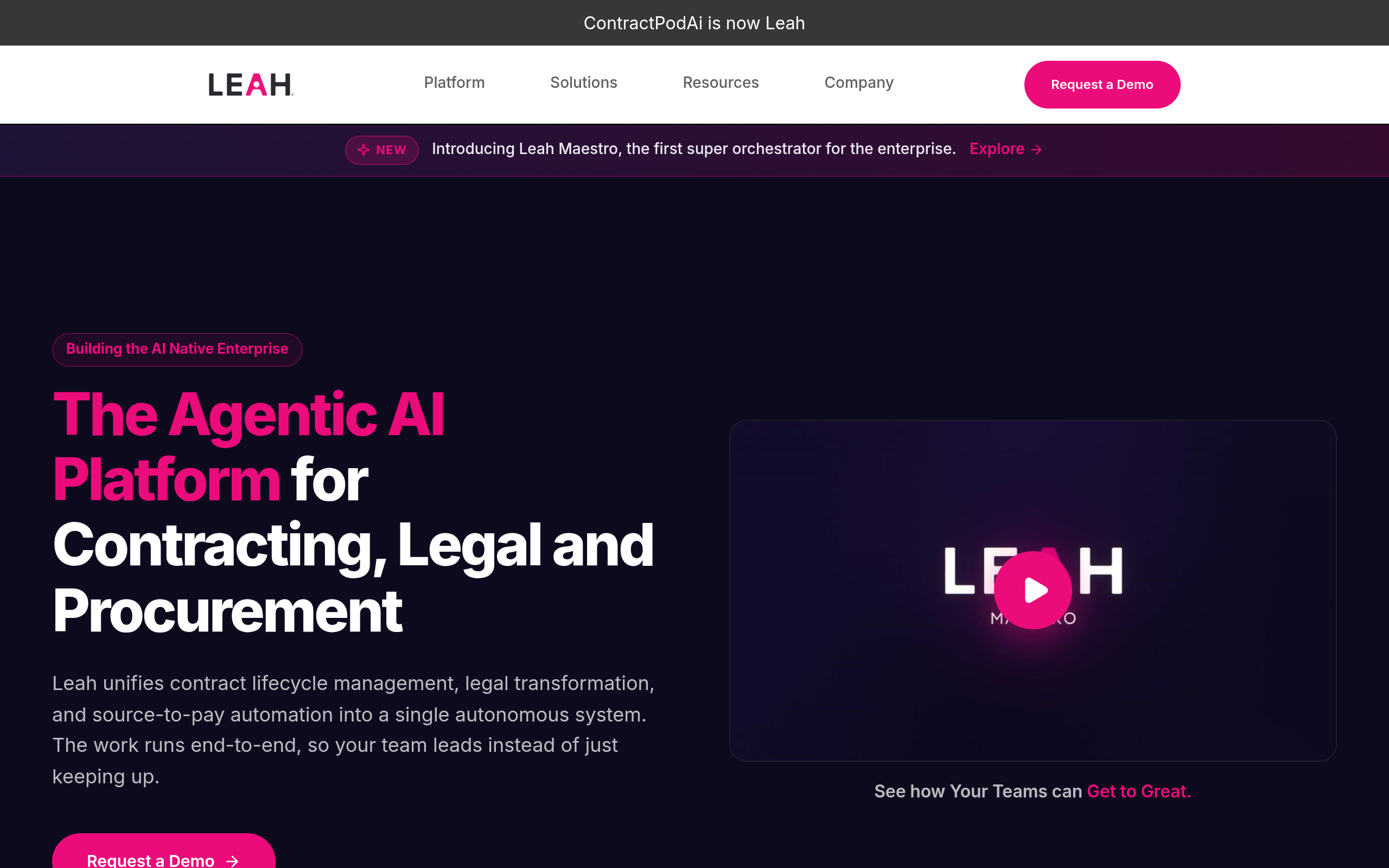
ContractPodAi (now renamed Leah)
Core parameters and statistics of ContractPodAi
| Projects | Data |
|---|---|
| Product positioning | Agentic AI platform for commercial enterprises, covering contract management, legal affairs, procurement and finance |
| Current Brands | Leah (formerly ContractPodAi), owned by ContractPod Technologies Limited |
| AI assistant name | Leah (multi-domain agent built into Agentic OS) |
| Delivery form | SaaS Web + Mobile + API + Microsoft Office plug-in |
| Customer scale | Serving Fortune 500 companies around the world, covering regulated industries such as manufacturing, finance, medical care, and energy |
| Management business value | Publicly declared management $125B+ business value, total market value of customer base $5T+ |
| Delivered ROI Impact | $10B+ (official claim) |
| Integration Ecosystem | Salesforce, Microsoft Dynamics, HubSpot, SAP, SAP Ariba, Oracle, Workday, Coupa, ServiceNow, NetSuite, iValua, DocuSign, Adobe Sign, Signicat, Viafirma, SharePoint, OneDrive, Box, Google Drive, Dropbox, Net Documents, Microsoft Teams, Slack, Outlook |
| Compliance certification | SOC 2 Type II, ISO 27001, GDPR; data is not used for model training; supports single-tenant deployment and data residency |
| Implementation cycle | Officials say most customers can go online within two weeks |
| Multi-language support | Supports contract review, clause extraction and drafting in 30+ languages |
The core competitiveness of ContractPodAi (now Leah) lies in the architectural leap from "traditional CLM storage and routing" to "Agentic AI autonomous execution". The platform does not superimpose AI functions on existing SaaS, but is rebuilt with an AI-native architecture. Leah can not only store and circulate contracts, but also perform end-to-end drafting, review, redline marking, obligation tracking, contract renewal reminders, etc., and collaborates across the three departments of legal, procurement, and finance. Its "One Connected System" concept uses contracts as the system core of business records, and all expenditure decisions, obligation fulfillment and contract renewal events are driven by the same intelligent agent layer.
Users and market recognition of ContractPodAi
Client lineup: Official public clients include PwC, KPMG, Philips, Alaska Airlines, Sandoz (part of Novartis), Pernod Ricard, MUFG (Mitsubishi UFJ Financial Group), Daikin, YETI, Beiersdorf, Comerica Bank, Pleo, Hawaiian Airlines, Wood PLC, Cushman & Wakefield, Terumo Europe, Ansa McAL, Dubai Future Foundation etc., covering multiple industries such as professional services, manufacturing, aviation, finance, medical care, consumer goods, and energy. Client roles include general counsel, chief procurement officer, and head of finance.
Industry Recognition:
- Gartner CLM Visionary: Named a Gartner CLM Visionary (Vision Leader) 5 times in a row.
- G2 Market Ranking: Obtained multiple labels such as Leader (American Leader Mid-Market Americas Leader), High Performer, Easiest To Use, Best Support, Users Most Likely To Recommend, etc. in the Contract Lifecycle Management category; Obtained Easiest To Do Business With, Users Most Likely To Recommend in the Legal Document Drafting category.
- Industry Awards: LegalTech Breakthrough Award 2025, SpendMatters Validated 2025, Stevie Awards Gold Winner 2025 (International Business Award), Globee Awards Gold Technology 2025.
- Gartner Attribution: Appears in the Gartner CLM Market Guide email banner.
Quantitative results (from official customer cases):
- 91% reduction in contract review time (a large US logistics company)
- $18M+ revenue protected (a global manufacturer)
- $2M+ trackable savings (a US retail REIT)
- 67% faster contract cycle (a financial services company)
- Unified management in 40+ countries (a global industrial manufacturer)
- 800+ employees use the platform (legal operations team of a financial technology company)
Evaluation Note: The above figures are from the official public page of leahai.com. The contract size, baseline definition and calculation method of the specific case have not been fully disclosed. It is recommended to verify with your own data during the procurement POC stage.
Cost Advantages of ContractPodAi
ContractPodAi (Leah) does not disclose standard pricing, and the price system needs to be confirmed through business negotiations. The following cost analysis is based on public information from the official page and the general structure of similar CLM solutions in the industry:
C client/individual:
- Not for individual users, no personal free version or self-service subscription entrance.
- Individual practitioners or single-lawyer teams are recommended to evaluate AI Legal Assistant -like lightweight tools, as Leah's full platform is too heavy for a single-person scenario.
SMB/Team (Standard Edition):
- Standardized CLM functionality for SMBs, with an annual subscription.
- Includes basic contract creation, storage, approval routing and template management.
- The price range is not displayed on the public page. The SMB level of similar products in the industry (such as Ironclad, Lexion) is usually in the range of $15,000-$50,000 per year. Leah is most likely to be in a similar or slightly higher range, subject to the official quotation.
Enterprise Edition (Professional Edition/Enterprise Edition):
- Includes all capabilities of Leah AI (Agentic CLM, Leah Legal, Leah Procurement), as well as advanced workflow DeepSights analysis dashboard and multi-language support.
- Supports customized integration (CRM, ERP, e-signature deep binding), exclusive SLA, single-tenant deployment options.
- The cost of the enterprise version includes implementation and onboarding services (officially, most customers will go online within two weeks), but complex organizations may need to configure additional clause libraries and approval rules.
- Industry Benchmark: The annual fee for similar enterprise-level CLM platforms is usually in the range of $100,000-$500,000+. As an AI-native platform, Leah is expected to have a higher annual fee than traditional CLM, but officials say it can achieve ROI coverage by shortening the contract cycle and reducing manual review costs.
API/Developer:
- Leah provides an open CLM API for custom integration, but the API usually comes with enterprise subscriptions and there is no independent pay-as-you-go API product.
- Teams that require API integration should clarify the call quota and frequency control limits during business negotiations.
Hidden Costs and Considerations:
- Term library initialization cost: Importing existing contract terms and historical data into Leah and configuring the playbook (negotiation rules library) requires time from the legal team, and the first configuration may take 2-4 weeks.
- User Training and Change Management: Migrating from traditional CLM or manual processes to the Agentic platform requires process change training for legal, procurement, and finance teams.
- Data migration complexity: The quality of OCR recognition and structured extraction of existing contracts (especially scanned copies and non-English contracts) directly affects the initial experience. It is recommended to use real contract samples to test Leah's extraction accuracy during the POC stage.
- AI additional charges: Leah AI assistant may be billed additionally based on active seats or processing volume. It needs to be confirmed in the contract whether the billing model of the AI function is a fixed annual fee or a floating usage rate.
Main functions of ContractPodAi
The Leah platform focuses on the core of "Agentic CLM" and provides end-to-end contract and commercial operation capabilities. It can be divided into the following six modules according to functional areas:
Contract creation and intelligent drafting
- No-code contract writing: Complete contract creation through guided intake forms - step-by-step questionnaires with conditional logic, automatic filling of clause libraries, variable substitutions - no legal drafting experience is required for the initiating party.
- One-Drop upload and process: Drag in any contract document from the other party, and Leah will automatically classify the contract type (MSA, NDA, SOW, etc.), extract key terms and obligations, and trigger subsequent workflows, without manual marking in the entire process.
- Outlook plug-in creation: Initiate contract requests, upload attachments, and trigger approvals directly in emails, and all operations are automatically synchronized back to CLM.
- Metadata driven: Each intake field is converted into structured data to drive searches, reports, workflows and template filling, eliminating repeated entry across systems.
AI review, redlining and negotiation support
- Playbook-driven massive redlining: Leah automatically applies the company's negotiation rules (playbook) to every clause, ensuring all contracts are aligned regardless of who is handling them.
- Ask Leah Inline AI Q&A: Ask questions directly during the contract review process - "Is this indemnification clause a market standard?" "What are the risks of accepting this termination notice?" - and get instant answers at the clause level.
- Word Plug-in Review: Complete reviews right inside Microsoft Word, accept or reject AI redlines, and navigate clause structure without switching systems or copying text.
- Historical Transaction Intelligence: Leah detects the position of previously negotiated terms with the same counterparty, helping the team stick to the negotiated results achieved and avoid repeated concessions.
Automation of approval and signing
- Intelligent Conditional Routing: The approval path is dynamically adjusted based on the contract content - the next approver is automatically determined based on conditions such as transaction amount, risk level, jurisdiction, contract type, etc.
- Full-link visibility: Approvers see complete contextual information, and initiators understand the contract progress in real time, without the need for reminder emails.
- Built-in DocuSign and Adobe Sign: Initiate signing directly in the platform, define the signing order, add carbon copy people, set the expiration time, and automatically archive the signed document.
- Delegation and automatic upgrade: The approver can temporarily delegate to others, and the contract will automatically be upgraded to the higher-level decision-maker if it is not approved within the specified time limit.
Smart contract warehouse and obligation tracking
- Cognitive Search: Supports fuzzy search, wildcard, proximity search and phrase search, and can locate "limitation of liability clauses in SaaS agreements expiring in Q2".
- Obligation Tracking and Renewal Reminders: Each obligation is automatically extracted when the contract is entered and tracked to completion. Automatic reminders are triggered on renewal dates, notice periods and key milestones.
- DeepSights Analytics Dashboards: CFO dashboard tracks contract value and risk exposure, CPO dashboard displays supplier performance, and CRO dashboard monitors transaction pipeline—with board-level insights automatically generated.
- Global Visibility and Local Control: One platform covers all entities, regions and teams, and role-based permission control ensures that each user only sees content within his or her authorization.
Legal and procurement collaborative intelligence
- Leah Helpdesk: Business teams (purchasing, sales, finance) can ask Leah any contract questions directly, and the answers will be accompanied by links to source clauses and automatically recommend next actions (mark risks, initiate revisions, upgrade legal).
- Leah Discovery: Cross-contract portfolio analysis – find all contracts with GDPR notification obligations, identify which suppliers are facing price increases – with just one natural language query.
- Legal Intake unified portal: Procurement submission of new supplier NDA, financial request compliance review, sales request acceleration contract - each request has an independent intake form, Leah automatically categorizes, prioritizes and routes to the correct reviewer.
Cross-department Agentic workflow
- Skills-Based Orchestration: Leah Agentic OS assigns the right agents to the right jobs, executing in the right context - legal agents, contract agents, procurement agents, financial agents can work in parallel.
- Agentic Workflows: Workflow self-healing - automatically recovers when exceptions occur, without manual intervention.
- Agentic App Builder: Business teams can assemble, configure and publish production-grade applications on their own without developer involvement.
Comparison of main functions (similar CLM):
| Functional domain | Leah (ContractPodAi) | Traditional CLM (e.g. Icertis) | Legal AI tools (e.g. Harvey) |
|---|---|---|---|
| Contract creation and drafting | AI-native guided intake + One-Drop automatic classification | Template + manual entry | Not supported |
| AI review and redlining | Playbook driver + Word plug-in + Ask Leah Q&A | Basic AI assistance | Single task assistance |
| Cross-department collaboration | Legal + procurement + financial unified platform | Independent contract department | Legal affairs only |
| Approval and signing | Intelligent conditional routing + built-in e-signature | Basic approval flow | Not supported |
| Obligation tracking | Automatic withdrawal + proactive reminder before expiration | Manual setting | Not supported |
| Analysis dashboard | DeepSights role-based dashboard | Basic report | None |
| Autonomous execution capability | End-to-end autonomous operation without manual push | Routing to people | Assisted single tasks |
ContractPodAi’s model and version evolution
Brand and product main line
ContractPodAi is a veteran vendor in the field of CLM (Contract Lifecycle Management). In its early days, it served Fortune 500 companies as a traditional SaaS CLM platform. Its key transformation nodes are as follows:
- ~2015-2020 (Initial stage of ContractPodAi): A traditional CLM platform focusing on contract storage, approval flow and basic reporting. Its customers are concentrated in large enterprises in North America and Europe.
- ~2022-2023 (AI capability introduction): Start adding AI-driven contract review and risk analysis functions to the platform. According to public information, machine learning-based clause extraction and risk scoring capabilities will be launched around 2023. Marked as v4 major release.
- ~2025-03 (Launch of Leah AI): The dedicated AI assistant Leah is launched, supporting natural language contract question and answer and intelligent clause extraction, and the human-computer interaction interface shifts from traditional menus to conversational ones. Marked as v5 version.
- 2025-2026 (Comprehensive transformation of Leah brand): The company was renamed Leah (ContractPod Technologies Limited), and the product was upgraded from "AI-enhanced CLM" to "Agentic AI Platform for Contracting, Legal and Procurement". The official website will be redirected from contractpodai.com to leahai.com. Launched Leah Agentic OS, Agentic CLM, Leah Legal, Leah Procurement, Leah Finance and other product lines; introduced Leah Maestro (super orchestrator), Skills-Based Orchestration, Agentic App Builder. Received multiple G2 Leader labels and LegalTech Breakthrough Award in 2026.
Version summary
| Version ID | Release time | Core changes |
|---|---|---|
| ContractPodAi v4 | ~2023-06 | Introducing AI-driven contract review and risk analysis |
| ContractPodAi v5 (Leah AI) | ~2025-03 | Launch of Leah AI natural language assistant, intelligent extraction of terms |
| Leah Platform (brand renaming) | 2025-2026 | Comprehensive transformation of the Agentic AI platform, launching Leah Agentic OS, Agentic CLM, and multiple product lines; the official website is moved to leahai.com |
Note: The above version date is an inference based on public milestones. The precise date has not been made public. The official announcement shall prevail.
Technical advantages of ContractPodAi
Architecture: AI-native Agentic OS, not SaaS + AI overlay
The core technical difference of Leah is that the underlying architecture is not "traditional SaaS database + AI plug-in", but an Agentic AI architecture built from scratch:
- Skills-Based Orchestration: The platform has built-in multiple domain agents (legal, contracts, procurement, finance). Leah Orchestrator automatically assigns the correct agents to perform work based on task type, context and domain intelligence, rather than routing all requests to people.
- Agentic Workflows (self-healing workflow): If an exception occurs during workflow operation (such as the approver is not on duty, the external system times out), Leah can automatically recover or choose an alternative path without manual intervention to repair it.
- Shared Business Intelligence Layer: All agents share the same business context - contract terms, legal obligations, supplier risks, spend data are linked in the same intelligence layer, which means that the procurement agent's decisions can automatically reference the risk information identified by the legal agent without the need for integration or manual synchronization.
Causes of performance differences with traditional CLM
Traditional CLM (such as Icertis, DocuSign CLM) is based on "storage + routing". Contract data is stored in the database, and workflow assigns tasks to corresponding personnel. Leah stores contract terms, obligations, and risk scores as structured knowledge graphs, which are directly read and executed by AI agents instead of relying on humans to process them one by one. This architecture produces substantial efficiency differences in the following scenarios:
- Contract review: The traditional process requires the legal department to compare the playbook clause by clause. Leah scans all clauses in milliseconds and puts forward modification suggestions.
- Obligation tracking: Traditional CLM relies on manual entry of due dates, Leah automatically extracts obligations during contract entry and continuously monitors them.
- Cross-department query: Traditional solutions require different departments to log in to their respective systems, export data, and manually integrate. Leah can search across warehouses with a natural language query.
Limitations and adaptation boundaries of Domain-Specific agents
Leah's domain agent is deeply optimized for commercial contract scenarios, which means it is not suitable for:
- General legal research (such as case search, comparison of legal provisions - not its design goals)
- Drafting of litigation documents (although documents related to contract disputes can be processed, special litigation tools are better)
- Non-contract document processing (such as patents, trademarks, academic papers)
Security and Compliance Architecture
- Data isolation: Contract data is not used for model training and single-tenant deployment is supported.
- Encryption: Encrypted both in transit and at rest.
- Compliance certifications: SOC 2 Type II, ISO 27001, GDPR.
- Audit traceability: Each agent action can be traced from trigger to result, meeting the audit requirements of regulated industries.
- Data residency: Supports selecting data storage area according to enterprise requirements.
How to use ContractPodAi (Leah)
Access method
| Entrance | Description |
|---|---|
| Web client (SaaS) | Log in through leahai.com, standard browser access |
| Microsoft Word plug-in | Complete contract review, redlining, and clause Q&A in Word |
| Microsoft Outlook plug-in | Initiate contract requests, upload attachments, and trigger approvals in emails |
| Mobile | The official has not clearly disclosed the details of the mobile app, please refer to the official page |
| API | Open CLM API for custom integrations |
Standard implementation path
- Requirement Confirmation and Demo: Submit a Demo request through leahai.com and confirm the business scenario and scale with the sales team.
- Onboarding (online within two weeks): Officially said that most customers will complete the onboarding within two weeks, including:
- Connect existing systems (CRM, ERP, e-signature, file storage, etc.)
- Configure playbook (negotiation rule library) and approval rules
- Import existing contracts (supports batch import and OCR automatic structuring) -Team permission settings and role assignments
- Pilot and comparison: It is recommended to select 1-2 contract types (such as NDA or SOW) to pilot in a single legal team to measure the change in the cycle from intake to signature.
- Expansion and Promotion: Based on the pilot results, it will be gradually expanded to the procurement and finance teams to cover more contract types and business processes.
Technical prerequisites:
- Enterprises need to have mainstream CRM (Salesforce / Dynamics / HubSpot) or ERP (SAP / Oracle / Workday) environment to obtain the best integration effect.
- Existing contracts must be provided in the form of electronic files (PDF, Word, scanned copies), and paper contracts must be digitally scanned first.
- The legal team needs to cooperate with the playbook configuration to clarify the approval lines, risk thresholds, and standard clauses of various contracts.
Product Pricing for ContractPodAi
| Tier | Target customers | Pricing model | Inclusion capabilities | Reference annual fee (industry deduction, subject to official) |
|---|---|---|---|---|
| Standard version | Small and medium-sized enterprises | Annual subscription | Basic CLM (contract creation, storage, approval routing, template management) | Same level in the industry ~$15K-$50K/year |
| Professional Edition | Medium/Growing Enterprises | Annual Subscription | Standard Edition + Leah AI, Advanced Workflow DeepSights, Word/Outlook Plug-ins | Business Negotiation Required |
| Enterprise Edition | Fortune 500 / Multinational Enterprises | Annual Subscription | Professional Edition + Customized Integration, Single Tenant Deployment, Dedicated SLA, Multi-Language 30+, AI Governance | $100K-$500K+/Year |
| AI add-on module | Already subscribed customers | By active seats or usage | Leah AI assistant Leah Discovery, cross-contract analysis | Subject to contract confirmation billing model |
Pricing Transparency: Leah (formerly ContractPodAi) does not publish a standard price list, and all subscription prices are determined through sales negotiations. The above industry deductions are for reference only and are subject to official real-time quotations. It is recommended to ask clearly when purchasing:
- Is the AI function a fixed annual fee or is it floating based on usage/seats?
- Is the integration implementation service included in the annual fee, or is it a separate fee?
- What is the maximum number of hours for data migration and initial configuration of the clause library?
- Is there a minimum seat or minimum annual fee commitment in the contract?
Application scenarios of ContractPodAi
A unified contract and business operation platform for multinational enterprises
Scenario Description: A global manufacturer operating in 40+ countries needs a unified system to manage contracts, obligations and compliance requirements across all jurisdictions. Leah connects all entities on a single platform. Legal teams in each region have independent authority and control boundaries, but headquarters has a global view of the risk exposure and renewal calendar of the contract portfolio.
Key points to verify:
- Does Leah's language support for target jurisdictions cover local contract law terminology?
- How to resolve the priority conflict between local approval rules and global playbook?
- Does the data residency solution for cross-border data transfer meet the compliance requirements of each jurisdiction?
Improve efficiency in negotiation of high-traffic procurement contracts
Scenario Description: The procurement team processes 50+ supplier contracts (NDA, MSA, SOW) per week, each requiring legal review. In the traditional process, legal affairs have become the bottleneck - Leah automatically imports supplier contracts, completes redlining according to the playbook, and marks high-risk clauses. The purchasing manager can complete the preliminary screening before legal affairs officially intervene, and legal affairs only handles the marked abnormal clauses.
Key points to verify:
- Leah's accuracy in identifying industry-specific clauses (such as confidentiality agreement clauses in pharmaceuticals and service level agreements in IT outsourcing)?
- Flexibility of playbook configuration - does it support setting different rules according to supplier level and procurement category?
- How deep is the integration with procurement systems such as SAP Ariba / Coupa - how is the bi-directional synchronization of contract data and purchase orders?
Contract renewal and income protection
Scenario Description: Enterprises passively renew or automatically extend a large number of contracts after they expire every year, resulting in missed renegotiation opportunities. Leah continuously monitors key dates for all contracts, automatically triggers internal approval processes before renewal windows, compares current terms with market standards, and prompts the procurement team to renegotiate at the best time.
Key points to verify:
- Is the number of days in advance for renewal reminders configurable (set separately by contract type and supplier importance)?
- Are bulk renewal operations (such as merged renegotiations of multiple SaaS agreements) supported?
- Does the renewal approval process support the "automatic upgrade if no response is received" mechanism?
Contract retrieval and analysis for compliance audit
Scenario description: The audit team needs to quickly identify all contracts that contain "automatic renewal", "exclusivity clauses" and "GDPR data processing". Traditional methods require legal teams to manually page through thousands of PDFs. Leah Discovery analyzes the entire contract warehouse in seconds and provides relevant summaries and links to the original terms of each contract.
Key points to verify:
- How does cognitive search perform on semantic searches for non-English contracts (Chinese, Japanese, German)?
- What is the recognition quality of OCR on scanned documents (stamped documents, handwritten annotations)?
- Leah Discovery's Query Capability Bounds - Does it support combined conditions (e.g. "SaaS contract with value > $1M and expiration date in Q2 with an indemnification clause")?
M&A Due Diligence Acceleration
Scenario Description: In an M&A transaction, the buyer needs to quickly review thousands of contracts for the target company. Official case study shows Leah reduced contract review time for M&A due diligence by 87%. Leah automatically extracts key terms, obligations, expiry dates and risk signals for each contract, filtering out those contracts that require focus based on acquirer criteria.
Key points to verify:
- What is the throughput limit for concurrent review of multiple contracts?
- Output format of due diligence report (can it be exported directly to Excel/PDF summary)?
- Integration support with Virtual Data Room (VDR)?
Applicable groups of ContractPodAi
General Counsel/Head of Legal Affairs
- Adaptation Value: Leah provides global visibility into legal work—intake traffic, contract review volume, approval bottlenecks, external lawyer fees—and uses DeepSights dashboards to quantify the legal team’s business contribution. Legal affairs have been transformed from "business bottlenecks" to "business enablers".
- Not suitable for the boundary: If the corporate legal work mainly focuses on litigation and dispute resolution (rather than contracts and commercial transactions), Leah focuses on commercial contract management and lacks litigation assistance capabilities. It is recommended to use special litigation support tools.
Contract Operations/CLM Team
- Adaptation value: The automation of the entire process from contract intake to signing and renewal greatly reduces repetitive operations. The "contract cycle shortened by 67%-91%" quoted in the official case directly points to the efficiency improvement of the contract operation team.
- Does not fit the boundary: If the enterprise contract size is small (<50 contracts per year), Leah's full platform is too heavy-duty and costly, and it is recommended to evaluate lightweight document management solutions or Google Workspace/Microsoft 365 built-in features.
Purchasing Manager/Purchasing Team
- Adaptation value: The contractual obligations and legal risks behind procurement decisions can be viewed in real time, and supplier risk management changes from "one-time onboarding inspection" to continuous monitoring. Leah links purchase orders with contract terms to reduce compliance gaps in the procurement process.
- Misfit Boundary: Leah’s contract intelligence advantages cannot be fully realized if the procurement process completely uses a single Source-to-Pay platform (such as Coupa, SAP Ariba) and does not involve the negotiation of complex contract terms. It is recommended to use the number of "non-standard terms" involved in the procurement process as the threshold for judgment.
CFO / Head of Finance
- Adaptation value: Expenditure analysis is directly related to contract obligations, revenue recognition schedules are automatically extracted from the contract, and renewal risks are visible in advance. Leah helps finance teams move from "reactive recording" to "active management of business risk".
- Unfit Boundary: If financial management needs are limited to basic invoice approval and order-to-cash processes, Leah's contract intelligence layer may exceed actual needs, and the traditional ERP financial module is sufficient.
Scenarios not suitable for using ContractPodAi
- Solo Lawyer/Solo Practitioner: Leah's enterprise-grade features and pricing are severely overkill for single-person scenarios, and it is recommended to use a lightweight legal AI tool.
- Simple document storage only: If you just need a searchable electronic contract folder, Google Drive / SharePoint with a little manual tagging will do.
- No need for cross-department collaboration: Leah’s core value lies in the linkage of legal affairs, procurement and finance. If contract management is limited within the legal department, traditional CLM or legal AI tools are more cost-effective.
- Extremely long customization requirements: Although Leah provides configurable playbooks and approval rules, extremely in-depth ERP customization (such as SAP module level modifications) still requires the involvement of the traditional SI team.
Summary and Outlook of ContractPodAi
Core Advantages:
- Leading architecture: AI-native Agentic OS built from scratch, non-traditional CLM + AI patch overlay, has generational advantages in autonomous workflow execution and cross-department collaboration.
- Full customer verification: multiple Fortune 500 customer cases, quantifiable efficiency data (67-91% contract cycle reduction), and 5 consecutive Visionary positionings by Gartner.
- Complete ecological coverage: pre-built connectors with 20+ mainstream CRM/ERP/e-signature/file storage systems, and the implementation cycle is shortened to two weeks.
- Compliance & Security Maturity: SOC 2/ISO 27001/GDPR certification + Data not used for training + Single-tenant deployment options to meet regulated industry entry barriers.
Current Limitations and Uncertainties:
- Insufficient pricing transparency: There is no public price system, companies need to go through a complete sales research and POC process when evaluating costs, and the procurement decision-making cycle is long.
- Brand transition period: The name change from ContractPodAi to Leah is still in progress. There are transition frictions in the brand recognition of some existing customers and channel partners. The consistency of information between official documents and third-party reviews requires continued attention.
- AI Agent maturity assessment: Leah’s “autonomous execution” performs well under ideal scenarios, but its performance under highly abnormal contracts and extremely complex clause combinations still lacks independent third-party benchmark testing. It is recommended that the POC stage use the company’s own 20-30 most complex contracts for actual testing.
- Asia-Pacific localization: Although it is announced that it supports 30+ languages, the product design concept is based on British and American contract law, and the depth of coverage of the legal systems in the Asia-Pacific region (such as mainland China contract law, Islamic financial contracts) needs to be verified by the enterprise itself.
- Competitive product pressure: Traditional CLMs such as Ironclad and Icertis are accelerating the construction of AI functions, and legal AI tools such as Harvey are also expanding towards workflow. Leah needs to continue to maintain the speed at which architectural advantages are realized.
Procurement risk assessment and implementation suggestions:
- Pilot first: Select 1-2 contract types (NDA and standard SOW recommended), pilot them with a single legal team for 4-6 weeks, and measure intake-to-signature cycle changes and AI review accuracy.
- Acceptance Focus: Leah’s accuracy in extracting terms of non-English contracts, two-way data synchronization delay with existing ERP/CRM, and abnormal scenario recovery mechanism of the approval flow.
- Expansion Conditions: When the contract period of the pilot is shortened by ≥ 40% and the AI review accuracy rate is ≥ 90%, it can be extended to the procurement team and finance team.
- Contract terms verification: Before signing, confirm the billing model (fixed vs. floating) of the AI function, data residency options, availability commitments and response times in the service level agreement (SLA), and data migration support terms upon contract termination.
Version Info
- ContractPodAi v5 with Leah AI :Launched Leah AI assistant, which supports natural language contract Q&A and smart clause extraction. There is no official precise date yet.
- ContractPodAi v4 :Introducing AI-driven contract review and risk analysis. There is no official precise date yet.
User Reviews