 copy.love
Free
copy.love
Free
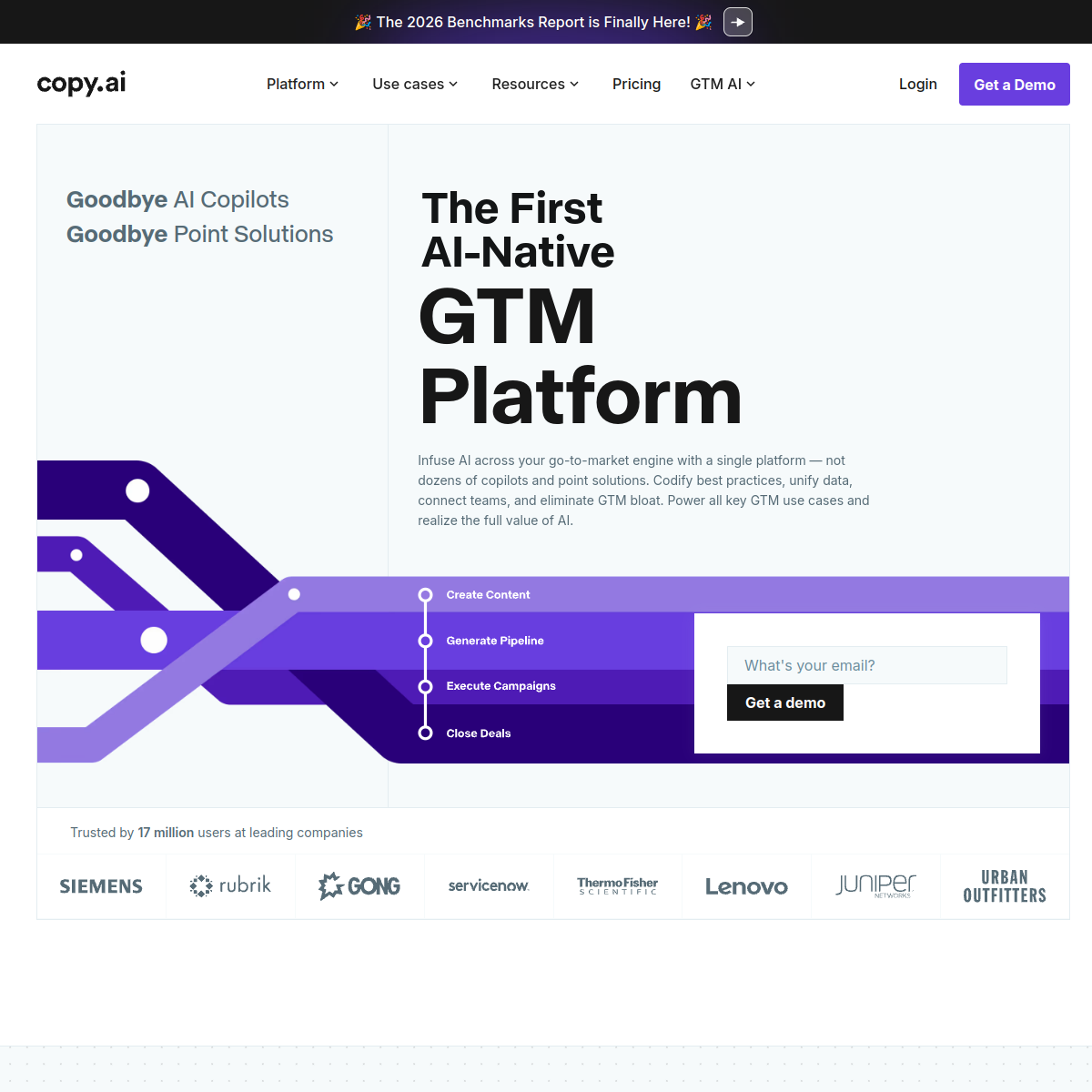
Copy.ai is an AI Writing platform for marketing teams. It provides multi-style copywriting generation, templates and GTM workflow, and supports embedding content production into automated processes.
Copy.ai
Copy.ai’s core parameters and statistics
Copy.ai is the world's first product positioned as a "GTM AI platform". It has evolved from an AI copywriting generation tool in 2020 to a workflow platform covering the entire link of marketing and sales. Its core architecture is built around Workflows, Copy Agents, Actions and Intelligence Layer.
| Dimensions | Key information |
|---|---|
| Product Positioning | GTM AI Platform (Go-to-Market AI Platform) |
| Core Competencies | AI copywriting generation, GTM workflow orchestration, intelligent agent automation, data integration |
| Platform Components | Workflows, Copy Agents, Actions, Tables, Infobase, Brand Voice, Chat |
| Underlying model | Multi-model access (OpenAI, Anthropic, Gemini, Perplexity), model-independent architecture |
| Integration Ecosystem | 2,000+ application integrations (Salesforce, HubSpot, Gong, Zapier, Outreach, Salesloft) |
| Compliance Certification | SOC 2, GDPR, SSO |
| User scale | 17 million+ users (official disclosure) |
| Enterprise customers | Siemens, Lenovo, Juniper Networks, ServiceNow, ThermoFisher Scientific, etc. |
Key differences: Copy.ai is not a single-point copywriting tool, but integrates content generation, lead processing ABM, translation localization, transaction coaching and other GTM sections on one platform, and connects them into a reusable automated process through Workflows. Its "model-agnostic" architecture lets users switch between different LLMs without locking into a single vendor.
Copy.ai’s users and market recognition
C-side and small and medium-sized teams: As of 2025, Copy.ai claims to have more than 17 million users, covering everyone from individual creators to small and medium-sized enterprise marketing teams. Its Self-Serve package enters the market at a price of $29/month (5 seats), lowering the threshold for team-level AI copywriting tools.
B-side enterprise market: Core customers include Fortune 500 companies such as Siemens, Lenovo, Juniper Networks, and ServiceNow. Roman Olney, head of global digital experience at Lenovo, publicly stated that Copy.ai helped the company save $16 million in agency expenses in one year. Former Juniper Networks CMO Jean English says she achieved a 5x increase in meeting conversions with Copy.ai’s personalized GTM strategy.
Industry Positioning: Copy.ai is an early market-defining product in the GTM AI category. Compared with traditional copywriting generation tools (such as Jasper and Writesonic), its difference lies in extending from "writing copywriting" to "running processes" - embedding content generation into real business flows such as sales prospecting, inbound lead processing, ABM, etc. However, specific market share and revenue data have not been made public.
Cost Advantages of Copy.ai
Copy.ai's cost structure needs to be evaluated separately from three levels: C-side self-service, team collaboration, and enterprise level.
C-side/individual users: The platform provides a free package (including basic copywriting quota), which is suitable for personal experience and light use. The paid self-service version (Self-Serve) is $29/month (monthly payment) / $23/month (annual payment), including 5 seats, unlimited Chat words, unlimited Chat projects, and can access OpenAI, Anthropic and Gemini models. In comparison, Jasper's similar package starts at $39/month (single seat), and Copy.ai has an advantage in the team entry price.
API/Developer Level: Copy.ai provides API interfaces for custom integration, but API pricing is not listed on the public page and requires business contact. For developers, this means that they cannot self-assess costs like pure API products (such as OpenAI), and the implicit threshold is higher.
Enterprise level: Adopt guided implementation mode, including exclusive onboarding, process sorting, integrated configuration and priority support. Pricing requires business communication. According to Fortune 500 customer cases (such as Lenovo saving $16M agency costs), it can be inferred that the enterprise version ROI performs outstandingly in large-scale content production scenarios, but the annual contract amount is not disclosed.
Hidden costs: First, the learning curve of workflow orchestration - non-technical users need time to understand the configuration logic of Workflows; second, the additional purchase cost after the usage exceeds the package limit. The Workflow credits mechanism may make the actual expenditure of high-frequency usage teams higher than the subscription fee itself. The unit price and consumption rate of Workflow credits have not yet been officially disclosed. You need to confirm with sales before purchasing.
Copy.ai’s main features
Copy.ai's functional system is designed around "GTM full-link AI", and there are obvious synergies between the core modules:
- Workflows: Arrange multiple AI actions into reusable automated processes. For example, "Content creation -> Brand tone adaptation -> Multi-language translation -> Publish to HubSpot" can be set up once and executed repeatedly. Expert View: Workflows is the key that distinguishes Copy.ai from single-point tools such as Jasper - it does not help you write an article, but helps you build a "content production line".
- Copy Agents: Task-specific AI automation units that can independently execute goals within the constraints of guardrails. For example "Automatically research target accounts -> write personalized outreach -> update CRM records". Expert View: Agents and Workflows can form a closed entity when used together. Workflows define the process skeleton, and Agents fill in the decision-making and execution of each node.
- Prospecting Cockpit: Dive into account and contact information to automatically generate high-quality sales outreach content. Direct two-way sync with CRMs like Salesforce.
- Content Creation (content creation engine): Covers a variety of topics such as SEO articles thought leadership, social media posts, case studies, etc., from the first draft to multi-version iterations can be completed in seconds. Lenovo's $16M savings mainly come from this module replacing agency output.
- Inbound Lead Processing: Automatically enrich, research and follow up on leads generated by marketing, shortening the speed-to-lead window.
- Translation + Localization: Supports multi-lingual real-time translation, the output quality is in line with the native language level, and the cost is much lower than that of traditional translation agencies. Combined with Workflows, it can achieve a one-stop process of "content generation -> multi-language adaptation -> multi-channel publishing".
Hidden linkage: The most easily underestimated is the three-layer linkage of Infobase (knowledge base) + Brand Voice (brand tone) + Workflows. Store company product documents, competitive product analysis and other materials in Infobase, and after configuring the brand tone, all subsequent generated content will automatically follow a unified style and knowledge benchmark, eliminating the need to re-enter the context each time.
Copy.ai’s model and version evolution
Copy.ai's version evolution can be divided into three stages, reflecting its strategic upgrade from tool to platform:
Phase 1: Copywriting Template Tool (2020-2022)
- 2020-10: Copy.ai is officially launched, with templated AI copywriting generation as the core, covering common marketing writing scenarios such as advertising copywriting, emails, and social media. Initially relying on the GPT-3 model, it is positioned to directly compete with Jasper and Writesonic.
- 2021-2022: Continue to expand the template library and add basic functions such as brand tone and team collaboration, but overall it still falls into the category of "AI writing assistant".
Phase 2: Workflow transformation (2023-2024)
- 2023: Introducing the concept of Workflows, moving from single copywriting generation to an orchestratable content production process. This marks the upgrade of the product from "writing things" to "building a content production line".
- 2024-06: Officially released GTM AI Platform, expanding its capabilities from marketing content to sales prospecting, lead processing ABM, translation and transaction coaching, forming a platform-level product covering the entire GTM link.
Phase 3: Platform Maturity Period (2025-present)
- 2025: Copy Agents, Tables (queryable data layer), and Infobase (knowledge base hub) are launched, and model access is extended to multiple vendors such as Anthropic, Gemini, and Perplexity to achieve LLM model-independent architecture. Number of integrations grows to 2,000+.
The latest version uses "GTM AI Platform" as a unified brand, but the official does not mark iterations with semantic version numbers (such as v2.0, v3.0). Product evolution is reflected through the increase or decrease of functional modules and the enrichment of platform components.
Copy.ai’s technical advantages
The causal chain of Mechanism -> Effect -> Scenario is the key to understanding the value of Copy.ai technology:
- Model-agnostic architecture: Not tied to a single LLM vendor, can switch between OpenAI, Anthropic, Gemini, and Perplexity on a task basis. The effect is to avoid supplier lock-in while flexibly choosing between cost, quality and compliance. Applicable scenarios: Financial, medical and other enterprises that have requirements for data sovereignty can run workflows on models that are allowed by compliance.
- Intelligence Layer: consists of three layers: Tables (structured data query), Infobase (unstructured knowledge base) and Brand Voice (style definition). The effect is that when generating content, the company's own data is automatically referenced and the style is consistent, without the need for handwritten background prompts. Applicable scenarios: When producing large-scale content, the company's product positioning and tone preferences are automatically "known" every time it is generated.
- Workflows + Agents two-tier architecture: Workflows define a deterministic process (such as "write copy first -> then translate -> then publish"), and Agents perform non-deterministic tasks in process nodes (such as "select the best outreach strategy based on account information"). The effect is to introduce AI decision-making flexibility into controllable processes. Applicable scenarios: Sales prospecting and ABM that require standardized operations but personalized output.
- 2,000+ Integration Ecosystem: Two-way data synchronization with core GTM tools such as Salesforce, HubSpot, Gong, Outreach and more. The effect is that AI-generated content can be pushed directly to the CRM or marketing automation platform, reducing manual handling. Applicable scenarios: Enterprises that already have a mature MarTech/SalesTech stack can embed rather than replace existing tools.
How to use Copy.ai
| Entrance | Description | Suitable for the scene |
|---|---|---|
| Web App | Visit app.copy.ai to register and use it. It supports all functions such as Chat, Workflows, Agents, etc. | Daily content creation, workflow construction and management |
| API | Integrate Copy.ai capabilities into your own systems or automated pipelines through REST API | Enterprise-level custom integration, data import and export |
| Integrated Marketplace | Call Copy.ai functionality directly within Slack, Salesforce, HubSpot, and more | Teams using existing tools don’t need to switch contexts |
Typical steps:
- Register a Copy.ai account and log in to the Web App.
- Configure Infobase to upload corporate knowledge materials (product documents, customer FAQs, etc.) and set up Brand Voice.
- Select or create a template in the Workflows interface to define the generation -> review -> release process.
- Connect to CRM or marketing tools (such as Salesforce, HubSpot) and configure data synchronization.
- Start Workflow or directly initiate a generation task through Chat, and the output results will be automatically synchronized to the target system.
For enterprise customers, Copy.ai provides guided implementation services, including dedicated AI experts to assist in sorting out the process, configuring integration, and testing and launching. The official announcement is that it will start testing on Week 1 on Day 1 and enter production on Day 15.
Product Pricing for Copy.ai
The pricing model is subject to the official real-time page. Usually a freemium or subscription system is adopted, basic functions can be used for free, and advanced functions or high-frequency use require payment.
Application scenarios of Copy.ai
- Sales Prospecting and Personalized Outreach: Prospecting Cockpit automatically researches target accounts and contacts, combining it with enterprise knowledge from Infobase to generate personalized sales emails. Cost reduction and efficiency improvement: Traditional SDR manual research + writing a high-quality outreach letter takes about 30-60 minutes. Copy.ai can shorten it to 5-10 minutes, improving efficiency by about 5-10 times. Juniper Networks' 5x conference growth validates this derivation.
- Marketing content production at scale: From SEO blog posts to social media posts, batch generation and automatic distribution through Workflows. Cost reduction and efficiency improvement deduction: Lenovo’s case shows that it takes several weeks and costs tens of thousands of dollars for an agency to complete content of the same scale. Copy.ai can complete the first draft in seconds, and the later stage is manually reviewed and polished. For medium and large marketing teams that produce 50+ pieces of content per month, 60-80% of external agency expenses can be saved.
- Automatic Inbound Lead Processing: Inbound Lead Processing automatically enriches lead information, sends initial follow-up, and pushes high-quality leads to the sales team. Cost reduction and efficiency improvement: It takes about 8-10 hours for a traditional BDR team to manually process 100 inbound leads. Copy.ai can complete preliminary screening and follow-up within minutes, and speed-to-lead is reduced from hours to minutes.
- Multi-language localization and ABM: Translation + Localization supports real-time multi-language translation; Account Based Marketing generates highly personalized marketing materials for target accounts. The combination of the two can increase the production speed of localized content by global teams by 5-10 times.
Not suitable for scenarios: highly customized creative campaigns (requiring original visual design or breakthrough creative strategies), final release content in industries with strong compliance regulations (such as medical advertising and financial product descriptions requiring professional compliance review, AI-generated content can only be used as first drafts), ultra-long and in-depth research reports (long articles of 10,000+ words require structured argumentation by human analysts, Copy.ai is more suitable for large-scale output of short to medium length).
Applicable groups of Copy.ai
- Marketing Team (Content Marketing ABM, Growth Operations): The core value lies in automating repetitive copywriting labor and releasing manpower to the strategic level. Users are required to have basic process thinking and be able to dismantle the division of labor boundaries between "humans making judgments and AI doing execution".
- Sales Development Team (SDR/BDR): Prospecting Cockpit and Inbound Lead Processing directly solve the efficiency bottleneck in the prospecting stage. However, final customer communication for complex enterprise deals still requires manual judgment and relationship maintenance by senior salespeople.
- SMEs and Startups: Low-entry self-service pricing ($29/month for 5 seats) allows teams that lack full-time content writers or marketing automation engineers to set up content production processes. But when your team scales to 50+ seats, you need to evaluate the long-term cost comparison between enterprise pricing and a self-built solution.
- Globalization Operations Team: The translation + localization function enables multi-language content production to shift from the "outsourcing agency model" to the "AI first draft + manual proofreading" model, which is suitable for the multi-market content coverage needs of SaaS companies.
Not suitable for people: Senior content directors who need completely original and highly strategic content (AI can improve efficiency but cannot replace strategic decisions); industries that rely on a single LLM and have extreme requirements for data sovereignty (such as government secret projects, Copy.ai's model-independent architecture can mitigate but cannot completely eliminate the risk of data outbound); budget-sensitive individual writers (the free quota is limited, and the Pro package is more expensive for individual users).
Human-machine collaboration boundary:
- 100% Automable: Lead information enrichment, first draft generation, first draft translation, data synchronization, regular content distribution.
- Manual intervention is required: Outreach final tone adjustment, verification of sensitive information such as contract amount, brand strategy decision-making, compliance review, and relationship communication with high-value customers.
Summary and Outlook of Copy.ai
Through the differentiated positioning of "GTM AI Platform", Copy.ai has evolved from an AI copywriting tool to an automation platform covering the entire marketing and sales link. Its core value lies in Workflows orchestration, model-agnostic architecture and ecological barriers of 2,000+ integrations - which sets it apart from single-point copywriting tools such as Jasper and Writesonic. Lenovo's $16M savings and Juniper's 5x conference growth case illustrate its clear ROI support in large-scale content production scenarios.
Current Limitations and Uncertainties:
- The pricing transparency and consumption rate of Workflow credits are potential cost traps, and high-frequency users may trigger excessive charges without warning.
- The increasing complexity of platform functions has brought about a learning curve - the paradigm shift from "open and write" to "build the process first and then write" is not natural for non-technical users.
- Specific revenue, market share and customer retention rate are not disclosed, making it difficult to assess its true market position relative to competing products such as Jasper and Writer.
- The closed nature of enterprise version pricing means that medium-sized enterprises need to invest in business communication costs to make budget assessments before purchasing.
Procurement/Adoption Risk Assessment: It is recommended to try the self-service version for 1-2 months first, focusing on verifying: ① the consumption rate and monthly cost of Workflow credits at the real business level; ② the reliability of two-way synchronization with the existing CRM/MarTech stack; ③ whether the content consistency of Infobase + Brand Voice can meet the team quality requirements. If the average daily content output is >20 articles and the team already has process thinking, the ROI advantage of Copy.ai will be significantly magnified; if the requirement is to occasionally write a few copywriting articles, the cost of direct output from a single point tool or ChatGPT may be lower.
Related tools:  Notion AI,
  Jasper
Comparison of competing products
| Comparison dimensions | The tool | Competitor A | Competitor B |
|---|---|---|---|
| Core Differences | — | — | — |
| Price | — | — | — |
| Target User | — | — | -- |
How to use Copy.ai
- Web client: You can use it by visiting the official website and registering an account. Most functions do not require installation.
- API access: Provides RESTful API, developers can obtain the API Key and integrate it into their own applications.
Version Info
- GTM AI Platform :Upgraded from single-point copywriting generation to GTM workflow platform, supporting batch content, process orchestration and team collaboration; specific capabilities are subject to the latest official page.
- Copy.ai is online :Enter the marketing writing market with templated AI copywriting generation.
User Reviews