 Cosmos 3
Free
Cosmos 3
Free
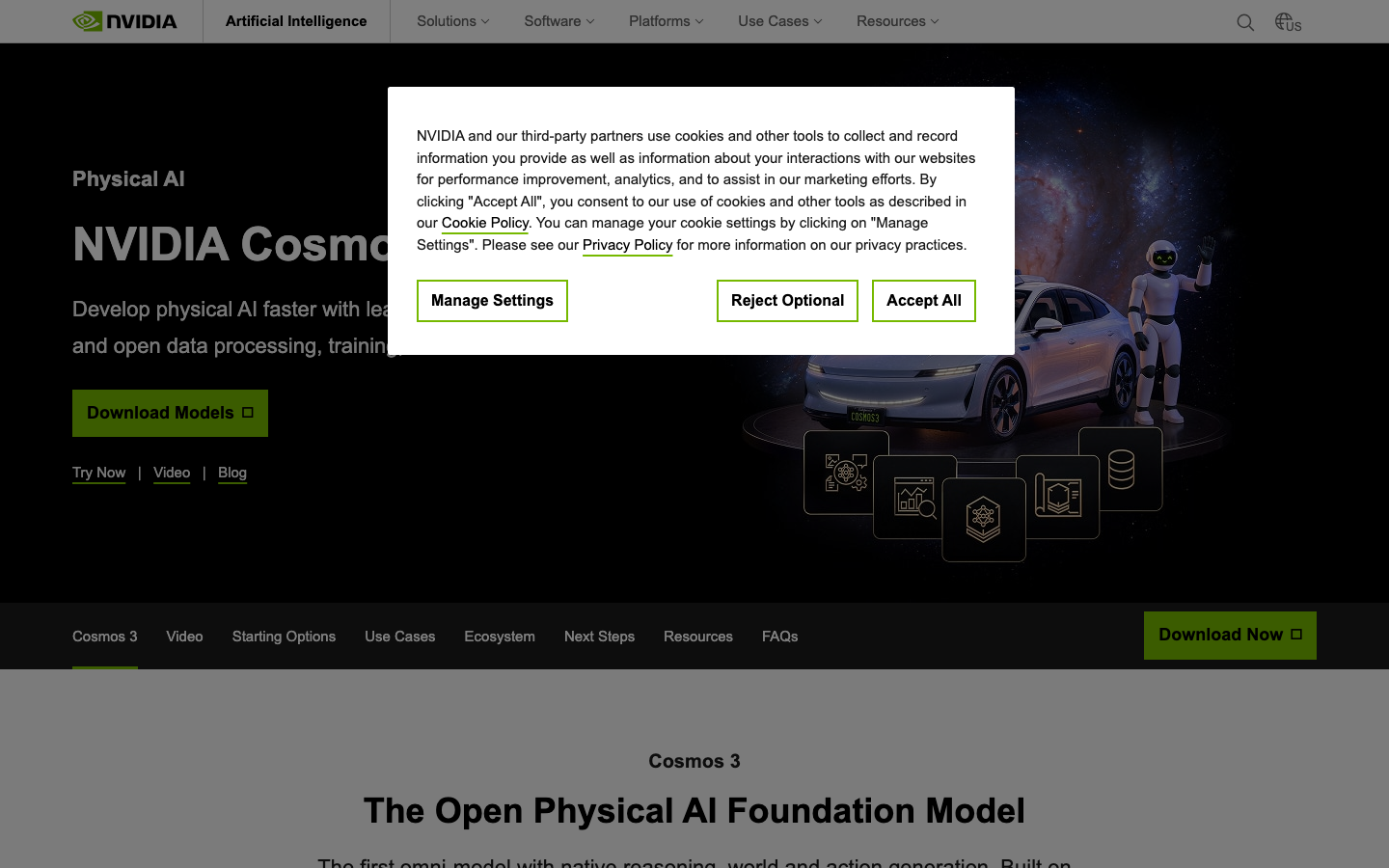
Cosmos 3 is the main line of open world basic models launched by NVIDIA for Physical AI. It puts visual understanding, future state prediction, synthetic video generation and action generation in the same model system. The goal is not to chat, but to allow robots, autonomous driving and intelligent space systems to "think, act and try" before deploying in reality.
Cosmos3
Core parameters and statistics
Cosmos 3 belongs to a special category between [Basic Large Model/API Infrastructure] and [World Model Training Base], but the main delivery form is closer to Physical AI infrastructure. A brief comment: It is not a model for people to chat, but a bottom-level brainstem that "first understands, then predicts, and then generates actions and the world" for robots, autonomous driving and visual AI systems.
| Projects | Public Information |
|---|---|
| Official positioning | The Open Physical AI Foundation Model |
| Architecture keywords | Omni-model, Mixture-of-Transformers |
| Core Competencies | Vision AI reasoning, world generation, action generation |
| Input modal | text, image, video, ambient sound, action |
| Main uses | Robot strategy learning, simulation, visual intelligence, synthetic data |
| How to get | Hugging Face open model GitHub code NVIDIA Build trial Cookbook |
| License thread | OpenMDW 1.1 license |
| Ecological adoption | Used by many robots, autonomous driving, and vision AI manufacturers |
Publicity verification: The official website defines Cosmos 3 as the first omni-model with native reasoning, world generation and action generation. The key to this promotion is not the “first” itself, but that it brings together the capabilities that were previously dispersed in VLM, video models, simulators, and strategy models into the same model system. It really hits the core pain point of expensive and fragmented physical AI data.
Expert View: To most people, Cosmos 3 looks like a "stronger video model"; for teams that actually do robots and world simulations, its meaning is actually to make the link of "visual understanding -> future prediction -> action data -> synthetic training set" shorter.
User and market recognition
The recognition of Cosmos 3 does not depend on the number of C-end users, but on industry adoption and list position.
User and market recognition: The official website clearly lists a large number of adopters, covering robotics, autonomous driving, industrial vision and intelligent space, such as Agile Robots, Figure AI, General Motors, Toyota Research Institute, Uber, Xiaomi, etc. The value of such a list is not to prove that it is "fully commercialized", but to prove that it is not an orphan product in the laboratory.
Publicity verification: NVIDIA blog publicly mentioned that Cosmos 3 ranks at the top of open source on smart infrastructure understanding lists such as VANTAGE-Bench and TAR, and ranks high on multiple world generation-related leaderboards. This means that its selling point does not rely solely on brand endorsement.
Hidden benefits: For the Physical AI team, the biggest benefit is not the model score, but the reduction in the cost of real-world collection, labeling, and dangerous scene reproduction experiments. As long as long-tail scenarios can be generated and screened in the model first, the R&D rhythm will change from "waiting for real data" to "constructing hypotheses first and then verifying them."
Cost advantage
Cosmos 3 does not have a "membership fee" logic for ordinary consumers, and its cost analysis must be viewed at three levels.
C-side/Personal: There is almost no personal use value in the traditional sense. Even if you can try it out at build.nvidia.com, the real benefits are only meaningful to people who do robotics, simulation, and visual intelligence.
Developers/Research Team: Open models, open source frameworks, and public cookbooks lower the barrier to experimentation and are much cheaper than training a world model from scratch. The cheaper part is not the inference fee, but the saving of a lot of model pre-training and tool chain self-construction costs.
Enterprise/Platform Team: The real costs are concentrated in GPU resources, post-training, simulation stack integration, evaluation pipeline and data governance. Cosmos 3 can reduce “scratch” costs without turning Physical AI into a low-budget project.
The Free Truth: Open model does not equal free deployment. Downloading weights and code is just the starting point. What is really expensive is computing power, data pipelines and post-training experiments.
Hidden costs: If the team does not have high-quality sensor data, no simulation evaluation indicators, and no robot strategy training stack, bringing in Cosmos 3 alone will not immediately turn it into production capacity.
Main functions
- Visual Reasoning: Analyze objects, interactions, intentions and future states in complex real-life scenes, suitable for factories, transportation, security and smart spaces.
- Action Generation: Natively generates action data such as joint angles, gripper positions, trajectory points, etc., suitable for robot strategy learning.
- World Generation: Generate physically plausible future world sequences from text, images, videos, ambient sounds, and motion inputs.
- Synthetic Data Amplification: Generate long-tail and dangerous scenarios, service robots and autonomous driving training.
- Close simulation: Evaluate multiple behavioral routes in simulation, first screen and then verify on the actual machine.
Expert View: The most critical hidden linkage is to put action data and world generation in the same system. This can reduce the fault of "the video generation model is very good at acting, but does not give trainable action signals".
Model and version evolution
The focus of the evolution of Cosmos 3 is not the consumer model, but the Cosmos ecosystem gradually moving from "world understanding" to "world understanding + action generation + open tool chain".
Current main line
- Cosmos 3: 2026-05-31 Strengthening external communication is the core main line currently disclosed.
Ecological extension
- Cosmos Curator: data filtering, annotation, and deduplication.
- Cosmos Evaluator: Generate video results from large-scale reviews.
- Cosmos Cookbook: Provides recipes around robotics, simulation, and visual intelligence.
Version Interpretation: This is not a single model running alone, but an integrated ecosystem of model + evaluation + data + deployment. For enterprise teams, the version they really want to pursue is not just the model number, but the tool chain compatibility.
Technical advantages
Mechanics -> Effects -> Scenes:
Omni-model structure: Put visual reasoning, world generation and action generation into one system. The effect is to reduce the cost of assembly of multiple models. It is suitable for scenarios such as robotics and visual AI that require timing consistency.
Mixture-of-Transformers: The official emphasizes that its reasoning block first interprets the scene, and then the generation block outputs physically constrained results. The effect is that it is more suitable for world prediction than pure video generation.
Open model and open license: Promoted through Hugging Face, GitHub, Cookbook and OpenMDW 1.1 license, the effect is to allow developers to directly take over post-training and industry fine-tuning.
Performance and Throughput: The official page does not disclose unified TTFT, RPM, and TPM indicators, so it cannot be compared with a traditional API large model. What it's good at is complex world modeling, not low-latency chat.
Adaptation Boundary: It is best at physical world timing, action and spatial relationship tasks; it is least good at scenarios that have nothing to do with Physical AI such as general office conversations or lightweight content generation.
How to use
The official path to get started is already relatively clear.
- Download Model: Get the open model from the Hugging Face collection page.
- View code: Enter the training and post-training process from the NVIDIA Cosmos repository on GitHub.
- Try the hosting experience: Experience model capabilities at build.nvidia.com.
- Apply Cookbook: Directly reuse recipes for robotics, simulation, and visual intelligence.
Get started quickly in 3 minutes:
# Subject to the official open entrance
open https://huggingface.co/collections/nvidia/cosmos3
open https://github.com/nvidia/Cosmos
open https://nvidia-cosmos.github.io/cosmos-cookbook/
Current Limitation: The official webpage does not give a general curl like normal LLM. Because it is not a single API that "winds up prompts and outputs text", but a more important model and workflow system.
Product Pricing
The public page does not give a unified retail price.
- Trial entrance: Can be experienced through NVIDIA Build.
- Open Model: Downloadable weights and code.
- Enterprise Implementation: Actual cost depends on GPU, training, simulation and engineering integration.
Hidden benefits: If it can capture simulation and action data generation, it can significantly reduce the cost of real long-tail data collection.
Compliance and Risk: It is not light SaaS, but high-threshold infrastructure. Model licensing, data sources, downstream deployment security, and human control boundaries are all reviewed individually.
Application scenarios
- Robot Strategy Learning: Generate action condition data for tasks such as grabbing, handling, and assembly.
- Autonomous Driving and Traffic Intelligence: Deducing future scene changes and abnormal states.
- Industrial Vision and Intelligent Space: Understand and provide early warning for the temporal behavior of factories, warehousing, and urban spaces.
Dimensionality reduction strike scene: Long-tail realistic scenes that are dangerous, rare, expensive, and difficult to collect repeatedly.
Dissuade Scenarios: Pure content generation team, ordinary image creative team, lightweight team without GPU infrastructure.
Applicable people
- Robot R&D Team: Requires action data related to strategy training.
- Autonomous Driving and Simulation Team: Needs future state prediction and long-tail scenario generation.
- Industrial Vision Platform Team: Requires video understanding, dense description and alarm reasoning.
Persuasion Scenario:
- People who want to use it as a general chat model.
- An early small team without the support of data, computing power and evaluation stack.
- Content teams who are just looking for a low-threshold Vincent picture or Vincent video tool.
Summary and Outlook
The value of Cosmos 3 does not lie in "making another generative model", but in its attempt to integrate real-world understanding, action generation and synthetic data infrastructure into a unified model stack. For teams that really do Physical AI, this route is critical because it directly affects data cost, training speed, and dangerous scene coverage.
Current limitations: It has a very high threshold and is not an out-of-the-box AI product; the public page does not explain all model specifications, resource consumption and deployment details. Procurement/Adoption Risk Assessment: Suitable for pilot teams with existing GPU, simulation and strategy training foundations; not suitable for misjudgment of "downloading open source models" as "low-cost launch".
Related tools:  Hugging Face, replicate
Comparison of competing products
| Comparison dimensions | Cosmos 3 | Competitor A | Competitor B |
|---|---|---|---|
| Core Differences | — | — | — |
| Price | — | — | — |
| Target Users | — | — | — |
Note: The above comparison is based on product public information, and actual differences are based on user experience.
Technical advantages and capability boundaries
As an AI model and API product, the core capabilities of Cosmos 3 can be deeply understood through the following dimensions, which directly affect technology selection and implementation effects.
Inference Performance and Benchmark Performance The model’s reasoning performance is reflected in its performance on standard NLP tasks (text generation, code completion, semantic understanding, multi-turn dialogue, information extraction, etc.). It is recommended to conduct horizontal comparison through public benchmark test lists (such as MMLU, HumanEval, GSM8K, etc.), but please note that there may be a gap between benchmark test scores and actual business scenario performance. Key indicators that affect the actual user experience include: inference speed (Token/s or response delay, which directly determines the smoothness of the user experience), context window length (which determines the input size that can be processed at a time, affecting the complexity of the tasks that can be processed), and consistency of output quality (the stability of the results of multiple outputs of the same input, which affects the perception of reliability).
API Compatibility and Development Ecosystem The depth of API compatibility with mainstream development frameworks (LangChain, LlamaIndex, Semantic Kernel, etc.) directly affects the cost and cycle of integrated development. It is recommended to pay attention to the following integration dimensions: the coverage of language types supported by the SDK (whether mainstream languages such as Python, JavaScript, Go, and Java have official SDKs), streaming output support (SSE/WebSocket protocol compatibility), function calling and tool usage capabilities (whether it supports mapping model output to structured function calls), the flexibility of structured output (JSON mode), and the ability to integrate with enterprise-level infrastructure (VPC deployment, Private Link, unified identity authentication). Complete API documentation and rich code examples can significantly lower the entry barrier to development and reduce integration time and costs.
Deployment Flexibility vs. Cost Tradeoff Depending on data privacy requirements, latency sensitivity and usage scale, Cosmos 3 can be deployed via cloud API calls or on-premises. The advantages of cloud deployment are zero operation and maintenance costs and elastic scalability, which is suitable for scenarios with large fluctuations in usage and rapid prototype development; local deployment provides complete data sovereignty and low latency (no network round-trip overhead), but you need to bear the cost of purchasing hardware such as GPUs and operation and maintenance manpower. It is recommended to use a monthly API call volume of 1 million times or a monthly fee of US$1,000 as a reference dividing line: below this threshold, the cloud API has better cost-effectiveness and flexibility. After exceeding this threshold, the total cost of ownership of the self-deployment solution should be comprehensively evaluated, taking into account factors such as hardware depreciation, electricity, operation and maintenance manpower, etc.
Model selection and version strategy
For the selection of Cosmos 3 series models, it is recommended to match the model capabilities of different versions according to specific usage scenarios. The large-parameter version performs better on complex reasoning and multi-step tasks, but has higher costs and longer delays; the small-parameter version can already provide satisfactory output quality in scenarios such as daily conversations and simple question and answer, and the cost is only a fraction of the large version. The recommended selection strategy is: use small and medium versions in standard scenarios to reduce costs, and only call large version models when complex inference tasks need to be processed. This hierarchical calling strategy can reduce the overall API cost by 40-60% without significantly affecting the output quality.
Version Info
- NVIDIA Cosmos 3 :The open Physical AI world base model that NVIDIA will publicly promote in the 2026 COMPUTEX/GTC Taipei cycle integrates visual reasoning, multi-modal generation and action generation.
- Earlier Cosmos Models :The official FAQ clearly distinguishes Cosmos 3 from earlier Cosmos models, indicating that earlier Cosmos routes have existed before, but the public page does not fully list the precise version number of each generation. There is no official precise date yet.
User Reviews