 Coursera AI
Free
Coursera AI
Free
Coursera partners with 300+ top universities and companies around the world to offer over 10,000 courses and specializations. AI capabilities run through course recommendations, smart notes, automatic subtitle translation, AI tutor assistants, and learning progress predictions to help learners complete their career development goals more efficiently.
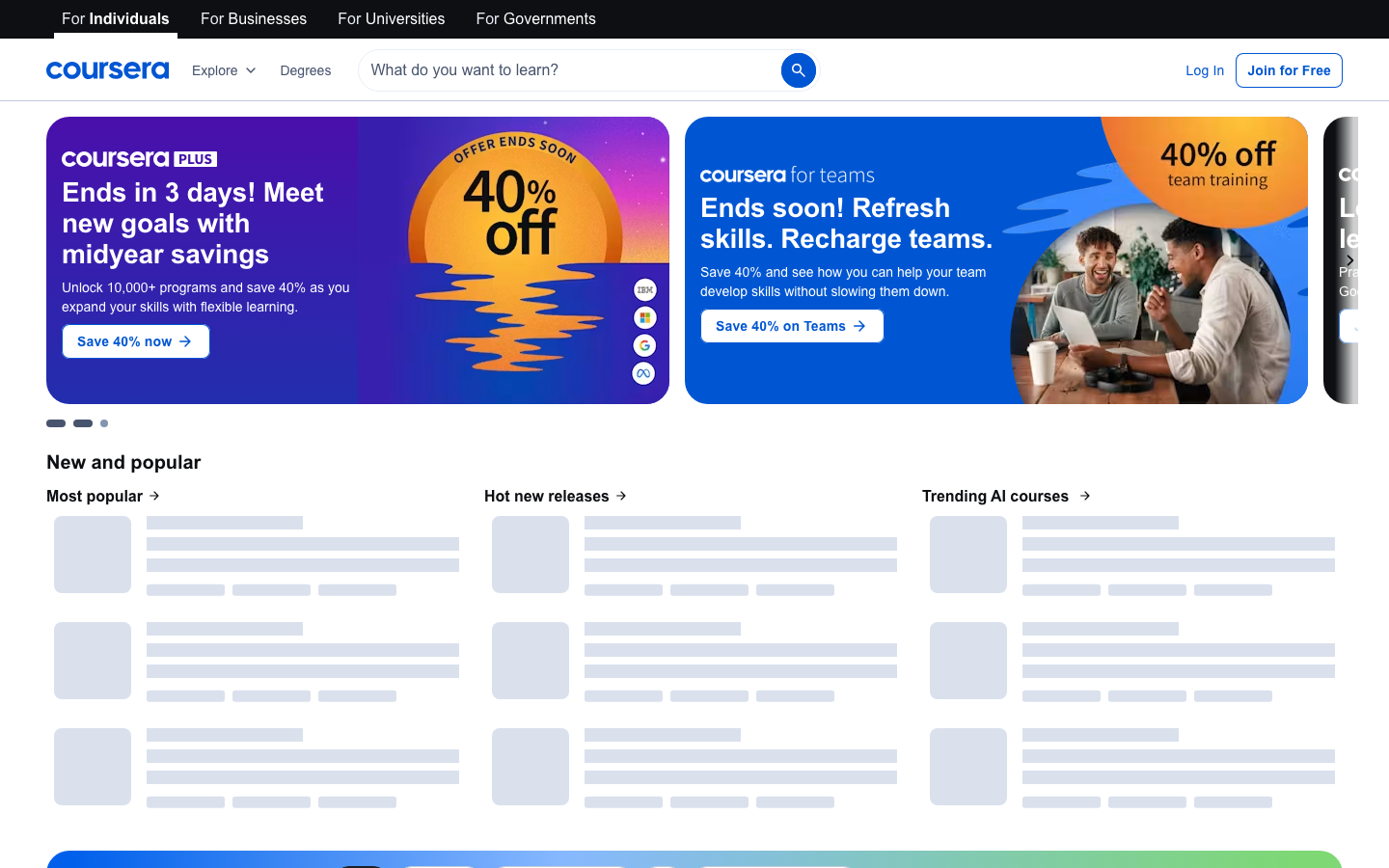
CourseraAI
Core parameters and statistics
As the world's leading MOOC platform, Coursera's AI capabilities are not independent products, but an intelligent layer embedded in the entire learning link. Coursera Coaches (AI tutors) answer questions and explain concepts in real time, and the AI-driven course recommendation engine dynamically adjusts paths based on learning history and goals.
| Projects | Public Information |
|---|---|
| Platform Positioning | Global Online Learning and Career Development Platform |
| Partner institutions | 300+ top universities and industry partners |
| Total Courses | 10,000+ courses, specializations, and degree programs |
| Registered Learners | Approximately 148 million (as of early 2026) |
| AI capabilities | Coursera Coach, intelligent recommendations, automatic subtitle translation, AI note generation |
| Enterprise Clients | 8,000+ Enterprises and Institutions (Coursera for Business) |
| Supported languages | Multi-language interface and subtitles, including Chinese |
| Latest Pricing Model | Free Audition + Paid Certificate/Subscription (Coursera Plus) |
Parameter Interpretation: 148 million registered users and 8,000+ corporate customers form Coursera's bilateral network - the more C-side data, the more accurate the course recommendation algorithm; the larger the B-side procurement scale, the more targeted the platform's coverage of industry skill needs. The value of AI Coach is also positively related to this: the larger the number of users, the richer the question and answer data accumulated by the AI tutor, and the higher the contextual relevance of subsequent reasoning.
User and market recognition
- C-side coverage: 148 million registered learners in 190+ countries, covering all stages from college preparatory to executive education.
- B-side penetration: 8,000+ companies use Coursera for Business to improve employee skills. Customers include Delta Airlines, PwC, PayPal, etc.
- Academic Cooperation: Cooperate with 300+ top universities such as Stanford, Yale, Michigan, and Imperial College to offer online degrees and special courses.
- Industry Benchmarking: In the MOOC track, Coursera is ahead of edX and Udacity in the number of degree programs and the scale of university partners, but the course completion rate (usually 5%-15%) is a common problem in the entire MOOC industry. Whether AI tutoring can effectively improve the course completion rate is an important observation point in the future.
Cost advantage
Coursera's cost structure is a typical "three-tier stack" - the free tier serves as the funnel entrance, the subscription tier covers mid-frequency learners, and the degree level caters to high-value further education needs.
| Tiers | Pricing | Suitable for people | Includes AI capabilities |
|---|---|---|---|
| Free auditing | ¥0 | Browse course content (no certificate, no assignment grading) | Some AI recommendations |
| Coursera Plus Subscription | $59/month or $399/year | Medium to high frequency learners, no course limit | Complete AI Coach + Intelligent Recommendation |
| Specialized course certificate | $39-$99/course | Oriented skills improver | AI coaching and notes |
| Online Degrees | $10,000-$45,000/Total | Degree Seekers | AI Learning Path Planning |
Developer/API layer: Independent AI API is not publicly available. Enterprise customers can analyze the dashboard and AI recommendations through the Coursera for Business purchasing team, but the price needs to be confirmed by the business.
Hidden Cost: The free tier has access to course videos, but there is no certificate, no homework grading, and no AI Coach interaction permissions. The actual course completion incentives are significantly lower than the paid tier. Enterprise customers also need to additionally consider the labor costs of in-house LMS integration and employee progress tracking.
Main functions
- Coursera Coach (AI Tutor): A large model Q&A assistant based on course content. Learners can ask questions directly on the course page. AI combines the current video/reading materials to generate context-sensitive answers - switching the learning mode from "passively watching videos" to "actively asking questions".
- Personalized Course Recommendation Engine: Dynamically recommends courses based on learning history, career goals and skill gaps, rather than static category browsing.
- AI automatic subtitles and translation: Videos automatically generate multi-language subtitles (including Chinese, Spanish, Arabic, etc.), lowering the language threshold for non-English learners.
- Smart notes and summaries: AI automatically extracts key knowledge points from videos and reading materials, and supports the generation of course summaries and review notes.
- Course Builder (institutional side): AI-assisted course creation tool that helps universities and companies quickly generate course outlines, learning objectives, and assessment designs.
Expert View: Coursera Coach is deeply bound to the course content, which means that it is not a general chatbot, but a context-aware assistant that "knows what minute you are watching now." This coupling to learning progress makes its answers more course-specific than standalone AI Q&A tools like ChatGPT. But this also means that its reasoning boundaries are limited to the course content library—problems outside the scope of the course may not be as flexible as a general model.
Model and version evolution
The relevant information has not been made public, please refer to the official real-time page.
Technical advantages
Technical Architecture: Coursera's AI layer is built on a large language model (LLM), but the key difference is that it deeply binds model reasoning to the course content knowledge base within the platform, rather than directly accessing a general large model. This means that the AI assistant's answers have course content as factual anchors, and the hallucination rate is theoretically lower than a purely general model.
Recommendation mechanism: Collaborative filtering + knowledge graph dual engines - collaborative filtering recommends from the perspective of "learners similar to you", and the skill graph recommends from the perspective of "what other skills do you need", and the weights of the two are dynamically adjustable.
Engineering Optimization: The real-time AI translation of video subtitles uses sharded asynchronous processing, and the translated segments are pre-loaded during video playback to reduce the lag caused by real-time inference delays. Automatic note generation uses non-streaming batch processing to complete summary generation within 1-2 minutes after the video ends.
Adaptation Boundary: Best at structured knowledge and skills certification scenarios; less suitable for scenarios that require highly personalized creative guidance (such as writing, art) or real-time oral dialogue practice.
How to use
| How to use | Suitable for everyone | Core values |
|---|---|---|
| Web version (coursera.org) | All learners | Full functionality, including AI Coach and course recommendations |
| Mobile App (iOS/Android) | Fragmented time learners | Offline viewing + AI subtitles, but some AI functions are limited |
| Coursera for Business | Corporate Training Manager | Team Learning Analytics + AI Skills Gap Diagnosis |
| Coursera for Campus | University/College | Degree Program Management and AI-Assisted Teaching |
Typical learning path: Register an account → Set a career goal (such as "become a data analyst") → AI recommended learning path (course sequence) → Start watching videos and open Coursera Coach to ask questions when you encounter questions → AI generates notes and summaries → Complete assignments and give feedback through AI scoring → Obtain a certificate.
Product Pricing
Coursera adopts the "free entrance + pay-as-you-go" model:
- C-side Free: Free access to the video content of all courses, but no certificates, no graded assignments, and no full AI Coach functionality.
- C-side subscription (Coursera Plus): $59/month or $399/year, unlimited access to 10,000+ courses and special courses, including complete AI Coach, certificates and ratings.
- Single course certificate: $39-$99/course, you can get certification by paying per course, suitable for a small number of precise learners.
- Corporate Training: Subscription by seat, team analysis dashboard + AI skills diagnosis, price needs business confirmation.
- Online Degree: $10,000-$45,000, depending on institution and degree type.
Application scenarios
- Personal professional skills improvement: Switch to data analysis, AI engineering, product management, etc., and go from "not knowing what to learn" to "systematic learning" through AI recommended learning paths + AI Coach guidance. The benefits are reflected in the reduction of route planning time from hours to minutes.
- Enterprise employee skills reshaping: Enterprises purchase Coursera for Business for employees, use AI skill gap analysis to identify team shortcomings, and push targeted courses. From "HR manual research needs" to "AI automatic diagnosis of skill gaps".
- University Hybrid Teaching: Professors use Coursera for Campus to deploy flipped classrooms, students watch videos + AI tutoring on the platform, and class time is used for discussions and projects. Transformation of teaching model from "classroom lecture" to "classroom discussion".
- Degree Preparatory Learning: Complete graduate preparation courses (such as Computer Science Fundamentals) through Coursera, where an AI recommendation system helps identify the best-matching online degree programs.
Applicable people
- Individual Learners: For learners who want to systematically improve their professional skills but do not have a fixed learning path, AI recommendation + AI Coach can significantly reduce planning costs. Not suitable: For learners who only need to check knowledge points quickly at one time, it is more efficient to use general AI Q&A directly.
- Corporate Training Leader: HR/L&D department that needs to quantify the effectiveness of team skill improvement. Not suitable: The enterprise already has a mature self-built LMS and is unwilling to migrate.
- Higher Education Institutions: Universities that wish to introduce online resources to supplement offline teaching. Not suitable for: institutions that have extremely high requirements for course autonomy (need to design content completely on their own).
Summary and Outlook
The core value of Coursera's AI capabilities lies not in "stronger models" but in embedding AI in the context of "the learner already knows where the progress is". Coursera Coach understands course content better than a general chatbot and is more flexible and interactive than traditional FAQs. Its real barrier is the learning behavior data of 148 million users, which is the core moat for subsequent AI continuous fine-tuning and recommendation optimization.
Procurement/Adoption Risk Assessment: As a public company, Coursera continues to iterate on AI capabilities but has no independent SLA commitment. If corporate customers have strict requirements on the accuracy of AI answers, they need to establish a manual review mechanism. Individual users need to pay attention to the automatic renewal terms of Coursera Plus subscription, as well as the limitation that free auditing cannot obtain certificates and the full functionality of AI Coach. With the rise of vertical education AI such as Duolingo and Khan Academy, Coursera needs to find a clearer differentiated positioning between "breadth platform" and "depth tutoring".
Related tools:  Khanmigo, quizlet
Version evolution of Coursera AI
Coursera’s AI capabilities are released in the form of platform function iterations rather than independent version numbers:
- 2026 Summer Edition (~2026-07): Coursera Coach continues to optimize contextual understanding, expands the scope of supported courses, and enhances multilingual Q&A and note generation.
- 2026 Winter Edition (~2026-01): Officially launched Coursera Coach AI assistant, covering thousands of courses, supporting real-time Q&A and concept explanation.
- 2024 Fall Edition (~2024-10): Launched the AI-assisted course generation tool Course Builder to help institutional partners quickly create course structures.
- 2023: Introduce AI-driven skill maps and personalized learning path recommendations, and launch AI subtitle translation.
Business process integration and ROI analysis
As a productivity tool for enterprises or professional positions, the true value of Coursera AI depends on the depth of integration with existing workflows and the quantifiable efficiency improvement effect. The following is a systematic analysis from three core dimensions.
System integration and data interoperability The ability to interoperate with existing business systems is a key prerequisite for productivity tools to be integrated into workflows. It is recommended to focus on evaluating the following integration dimensions: the openness and documentation quality of the RESTful/GraphQL API (whether a complete API reference and SDK examples are provided), the support scope of Webhook event notifications (which business event types are supported for automatic push), the number and depth of pre-built integrations with common collaboration SaaS tools (WeChat Enterprise, DingTalk, Feishu, Slack, Notion, Jira, etc.), and enterprise-level identity authentication support (SSO/SAML/OAuth and LDAP/AD directory integration). Products that lack integration capabilities are easily isolated into information islands, which in turn increases the cognitive cost and operational friction for teams to switch between different tools.
Efficiency Quantification and ROI Estimation Methodology Before purchasing decisions, it is recommended to quantify the input-output ratio through a structured method: Step 1, choose 3-5 Standardized tasks that are frequently repeated and time-consuming in each team are used as test samples; in the second step, the average time consumption of a single task before and after tool intervention, first-time pass rate or error rate, and the number of links requiring manual intervention are recorded under controlled conditions; in the third step, the saved manpower time is converted according to the comprehensive cost of the position (salary, benefits, management sharing), and soft benefits (increased employee satisfaction, standardization of work quality, and improvement in response speed to core business) are superimposed to obtain a comprehensive ROI estimate. It is recommended to continue tracking ROI trends on a monthly basis, as the value of a tool usually increases over time as team proficiency increases and workflows are optimized.
Phase-based implementation strategy and risk control It is recommended to adopt a three-stage implementation path of "pilot verification-gradual promotion-continuous optimization". In the pilot stage (1-2 weeks), a single team or a single business scenario is selected for small-scale verification. The core goal is to verify technical feasibility and user acceptance, and establish preliminary usage specifications and success standards; in the promotion stage (2-4 weeks), after the pilot verification is passed, the coverage is gradually expanded, and standardized activation processes and training materials are developed; in the optimization stage (continuous), the workflow configuration is continuously adjusted based on actual usage data and user feedback, and more high-value application scenarios are explored. Clear quantitative key result indicators should be set at each stage to avoid blindly expanding the scope of use without data support.
Version Info
- Coursera AI 2026 Summer Edition :Continuously integrates AI tutor (Coursera Coach), smart notes, automatic translation and personalized learning path recommendation functions.
- Coursera AI 2026 Winter Edition :Launched Coursera Coach AI assistant to support real-time Q&A and concept explanation in the course.
- Coursera AI 2024 Fall Edition :Introducing the AI-assisted course generation tool Course Builder to help institutions quickly create course outlines and content.
User Reviews