 Coze
Coze
Coze is a code-free AI Bot building platform launched by ByteDance that supports drag-and-drop creation of intelligent conversational Bots with plug-ins, knowledge bases and workflows. The free version allows you to experience top models such as GPT-4. 100+ practical plug-ins have been launched. The built Bot can be published to mainstream channels such as Feishu Discord and WeChat with one click. The domestic version is "Kouzi".
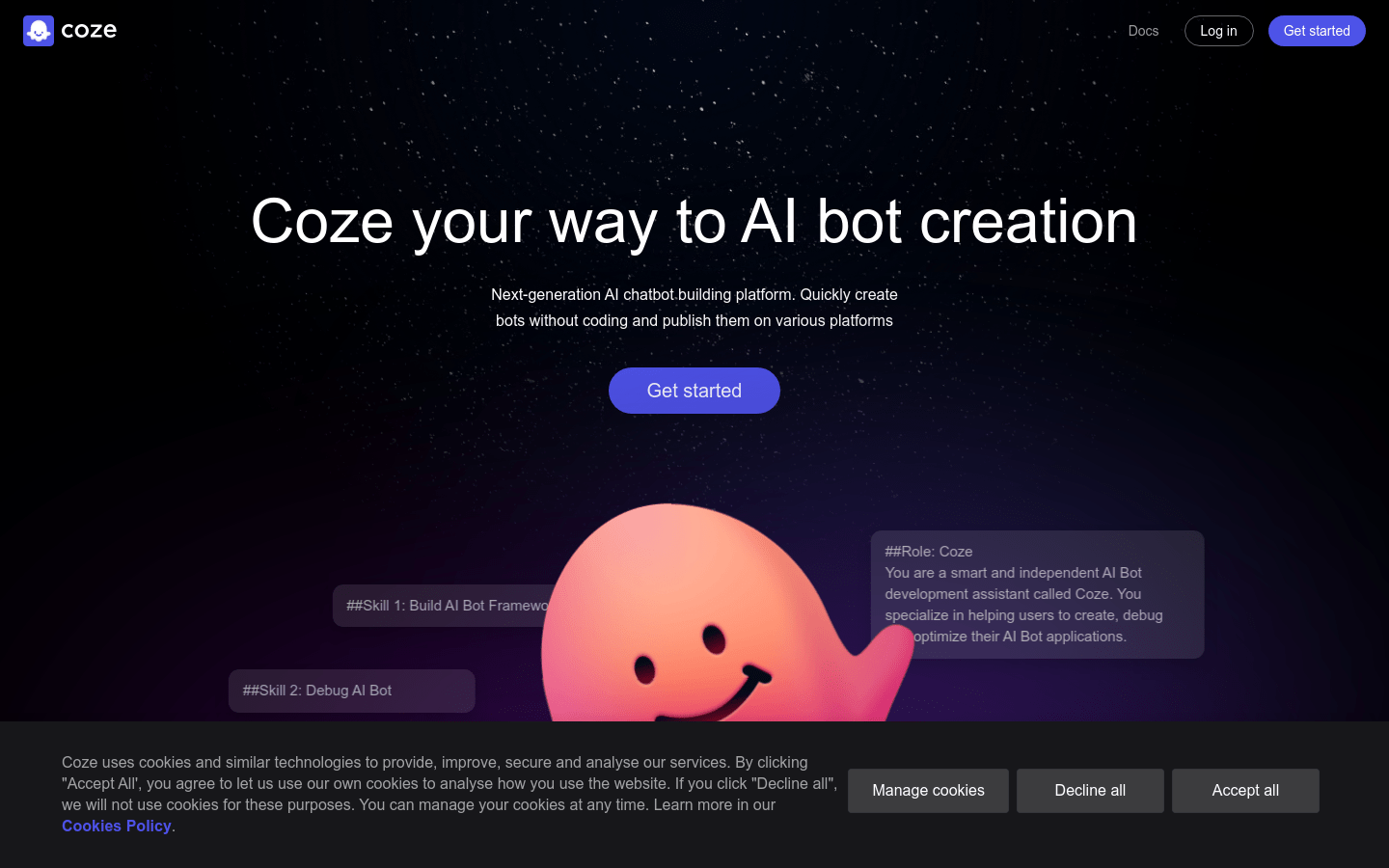
Coze — ByteDance’s codeless AI Bot building platform
Coze’s core parameters and statistics
| Parameters | Details |
|---|---|
| Release time | December 2023 (global version) / February 2024 (domestic version "Button") |
| Affiliated Company | ByteDance |
| Supported models | GPT-4o, GPT-3.5, Claude, Gemini (global version); Doubao, Wenxin, Tongyi, etc. (domestic version) |
| Number of plug-ins | 100+ official plug-ins + community plug-ins |
| Publishing channels | Feishu Discord, Slack, Telegram, WeChat mini program (domestic), Douyin (domestic) |
| Pricing model | Free version (including GPT-4 quota) + Pro version + enterprise customization |
| Knowledge base capacity | The free version has quota and file size limits, and the Pro/Enterprise version can be expanded |
| Workflow engine | Visual Workflow design, supporting conditional/cyclic/parallel |
| Scheduled tasks | Support Bot scheduled active triggering |
| Domestic version | Coze (coze.cn), supports domestic models and channels |
Competitive positioning: The core difference of Coze is not in model capabilities (it does not train the model itself), but in compressing the entire link of "select model → configure capabilities → publish to channel" into no-code operations. In contrast, OpenAI GPTs can only run within the ChatGPT ecosystem, while Coze Bot can be published to multiple real-life business scenarios such as Feishu Discord, Telegram, and WeChat. This ability to "build once and distribute across multiple channels" is Coze's core product differentiation.
Platform dependency: Coze’s model layer completely relies on third-party LLM (OpenAI, Anthropic, Doubao, etc.), which means that its cost structure and capacity ceiling are affected by the upstream model pricing strategy. ByteDance’s subsidy strategy is the main support for its current free quota, but adjustments to the subsidy policy will directly affect user experience—this is not a problem with the product itself, but an inherent risk in the business model.
Agent construction paradigm: Coze abstracts Agent construction into four major components: "personality + knowledge base + plug-in + workflow". Each component corresponds to an independent capability module. This layered design reduces the complexity of the build, but also introduces debugging difficulty at the component collaboration boundary - when the Bot behavior does not meet expectations, users need to investigate whether the deviation is caused by Prompt design, knowledge base recall, or workflow logic.
Tool Classification Determination: Coze’s main delivery form is Productivity/Business Application (end-to-end AI Bot construction platform), and it also has the core characteristics of Agent/Automation Tool - its Bot is essentially an LLM-driven Agent that interacts with the external world through plug-ins, knowledge bases and workflows. The following analysis covers both types of rule requirements.
Coze’s users and market recognition
User Growth Curve: After the release of the global version of Coze, with the differentiation strategy of "free use of GPT-4", it triggered viral spread in English communities such as Twitter and Reddit. According to ByteDance’s public information, registered users exceeded one million within a few months after its release, making it one of the fastest-growing platforms in the field of AI Bot construction. The domestic version of "Kouzi" relies on the distribution channels of Feishu and Douyin, and is rapidly spreading among enterprise users. It is used by a large number of small and medium-sized enterprises in customer service, knowledge management and content generation scenarios.
Enterprise adoption status: The penetration rate of Kouzi in the domestic enterprise market is significantly higher than that of the international version. There are three reasons: First, Feishu’s share of China’s SaaS collaboration market brings natural enterprise customer reach; second, Kouzi supports domestic mainstream large models (Doubao, Wenxinyiyan, Tongyi Qianwen), meeting data compliance requirements, and enterprises do not need to worry about model calls involving cross-border data flows; third, ByteDance’s sales team packages and sells Kouzi as Feishu ecological value-added modules, reducing the independent evaluation cost of enterprises. In contrast, the international version of coze.com is more used by enterprise customers for small-scale verification and prototype development, and has not yet formed a deep binding with mature enterprise software ecosystems such as Salesforce and Zendesk.
Community ecological health: Although Coze's plug-in market already has 100+ plug-ins, its growth mainly relies on the official team and a small number of top partners, and the contribution ratio of third-party developers is low. This means that the expansion speed of the plug-in category and the bug repair cycle are subject to Coze’s official schedule, unlike the open source ecosystem that can drive iterations by itself. The progress of solving problems reported by users in Discord and Feishu communities - such as insufficient knowledge base retrieval accuracy, limited workflow debugging information, and opaque free credit updates - is a key observational indicator to measure the platform's ecological maturity.
Competitive landscape position: In the AI Bot construction platform track, Coze's competitive situation includes OpenAI GPTs (closed ecology but the strongest model capabilities), Poe (multi-model aggregation but weak Agent capabilities), Dify (open source and self-hosted but with high deployment threshold), and various vertical Bot platforms. Coze's core competitiveness lies in the combination of "free + multi-channel + byte-based distribution", one of which is indispensable. If the free quota is significantly reduced, its user growth engine will face a direct impact, and it will be necessary to test whether the value of its products is sufficient to support paid conversions.
Cost advantage: How byte subsidies lower the entry barrier for Bot construction
C-side free model quota: Coze provides a limited number of daily GPT-4 level conversations in the free version, which means that individual users can experience the reasoning capabilities of GPT-4 without paying the $20/month ChatGPT Plus fee. The free quota covers daily Q&A, code assistance, document analysis and other scenarios, but the quota will be consumed quickly in high-frequency or long-context scenarios. This "limited free" strategy not only maintains user stickiness, but also directs heavy users to paid plans.
API call cost: When developers call Bot through Coze API, the cost is calculated based on the number of calls or Token consumption. Compared with directly calling the OpenAI API (GPT-4 is about $10-30/million input tokens), Coze's API middle layer has a certain premium - because Coze needs to superimpose platform service costs such as knowledge base retrieval, plug-in execution, and channel distribution on top of the model call. However, for small and medium-sized enterprises that need Bot capabilities but do not have an AI development team, the total cost of ownership of Coze API is still lower than the engineering investment of building a self-built Agent system (the latter usually requires 1-2 AI engineers to work for 1-3 months).
Corporate/Private Pricing:
- Free version: $0/month, limited daily GPT-4 conversations, basic plug-ins and knowledge base, single Bot release, suitable for personal experience and small-scale PoC.
- Pro version: Pay on demand, with higher call limit, larger knowledge base, and more concurrency. It is suitable for professional users and entrepreneurial teams with continuous use. The specific price is based on the latest plan on the official website. It is recommended to confirm the billing details with sales during the PoC stage.
- Enterprise Edition: Customized quote, including private deployment options, dedicated API quotas, team management SLA guarantee and dedicated technical support, suitable for large organizations integrating Coze into core business processes. Business negotiations need to focus on the data storage location, SLA compensation limit, and the data export format after the contract is terminated.
Implicit Cost Tip: Coze’s explicit subscription fee is only a portion of the total cost. In actual implementation, the following hidden costs also need to be included in the budget: the human investment required for Bot behavior debugging and Prompt optimization (non-technical users usually require 3-5 rounds of iterations to produce a usable Bot); the cost of organizing, cleaning and regular updating of knowledge base documents; the risk of vendor lock-in caused by dependence on the Coze platform - once a large number of Bots and knowledge base assets are built on Coze, the switching cost of migrating to other platforms cannot be ignored, because there is currently a lack of standardized export and migration tools.
Cost reduction and efficiency increase deduction: Taking an e-commerce team that needs 5 customer service Bots as an example, the monthly fee for directly using the Coze Pro version is assumed to be $50-200, plus manual debugging and maintenance time (about 10-20 hours per month), the total monthly cost is about $300-800. Compared with the self-built solution (LLM API calling fee + server + 1-2 engineer development), the initial engineering investment usually requires $5,000-15,000, and the launch cycle is measured in months. Coze has an order-of-magnitude cost advantage in the "quick verification" stage, but in the scale-up stage, as the number of Bots and the volume of calls increases, it is necessary to recalculate whether the marginal cost of a single conversation is still better than the self-built solution.
Coze’s main features
Coze's functional system is designed around the goal of "quickly building a production-ready AI Bot", and there are obvious synergies between core capability modules:
-
Visual Bot Builder: Configure Bot personality (System Prompt), select models, associate capabilities, and set release channels through the web interface, without coding. Synergy effect: The tone and rules defined in the persona will be automatically passed to the answer generation section for the knowledge base retrieval. Users do not need to repeatedly configure style parameters on the knowledge base side, reducing cross-module configuration friction. But this also means that the quality of the persona directly affects the format and style consistency of the answers in the knowledge base.
-
Knowledge Base (RAG Engine): Supports uploading PDF, Word, TXT, web link and other formats to build an exclusive knowledge base. Bot automatically performs search enhancement generation when answering. Expert View: The upper limit of the value of a knowledge base depends on the document quality and chunking strategy. Coze's default chunking has uneven semantic segmentation effects on long Chinese documents - in particular, tables, term sheets, and mixed layouts are easily fragmented, resulting in incomplete semantics of recalled fragments. Users need to optimize the recall accuracy by adjusting Top K (recommended 3-5) and similarity threshold (recommended 0.7-0.8), which is an invisible parameter adjustment threshold for non-technical users. It is recommended to optimize the structure of the source document (add clear subtitles, abstracts and paragraph divisions) before uploading, which can significantly improve the retrieval effect.
-
Plugin Store: Built-in 100+ official plug-ins, covering web search (Bing), code execution (Code Interpreter), weather, news, maps, shopping and other categories, adding real-world data access capabilities to Bots with one click. Synergy: Plug-ins and knowledge bases can collaborate in layers - general knowledge is obtained from web searches, private knowledge is retrieved from the knowledge base, and the two are automatically integrated in Bot answers without the need for users to write any glue code. The plug-in system is essentially the "open list of tools" exposed by Coze to Bot, including but not limited to:
web_search(web page search),code_interpreter(code execution),weather_query(weather query),news_retrieval(news retrieval),map_navigation(map navigation) and other tool interfaces. The large model orchestrates these tools into a complete user interaction package through Coze's middle layer. -
Visual Workflow: drag-and-drop design of multi-step execution logic, supporting conditional branching, looping nodes, parallel execution and external API calls. Engineering Tip: The workflow debugging experience is a current shortcoming of Coze - when the process has multiple branches, it is difficult for users to track the execution path and variable values of each branch online. It is recommended to start verification with a simple linear process, gradually increase the complexity, and add output nodes at key nodes for debugging. Workflows should be designed to avoid deeply nested conditions to prevent execution paths from being difficult to trace.
-
One-click publishing to multiple channels: The built Bot can be published to Feishu Discord, Slack, Telegram, WeChat mini-programs and other channels. Core Value: This is the strongest point of difference between Coze and OpenAI GPTs and Poe - GPTs can only be used within ChatGPT, while Coze Bot is deployed into IM tools used daily by users, achieving a leap from "toy" to "tool". The differences in interactive characteristics of each channel (such as Feishu's card messages and Telegram's inline keyboard) are automatically handled by Coze's channel adaptation layer, and developers do not need to care about the underlying implementation.
-
Scheduled Tasks: Configure Bot to actively trigger tasks at specified intervals, such as generating data briefings daily and summarizing user feedback every week. Synergy: The combination of scheduled tasks + knowledge base + plug-in can realize a fully automated information monitoring and report generation pipeline - Bot is executed regularly every day: trigger → call the news search plug-in to capture information → generate a summary based on the industry background of the knowledge base → push to the team group. The entire process requires no manual intervention.
-
Bot collaboration and Loop function: Multiple Bots can collaborate to handle a single complex request (Bot team), and Bots can also actively initiate conversations (Coze Loop) instead of just responding passively. This is a key step in Coze's evolution to a more complex Agent form. Architecture link: In a Bot collaboration scenario, user requests arrive at the main Bot → the main Bot splits subtasks → calls the sub-Bots to complete specific capabilities (such as one responsible for retrieval and one responsible for generation) → the sub-Bots return results → the main Bot summarizes and replies to the user. The data return path is: User → Master Bot → Sub Bots → Knowledge Base/Plugins → Sub Bots → Master Bot → User.
-
Model multiple selection and on-demand switching: In the same Bot, different LLMs can be switched according to task types, such as GPT-4o for complex reasoning and GPT-3.5 for simple question and answer, achieving a dynamic balance between quality and cost. Implementation Tip: It is necessary to test the impact of model switching on answer consistency in actual deployment - frequent model switching may lead to differences in the answering style and accuracy of the same Bot in different rounds, affecting users' consistent expectations for the Bot's capabilities.
Coze’s model and version evolution
Coze’s version evolution reflects ByteDance’s strategic rhythm on the AI Bot platform: first use free strategies to quickly acquire users, then use ecological functions to build a moat, and finally achieve commercialization through the enterprise version.
Global version released (2023-12)
- Coze.com is publicly launched for the first time, providing basic Bot construction capabilities
- The free version can use GPT-4 Turbo, becoming the most generous GPT-4 access solution for individual users on the market at that time
- Basic plug-ins: web search, code execution, image understanding, covering the three most commonly used Agent capability requirements
The domestic version of "Button" is online (2024-02)
- coze.cn is officially released, supporting domestic compliance models such as Doubao, Wen Xin Yi Yan, and Tong Yi Qian Wen.
- Deeply integrated with domestic channels such as Feishu, Douyin, and WeChat mini programs
- The plug-in market adds domestic scene plug-ins such as Amap and JD Shopping, and the channels and plug-in system of Button are differentiated from the global version.
Plug-in Market and Workflow Release (2024-04)
- The number of plug-ins exceeded 100, allowing developers to submit custom plug-ins and start building a plug-in ecosystem
- Introducing a visual Workflow engine, extending Bot capabilities from "dialogue" to "process automation"
- Scheduled task function is online, Bot can actively push instead of just passively responding
Multimodality and Collaboration Enhancement (2024-09)
- Supports image, file and voice input processing, Bot can handle richer user input types
- Bot team collaboration function (multiple Bots collaboratively process a single request), paving the way for complex enterprise scenarios
- The knowledge base supports more document formats and automatic updates, reducing knowledge maintenance costs.
Workflow major version upgrade (2025-06)
- With support for complex conditional branching, loop nodes, and parallel execution, the workflow engine is on par with professional PaaS
- Coze Loop: Bot can actively initiate conversations instead of just responding passively. This ability enables Bot to realize real value in scenarios such as customer service return visits and regular inspections.
- Multi-modal capabilities are further enhanced to support richer input and output types
Current focus direction (2026)
- Complete enterprise-level functions (SSO, audit logs, private deployment) to deal with key bottlenecks in enterprise procurement
- Knowledge sharing and capability reuse mechanism between Bots to reduce the cost of repeated configuration of large-scale Bot deployments
- Deep integration with ByteDance AI infrastructure (Doubao Big Model, Jimeng AI), shifting from model dependence to model differentiation
Coze’s technical advantages
Engineering encapsulation of zero-code Agent construction: The core technical achievement of Coze is to encapsulate the complete Agent execution link of "LLM call → knowledge base RAG → tool call → result orchestration" into a visual component assembly model. When the user drags and drops components, Coze automatically generates metadata descriptions, planning prompts, and error handling logic for Agent execution in the background. This "WYSIWYG Agent construction" lowers the threshold for AI application development, but the price is that users have limited control over the underlying execution logic - when the Bot behaves abnormally, the scope of troubleshooting is limited to the debugging information provided by Coze, and cannot go deep into the token-level reasoning process at the model layer. Mechanism → Effect → Scenario: Component encapsulation allows non-technical users to participate in Agent construction → However, the debugging black box causes troubleshooting efficiency in complex scenarios to depend on the observability tools provided by Coze → Suitable for rapid prototyping and standardized scenarios, but not suitable for scenarios that require fine control of complex Agent behavior.
Multi-layer retrieval strategy of RAG knowledge base: Coze's knowledge base engine adopts a multi-layer recall strategy of "semantic retrieval + keyword retrieval + re-ordering". After the user asks a question, the system first matches the candidate paragraphs through Embedding, then uses BM25 keyword search for complementary recall, and finally reranks the results through the Rerank model. This hybrid retrieval architecture is better than pure vector retrieval in general scenarios, but in scenarios with dense professional terms, mixed multilingual languages, or frequently updated documents, the recall rate may still drop significantly. Users need to optimize for their own document characteristics by adjusting the chunk size (recommended 200-500 tokens), overlapping window and Top K value (recommended 3-5).
Security sandbox mechanism for plug-in calls: Coze provides a runtime sandbox for third-party plug-ins, restricting plug-in access to sensitive APIs and local resources. Plug-in developers need to declare the required set of permissions (read/write/network access, etc.), and users can view these declarations when adding the plug-in. This "declarative permissions" model is similar to the application permission management of mobile operating systems, but non-technical users need to judge the reasonableness of plug-in permissions by themselves - "This plug-in can read the content of your web pages" means that plug-in developers can obtain the content of links provided by users in conversations, and extra attention needs to be paid to Bots that handle sensitive information.
Consistent abstraction layer for multi-channel publishing: Coze defines a unified set of Bot message formats and interaction protocols, converting Bot input and output into the native message formats of each channel (Feishu message card Discord Embed, Telegram Markdown, etc.). This means that the Bot's answers on different channels remain consistent, while the special capabilities of each channel (such as Feishu's interactive card Discord's slash command) are enabled on demand through channel plug-ins. The high engineering complexity of this set of abstraction layers also explains why Coze often requires a long development cycle when releasing new channel integrations - each channel requires independent protocol adaptation and testing.
Cost-optimized model routing logic: Coze implements intelligent routing of model calls in the background - for simple queries (such as weather queries, questions and answers with high knowledge base hit rates), it is automatically routed to lower-cost models (such as GPT-3.5 or Doubao); for complex inference tasks, high-end models such as GPT-4o are used. While this kind of transparent routing optimizes costs, it may also cause fluctuations in answer quality in the same conversation. Users need to pay attention to the impact of model routing on answer consistency in key business scenarios. It is recommended to fix the model selection in important customer service bots to avoid inconsistency in answering styles caused by model switching.
Guide to engineering pitfalls:
- Dead-end loops and Token inflation control: Bots may fall into infinite execution due to improper design of conditional branches in workflows or multi-round conversations (such as loop nodes lacking exit conditions), consuming a large amount of Tokens and API call credits. Solution: Set the maximum number of iterations in the loop node of the workflow (5-10 times recommended), and clearly constrain the conversation depth and response length in the Bot personality to prevent the model from accumulating too many Tokens in the context.
- Knowledge base retrieval accuracy decreases: The chunking effect of tables, code blocks, and mixed layout content in long Chinese documents is unstable, causing the Bot to retrieve irrelevant fragments. Solution: Clean the source document structure in advance (remove redundant formats, clarify segment titles), adjust the chunk size (use 200 tokens for short text, 500 tokens for long documents), and add a back-up instruction to the Bot's profile "If there is not enough information in the knowledge base, please clearly inform the user and do not make up answers."
- Inconsistent behavior across multiple channels: The same Bot on different channels may be truncated or formatted abnormally due to channel restrictions (such as the upper limit of Telegram message length of 4096 characters, the limit on the number of Feishu card fields). Solution: Conduct a complete conversation test on each target channel before the bot goes live, checking the truncation position of long answers and the effect of card rendering. For scenarios where structured data needs to be displayed, channels that support rich cards, such as Feishu or Discord, are preferred.
Coze usage path
Entrance and registration
| Entrance | Description | Suitable for users |
|---|---|---|
| Global version of coze.com | Google/Discord account login, international models and international channels | Overseas users, international team |
| Domestic version coze.cn | Douyin/Feishu/Mobile phone number login, domestic models and domestic channels | Chinese enterprise users |
| API Documentation | docs.coze.com, Developer Access and Bot API Integration | Developers & Enterprise |
Typical construction process (taking knowledge base Q&A Bot as an example)
Step 1 - Registration and Creation: Visit coze.com, register with a Google account, enter the workbench and click "Create Bot". Fill in the Bot name, avatar and role description. It is recommended to clearly specify the answering style (professional/friendly/succinct), knowledge boundaries (only answer knowledge base relevant content) and hedging strategy (how to respond when unsure) in the role description.
Step 2 - Knowledge base construction: Click "Add" on the "Knowledge" tab and upload product manual FAQ and other files (supports PDF, Word, TXT). Key parameters: Top K is recommended to be 3-5, similarity threshold is recommended to be 0.7-0.8. A threshold that is too low will introduce noisy results, and a threshold that is too high may miss the recall. It is recommended to use 5-10 test questions to verify the retrieval effect before adjusting the parameters.
Step 3 - Capability Association: Add plug-ins as needed in the "Plugin" tab. For customer service bots, the web search plug-in can help answer the latest questions not covered by the knowledge base; the code execution plug-in is suitable for scenarios that require dynamic calculations. It is recommended to only add plug-ins that are directly related to the business scenario to avoid too many plug-ins that may cause difficulties in Bot selection or confusing Bot calls.
Step 4 - Preview test: Test the Bot's answer effect in the right dialogue window, focusing on three points: whether the knowledge base search hits the correct content (rather than specious fragments), whether the answer tone matches the preset persona, and whether the answer is still stable and controllable in boundary situations (such as vague questions, multiple rounds of questioning, and questions beyond the scope of knowledge).
Step 5 - Publish Online: Click "Publish" when satisfied, select a publishing channel, and configure channel-specific parameters (such as Feishu Robot's Webhook URL, Discord Bot Token). After the initial release, it is recommended to perform grayscale verification among a small range of users for 24-48 hours, and collect real conversation logs before releasing it in full.
Get started quickly in 3 minutes
- Open https://www.coze.com and register with a Google account
- Click "Create Bot", enter the name "My Test Bot", and fill in the character "You are a friendly assistant"
- Upload a company FAQ PDF file in "Knowledge", set Top K=3, threshold=0.75
- Add the "Web Search" plug-in to allow Bot to obtain real-time information
- Click "Publish" to select Telegram, copy the Bot Token to Telegram BotFather to complete the binding.
- Start a conversation with the Bot in Telegram and test FAQ questions and real-time queries
Product Pricing for Coze
Coze's pricing strategy adopts a three-layer funnel model of "free experience-driven → pay-as-you-go expansion → enterprise customized contracting", which is highly consistent with ByteDance's Internet product operating genes.
Free version ($0): A limited number of GPT-4 conversation quotas per day (the specific number is adjusted according to the policy), supports basic plug-ins and knowledge base functions, and Bot can be published to major channels. Suitable for personal experience, learning and small-scale PoC (proof of concept). Although the free quota is generous, it will be exhausted quickly in high-frequency scenarios (such as customer service with daily consultation volume > 100), and users need to monitor usage in real time. A common misunderstanding is that the free version can support production-level customer service - in fact, the free version is usually only enough for dozens of in-depth conversations, and it will need to be upgraded soon if it is used in production.
Pro version (pay as you go): Higher LLM call quota, larger knowledge base storage space, and more concurrent request support. The target users of the Pro version are heavy users who have reached an indicator inflection point - when the free quota is not enough to support the daily activity demand, the Pro version provides a smooth upgrade path. The specific price is subject to the latest plan on the official website. It is recommended to confirm the billing details of the Pro version with the salesperson during the PoC stage, including how to charge the excess, whether there is an annual discount, and the additional cost of knowledge base storage.
Enterprise Edition (Customized Offer): Private deployment options, dedicated API quotas, team member management and permission control, enterprise-grade SLA and dedicated technical support. Business negotiations for the enterprise version need to focus on the following key terms: data storage location and deletion policy (in compliance with GDPR/Personal Information Protection Act), availability commitments and compensation mechanisms in the SLA, data export format and migration support after contract termination. These terms should be confirmed with the Coze sales team before the PoC to avoid post-acceptance passivity.
API call (pay-as-you-go): Developers can call published Bots through APIs in their own applications. The billing dimensions include the number of API requests and LLM Token consumption. The specific rates are subject to the official developer documentation. It should be noted that the Coze API rate includes the platform service premium - in addition to the underlying LLM call fee, it also includes the cost of platform components such as knowledge base retrieval, plug-in execution, channel distribution, etc. Compared with directly calling the underlying LLM API, the Coze API has a certain price difference, but it has significant advantages in reducing integration complexity and accelerating the development cycle.
Pricing Evaluation Points: Coze’s pricing page does not fix price numbers for a long time, but dynamically adjusts them following subsidy strategies and operational activities. Before making a purchasing decision, it is recommended to confirm the actual cost through the following methods: first, create a free account and use it for 1-2 weeks to experience the credit consumption speed and functional limitations; second, contact sales to obtain a formal quotation for the Pro/Enterprise version, and lock in the price for 6-12 months; third, compare the Coze fee with the engineering cost of the self-built solution throughout the cycle (12-24 months). Not only should the monthly fee be compared, but also the marginal cost after the number of Bots increases.
Application scenarios of Coze
1. Enterprise intelligent customer service
Scenario description: The enterprise uploads product document FAQ and after-sales policy to the Coze knowledge base, builds a 7×24-hour online customer service Bot, and publishes it to Feishu, website or WeChat applet. Efficiency deduction: Standardized questions (such as order inquiries, return and exchange processes, product parameters) usually account for 60-80%. Bot can answer them instantly, and the average response time is reduced from manual 5-8 minutes to immediate. Manual customer service only needs to handle complex complaints and emotional appeal conversations that are upgraded by the Bot. The number of standardized questions handled in a single day has increased from 50-80 to 300-500 for the Bot, and the proportion of manual intervention has dropped from 100% to 20-30% (the above are deduced values, and the actual effect depends on the coverage of the knowledge base and the degree of standardization of the questions). Human-machine collaboration boundary: Standard Q&A can be 100% automated; scenarios involving refund approval, complaint escalation, customer commitment, etc. must set up manual confirmation points. It is recommended to configure the back-up logic of "automatically transferring to manual customer service when it is detected that the customer is emotional or the problem exceeds the scope of the knowledge base" in the Bot profile. Implementation Tips**: You need to prepare at least 50-100 high-frequency Q&A as a seed knowledge base, and continue to analyze the "Bot failed to answer" dialogue logs after the Bot goes online, and supplement knowledge blind spots every week.
2. Internal knowledge management and employee self-service
Scenario Description: HR and administrative teams upload internal documents such as employee handbooks, reimbursement policies, IT guidelines, etc. to the knowledge base, and employees can query them on their own through Feishu Bot. Efficiency deduction: It takes employees an average of 15 minutes to find internal policies (searching documents + browsing content), and Bot self-service query is reduced to less than 30 seconds. For a company with 500 employees, assuming there are 200 internal policy consultations per month, about 50 hours of HR transactional work can be saved per month (the above is a deduced value). However, the initial construction and regular updates of the knowledge base require dedicated maintenance, and this investment cannot be ignored. Human-machine collaboration boundary: Policy inquiries and process guidance can be fully automated; scenarios involving salary adjustments, special approvals, labor disputes, etc. must be transferred to manual HR processing. Implementation Tips: Internal knowledge Bots have extremely high requirements on the accuracy of answers (salary policies, attendance rules, etc. cannot make mistakes). It is recommended to mark the information source documents and specific clause locations in Bot answers to facilitate employee verification.
3. Personal knowledge management and "second brain"
Scenario description: Individual users upload reading notes, course handouts, and work materials to build a private knowledge base Bot, which can be queried at any time through Telegram or WeChat. Efficiency deduction: Traditional personal knowledge management relies on keyword search using tools such as Notion/Evernote, but is limited to exact matching. Coze's semantic retrieval can understand vague questions such as "What is the North Star indicator case mentioned in that book about user growth?" shorten recall time from minutes to seconds. For heavy knowledge workers, this can save 15-30 minutes of retrieval time per day. Implementation Tips: Individual users are advised to pay attention to privacy settings - the content of the Coze knowledge base is stored in the cloud, and sensitive information (such as personal passwords, financial records, customer data) needs to be evaluated whether it is suitable for uploading. The free version of the knowledge base has limited capacity, so it is recommended to give priority to uploading the most frequently consulted core documents.
4. Content creation and social media operations
Scenario description: Content creators upload the brand style guide and previous content files to the knowledge base, build a content creation Bot, and implement regular content planning in conjunction with scheduled tasks. Efficiency deduction: A standard social media tweet usually takes 1-2 hours from topic selection to final draft. After Bot assists in generating the first draft, manual modification can be completed in 15-20 minutes. The production efficiency of a single piece of content is increased by about 70%. Weekly report content (such as industry weekly reports, competitive product updates) can be fully automatically generated and pushed through scheduled tasks. Boundary of human-machine collaboration: The first draft of content can be 100% automated; all externally released content (especially brand official accounts) must be manually reviewed to avoid brand tonality deviations and factual errors caused by AI-generated content. It is recommended to position the bot as a "first draft generator" rather than an "automatic publisher". Implementation Tips: Upload 20-30 high-quality historical content in the knowledge base as a style reference. The articles generated by the Bot will be more consistent in brand tone.
5. Information monitoring and aggregate push
Scenario description: Configure a Bot that integrates plug-ins such as news search and social media monitoring to regularly capture the latest information on specific keywords and summarize and push it to the team collaboration platform. Efficiency deduction: The marketing team's competitive product information collection work has been reduced from 1-2 hours of manual browsing per day to 15 minutes of reading and screening after automatic aggregation by Bot, efficiency increased by 4-8 times. For public opinion scenarios that require 7×24 monitoring, Bot can achieve minute-level response, which is a dimension that manual monitoring cannot cover. Implementation Tips: Keywords and source quality need to be carefully configured to avoid "alarm fatigue" caused by Bot pushing noisy information to the team. It is recommended to set up a keyword blacklist to filter irrelevant content and control the frequency of push (such as 1-2 summary times a day instead of real-time push one by one).
Applicable people for Coze
- Non-technical business users: Personnel in marketing, customer service, operations and other positions can build a usable customer service or knowledge management Bot within 30 minutes without programming skills. Adaptation Boundary: Business users need to have basic structural expression capabilities (the ability to convert requirements into clear Bot personality descriptions). Although Coze has no code, it cannot replace requirements analysis and process design capabilities. If a team can’t even draw a business process diagram, Coze won’t automatically do it for them.
- Content creators and individual users: bloggers, self-media people, knowledge workers, use GPT-4 to build personal AI assistants to reduce the time cost of information retrieval and content generation. Adaptation Boundary: Users with strict requirements on data privacy (e.g., lawyers, doctors) need to carefully evaluate whether to upload client or patient data to the Coze knowledge base. The knowledge base capacity and model calling quota of the free version may not meet the needs of high-frequency use.
- SME Digital Team: Startups and SMEs with 3-50 people who need to quickly deploy AI customer service or internal knowledge tools, but do not have full-time AI engineers. Adaptation Boundary: When an enterprise requires highly customized Agent logic (such as complex multi-round dialogue strategies, deep integration with ERP systems), Coze's configuration capabilities may reach its upper limit, and more flexible frameworks or self-built solutions such as Dify and AutoGen need to be considered.
- Feishu/Douyin Eco-Enterprises: For enterprises that have heavily used Feishu, the native integration of Coze and Feishu Robots provides the lowest access cost - Bots can be directly published as Feishu Robots without additional channel adaptation work. Adaptation Boundary: If the company's main collaboration platform is Slack/Teams rather than Feishu, Coze's integration depth on these platforms (such as message card interaction, channel management functions) may not be as complete as the Feishu version.
- AI Product Manager and Entrepreneur: required
Entrepreneurs who want to quickly verify the concept of AI Bot products can use Coze to complete MVP development and user testing in a few days, greatly shortening the cycle from Idea to Demo. Adaptation Boundary: After the MVP verification is successful, if the product needs to be independently deployed, have its own brand, or have in-depth data connection with external systems, it is necessary to evaluate the cost and path of migrating from Coze to a self-built platform - this migration process currently lacks official tool support.
Not suitable for the crowd:
- AI researchers and advanced developers who need full control over the LLM inference process, training data, or data storage should choose self-hosted frameworks such as LangChain, AutoGen, and Dify. Coze's abstraction layer will limit direct control of the underlying model.
- Financial institutions and government departments that have strict compliance requirements for data sovereignty should not upload core business data to Coze Cloud before obtaining the enterprise version private deployment plan and completing the security assessment.
- For content teams that need to generate a large amount of original visual designs or high-quality long articles, the boundaries of Bot's capabilities will be quickly exposed in complex creative scenarios - Coze's model layer cannot replace human creative judgment and in-depth research capabilities.
Summary and outlook of Coze
Core Competencies: Coze is one of the AI Bot construction solutions with the "highest input-output ratio" on the current market - it uses ByteDance's subsidy strategy in exchange for user growth, uses zero-code encapsulation to lower the threshold for AI applications, and uses multi-channel release to turn Bot from a toy into a tool. On the AI Agent platform track, Coze has significant advantages in the two dimensions of "lowering the threshold for use" and "expanding the scope of deployment." Especially for small and medium-sized enterprises without AI development teams, Coze provides the shortest path from scratch to production.
Current Limitations:
- Cost sustainability is questionable: The free GPT-4 quota completely relies on ByteDance’s strategic subsidies. Once the subsidy strategy is adjusted or the capital situation changes, users will face significant experience degradation. Coze has not announced its unit user subsidy amount and expected subsidy period, which lacks transparency about the long-term stability of its commercialization model. When companies make mid- and long-term technology selections, they need to set aside a budget buffer for the scenario of "subsidy reduction".
- Limited deep customization capabilities: Coze's configuration mode is efficient when meeting 80% of standardized requirements, but the remaining 20% of highly customized requirements (such as custom Agent planning strategies, refined model calling parameter control, and in-depth tuning of knowledge base partitioning strategies) are difficult to implement within the Coze framework. When exceeding the boundaries of platform capabilities, you need to switch to a more flexible framework.
- Vendor lock-in risk: Bots and knowledge bases built on Coze lack standardized export formats and migration tools, and the switching cost for users leaving the Coze platform is high. It is recommended that enterprises keep an independent backup of core knowledge assets (such as FAQ documents, Bot character descriptions) while using Coze, and maintain a copy in a non-platform-bound format (such as ordinary Markdown/PDF).
- Insufficient third-party contributions to the ecosystem: The plug-in market mainly relies on official and leading partners, and the third-party developer ecosystem has not yet formed a virtuous cycle of self-driven growth. Compared with mature ecosystems such as the WordPress plugin market or Slack App Directory, there is a significant gap in the quantity and quality of Coze’s plugins.
Future Observation Points:
- Whether ByteDance’s strategic positioning of Coze will shift from “ecological entrance” to “profit center”, as well as the extent and pace of adjustment of the subsidy policy – this is the biggest variable that determines Coze’s user base and growth curve.
- Whether Coze will open up more underlying controls (such as custom RAG parameters, model fine-tuning access, workflow log export) in the enterprise version to meet the customization needs of medium and large enterprises will determine whether it can break through the ceiling of small and medium-sized enterprises and enter the large enterprise market.
- Deep integration progress with Byte AI infrastructure (Doubao Big Model, Jimeng AI, etc.) - If Coze can exclusively use the advanced capabilities of Byte's self-developed models (such as multi-modal understanding, low-latency reasoning), it will form model layer differentiation that cannot be copied by other platforms.
- Changes in the competitive landscape of global AI Bot platforms, especially the iterative direction of OpenAI Assistants API, Google Gemini Gems, and Microsoft Copilot Studio. Coze needs to continue to maintain its advantages in the two dimensions of "free quota" and "channel coverage", otherwise it will easily be overtaken by competing products with a stronger ecosystem.
Procurement/Adoption Risk Assessment: For teams considering using Coze for production, the following stages of assessment are recommended:
- Phase 1 (1-2 weeks): Use the free version to build Bot in 1-2 low-risk scenarios, focusing on verifying the knowledge base retrieval accuracy (testing the hit rate with 20-30 real user questions), plug-in usability, and quota consumption speed (recording the average daily conversation volume and corresponding GPT-4 quota consumption).
- Phase 2 (3-4 weeks): Communicate with Coze sales team on detailed quotation, data storage strategy and SLA terms for Pro/Enterprise edition while widening the scope of the scenario. In particular, it is necessary to confirm: whether the data is used for model training, whether the storage location meets compliance requirements, and the excess upper limit and current limiting threshold.
- Phase 3: After confirming the long-term availability and migration path of the Coze platform, decide whether to migrate core business processes to the platform. Before purchasing, enterprises must additionally verify whether the contract contains a data export right clause, a data migration plan when the service is terminated, and the actual compensation cap and exemption clause of the platform availability SLA.
Related tools:  CrewAI,
  LangChain
Version Info
- Plug-in market and workflow publishing :The plug-in market is officially released, and developers can submit and share custom plug-ins; the Workflow function is introduced, allowing multi-step Bot execution logic to be designed visually; the number of plug-ins exceeds 100, covering multiple categories such as productivity, media, travel, and shopping.
- Button (domestic version) released :The domestic version of "Coze" (coze.cn) is officially launched, supporting major domestic models such as Doubao, Wenxinyiyan, and Tongyi Qianwen; it is deeply integrated with Bytedance platforms such as Feishu, WeChat mini-programs, and Douyin, as well as mainstream domestic channels; the plug-in market has expanded significantly, and a large number of plug-ins suitable for domestic users have been launched (Amap, JD.com, Xiaohongshu, etc.).
- Coze global launch :Coze was officially released overseas (coze.com), providing basic AI Bot building functions. The free version can use GPT-4 Turbo, with built-in basic plug-ins such as web search and code execution. After its release, it quickly attracted widespread attention due to its free use of GPT-4 strategy, and registered users grew rapidly.
- Coze Workflow workflow upgrade :The Workflow function has been significantly upgraded to support more complex conditional branches, loop nodes and parallel execution; the Coze Loop function has been introduced, so Bots can actively initiate conversations instead of just responding to user messages; a new Bot team collaboration function has been added, and multiple Bots can collaborate to process a single complex request; multi-modal capabilities have been expanded to support image, file and voice input processing.
User Reviews