 Brandwatch
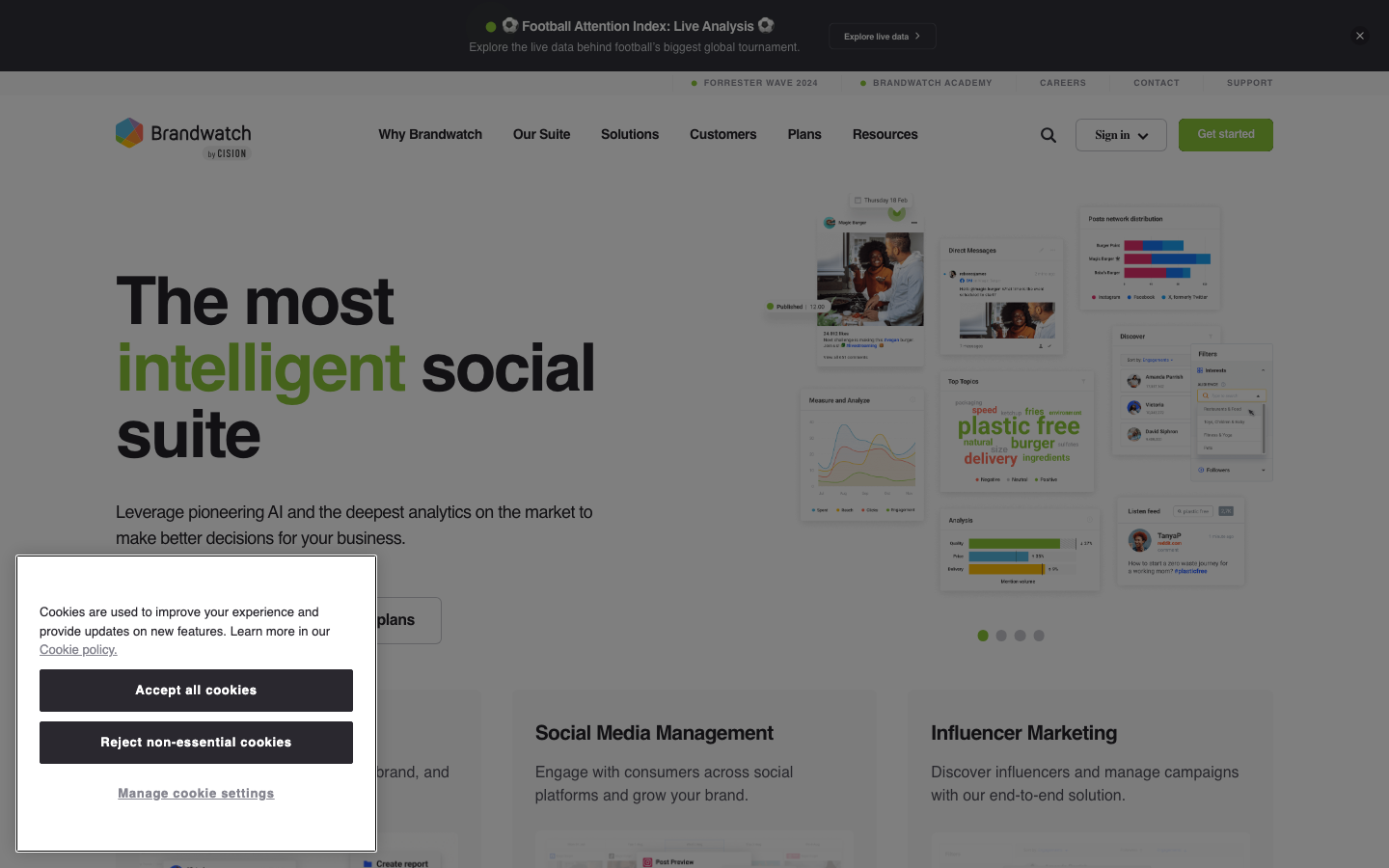
Brandwatch (formerly Crimson Hexagon) is an AI-driven social media monitoring and consumer insight platform that helps companies monitor brand public opinion, analyze consumer trends and competitive product dynamics in real time. It leverages AI and NLP technologies to analyze billions of social media content, providing sentiment analysis, trend discovery, and impact assessment. Brandwatch is a product of Cision.
Brandwatch
Core parameters and statistics of Brandwatch
Brandwatch (formerly Crimson Hexagon) is Cision's AI-driven social media monitoring and consumer insights platform, which belongs to Type D (productivity/business application). Its core value lies not in "post management" but in extracting consumer insights that can guide business decisions from massive social data.
| Projects | Public Information |
|---|---|
| Product Positioning | Social Media Monitoring and Consumer Insights Platform |
| Parent Company | Cision (acquired for $450 million in 2021) |
| Predecessor | Crimson Hexagon (founded in 2007 by Harvard professor Gary King) |
| Data scale | 1 trillion+ public social posts, covering 100 million+ data sources |
| Customer scale | 7,500+ enterprise customers |
| Global offices | 17 (New York, London, Berlin, Singapore, Sydney, etc.) |
| Employee size | 501–1,000 people |
| Platform | Web, API |
| Business model | Enterprise-level SaaS subscription (priced by data volume and feature level) |
| Supported languages | mainly en-US, covering multi-language social content analysis |
| Place of Belonging | GB (Registered in the United Kingdom) |
Brief review in one sentence: Brandwatch is not another social media management tool, but "uses AI to listen to the real voices on social media" - it transforms trillions of social posts into structured consumer insights, telling corporate brands about their true word-of-mouth and market trends on social media.
The Significance of Data Scale: 1 trillion+ posts means Brandwatch’s AI models have one of the largest social corpora in the industry when training and inferring. Data scale directly affects the accuracy of sentiment analysis, trend discovery and prediction models - the richer the data, the better the model's ability to capture long-tail topics and emerging trends.
Enterprise-grade positioning: 7,500+ customers and 17 global offices demonstrate that Brandwatch has moved beyond startup validation to mature delivery at scale. Its customer base is mainly concentrated in the world's top 500 brands and large agencies. The stability of its products, data compliance and service system have been verified by large enterprises.
Brandwatch’s users and market recognition
Gradually build user awareness in the field, and product capabilities are used by content creators and teams to improve work efficiency. Specific user scale and industry adoption data are subject to the official real-time page.
Brandwatch’s cost advantage
Brandwatch's cost structure presents typical enterprise-level SaaS characteristics: high threshold, on-demand customization, and hidden costs concentrated on data governance and manual verification.
C-side/Individual: Brandwatch is not for individual users. Product design and pricing are geared towards teams and enterprises, and there is no free version for individuals. For individual researchers or independent marketers, consider Talkwalker Free (there is a free version) or Brandwatch’s limited-time trial, but the functionality and data volume of the latter are severely limited.
API/Developer: Brandwatch provides data API for enterprises and research institutions with customized needs. API pricing is based on data call volume, data source scope and analysis capabilities. The specific price needs to be confirmed by the business. API customers often have an existing internal data platform and need to plug social data into their own dashboards or analytics pipelines.
Enterprise/Private: Brandwatch is mainly based on enterprise-level SaaS subscriptions and is priced based on the combination of data volume, number of monitored keywords, user seats, and functional modules (Consumer Intelligence / Social Media Management / Influencer Marketing). The annual fee usually ranges from tens of thousands of dollars to hundreds of thousands of dollars, and is subject to the official business quotation. Combination subscription discounts may be available to Cision-owned customers.
The Free Truth: Brandwatch does not offer a forever free plan. Trial periods are typically 7–14 days, with limited functionality and data volume. If you do not subscribe after the trial, the data and analysis results will not be retained.
Compliance and Risk: The collection and use of social media data involves privacy regulations such as GDPR (EU), CCPA (California), and more. Brandwatch's data source is public social content, but when tracking specific user groups, storing and analyzing personal data, enterprise users still need to independently confirm compliance boundaries. In addition, the accuracy of AI sentiment analysis in sarcasm, irony, and culturally specific expressions (such as "This is awesome" can be positive or negative in different contexts) is still a difficult problem in the industry. It is recommended to combine manual sampling to verify the AI analysis results. This part of the labor cost should be included in the total cost of ownership (TCO).
Hidden benefits: The long-term value of Brandwatch lies in "establishing a data baseline of brand public opinion" - the accumulation of data formed by continuous monitoring for more than 12 months is much more valuable than the analysis report at a single point in time. Trend changes are more insightful than absolute values. But for businesses purchasing for the first time, the ROI in the first year may not be as significant as in the second year because baseline data takes time to accumulate.
Key Features of Brandwatch
Brandwatch's current product line is divided into three major sections: Consumer Intelligence, Social Media Management and Influencer Marketing. The core functions are as follows:
- Consumer Research: Retrieve social data from 100 million+ online sources to support market research, brand health tracking and consumer attitude analysis. The value lies in converting unstructured social conversations into structured statistical data, which is suitable for brand positioning research and category trend analysis.
- Public Opinion Monitoring and Sentiment Analysis: Track brand mentions on social media in real time, and AI automatically determines positive/negative/neutral emotions. Applicable tasks: brand image management, crisis warning. Sentiment analysis has a high accuracy on English content, but requires manual sampling for low-resource languages and culture-specific expressions.
- Trend Detection: Use AI to identify rising topics, keywords and emotional patterns to help brands capture market signals in advance. Different from Google Trends (which only looks at search volume), Brandwatch can analyze the real discussion content and emotional tendencies on social media, so trend discovery is more contextual.
- Competitive product benchmarking (Benchmark): Compare the social media performance indicators (volume, sentiment, share, audience growth, etc.) of the brand and competing products. Suitable for competitive intelligence and category positioning analysis.
- Audience: Build audience portraits based on social behavior data to understand the interests, demographic characteristics and consumption preferences of target users. This feature is integrated with technology from the 2014 acquisition of PeerIndex.
- Content Publishing and Management (Publish): Unified management of content scheduling, publishing and approval processes for multiple social channels. This capability will primarily come from the Falcon.io product line that will be merged in 2022.
- Influencer Marketing (Influence): An end-to-end platform for discovering, evaluating and managing influencer cooperation, with a built-in 30 million+ influencer database. Suitable for large-scale cooperation management between brands and creators.
- Reverse Image Search: Industry-first technology pioneered by Crimson Hexagon in 2018, powered by
Image search for its usage on social media helps brands track the spread of visual content.
Synergy: Brandwatch’s capabilities don’t stand alone. A typical workflow is: Identify hot topics through trend discovery → Use consumer research to deeply analyze the emotions and motivations behind the topics → Convert insights into content strategies → Perform multi-platform content distribution through the publishing module → Use influencer marketing to amplify the communication effect → Finally, use public opinion monitoring and sentiment analysis to measure the effect. This concept of "discover → analyze → execute → measure" is the key value that distinguishes Brandwatch from a single-function tool.
Brandwatch model and version evolution
The development history of Brandwatch is a "history of mergers and acquisitions in the social listening industry", with corporate-level acquisitions and technology mergers as the main nodes in its version evolution:
Independent start-up period (2005–2014)
- 2005: Runtime Collective Ltd was founded by Giles Palmer in Brighton, UK, initially doing web engineering.
- 2007: Brandwatch was born and transformed to focus on social media mention tracking and social advertising impact analysis.
- 2007: Crimson Hexagon was founded by Harvard professors Gary King and Candace Fleming in Boston, USA. The technology originated from Harvard University's Institute for Quantitative Social Science.
- 2009: Crimson Hexagon ForSight platform goes live as a Twitter certified product.
- 2012: Brandwatch receives $6 million in Series A investment from Nauta Capital.
- 2014: Brandwatch acquires PeerIndex (social influence scoring platform) and launches Audiences product in the same year.
M&A integration period (2015–2020)
- 2015: Brandwatch completed $33 million in Series C financing to accelerate expansion in the US market.
- 2017: Brandwatch acquires BuzzSumo (content marketing research and analytics tool).
- September 2018: Crimson Hexagon releases the industry’s first reverse image search technology.
- October 2018: Brandwatch merges with Crimson Hexagon to form a new company valued at $100 million. Merger integrates technologies to launch Brandwatch Consumer Research, replacing Brandwatch Analytics and Crimson Hexagon’s ForSight platform.
- 2019: Brandwatch acquires Qriously (a mobile market research and polling tool), and Falcon.io, acquired by Cision in the same year, begins to integrate internally.
Cision Era (2021–present)
- February 2021: Cision acquires Brandwatch for $450 million, forming a PR, marketing and social listening powerhouse.
- May 2022: Falcon.io officially merges into Brandwatch, with the former Falcon.io product line becoming a core component of Social Media Management.
- 2023–2026: Continue to enhance AI analysis capabilities, expand multi-language coverage, and deepen product integration with Cision's PR Newswire and CisionOne.
Brandwatch’s technical advantages
Brandwatch's technical advantages come from three layers of accumulation: Crimson Hexagon's AI analysis engine, Brandwatch's own data processing pipeline, and the data collaboration of the Cision ecosystem.
NLP and Sentiment Analysis Engine: The core is a self-developed AI sentiment analysis model that can handle unstructured social content in dozens of languages. Unlike general-purpose large models (such as the GPT series), Brandwatch's models are specifically optimized for social media text and have better recognition capabilities for abbreviations, emoticons, hashtags, and Internet slang. Its sentiment analysis mechanism is: first perform language detection and topic classification on each post, then score it according to the multi-dimensional emotional axis (positive/negative/neutral + subdivided emotions such as anger, joy, disappointment), and finally aggregate and present it according to topics, time, region and other dimensions.
Image Analysis Capabilities: Crimson Hexagon’s reverse image search technology, pioneered in 2018, allows brands to upload an image and search all its occurrences on social networks. This capability has unique value in visual content (brand logo exposure, product image dissemination UGC images) monitoring scenarios. The merger will see the technology integrated into Brandwatch's Consumer Intelligence product line.
Data architecture scale: A data pool of 1 trillion + posts and 100 million + data sources means that Brandwatch has a unique infrastructure in data storage, indexing and real-time querying. For customers, this means that years of historical social data can be retrieved in a matter of seconds—a price/performance that is almost impossible to achieve with a self-built solution.
Multi-lingual coverage boundary: Officially claims to support dozens of languages, but no detailed benchmarks have been disclosed on the depth of NLP processing of non-Latin languages such as Chinese and Arabic. The handling of multilingual mixed posts (such as mixing Chinese and English, code switching) has not been detailed in public documents. Before purchasing, it is recommended to conduct actual testing with sample data in the target language and industry.
Brandwatch How to use
The usage paths of Brandwatch vary according to different product lines. The typical process is as follows:
Standard access process
- Contact the business team: Book a demo through the official website or contact sales directly to clarify your needs and budget.
- Configure monitoring parameters: After the business is confirmed, Brandwatch's customer success team will assist in configuring monitoring keywords, data source ranges, sentiment analysis rules and dashboard templates.
- AI automatic collection and analysis: The system automatically captures social data within the configured range, runs AI sentiment analysis and trend detection, and generates updates every day.
- View Dashboards and Reports: View data in real time through the web-side dashboard, which supports custom report export and automated regular sending.
- API integration (optional): For companies that need to connect data to internal systems, obtain structured data through the Brandwatch API.
How to use the three product lines
| Product Line | Main Entrance | Typical User Roles | Core Operations |
|---|---|---|---|
| Consumer Intelligence | Web dashboard | Market researcher, consumer insight team | Query database, build dashboard, export report |
| Social Media Management | Web management backend | Social media manager, content operation | Scheduling posts, community interaction, public opinion monitoring |
| Influencer Marketing | Web Workbench | Influencer Marketing Manager | Search for creators, manage relationships, track ROI |
Suggestion on implementation pace: First select a brand or product line for 3 months of pilot monitoring to verify the accuracy of AI analysis in a specific industry/language, and then decide whether to expand to the entire brand and the entire market. The acceptance indicators for the pilot include: sentiment analysis accuracy (manual sampling of 200–500 posts), trend warning timeliness, team time to get started, and data coverage.
Product Pricing by Brandwatch
Brandwatch does not disclose specific pricing and adopts a Custom Quote model. Prices vary depending on functional modules, data volume, user seats and usage time.
Price tier overview (subject to official business quotation):
- Consumer Intelligence: For researchers and analysts, priced based on data query volume and analysis dimensions. Annual fees for basic plans typically range from $30,000–$100,000.
- Social Media Management: For social media teams, priced based on the number of management accounts and user seats. Contains publishing, community management and basic monitoring functions.
- Influencer Marketing: For influencer marketing teams, priced based on database access and collaboration management capabilities.
- Enterprise Complete Plan: Subscribe to multiple product lines at the same time and usually get a combined discount.
C-side/Personal: No personal plan. Individual researchers can apply for a limited-time trial, but the functions and data are limited and not suitable for long-term use.
Explicit Cost: Subscription fee + optional data volume upgrade fee.
Hidden costs: ① The manpower to manually verify the AI sentiment analysis results; ② The development cost of integrating data into existing analysis pipelines (such as Tableau, Power BI); ③ The onboarding period for the team to receive training.
Application scenarios of Brandwatch
Brandwatch's implementation scenarios focus on high-value areas that require extracting business insights from social data:
- Brand Public Opinion Management and Crisis Warning: Real-time monitoring of brand mention trends across the entire network, and setting emotional thresholds to trigger early warnings. Deduction: From "passively waiting for complaints to come to your door" to "real-time monitoring and early warning", the response time of the public relations team has been shortened from hours to minutes. However, it should be noted that the false positive rate of AI warnings needs to be repeatedly adjusted. Excessive warnings can lead to the "crying wolf" effect.
- Consumer Demand Insights and Market Research: Understand the real needs, pain points and preferences of target users by analyzing social conversations, replacing or supplementing traditional survey questionnaires. Quantitative Extrapolation: A traditional focus group interview (6–8 people, 2 weeks) costs about $5,000–15,000, while Brandwatch can extract consumer attitudes from tens of thousands of relevant social discussions in a matter of hours. But for highly personal or infrequently discussed topics, such as B2B purchasing decisions, the coverage of social data may not be enough to replace traditional research.
- Competitive Product Dynamic Tracking: Continuously monitor the performance of competing products on social media—reactions to new product launches, user complaint hot spots, and marketing campaign effects. Suitable for competitive intelligence and category pattern analysis. Human-machine collaboration boundary: Data collection and indicator statistics can be 100% automated, but competitive strategy interpretation and response plans still require manual judgment.
- Industry trend and innovation signal capture: Identify rising topics, keywords and usage scenarios to help product teams and strategic departments detect market changes in advance. Different from Google Trends (which only looks at search volume), Brandwatch can analyze the content and sentiment of discussions, and trend signals are more contextual.
- Content Strategy and Effect Measurement: Guide the creative direction of content based on social data insights, and use quantitative indicators (volume, interaction rate, emotion) to fully evaluate the content effect after release. A "data-driven content" workflow for large enterprise social media teams.
Industry adaptability
| Industry | Adaptability | Typical use cases | Verification key points |
|---|---|---|---|
| Consumer retail | High | Brand health, new product feedback UGC monitoring | Chinese/minor language emotion accuracy rate |
| FMCG catering | High | Word-of-mouth tracking, crisis warning, consumer preferences | Real-time nature of hot topics |
| Finance and Insurance | Medium | Brand reputation, customer complaint trends | Compliance review (privacy, record retention) |
| Healthcare | Medium | Patient feedback, health topic trends | Privacy regulations (HIPAA) compliance |
| B2B technology | Medium-low | Competitive product intelligence, industry topic monitoring | Insufficient social data density |
| Government/Public | Low | Public opinion monitoring (requires professional data partner) | Data compliance and review |
Applicable groups of Brandwatch
Brandwatch's enterprise-level positioning determines that it is not suitable for individuals or small teams. Its core applicable groups are:
- Brand Marketing Team: Need to grasp brand reputation in real time, monitor the effectiveness of marketing activities, and respond to public opinion events in a timely manner. Brandwatch's public opinion monitoring and sentiment analysis directly correspond to the daily work of such teams. Prerequisites for implementation: The team already has a basic social media operation process and needs to be upgraded to the "data-driven" level.
- Public Relations and Communications Team: Pay attention to media mentions, crisis warnings and reputation management, and need to extract brand health indicators from social data that can be used for senior management reporting. Key acceptance points: the accuracy of sentiment analysis and the timeliness of early warnings.
- Market Research and Consumer Insights Team: Use Brandwatch’s Consumer Intelligence product for category trend analysis, consumer attitude research and competitive product benchmarking. This type of team is the main user of Buyer Persona. They usually have a market research background and can judge the quality boundaries of AI analysis.
- E-commerce and Category Management Team: Track social discussion trends, changes in consumer preferences and competitive product dynamics of product categories to provide data support for product selection and category strategies.
- Corporate Strategy and Innovation Department: Use the trend discovery function to identify early market signals and innovation opportunities to assist strategic decision-making. This type of user usually needs to cross-analyze Brandwatch data with internal corporate data (sales CRM).
Not suitable for the boundary: Not suitable for individual bloggers, freelancers or small teams of less than 10 people - the annual fee threshold and functional complexity exceed the needs of these users. For scenarios that only require basic social media management and scheduling (such as posting, replying to comments), tools such as Sprout Social and Hootsuite are more cost-effective. For government/military industries that require in-depth long-text public opinion analysis or have extremely high requirements for data sovereignty, it is necessary to evaluate whether Brandwatch's data storage location and compliance certification meet the requirements.
Summary and Outlook
Brandwatch upgrades AI-driven social listening from a "monitoring tool" to a "consumer insights engine." Its core competitiveness comes from three aspects: ① The data barrier constituted by 1 trillion+ posts, ② Crimson Hexagon’s legacy AI analysis capabilities, ③ Cross-product collaboration under the Cision ecosystem (PR Newswire + Brandwatch + CisionOne). For large and medium-sized companies that have developed a need for brand monitoring, Brandwatch is one of the most mature options in the category.
Current limitations: Brand monitoring still requires manual calibration of sentiment analysis accuracy—especially in the context of a mix of multiple languages, industry jargon, and sarcastic expressions. The quality of insights generated by AI is highly dependent on the keyword strategy and rule settings in the configuration stage. Improper configuration may lead to excessive data noise or missing key signals. In addition, the lock-in risk of the PaaS model (historical data is stored in Brandwatch’s cloud and migration costs are high) is also a factor that long-term customers need to evaluate.
Procurement/Adoption Risk Assessment: ① Whether the annual subscription cost matches the ROI - it is recommended to conduct a 3-month pilot with 1 brand in 1 market to quantify the time savings and incremental insights and then evaluate; ② Whether the data coverage includes the target market and language - pay special attention to the quality of minority languages and Chinese social data; ③ Compliance terms - data storage location, compliance with privacy regulations (GDPR/CCPA), and whether the data can be used for model training, need to be specified in the contract; ④ Exit costs - The export method and format of historical data after contract termination needs to be confirmed in advance.
Future observation points: whether Cision will further integrate Brandwatch into a unified platform to form a deeper ecological binding; the degree of automation of AI sentiment analysis and trend prediction will be improved; and whether a small and medium-sized enterprise version/light version will be launched to expand the customer base.
Brandwatch How to use
- Web client: You can use it by visiting the official website and registering an account. Most functions do not require installation.
- API access: Provides RESTful API, developers can obtain the API Key and integrate it into their own applications.
Version Info
- Brandwatch Current Product Line :The current product line includes three major solutions: Consumer Intelligence, Social Media Management, and Influencer Marketing, and continues to iterate AI analysis and social data coverage.
- Brandwatch Consumer Research :The new generation consumer insights platform launched after merging Crimson Hexagon technology integrates AI image analysis, reverse image search and other functions. There is no official precise date yet.
- Crimson Hexagon ForSight :Crimson Hexagon launches first version of ForSight platform, based on technology from Harvard University’s Institute for Quantitative Social Science. There is no official precise date yet.
User Reviews