 Crisp AI
Crisp serves small and medium-sized enterprises with a "simple but not simple" positioning. It integrates website chat, customer service inbox, knowledge base and AI automatic reply, emphasizing lightweight and rapid deployment.
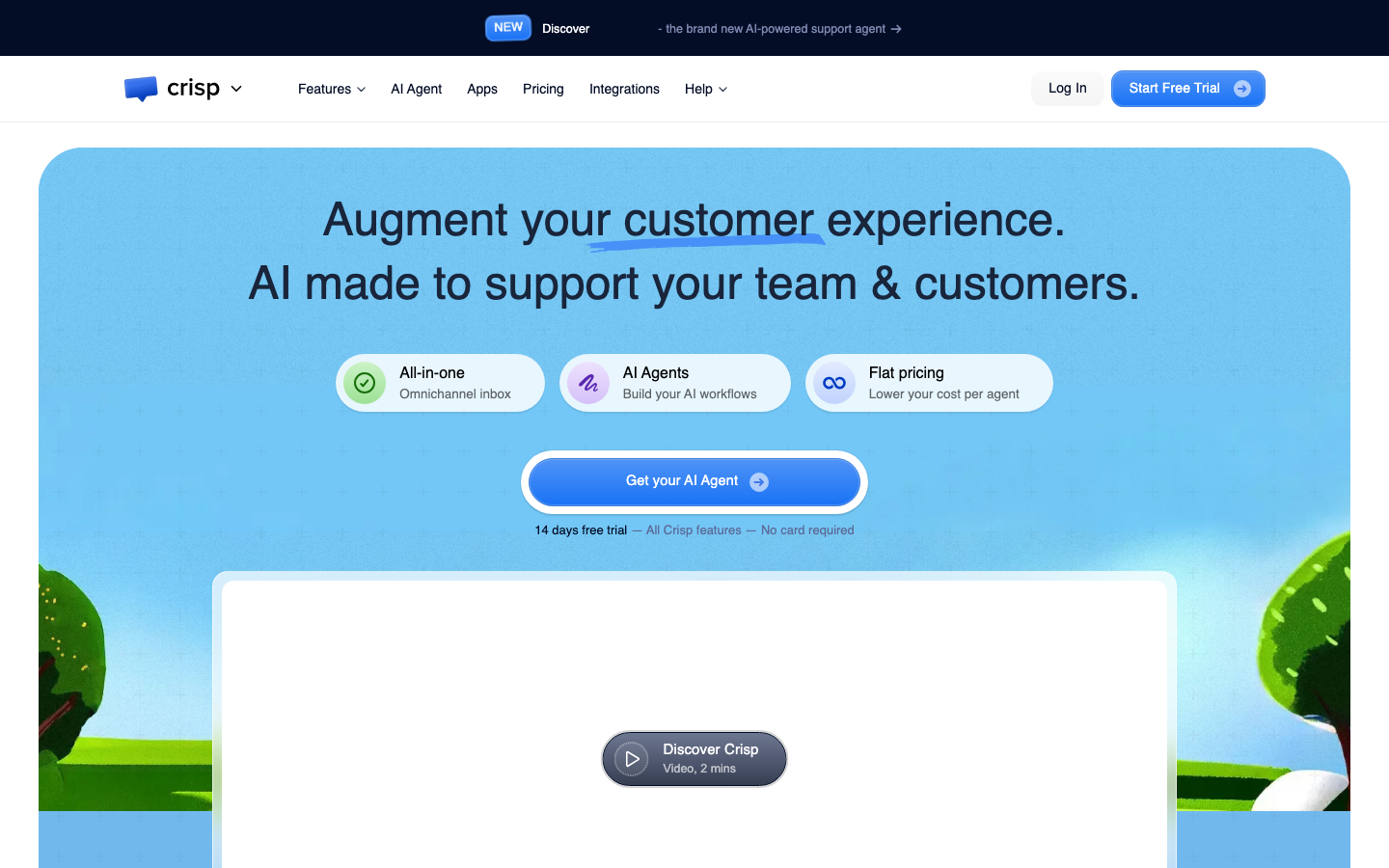
Crisp AI: AI-native customer communication platform for SMEs
Core parameters and statistics of Crisp AI
Crisp's positioning accurately corresponds to the market gap of "Intercom is too expensive and Zendesk is too heavy" - it uses a minimalist UI, unified inbox and pay-as-you-go AI module to provide "just right" customer service communication capabilities for small and medium-sized enterprises. The launch of Hugo AI Agent in 2026 will push the automation rate to 60%, allowing Crisp to evolve from a "chat tool" to an "AI native help desk".
| Projects | Public Information |
|---|---|
| Official positioning | AI-first customer communication and support platform (The AI Customer Support platform) |
| Core module | Website chat, multi-channel inbox, knowledge base AI chatbot Hugo AI Agent, CRM, analysis panel |
| AI capabilities | Hugo AI Agent (automatically resolve work orders), AI Copilot (customer service assistance), MagicReply (confidence controllable reply), conversation summary, intelligent translation Overlay search widget |
| How to deploy | SaaS cloud (14-day free trial, no credit card required) |
| Integration Ecosystem | Slack, Shopify, WordPress, Zapier, HubSpot, Salesforce, MCP protocol connection + 100+ third-party integration |
| Customer scale | Officially disclosed more than 10,000 corporate customers, serving more than 5 million websites |
| Latest version | 2026.7 (July Update) |
| Supported platforms | Web, iOS, Android, Windows desktop client |
| Headquarters/Establishment | Paris, France / 2015 |
| GDPR Compliance | Yes, data is stored within the EU |
Brief review in one sentence: Crisp is not an independent chat software, but a customer service operating system with built-in AI Agent - Hugo is used to handle 60% of the repetitive work orders on the front end, allowing manual customer service to focus on high-value complex issues.
Core Difference: Crisp's core competitiveness is "AI native + cost-effective" - the deployment of Hugo AI Agent requires no code, can be accessed in 5 minutes, and the price is about 1/5-1/3 of Intercom, and AI calls are not billed on a "per-resolution" basis, but on a monthly AI Credits basis, eliminating the worry of "deducting money for each AI reply".
Users and market recognition of Crisp AI
Crisp's market recognition is reflected in three levels: customer base, third-party reviews and industry cases, rather than public revenue figures (the latter is not officially disclosed).
Customer scale: Both the official pricing page and the homepage show "Trusted by 10,000 companies worldwide". The customer list includes Emma (European mattress brand), Decathlon (Decathlon), Air France (Air France), Reedsy, Oxio, Hoxton Mix and other multi-industry companies spanning e-commerce, aviation, hotels, and publishing. Customers cover European, North American and Asia-Pacific markets.
Third Party Rating: The official G2 rating is 4.5/5.0. The brand page displays the evaluation conclusion of "Evaluated over 20 products, and Crisp came out on top", but the complete evaluation report has not been made public on the official website.
Customer Cases: Hugo AI official website has disclosed three sets of verifiable case data——
- AFS Foiling: About 60% of customer requests are completed automatically by Hugo end-to-end without human intervention.
- Emma: Hugo handles all inbound conversations and resolves approximately 40% of queries autonomously, freeing up customer service teams to handle more complex issues.
- SpiderVO: About 40% of inbound requests are fully automated by Hugo AI, and the remaining 60% are smoothly upgraded to manual, growing in scale while maintaining customer relationship quality.
Open source and developer ecology: Crisp maintains multiple open source SDKs and integration warehouses (crisp-im organization) on GitHub, providing REST API, JavaScript SDK, iOS/Android SDK, and developers can embed Crisp into their own backend through the API. Hugo AI Agent supports the MCP protocol to connect to external tools, further expanding the boundaries of automation.
Prerequisites for implementation: Crisp's value is most obvious at the stage of "there is a certain amount of customer inquiries, but you can't afford a dedicated customer service team". If the team's daily consultation volume is less than 20, the free version's AI assistance and manual responses are sufficient; if the team's consultation volume exceeds 500/day, it is necessary to evaluate whether the automation rate of Hugo AI Agent meets expectations.
Crisp AI’s cost advantage
The cost advantage of Crisp is not the lowest absolute value, but rather "tiered charging based on team size and AI usage" to avoid paying for unused seats and functions. The following is dismantled from the three layers of C-side/individual, developer and enterprise.
C-side/individual (small team, independent station)
| Cost Dimensions | Crisp | Intercom | Zendesk |
|---|---|---|---|
| Introductory price | Free (2 seats, unlimited conversations) | Starting from $39/month (1 seat) | Starting from $55/month (1 seat) |
| AI function threshold | $45/month (Mini includes $5 AI Credits) | Starting from $99/month (including Fin AI) | Need to purchase AI add-on modules |
| AI billing model | AI Credits monthly (can be accumulated if not consumed) | Billed based on each AI reply | Billed based on work order volume |
| Free trial | 14-day full functionality, no credit card required | 14-day limited trial | 14-day limited trial |
The Free Truth: The Crisp Free version includes 2 seats and unlimited conversations, but does not include AI Credits, meaning the AI autoresponder feature is not available. If you need AI capabilities, the minimum threshold is the Mini version ($45/month), which includes $5 in AI Credits (covers approximately 100 AI responses). Compared to Intercom Fin's "pay per resolution" model, Crisp's monthly subscription is more predictable for low- and medium-volume customers.
Developer/API Integration
Crisp does not offer a separate API pricing tier, and development capabilities are built into all paid plans:
- Cost: Developers can integrate for free via REST API and SDK, with no additional API call fees.
- Restrictions: API frequency control and advanced Webhook functions are only available in the Essentials version or above (starting at $95/month).
- Hidden costs: The man-hours for custom development and maintenance of MCP connectors need to be borne internally; custom training data preparation (knowledge base articles, Q&A pair writing) for Hugo AI Agent requires initial investment.
Enterprise/Privatization
Crisp currently only provides SaaS cloud deployment, and there is no public self-hosting solution:
- Enterprise Edition: Pricing requires business confirmation (through the "Ask for a demo" portal), including exclusive entry, customized SLA, enhanced frequency control, customized functions and team training.
- Compliance Cost: Data is stored in the EU, with a GDPR compliance statement, and the compliance cost for European customers is low; for industries (medical, financial) that require SOC2, HIPAA and other certifications, the official certification status has not been disclosed, and you need to confirm with sales before purchasing.
- Hidden benefits: Using a unified omni-channel inbox can reduce the time loss of customer service switching between multiple platforms. According to Emma's case, after Hugo took over, the customer service team "can focus on more complex problems", indirectly reducing staff turnover and training costs.
Cost comparison summary table
| Comparative Dimensions | Crisp | Intercom | Tidio | Freshdesk |
|---|---|---|---|---|
| Free version of AI available | No (paid plan required) | No | Yes (restrictions apply) | No |
| Lowest monthly AI fee | $45 (includes $5 AI Credits) | $99 (Fin AI add-on) | $29 (Lyro AI add-on) | $59 (Freddy AI add-on) |
| Unified Inbox | Yes | Yes | Partial | Yes |
| Built-in knowledge base | Starting from Essentials | All solutions | Independent modules | All solutions |
| Multi-language support | Yes (13+ languages) | Yes | Limited | Yes |
| Data Sovereignty | EU Hosting | US and Europe Optional | US and Europe Optional | US and Europe Optional |
Crisp AI’s main features
Crisp's capabilities are designed around "bringing every touch point of customer communication into a unified platform, and then using AI to improve the efficiency of each touch point" rather than the stacking of scattered functions.
Hugo AI Agent: "Digital Teammate" that automatically resolves work orders
- Automatic training: Automatically crawl company website content, while supporting the import of PDF, CSV, knowledge base articles and historical conversation records, without the need to manually label training data.
- Intelligent Routing: When the AI confidence is lower than the preset threshold (MagicReply function), the conversation will be automatically transferred to a human and the complete conversation context will be delivered to avoid customers repeatedly describing the problem.
- Multiple model support: Supports multiple large model backends such as Claude, ChatGPT, Llama, etc. Enterprises can choose the optimal model based on accuracy, latency and cost.
- MCP connection capability: By connecting external tools (CRM, order systems, logistics tracking) through the Model Context Protocol, AI can directly check order status, initiate refunds, and update customer information during the conversation.
Multi-Channel Inbox: Eliminating the Hidden Cost of "Switching Platforms"
- 10+ Channel Unified Management: Conversations on website chat, email, WhatsApp, Facebook Messenger, Instagram, LINE and other channels all enter the same inbox.
- AI-assisted reply: Customer service can trigger AI Copilot with one click in the inbox to obtain reply suggestions, tone correction and translation based on the knowledge base.
- Automatic labeling and classification: AI automatically identifies the conversation intention (return, complaint, consultation), labels it and assigns it to the corresponding queue.
Knowledge Base: Data Base for AI
- Dual-mode publishing: Knowledge base articles can be set to public (customer-facing help center) or private (only for AI and customer service), and AI will automatically quote article content to answer questions.
- Automatic re-indexing: The knowledge base is automatically re-indexed after the article is updated, no need to manually trigger training.
- Overlay search widget: Embed an AI search pop-up window anywhere on the website, allowing visitors to search for answers themselves before contacting customer service, reducing the amount of manual consultation.
Automated workflow: build customer service process without code
- Drag-and-drop editor: Create message triggering rules, automatic replies, work order routing, notification distribution and other processes without development intervention.
- Task Automation: The Plus version and above support unlimited task automation, which can be connected in series with multi-step operations such as AI judgment, channel dispatching and CRM updates.
CRM and analytics: Precipitate customer assets from conversations
- Built-in CRM: Each conversation is associated with a customer portrait, and aggregates browsing history, order information, and past conversation records. Customer service can have a complete picture of the customer before replying.
- Analysis Panel: Monitors dialogue volume, first reply time, resolution time, customer satisfaction AI automation rate and other indicators, and supports drill-down by team, channel, and time period.
[Expert View - Hidden Linkage]: The biggest synergy between Crisp functions is "training data connection" - knowledge base articles are cited by AI to answer customer questions → Unresolved conversations flow back to manual customer service → Content supplemented by customer service can be converted into knowledge base articles with one click → AI retraining reduces manual intervention for similar problems. Once this barrier is passed, the AI's automation rate will naturally increase over time, not just the static effect during the initial configuration.
Crisp AI model and version evolution
As a SaaS product, Crisp does not disclose the precise version number granularity, but its functional milestones can be inferred from the release rhythm of the official website, blog and Hugo AI.
Mainline release
- 2026.7 (July Update): The latest version, optimizing the AI chatbot knowledge base matching and multi-language reply accuracy. Hugo AI Agent continues to iterate on MCP connectivity capabilities and multi-model backend support during this cycle.
- 2026.2 (February Update): Introducing the AI automatic summary function, which automatically generates summaries and work orders after the customer service conversation, reducing the time of manual writing of summaries.
- 2025.4 (Hugo AI Agent initial release): Crisp releases the Hugo AI Agent brand, positioned as "AI-first support teammate", introducing MagicReply confidence control, multi-data source training and intelligent routing.
Functional evolution
| Time Window | Key Changes | Impact on Users |
|---|---|---|
| 2024 and before | Traditional chat plug-in + basic AI reply | Meet basic online customer service needs |
| First half of 2025 | Hugo AI Agent brand launch, introducing data source training and confidence control | AI upgrade from "keyword matching" to "knowledge base-driven intelligent reply" |
| Second half of 2025 | MCP protocol support, multi-model backend (Claude/ChatGPT/Llama) | AI Agent can perform operational tasks such as order checking, address change, etc. |
| First half of 2026 | Unlimited AI Copilot, Overlay search, and task automation | AI expands from "front-end customer service" to "internal assistance + self-service search" dual mode |
Since Crisp is a cloud-based SaaS, all users automatically use the latest version without having to deal with version migrations.
Crisp AI’s technical advantages
Crisp's technical advantage lies not in the "self-developed large model" (which calls an external LLM), but in the three-layer integrated engineering of "data-reasoning-action".
Data layer: multi-source knowledge fusion
- Automatic website crawling: No need to manually upload documents, AI automatically crawls company websites, blogs, and help center content as a knowledge base.
- Hybrid retrieval: Combines knowledge base, question and answer pairs (Snippets), historical conversations and uploaded files to perform multi-source retrieval and sorting during reasoning instead of relying solely on a single data source.
- Automatic Reindex: Automatically trigger index rebuilding after the data source is updated to ensure that AI answers do not lag behind content changes.
Inference layer: Confidence controllable generation
- MagicReply Mechanism: AI evaluates the confidence score when generating a reply, and rejects the answer when it is below the threshold and transfers it to humans instead of forcibly generating content that may be wrong. This mechanism is especially important for companies that are sensitive to brand reputation - they would rather say "I don't know" than give the wrong answer.
- Multi-model backend switching: Hugo supports switching between Claude, ChatGPT, Llama and other models. Enterprises can choose the optimal model according to industry scenarios (for example, legal scenarios prefer high-accuracy models, e-commerce scenarios prefer high-response models).
Action layer: MCP protocol connection
- Tool calling ability: Hugo connects to external systems through the MCP protocol and can perform operations such as checking orders, issuing refunds, and updating CRM during the conversation, upgrading the AI from a "chat robot" to a "virtual employee who can perform operations."
- Security Boundary: Operational dialogues still retain manual confirmation nodes, and system level safeguards ensure that irreversible operations are performed within the authorized scope.
Architecture description
Hugo AI Agent workflow link:
Customer Messages → Crisp Inbox → AI Intent Recognition → Knowledge Retrieval (Multiple Sources)
  ├─ Confidence is higher than the threshold → Hugo automatically replies (the MCP tool can be called to perform operations)
  └─ Confidence is lower than the threshold → Convert to manual + transfer context → Customer service reply → Can be converted to knowledge base article with one click
The core value of this link is that "the context is not lost when switching to manual processing" - customers do not need to repeat questions, customer service does not need to re-check history, and the average processing time is reduced by 30-50%.
How to use Crisp AI
Crisp provides three access paths, suitable for teams with different technical capabilities.
Path 1: Website chat plug-in (5 minutes access)
- Sign up for a Crisp account (14-day free trial, no credit card required).
- Get the website ID in the console.
- Paste the embed code at the end of the
<body>tag of your website. - The plug-in takes effect immediately, and visitors can initiate a chat in the lower right corner of the website.
Path 2: Hugo AI Agent configuration (4 steps to complete)
| Steps | Operation | Time consuming | Instructions |
|---|---|---|---|
| 1. Training AI | Automatically crawl the website + upload PDF/CSV + import knowledge base | 5–15 minutes | Question and answer pairs (Snippets) can be added to make up for the lack of public content |
| 2. Create workflow | Drag-and-drop editor to configure trigger conditions, reply rules and manual transfer thresholds | 10–20 minutes | Setable MagicReply confidence thresholds |
| 3. Testing and Deployment | Simulate the conversation in the real chat widget and verify the accuracy of the response | 15–30 minutes | Single-round conversation testing possible, verification without publishing |
| 4. Validation and Optimization | Monitor automation rates, customer satisfaction, and failed conversations via analytics dashboard | Ongoing | Replenish the knowledge base regularly, repeat step 1 |
Path three: Deep integration of API and MCP (developer path)
- REST API: Manipulate sessions, messages, and contact data through the
https://api.crisp.chat/endpoint, and use the API Key + Secret Key combination for identity authentication. - SDK Support: Officially provides JavaScript, Python, Ruby, PHP, Go, iOS, and Android SDKs.
- MCP connection: Hugo AI Agent supports mounting external tool servers through the MCP protocol. The configuration method is subject to the official Hugo AI documentation.
// Hugo MCP Server configuration diagram (claude_desktop_config.json)
{
  "mcpServers": {
    "hugo-crisp": {
      "command": "npx",
      "args": ["@crisp-im/hugo-mcp-server"],
      "env": {
        "CRISP_API_KEY": "<YOUR_API_KEY>",
        "CRISP_API_SECRET": "<YOUR_API_SECRET>"
      }
    }
  }
}
Product Pricing for Crisp AI
Crisp adopts a two-tier pricing structure of "platform per seat per month + AI Credits per volume". All plans are billed per workspace, with no limit on the number of conversations.
| Plan | Monthly Fee | Seats | AI Credits Included | Core Competencies |
|---|---|---|---|---|
| Free | $0 | 2 | $0 | Website chat, shared inbox, mobile, chat SDK |
| Mini | $45 | 4 | $5 | + Email inbox, shortcut keys, chat triggers, internal notes, unlimited data retention |
| Essentials | $95 | 10 | $25 | + CRM, omnichannel inbox, workflow automation AI chatbot, knowledge base, analytics dashboard |
| Plus | $295 | 20+ | $75 | + AI-First support suite, unlimited task automation, ticketing system 100+ integrations, white label, advanced analytics |
| Enterprise | Business Confirmation | Customization | Customization | + Exclusive entry, customized SLA, enhanced frequency control, customized functions, team training |
C-side/Individual: The Free version can cover the basic online customer service needs of individual webmasters or small teams of less than 2 people, but AI automatic replies are not available; the Mini version is suitable for early-stage teams that want AI assistance, and $5 AI Credits covers approximately 100 AI replies.
Developer/API integration: API capabilities have complete frequency control and Webhook support in Essentials and above versions; AI Credits have large differences in the amount of different plans. For high-frequency AI conversation scenarios (average 100+ times per day), it is recommended to start with Essentials.
Enterprise: The Plus version is currently the most complete solution with AI capabilities and is suitable for medium-sized teams with an average daily work order volume of 100+; the Enterprise version requires business confirmation and the standard pricing has not been disclosed.
Important: The pricing page shows that all plans come with a fully functional 14-day free trial, no credit card required. AI Credits adopts a monthly subscription system, and unspent balance can be accumulated. Compared with Intercom's "pay per solution" model, it is more suitable for teams with large fluctuations in conversation volume.
Crisp AI application scenarios
Scenario 1: SaaS and e-commerce website customer service
- Task Chain: Visitors initiate a conversation on the website → Hugo AI automatically recognizes the intent and retrieves the knowledge base → Frequently asked questions (logistics, returns and exchanges, billing) are directly solved by AI → Complex problems are transferred to humans and the context is delivered.
- Cost reduction deduction: Taking an e-commerce team with an average of 100 inquiries per day as an example, Hugo's automatic resolution rate of 40-60% means that 40-60 inquiries per day do not require manual intervention. Calculated based on 5 minutes of manual reply per inquiry, 3-5 hours are saved per day, which is equivalent to the output of 0.5-0.7 full-time customer service hours.
- Acceptance focus: AI's accuracy and compliance in answering highly sensitive questions such as refunds and complaints; whether the MagicReply threshold is suitable for the brand's risk preference.
Scenario 2: Multi-channel customer message center
- Task Chain: Customers contact through multiple channels such as WhatsApp, email, Facebook Messenger, etc. → All messages are imported into the Crisp unified inbox → AI automatically categorizes, labels, and routes to the corresponding customer service queue.
- Cost reduction deduction: E-commerce or service teams usually need to switch responses between 3-5 platforms. The unified inbox directly eliminates the time loss of "switching platforms + repeated logins". It is conservatively estimated to save 30-60 minutes per person per day.
- Acceptance concerns: Whether all target channels have native integration; customer identity merging between multiple channels (whether the same customer is identified as the same person when consulting across channels).
Scenario 3: Self-service help center + Overlay search
- Task Chain: Website visitors search for questions in the help center → Overlay AI search pop-up window directly gives the answer → If the answer is not satisfactory, one-click to transfer to chat and pre-fill the search context.
- Cost reduction deduction: Every 10% reduction in manual consultation volume in the help center is equivalent to saving 10% of man-hours for the customer service team. For a team with a monthly consultation volume of 1,000+, 10% is 100 conversations and about 8 hours of labor.
- Acceptance focus: Whether the recall rate of Overlay search can cover 80%+ of common problems; whether the downgrade experience is smooth when the search has no results.
Scenario 4: Internal customer service team collaboration and work order management
- Task Chain: Customer messages are converted into work orders → Internal notes, @ colleagues, status transfer (pending/processing/resolved) → AI automatically generates conversation summaries and work order summaries → Analysis panel monitors team performance.
- Cost reduction deduction: The conversation summary function saves customer service staff 1-2 minutes of work order filling time each time. Calculated based on an average of 100 conversations per day, this saves about 50-100 hours per month.
- Acceptance concerns: Whether the customizability of work order flow matches the internal SOP; whether the analysis panel supports customized reports.
Applicable groups of Crisp AI
-
Small Businesses and Independent Webmasters: Crisp’s Free version and low-threshold paid plan are most friendly to budget-conscious teams of 1-10 people. The core value lies in using AI to cover customer consultations during non-working hours and using a unified inbox to reduce switching between multiple platforms. It is not suitable for scenarios where the average daily consultation volume is less than 10 (in this case, the free version of the chat plug-in is sufficient, and the input-output ratio of the AI module is low).
-
Medium-sized e-commerce and SaaS teams: Essentials or Plus version + Hugo AI Agent is Crisp's "sweet spot" - the team size is 10-50 people, the average daily consultation volume is 50-500, AI automatically solves 40-60% of repeated work orders, directly reducing the labor cost of 0.5-2 full-time customer service personnel. However, it needs to be evaluated whether AI’s ability to handle complex issues (such as legal consultation, medical advice, high-value order customer complaints) meets brand standards.
-
Customer Success and Operations Leaders: Crisp’s analytics dashboard and conversation summary features are suitable for managers who need to quantify team performance and optimize customer service processes. Continuously iterate the knowledge base and vocabulary through indicators such as AI automation rate, first reply time, and resolution time. The unsuitable scenario is "just a simple contact form, no real-time chat required".
-
Not suitable for people:
- In-depth long articles/complex technical scenarios: AI replies are based on knowledge base retrieval and are not suitable for scenarios that require in-depth reasoning, item-by-item analysis of legal clauses, or highly professional customization.
- Highly customized visual brand requirements: The scope of UI customization of the chat window is limited. The white label function of the Plus version and above can remove the brand, but cannot deeply modify the interaction style.
- Ultra-large customer service team (100+ seats): The seats and SLA of the Enterprise version need to be confirmed by business. Compared with mature enterprise solutions such as Zendesk, Crisp may not be mature enough in advanced permissions management and SSO integration.
Summary and Outlook of Crisp AI
Core Competencies: Crisp is one of the most mature options in the "Intercom Alternative" - Hugo AI Agent's product completion and verification basis of 10,000+ customers, and the predictable pricing of "Platform Monthly + AI Credits" combine to form a clear differentiation in the small and medium-sized enterprise market. The biggest highlights are the two designs of "training data closure" and "confidence controllable AI response". The former allows AI accuracy to increase over time rather than decay, and the latter allows companies to safely put AI on the front line of customer service.
Current limitations: Hugo AI Agent's processing capabilities for complex reasoning scenarios (requiring multi-step logical judgment and cross-system transaction coordination) are still inferior to Intercom Fin; advanced analysis and custom reporting functions are weak; there is no self-hosted deployment solution, data sovereignty is limited to the EU region, and insufficient coverage of industries that require SOC2/HIPAA certification; Enterprise version pricing is opaque, and bulk purchases require business negotiation.
Human-machine collaboration boundary: According to Crisp's official case data and product design, the following sections can be 100% automated - frequently asked questions (logistics inquiries, return and exchange processes, bill consultations), information collection (order numbers, contact information, question classification), knowledge base retrieval and standard answer push. The following sections must retain manual confirmation points - refund and payment operations (especially scenarios involving third-party payment gateways), account deletion/data export (strong compliance approval), high-value customer consultation (setting VIP routing rules to force manual), complex complaints with AI confidence below the threshold. It is recommended that enterprises set a lower confidence threshold (such as 0.7) in the first 30 days of launching Hugo, allowing AI to filter obviously simple questions, manually process the remaining parts and precipitate new knowledge base entries; after 30 days, gradually increase the threshold based on actual automation rate data.
Purchase Suggestion: For teams with less than 50 people, it is recommended to start with the Free version and first use the website chat plug-in to verify the basic experience; upgrade to the Mini or Essentials version (including AI Credits) if there is a need for AI, and use a 14-day trial period to test Hugo’s automation rate in real conversations; after confirming that the automation rate meets the standard, expand to the Plus or Enterprise version as needed. Before purchasing, enterprises need to confirm with sales: data storage region (whether it is limited to the EU), compliance certification status (SOC2/HIPAA, etc.), Enterprise version seats and business terms of SLA, as well as the actual performance of Hugo AI Agent in multi-language scenarios.
Follow-up observation points: Whether the number of MCP connectors and ecological maturity of Hugo AI Agent will continue to grow; whether Crisp will launch self-hosted or private cloud solutions to meet the needs of high-compliance industries; whether the pricing of AI Credits will be adjusted simultaneously with the decline in model calling costs.
Related tools:  Notion AI, google-workspace
Version Info
- Crisp 2026 July Update :There is no official precise date yet. Optimize AI chatbot knowledge base matching and multi-language reply accuracy.
- Crisp 2026 February Update :There is no official precise date yet. Introducing the AI automatic summary function to automatically generate summaries and work orders after the customer service conversation.
User Reviews