 Crossbeam
Crossbeam is a partner ecosystem data platform that allows businesses and partners to securely match overlapping customers for joint sales and marketing without exposing sensitive data.
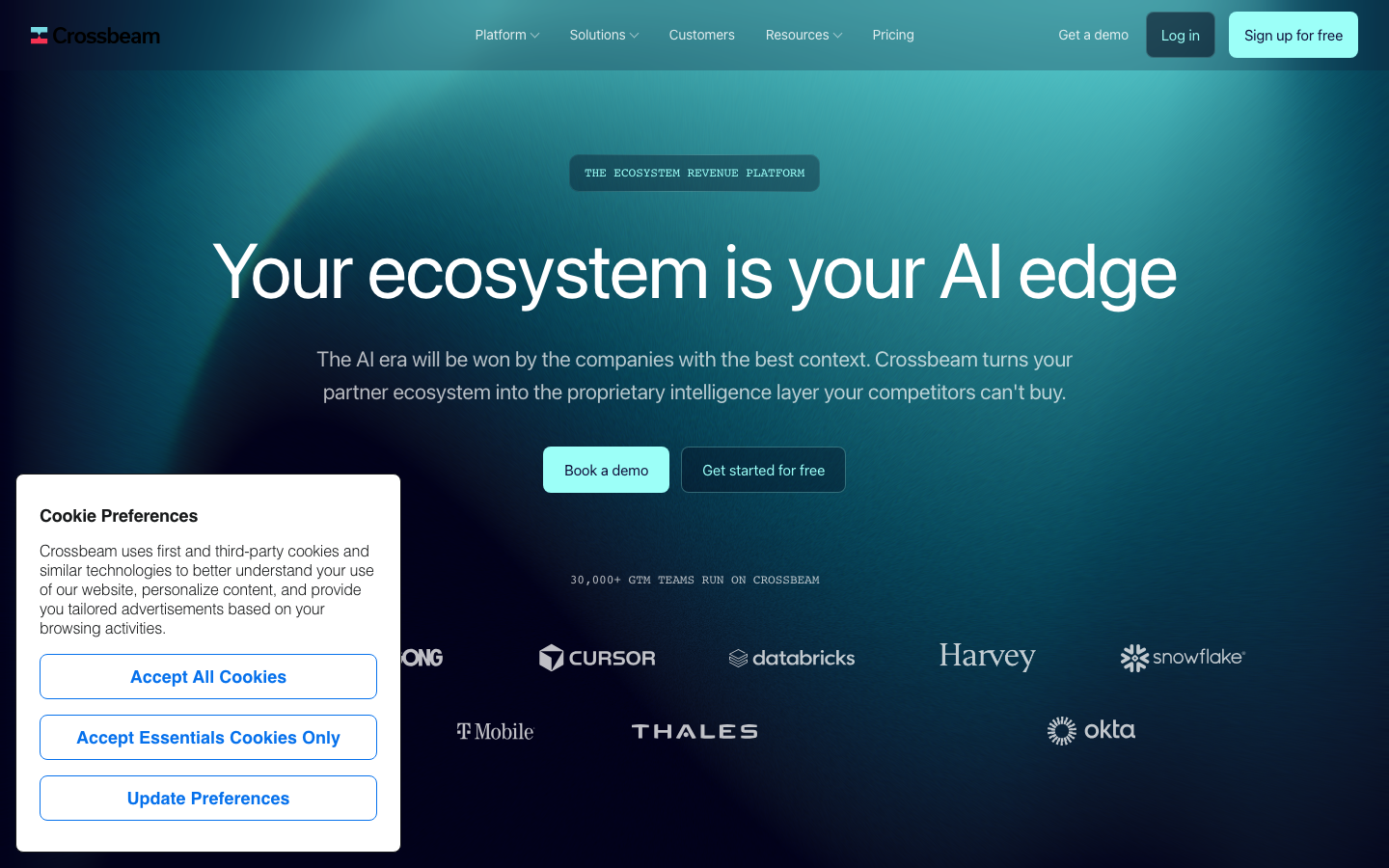
Crossbeam
Core parameters and statistics
The core question Crossbeam solves is "what customers do you and your partner have in common" - but neither side wants to hand over their complete customer list to the other. Crossbeam uses "data collision" technology to discover intersections without exposing data on either side. The latest official positioning is "The Ecosystem Revenue Platform", emphasizing full-link coverage from data discovery to revenue conversion.
| Projects | Public Information |
|---|---|
| Official Positioning | Ecosystem Revenue Platform |
| Core Competencies | Secure Data Overlap Matching + Ecological Insights + AI Collaboration Layer |
| Technical route | Encrypted hash matching + auditable data collision + MCP protocol |
| Network Scale | 30,000+ GTM Teams Joined Crossbeam Network |
| Integration Ecosystem | Salesforce, HubSpot, Snowflake, Microsoft Dynamics, Gong, Outreach, Slack, etc. |
| Typical uses | Joint sales, joint marketing, customer expansion, ecological construction, data enrichment |
| Latest version | 2026.7 |
| Support Platform | Web, API |
| Security Certification | GDPR, CCPA, PCI DSS Compliance |
Core Difference: Crossbeam is not a CRM or sales tool, but a "data matching layer + ecological insight engine" - it transforms partner data into actionable sales signals, allowing GTM teams to have an exclusive layer of intelligence when making decisions that their opponents cannot buy. The MCP and Copilot capabilities added in 2026 will further upgrade ecological data from "manually viewed reports" to "AI automatic consumption reasoning context".
Crossbeam’s users and market recognition
Crossbeam's user base is concentrated in medium and large B2B technology companies and channel-driven enterprises. Its market recognition is mainly reflected in the three dimensions of customer lineup, quantitative results and industry evaluation.
Customer lineup: Customers/partners publicly displayed on the official website include OpenAI, Capital One, LinkedIn, Thales, Databricks, Snowflake, Anthropic, Okta, Gong, HubSpot, Intercom, Stripe, ServiceNow, Typeform, Cursor, Glean, etc. Covering multiple tracks such as AI infrastructure, finance, security, and enterprise software, Crossbeam has entered the mainstream corporate procurement horizons.
Quantitative Results: Data disclosed in official case studies include - Intercom achieved a 157% increase in partner impact revenue, Gorgias achieved a 50% increase in partner impact deal closing rate, JustCall achieved a 66% increase in ACV and 90% retention, Census achieved a 34% higher partner impact deal ACV, and Typeform achieved 40% revenue growth through ecosystem-driven growth. The homepage of the official website also claims that ecological cooperation can increase transaction rates, shorten cycles, and improve retention.
Industry Recognition: Selected on Forbes' "America's Best Startup Employers" list; CEO Bob Moore was invited to share experience on industry platforms such as First Round Review and SaaStr; and has been rated as Philadelphia's top startup company by Technical.ly for many consecutive years.
Community Ecosystem: Crossbeam has an active Slack user community (Crossbeam User Group), provides the Crossbeam Academy training platform and regular Demo Office Hours, forming a complete user growth path from product experience to knowledge sharing. Developer documentation is publicly available at developers.crossbeam.com.
Crossbeam’s Cost Advantage
Crossbeam's cost structure covers the complete ladder from free verification to enterprise-level deployment, suitable for GTM teams at different stages to choose based on their needs.
Free Edition ($0): Supports up to 3 Full Access seats, includes 3 standard data groups, single partner Account Mapping (up to 50 records), Deal Navigator preview, no credit card required. Suitable for small teams with only 1-2 partners to verify the value of the platform.
Connector Edition ($4,800/year platform fee + $1,800/user/year): Includes 1 Full Access seat, supports complete multi-partner Advanced Account Mapping, 5,000 record export Deal Navigator full-featured Co-sell workflow Net New Accounts discovery. Suitable for large-scale use by teams with proven ecological collaboration value.
Supernode version (customized quotation): includes 3 Full Access seats, can purchase Sales seats ($40/user/month), supports 25,000 record export Crossbeam MCP (Beta), Performance Dashboard, Revenue Attribution, SAML SSO, Audit Logs, exclusive CSM. Suitable for medium and large enterprises that have established a mature ecosystem.
Enterprise Edition (Customized Quotation): 100,000 records export to start with SCIM user management Webhooks, advanced access control, and white-glove ecological onboarding services. Ideal for large organizations with complex channel partnerships and multi-regional teams.
Hidden cost and ROI calculation and deduction:
- Network Effect Cold Start: The value of Crossbeam is positively correlated with the number of partners connected. When there are only 1-2 partners in the early days, the matching results are sparse and the ROI may not be obvious. It is recommended to use "Complete 5+ partner connections in the first 3 months" as the acceptance indicator.
- Sales seat overlay cost: Sales seats for Supernode and above versions are billed at $40/user/month. When covering a 50-person sales team, the annual incremental cost is approximately $24,000. This part of the cost needs to be confirmed during contract negotiations.
- Internal Process Governance Cost: Ecological collaboration processes need to be clarified - who maintains partnerships, who views overlapping customers, and how joint sales leads are allocated. These hidden costs come from organizational changes rather than software purchases.
- Position Efficiency Deduction: After partner managers use Crossbeam, the time spent manually sorting out overlapping customers in Excel can be reduced from 4-6 hours per week to almost zero; sales representatives look up ecological signals in Copilot about 3-5 times faster than switching systems. The above is a deduction based on product capabilities and is an unofficial commitment.
Key features of Crossbeam
Crossbeam's capabilities are designed around the main line of "connecting partners → discovering overlapping customers → converting into revenue", and each section has a corresponding product module.
-
Secure Data Overlap Matching (Account Mapping): Enterprises and partners each access the CRM or data warehouse, and the system discovers overlapping customers, potential customers and open opportunities through encrypted hash collision. Advanced Account Mapping supports cross-comparison with multiple partners simultaneously to generate multi-dimensional overlapping views. The Free version can preview up to 50 records, and there is no limit for Connector and above versions.
-
Partner Ecosystem Map: Visually displays the overlapping relationships between all connected partners and its own customers. Identify at a glance "which partner has the most overlap with our customer base" and "which accounts are followed by multiple partners at the same time" to help prioritize cooperation. Supports filtering by industry, region, transaction stage and other dimensions.
-
Crossbeam MCP (Model Context Protocol): A key capability launched in 2026 that directly injects ecological insights into AI Agent workflows. AI tools such as Claude, ChatGPT, and Glean can query partner overlapping information, obtain contact recommendations, and generate joint sales strategies in real time through the MCP protocol. MCP is currently in read-only mode (Crossbeam data cannot be modified by AI), is in the Early Access stage, and is included in Supernode and above plans.
-
Crossbeam Copilot: Native plug-in embedded in Salesforce, HubSpot, Gong, and Chrome. Sales representatives can directly see ecological signals in the interface they use every day - "This customer overlaps with Partner X" and "The other party's sales have recently followed up on similar transactions." No need to switch to the Crossbeam main interface, reducing context switching costs.
-
Deal Navigator and Pipeline Generation: Automatically identify which deals can be accelerated through partners based on overlapping data and generate joint sales recommendations. Pipeline Generation discovers new demand signals from ecological data and transforms "opportunities that the other party does not know yet" into follow-up pipelines. Supports sorting open sales opportunities by partner coverage.
-
Dynamic Shared Lists and real-time collaboration: Share dynamic customer lists with partners, and automatically synchronize updates when the CRM data of both parties changes. Supports static snapshot and continuous synchronization modes. Connected Partners can create unlimited shared lists, and Offline Partners participate by invitation.
-
Performance Dashboard and Revenue Attribution: Track partners’ full-link data that affects revenue, and quantify the ROI of each partnership. Supernode and above versions provide automatic attribution, and Connector version provides manual attribution. Help decision makers identify "which partners are truly contributing revenue" and "which joint sales strategies are most effective."
-
Crossbeam Network (30,000+ teams): Built-in partner discovery network, new users can search for existing partners and initiate connection requests with one click after registration. The official website describes it as "like LinkedIn for partnerships". If your partner hasn't signed up yet, Crossbeam can assist with onboarding for free.
Crossbeam version evolution
As a SaaS product, Crossbeam does not have traditional version number iterations, but evolves through continuous release of functional modules and annual capability upgrades. The following is a publicly verifiable milestone sequence:
| Time nodes | Milestones | Key changes |
|---|---|---|
| 2019 | Product Release | Initial release, focusing on secure data matching and single-partner overlap discovery |
| 2020 | Series A financing $25M | Accelerate product development and launch deep Salesforce integration |
| 2021 | Series B Financing $50M | Launch Account Mapping, Dynamic Shared Lists, and establish Integrations Marketplace |
| 2022 | Ecosystem Intelligence goes online | Upgraded from "data matching" to "ecological insights" and joined Deal Navigator |
| 2023 | Crossbeam Copilot released | Embedding ecological signals into daily sales workflows for the first time (Salesforce, HubSpot, Chrome) |
| 2024 | Network breaks through 30,000 teams | Network effect enters the scale stage, Revenue Attribution and Performance Dashboard are launched |
| 2025 | Real-time matching engine + ecological graph reconstruction | Introducing multi-partner cross-analysis Greenfield Sharing and Net New Accounts |
| 2026.7 | Crossbeam MCP + AI layer release | Launched MCP Server, AI Chat, Copilot for Gong/Outreach, and upgraded the platform positioning to Ecosystem Revenue Platform |
Evolution Main Line: From "Secure Data Matching Tool" to "Ecological Collaboration Platform" to "AI-driven Ecological Revenue Engine". The release of MCP in 2026 marks Crossbeam's shift from "people looking for data" to "data actively reaching AI" - ecological signals are no longer just a report that needs to be viewed manually, but directly enter the real-time reasoning context of the AI Agent.
Crossbeam’s technical advantages
Crossbeam's technical advantages come from the integration of the three-layer architecture of "security privacy + data linkage + AI consumability", rather than the performance of a single algorithm.
Encrypted Hash Matching and Data Collision: The core mechanism is "hash first and then compare" - the enterprise performs SHA-256 encrypted hashing on customer data and then uploads it. Crossbeam completes the hash value comparison without touching the original data. Only the overlapping portion (customers owned by both parties) can be viewed by both parties. This mechanism solves the fundamental trust problem in B2B collaboration of "wanting to see overlap but not wanting to tell everything". Once matching is complete, data transfer and storage are GDPR, CCPA, PCI DSS compliant.
MCP protocol integration and AI consumable layer: Crossbeam MCP, launched in 2026, follows the Model Context Protocol standard proposed by Anthropic and encapsulates ecological data into a tool set callable by AI Agents. The AI assistant can directly query ecological insights through tools such as find_partner_overlaps, get_partner_contacts, rank_by_influence, etc., without the need to manually check Crossbeam and then paste it into the AI dialog box. This changes the interaction paradigm between the "data platform" and the "AI assistant" - from "people check the data first and then ask the AI" to "AI obtains ecological data in real time during the reasoning process." MCP is currently in read-only mode, and AI cannot modify Crossbeam account data through MCP.
Dual data flow architecture: Crossbeam supports both "data in" (pulling customer data from CRM/data warehouse) and "insight out" (pushing ecological signals back to CRM, Copilot, MCP), resulting in isolation. The data input end supports Salesforce, HubSpot, Snowflake, Microsoft Dynamics, Google Sheets, and CSV upload; the data output end supports CRM custom objects written to REST API, Webhooks (Enterprise version), and Slack notifications. This two-way architecture ensures that ecological data is always up to date in the GTM tool chain.
Compliance & Audit Infrastructure: Certified for GDPR, CCPA, PCI DSS compliance. Supernode and above versions provide Audit Logs, SAML SSO, and Custom Access Controls. Enterprise edition supports SCIM user management and Advanced CRM Object support. For compliance-sensitive industries such as finance and medical care, these capabilities are prerequisites for entering the procurement list. Crossbeam publicly states that "customer data will not be used for model secondary training."
How to use Crossbeam
The entrance and method of using Crossbeam vary according to the team size and demand stage:
| How to use | Suitable scenarios | Main features | Cost |
|---|---|---|---|
| Free version (self-registration) | Initial verification of 1-2 partners | No credit card required, available immediately, preview feature | $0 |
| Connector Edition (self-service purchase) | Verified value, full functionality required | Credit card purchase with full Account Mapping | $4,800/year + $1,800/user/year |
| Supernode/Enterprise (Business) | Large-scale use, multi-department coverage | Includes MCP, SSO, exclusive CSM, custom integration | Customized quotation |
Typical Getting Started Steps:
- Sign up and connect to CRM: Visit app.crossbeam.com to register a free account and connect Salesforce, HubSpot or Snowflake as a data source. Supports Google Sheets and CSV uploads as alternatives.
- Invite Partners: Search registered partners through Crossbeam Network, or invite new partners to join via email. Official website data shows that there are already 30,000+ GTM teams on the Network, and your partners may already be among them.
- Run Account Mapping: Select the data group to be compared (filter conditions can be customized), the system automatically runs encrypted matching, and usually returns overlapping results within minutes to hours.
- View Ecosystem Insights: View overlapping accounts, overlapping opportunities, and Net New Accounts with each partner in the Ecosystem Map. You can filter by partners, industries, transaction stages and other dimensions.
- Activate Copilot or MCP: Install the Salesforce/HubSpot Copilot plug-in, or configure Crossbeam MCP to connect to AI Agent (Claude, ChatGPT, Glean) to allow ecological signals to appear in the team's daily workflow.
- Set Shared Lists: Create dynamic shared lists, set automatic synchronization rules, and share updated overlapping data with partners in real time.
Implementation Suggestions: First select 1-2 partners with close relationships to complete matching verification on the free version, and then decide to upgrade after confirming the data quality and overlapping value. Key inspections in the first week: CRM data synchronization completeness, domain name matching accuracy, and the number of follow-up business opportunities among overlapping customers.
Crossbeam product pricing
Crossbeam uses a "freemium + annual subscription" model, and the following data comes from the pricing page disclosed on the official website.
| Plans | Pricing Baseline | Full Access Seats | Key Limitations | Fit Stage |
|---|---|---|---|---|
| Free | $0 | 3 | Standard groups 3, single partner matching limit 50 records | Initial verification |
| Connector | $4,800/year + $1,800/user/year | 1 | Record export 5,000, manual attribution | Verified Team |
| Supernode | Customized quotation | 3 | Record export 25,000, including MCP, SSO, automatic attribution | Medium and large enterprises |
| Enterprise | Customized quotation | Customization | Record export starting at 100,000 records, including SCIM, Webhooks | Global organization |
C-side/Personal: Personal version is not supported. Crossbeam is positioned as a team collaboration tool, and the free version also requires at least inviting partners to reflect its value.
Developers/API: Enterprise edition includes REST API and Webhooks access; developer documentation is available at developers.crossbeam.com. MCP Server is in beta and included in Supernode and above plans.
Enterprise/Private: Crossbeam is a pure SaaS product, with no self-hosted or private deployment options. The Enterprise Edition provides white-glove onboarding services, dedicated CSM, and advanced security controls. Lack of support for privatized deployment is a potential roadblock for some financial institutions and government projects.
Human-machine collaboration boundary (Rule D mandatory):
- Can be 100% automated: CRM data synchronization, hash matching operation, overlapping discovery notification Shared Lists update Copilot signal push. These knots require no human intervention.
- Manual confirmation points required: Joint sales lead allocation (needs to determine whether it is valuable), partnership establishment (requires business communication), business decision-making based on MCP query results (AI provides suggestions, humans make the final judgment), contract-level cooperation terms (cannot be automated).
- Compliance Sensitive Operation: Crossbeam MCP is currently in read-only mode and AI cannot modify data. This is a reasonable security design. Enterprise administrators can control who has access to which overlapping groups.
Crossbeam application scenarios
Crossbeam's value realization requires the participation of at least two parties (enterprise + partners), and its typical scenario revolves around "using partnerships to accelerate revenue".
-
Co-Sell: After the SaaS company and the integration partner (such as CRM + email marketing, data platform + BI tool) discover overlapping customers, the sales representatives of both parties jointly promote it. Intercom achieves 157% partner impact revenue lift with Crossbeam; Census’ partner impact deal ACV is 34% higher. Verification focus: The proportion of overlapping customers that actually enter the joint sales pipeline and generate revenue.
-
Co-Marketing: Two complementary product companies targeting similar target customer groups carry out joint email marketing, content co-creation or online activities based on overlapping customer lists. Gorgias achieved a 50% increase in closing rate through co-marketing. Key points of verification: Attribution ability - whether it is possible to distinguish between "increment brought about by joint activities" and "natural trading volume".
-
Channel Ecosystem Management: Large platform vendors (such as Salesforce AppExchange, Snowflake Marketplace) use Crossbeam to manage customer overlapping data of channel partners and optimize channel promotion resource allocation. JustCall achieves 66% ACV lift and 90% retention through channel partnerships.
-
Partner Discovery and CoSelling Extension: Discover "partners you didn't know you had" through the Crossbeam Network—companies with whom you already have mutual customers but don't yet have a formal relationship. The Net New Accounts feature helps identify prospects that are not in your CRM at all—incremental markets that partners already serve but you haven’t yet reached.
-
Second-party Data Enrichment: Use partner data as "Second-party Data" to make up for the missing contacts, department information and purchase intention signals in your own CRM. In the context of the gradual retirement of third-party cookies and the tightening of data compliance, the importance of this acquisition strategy continues to increase.
Who is Crossbeam suitable for?
Crossbeam's core user base is concentrated in the GTM team of B2B technology companies, covering the following five types of roles:
-
Partner Manager: Core user. Responsible for discovering, building and managing technology partnerships, using Crossbeam to identify overlapping accounts, assess partner value, and design joint sales strategies. Efficiency improvement points: Manually sorting out overlapping Excel sections was reduced from 4-6 hours per week to almost zero.
-
Sales Rep: See ecological signals in Salesforce/HubSpot through Crossbeam Copilot - "Which partners is this customer associated with?" "Is there an entry point for joint sales?" Efficiency improvement points: No need to switch systems to find partner information, saving 3-5 minutes for a single query.
-
Sales Leadership and Revenue Ops: Use Performance Dashboard and Revenue Attribution to quantify the impact of partners on pipeline and revenue and determine which partners deserve more investment. The basis for decision-making changes from "feeling" to "data".
-
Marketing Ops: Use Shared Lists and joint marketing trigger functions to carry out precise marketing activities for overlapping customers and track full-link conversions. Typeform achieved 40% revenue growth through this path.
-
Ecosystem/Partnerships Head: Develop ecological strategies, discover and evaluate potential partners through Ecosystem Map and Crossbeam Network, and monitor ecological health. Core indicators of concern: partner coverage, overlapping customer conversion rate, and revenue proportion affected by cooperation.
Not suitable for the crowd:
- An independent SaaS company without a partner ecosystem - the value of Crossbeam is based on collaboration between at least two entities, and it is meaningless for a single enterprise to use it.
- Small teams with fewer than 5 partners - The free version can be used for verification, but overlap matching is of limited value when the number of partners is very small.
- Industries that don’t require cross-enterprise data collaboration—consumer-facing DTC brands, local service merchants, etc.—basic scenarios that lack B2B partnerships.
- Organizations requiring a fully private deployment - Crossbeam is a pure SaaS offering and does not support self-hosting.
Summary and Outlook of Crossbeam
Crossbeam has established a differentiated competitive position in the "Partner Data Collaboration" segment. Its core value lies in transforming the vague cognition of "I know we have a common customer, but can't confirm who it is" in B2B cooperation into precise data assets that can be viewed, acted upon and attributed.
Core Competencies:
- Technical Barrier: Encrypted hash matching + MCP protocol integration to strike a balance between privacy security and AI consumability. The MCP read-only mode is reasonably designed to prevent AI misoperation.
- Network Effect: The Crossbeam Network composed of 30,000+ GTM teams constitutes a first-mover advantage - new users can discover existing partners when they join, without the need to accumulate from scratch.
- Complete Product Matrix: From Account Mapping to Deal Navigator to Revenue Attribution, covering the entire link of ecological collaboration. The addition of MCP and AI Chat in 2026 will push the product from "data platform" to "AI collaboration layer".
- Verifiable customer results: Intercom, Gorgias, JustCall, Census, Typeform and other cases provide verifiable quantitative results (157% revenue increase, 50% increase in closing rate, etc.), which is a key trust signal in enterprise procurement evaluation.
Current Limitations and Uncertainties:
- Cold Start Challenge: New users need partners to also sign up for Crossbeam to realize the value. Despite the scale of the Network, early users still need to push partners to complete the registration process.
- Data matching accuracy: Mainly based on corporate domain name matching, deviations may occur in scenarios where large groups have multiple subsidiaries, brand matrices, and business line isolation scenarios. No publicly available match accuracy data.
- No self-hosted option: A pure SaaS model cannot meet the compliance requirements of financial and government agencies that require fully private deployments.
- Insufficient price visibility: Supernode and Enterprise version prices require business confirmation, and enterprises must complete the contract negotiation process before purchasing.
- MCP Maturity: MCP is currently in the Early Access stage and is only available for Supernode and above plans. The pricing strategy and functional boundaries after official release have not yet been disclosed.
Procurement/Adoption Risk Assessment: It is recommended to first invite 2-3 core partners to complete matching verification on the Free version, focusing on data synchronization accuracy, value density of overlapping discoveries, and team activity in using Copilot. If continuous usage habits cannot be formed or follow-up business opportunities cannot be found within 4-6 weeks, it means that the current stage of the organization is not suitable for introducing the platform. Enterprise-level procurement needs to confirm in the contract: whether the data will be used for model training (the official statement is that it will not be used for secondary training), the data deletion process after the contract is terminated, the pricing strategy after the MCP function is officially released, and the annual increase limit for Sales seat fees.
Related tools:  Notion AI, google-workspace
Crossbeam’s model and version evolution
Continuous iterative updates, the latest version introduces performance optimization and new features. Historical version information can be viewed through the official release page. There is currently no complete public version evolution timeline.
How to use Crossbeam
- Web client: You can use it by visiting the official website and registering an account. Most functions do not require installation.
- API access: Provides RESTful API, developers can obtain the API Key and integrate it into their own applications.
Version Info
- Crossbeam 2026 :There is no official precise date yet. Enhanced data matching engine and secure collaboration capabilities.
- Crossbeam 2025 :There is no official precise date yet. Introducing real-time matching with deep integration with Salesforce.
User Reviews