 CSDN
Free
CSDN
Free
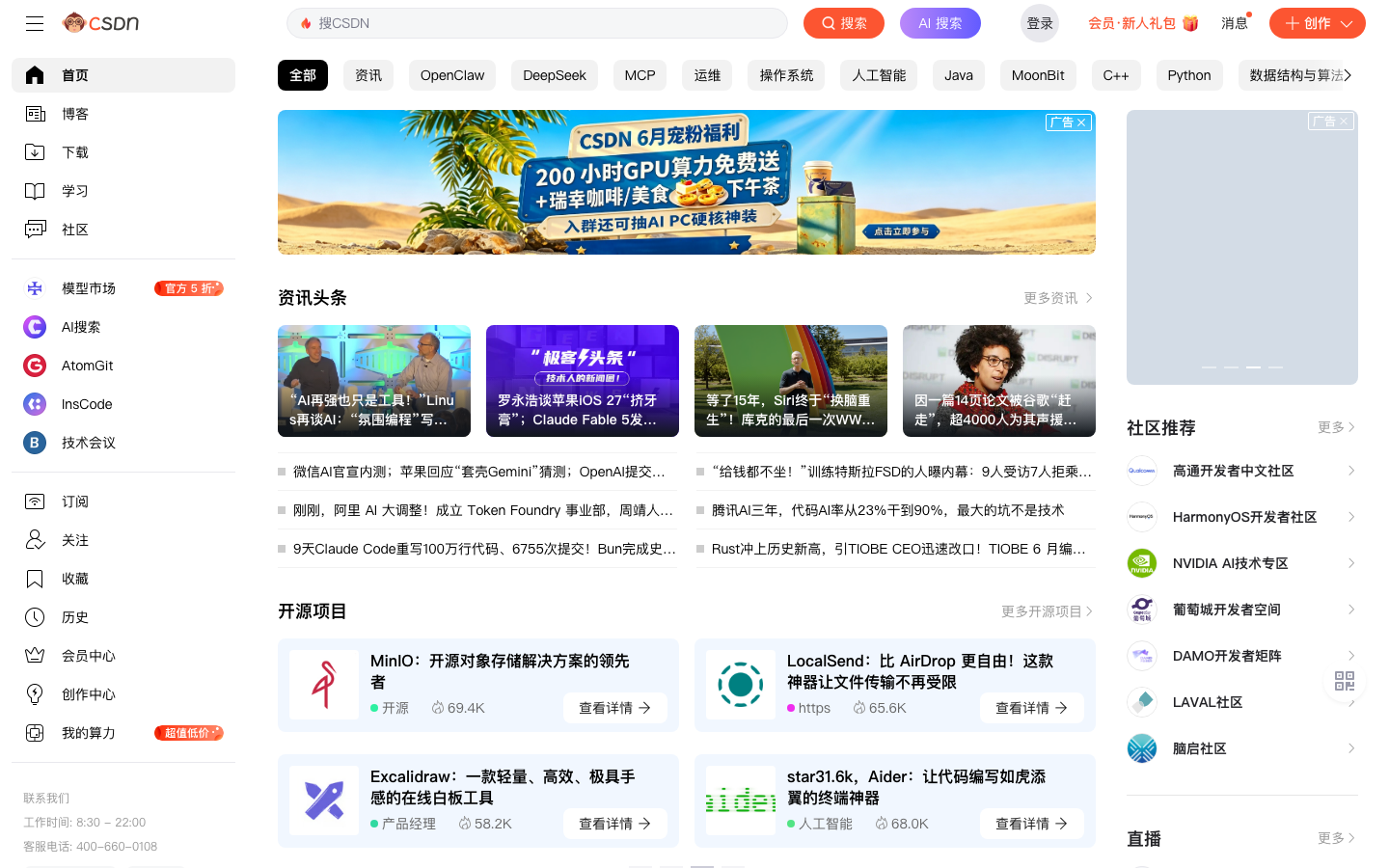
CSDN is a technical community for Chinese developers. It is officially positioned as a "professional developer community". In addition to blogs, Q&A, downloads and courses, it has gradually added AI Q&A assistants and online programming capabilities, becoming a high-frequency entrance for developers to check information, learn technology and troubleshoot.
Tool text
Core parameters and statistics
Specific technical parameters (such as model size, context length, supported file formats, input and output restrictions, etc.) are subject to the official product page. It is recommended that users verify the latest technical specifications and system requirements before choosing to ensure that they match their own usage scenarios.
User and market recognition
CSDN's recognition among Chinese developers is mainly reflected in content coverage and retrieval habits, rather than a single public operation number (official real-time activity data is not uniformly disclosed).
Search Habits: When troubleshooting error reports and checking framework usage in a Chinese context, CSDN is often one of the high-frequency sources in search engine results, indicating that its content has been embedded in developers' daily workflow.
Content Ecology: A large number of blogs come from community authors, and the quality is widely distributed - there are high-quality original practices, but also reprinted, repeated and timely content, which requires a certain screening ability when using them.
Prerequisites for implementation: The premise for using CSDN as an efficient entrance is that developers can quickly determine the content timeliness and applicable versions, and cross-verify key steps with official documents.
Cost advantage
The cost advantage of CSDN is that the core content is free to read, lowering the entry threshold for learning and consulting to close to zero, and then covering in-depth needs through membership and value-added services.
- C-side free tier: Most blogs and Q&A content can be browsed for free to meet daily troubleshooting and learning needs.
- Membership/Value-added: Some resource downloads, courses and membership rights are paid. The specific rights and prices are subject to the official website.
- Hidden Cost: The real cost is not in the subscription fee, but in content screening - when encountering outdated or imprecise content, extra time is needed for cross-verification to avoid being misled by wrong steps.
Main functions
CSDN’s capabilities are organized around the four actions of “search, learn, ask, and do”:
- Technical Blog: Long articles in Chinese to accumulate practical experience, error resolution and framework tutorials, suitable for retrieving specific problems.
- Technical Q&A: Questions and answers around specific issues, supplementing the immediate help scenarios outside of the blog.
- Resource downloads and courses: Provides code resources, documents and systematic courses, covering learning paths from entry to special topics.
- AI Q&A Assistant: Answer technical questions or explain errors in a conversational manner, reducing cross-page search costs.
- Online Programming (InsCode): Run and verify the code directly in the browser, extending "watching tutorials" to "running".
The actual value of each function mainly depends on the content timeliness and version matching, and whether the AI answers incorporate the latest framework practices.
Model and version evolution
Continuous iterative updates, the latest version introduces performance optimization and new features. Historical version information can be viewed on the official release page. There is no complete public version evolution timeline yet. It is recommended to pay attention to the official announcement to understand the rhythm of feature updates.
Technical advantages
The advantage of CSDN comes from "Chinese content scale + integrated learning link" rather than a single technical indicator.
Chinese search efficiency: The long-term accumulation of Chinese technical content allows native developers to reduce language switching and translation costs when troubleshooting.
Link Integration: Blog reading AI questioning and online operation are placed on the same platform, reducing the switching back and forth between "checking information-copying code-opening a new context verification".
Community-driven updates: The content is continuously contributed by a large number of authors, with wide coverage and fast updates. However, the quality varies and needs to be used in conjunction with official documents.
How to use
| How to use | Suitable for scenarios | Features |
|---|---|---|
| Web browsing | Search for error reports and tutorials | You can read most content without logging in |
| Register and log in | Ask questions, collect, and participate in the community | Post blogs, ask questions, and manage resources |
| Online programming | Verify code snippets | Run in the browser, no local context required |
| AI Q&A | Explain error reporting and questioning concepts | Obtain technical answers in a conversational manner |
Typical usage is: first use search to locate relevant blogs or Q&A, then use AI assistant to ask for unclear details, directly verify the code in the online programming environment if necessary, and finally return to the official documents to confirm the version compatibility of key steps.
Product Pricing
The pricing model is subject to the official real-time page. Usually a freemium or subscription system is used, and basic functions can be used for free. Advanced functions or high-frequency use require paid subscriptions, and users are advised to evaluate the optimal solution based on actual usage.
Application scenarios
- Daily Troubleshooting: When encountering errors or exceptions, search for Chinese solutions and quickly locate common problems.
- Technical Learning: Understand the usage of a certain framework, language or tool through blogs and course systems.
- Quick Verification: Run through a short sample code in an online programming environment to verify the feasibility.
- Knowledge Precipitation: Developers write their own practices into blogs to review and build technical influence.
Applicable people
- Chinese-native developers: People who prefer Chinese materials and need to efficiently retrieve error reports and tutorials will benefit most.
- Learning Stage Users: Students and career changers can use courses and blogs to build systematic knowledge.
- Content Contributors: Developers who want to accumulate experience and build technology brands.
Less suitable situations are: key decisions that require authoritative and strict version correspondence (such as production bounded core configuration). In this case, official documents should prevail, and community content should be used as a supplement rather than the only basis.
Summary and Outlook
The core value of CSDN lies in the huge Chinese technical content and the integrated link of "search, learn, ask, and do". It is still a high-frequency entrance for Chinese developers' daily troubleshooting and learning. Its limitation is that the content quality varies, requiring users to have screening and cross-validation capabilities.
What is worth observing in the future is the maturity of AI Q&A and online programming capabilities - if the AI assistant can be more stably combined with the latest framework practices and the online context can cover more languages and dependencies, CSDN has the opportunity to further transform from a "content community" into a lightweight learning and experimentation platform for Chinese developers. Please refer to official real-time information for specific capabilities, rights and prices.
Related tools:  Khanmigo, quizlet
Business process integration and ROI analysis
As a productivity tool for enterprises or professional positions, the true value of CSDN depends on the depth of integration with existing workflows and the quantifiable efficiency improvement effect. The following is a systematic analysis from three core dimensions.
System integration and data interoperability The ability to interoperate with existing business systems is a key prerequisite for productivity tools to be integrated into workflows. It is recommended to focus on evaluating the following integration dimensions: the openness and documentation quality of the RESTful/GraphQL API (whether a complete API reference and SDK examples are provided), the support scope of Webhook event notifications (which business event types are supported for automatic push), the number and depth of pre-built integrations with common collaboration SaaS tools (WeChat Enterprise, DingTalk, Feishu, Slack, Notion, Jira, etc.), and enterprise-level identity authentication support (SSO/SAML/OAuth and LDAP/AD directory integration). Products that lack integration capabilities are easily isolated into information islands, which in turn increases the cognitive cost and operational friction for teams to switch between different tools.
Efficiency Quantification and ROI Estimation Methodology Before purchasing decisions, it is recommended to quantify the input-output ratio through a structured method: Step 1, choose 3-5 Standardized tasks that are frequently repeated and time-consuming in each team are used as test samples; in the second step, the average time consumption of a single task before and after tool intervention, first-time pass rate or error rate, and the number of links requiring manual intervention are recorded under controlled conditions; in the third step, the saved manpower time is converted according to the comprehensive cost of the position (salary, benefits, management sharing), and soft benefits (increased employee satisfaction, standardization of work quality, and improvement in response speed to core business) are superimposed to obtain a comprehensive ROI estimate. It is recommended to continue tracking ROI trends on a monthly basis, as the value of a tool usually increases over time as team proficiency increases and workflows are optimized.
Phase-based implementation strategy and risk control It is recommended to adopt a three-stage implementation path of "pilot verification-gradual promotion-continuous optimization". In the pilot stage (1-2 weeks), a single team or a single business scenario is selected for small-scale verification. The core goal is to verify technical feasibility and user acceptance, and establish preliminary usage specifications and success standards; in the promotion stage (2-4 weeks), after the pilot verification is passed, the coverage is gradually expanded, and standardized activation processes and training materials are developed; in the optimization stage (continuous), the workflow configuration is continuously adjusted based on actual usage data and user feedback, and more high-value application scenarios are explored. Clear quantitative key result indicators should be set at each stage to avoid blindly expanding the scope of use without data support.
Version Info
- CSDN community current version :The site is a continuously iterative web and mobile community service. The unified version number has not been disclosed to the public. It is recorded here in the observable current service form. There is no official precise version date yet.
- Online programming and AI capability expansion :Based on the original blog and Q&A, the community has gradually introduced online programming (InsCode) and AI Q&A assistant to expand the link from "reading content" to "doing experiments". The specific launch time is subject to official information.
User Reviews