 CuspAI
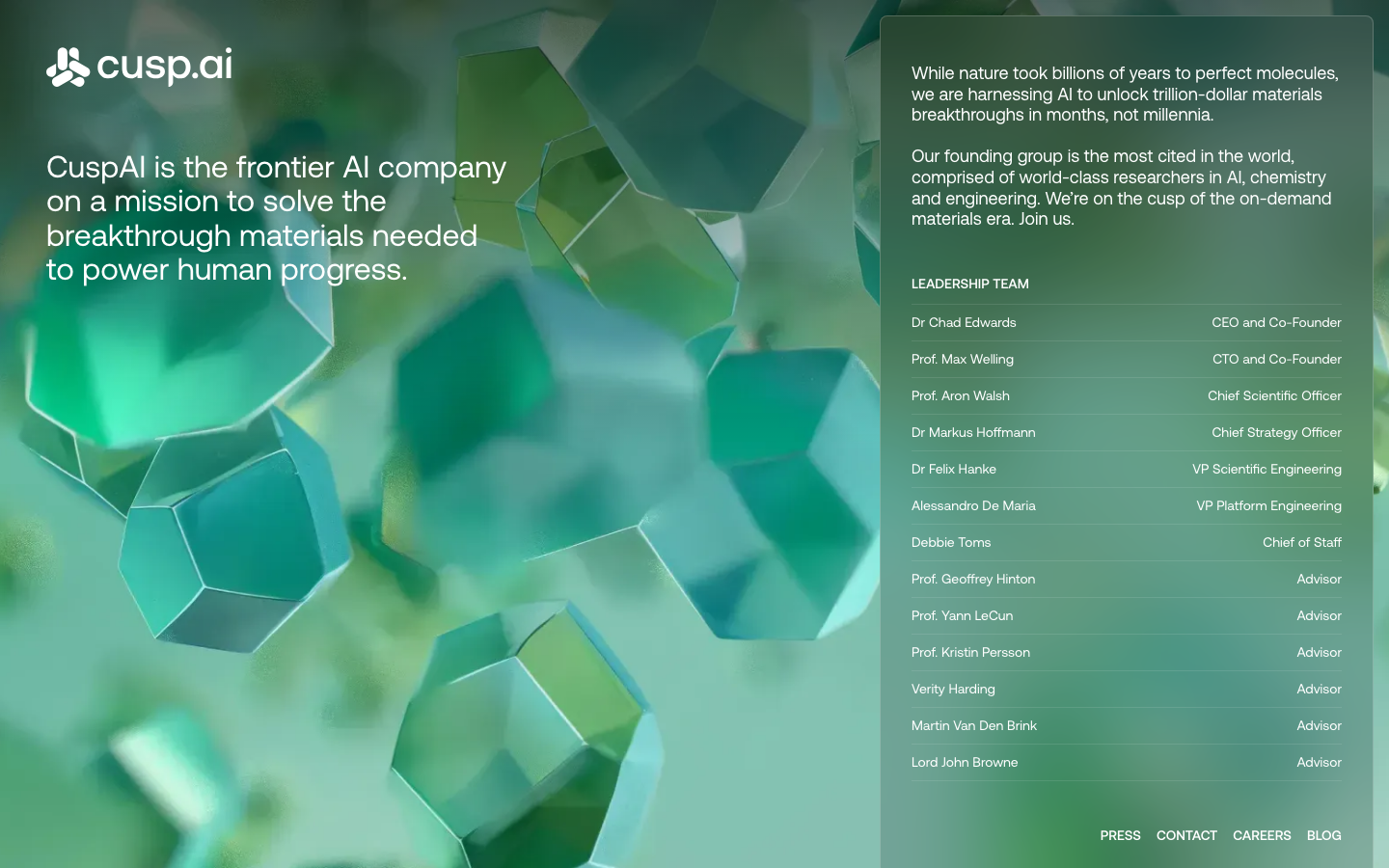
CuspAI is a generative AI company oriented towards the discovery of new materials. It combines generative models with physical simulations. The goal is to design molecules and materials with specific properties on demand, focusing on sustainable directions such as carbon capture and energy storage. Its service targets are scientific research institutions and industrial R&D teams, rather than individual consumers.
CuspAI
Core parameters and statistics
CuspAI is a research and development company that uses generative AI for the discovery of new materials. Its core proposition is to transform materials from "screening in known libraries" to "direct generation based on target performance." It is not a content generation tool for the public, but a scientific computing platform for scientific research and industrial R&D.
| Projects | Public Information |
|---|---|
| Official positioning | Generative AI platform for material discovery |
| Capability Portfolio | Generative Model + Physical/Chemical Simulation |
| Key directions | Carbon capture, clean energy, sustainable materials |
| Founding Team | Max Welling, Chad Edwards |
| Headquarters | Cambridge, UK |
| Service objects | Scientific research institutions, corporate R&D teams |
| Business model | Enterprise/scientific research cooperation (non-self-service consumption) |
| Price | Undisclosed, subject to business communication |
Positioning Interpretation: Traditional material research and development relies on a large number of experiments and trials, which results in long cycles and high costs. The value of CuspAI is to first use a generative model to propose candidate structures, then use simulation to filter out infeasible items, and condense the experiment to the few most promising candidates.
Boundary Note: Its output is "candidate materials and performance predictions" and cannot replace experimental verification; the real implementation still requires coordinated cooperation between wet laboratories and pilot tests.
User and market recognition
CuspAI's recognition mainly comes from the team background and research direction, rather than public user scale data.
Team signal: Co-founder Max Welling is a well-known scholar in the field of machine learning and graph neural networks, which gives CuspAI strong academic and engineering appeal in the direction of "AI for science".
Direction Recognition: The company focuses on carbon capture and sustainable materials, which meets the industry’s urgent needs for new adsorption materials and battery materials. It is a high-value track that capital and research institutions are paying attention to.
Items to be verified: The specific financing scale, list of cooperative enterprises, quantity of materials delivered and other data have not been officially disclosed by the official system. They should be subject to official real-time disclosure and should not be regarded as established facts based on rumors.
Cost advantage
CuspAI’s cost logic is not “cheap subscriptions” but “reduce the total trial-and-error cost of materials R&D.”
- C client/individual: Self-service subscription is not available to individual users, and individuals cannot purchase and use it on a monthly basis.
- Developer/API: Whether to provide external API or model interface is not disclosed and needs business confirmation.
- Enterprise/Scientific Research: Billed in the form of cooperative research and development or customized projects. The price and delivery scope require business communication and are subject to official real-time communication.
True cost structure: For the purchaser, the explicit expenditure is the cooperation fee, and the implicit benefit is moving the expensive experimental trial and error to the calculation and screening stage. When evaluating, you should focus on the candidate hit rate, experimental verification conversion rate, and the cost of docking with your own experimental system, rather than simply comparing platform quotations.
Main functions
CuspAI’s capabilities revolve around “generating and screening materials based on target performance”:
- Goal-directed material generation: Reversely generate candidate structures with desired properties (such as adsorption capacity, stability) as constraints.
- Physical/Chemical Simulation Evaluation: Predict the properties of generated candidates and filter out obviously unfeasible solutions.
- Sustainability Specialization: Accumulate task-related modeling capabilities in carbon capture, energy storage and other directions.
- R&D process collaboration: Connect AI candidates with experimental verification to form a "generation-simulation-verification" cycle.
The key to functional value is candidate quality: what really matters is not the quantity generated, but the proportion that can be verified after entering the experiment.
Model and version evolution
CuspAI operates as a continuously iterative R&D platform, rather than a consumer-grade software released according to public version numbers.
- 2024 (Establishment Period): The company is established and the direction of generative AI material discovery is established, and platform and collaborative research are launched.
- 2026 (current online form): Use the R&D platform to connect with partners and continue to strengthen model generation and simulation capabilities.
Since the official unified version number and precise release date have not been disclosed, the version context is expressed in public milestones, and specific capabilities are subject to official real-time disclosure.
Technical advantages
CuspAI’s technical advantage comes from the combination of “generation + simulation” rather than a single large model:
Mechanism: The generative model is responsible for proposing new candidates in the huge chemical/structural space, and the simulation section is responsible for predicting the physical feasibility and performance of the candidates.
Effect: Compared with pure experimental trial and error or pure database screening, this combination can explore a larger space while using simulation constraints to reduce invalid candidates.
Applicable scenarios: Most suitable for R&D tasks where the target performance is known but there is a lack of ready-made materials, such as designing adsorption materials for specific CO₂ capture conditions.
The price is the high reliance on computing resources, simulation accuracy and experimental loops, and the value of the platform is highly dependent on the quality of back-end simulation and verification.
How to use
CuspAI currently provides capabilities through collaborative research and development, not as a self-service tool that can be registered and used:
| Access method | Suitable objects | Features |
|---|---|---|
| Official website contact | Scientific research institutions, corporate R&D | Communicate cooperation intentions and needs through the official website |
| Customized projects | Teams with clear material goals | Co-constructed R&D processes around specific performance goals |
Typical collaboration is usually promoted by "clear target performance → AI generation candidates → simulation screening → experimental verification". It is necessary to align the target indicators and verification standards before implementation, otherwise it will be difficult to incorporate the generated results into the existing R&D system.
Product Pricing
The pricing model is subject to the official real-time page. Usually a freemium or subscription system is used, and basic functions can be used for free. Advanced functions or high-frequency use require paid subscriptions, and users are advised to evaluate the optimal solution based on actual usage.
Application scenarios
CuspAI’s scenarios focus on the upstream of materials research and development:
- Carbon Capture Material Design: Generate and screen candidate adsorption materials for specific capture conditions, with verification focusing on consistency between simulation and experiment.
- Clean Energy Materials: Exploration of new materials in energy storage, catalysis and other directions, focusing on the synthesizability of candidates.
- Scientific Research Acceleration: Expand the search space for material exploration, and use simulation to reduce invalid experiments. The focus of verification is the hit rate.
Applicable people
- Materials Research Institutions: laboratories that need to expand exploration space and shorten discovery cycles.
- Industrial R&D Team: Enterprises looking for new materials in the fields of energy, chemical industry, and carbon management.
- AI for science team: Researchers who want to embed generative models into real R&D loops.
Unsuitable situations are: those who lack experimental verification capabilities, only want a ready-made material list, or do not have clear target performance - such scenarios are difficult to play the value of "generation-simulation-verification".
Summary and Outlook
CuspAI’s core competency lies in using generative AI to push material discovery from passive screening to active design, with sustainable direction as the entry point. Its actual value is highly dependent on simulation accuracy and experimental verification. In the short term, it is still a professional platform for R&D institutions rather than a general tool.
The current limitation lies in the limited public information: key data such as financing, customers and verified results have not been disclosed systematically, and the true hit rate of candidate materials also needs to be supported by more public cases. For potential partners, it is recommended to first conduct a small-scale verification with a clearly defined material target, focusing on examining the conversion rate and docking cost of the candidate after entering the experiment, and then decide whether to expand cooperation; the ownership of intellectual property rights, data confidentiality, and delivery acceptance terms should be clarified before purchasing.
Version Info
- CuspAI R&D Platform (online version) :Currently, it connects with partners in the form of an online R&D platform to continuously and iteratively generate models and material simulation capabilities. The official unified version number has not been disclosed, and there is no official precise date yet. It is recorded according to the current public form.
- Company establishment and platform launch :The company was established in 2024 and disclosed the direction of generative AI material discovery, launching platform and collaborative research. There is no official precise date yet, it is recorded based on the time of public disclosure.
User Reviews