 Dagster
Free
Dagster
Free
Dagster is a data asset-centric AI data processing orchestration platform that helps data teams build, test, and monitor reliable data pipelines.
Dagster
Dagster’s core parameters and statistics
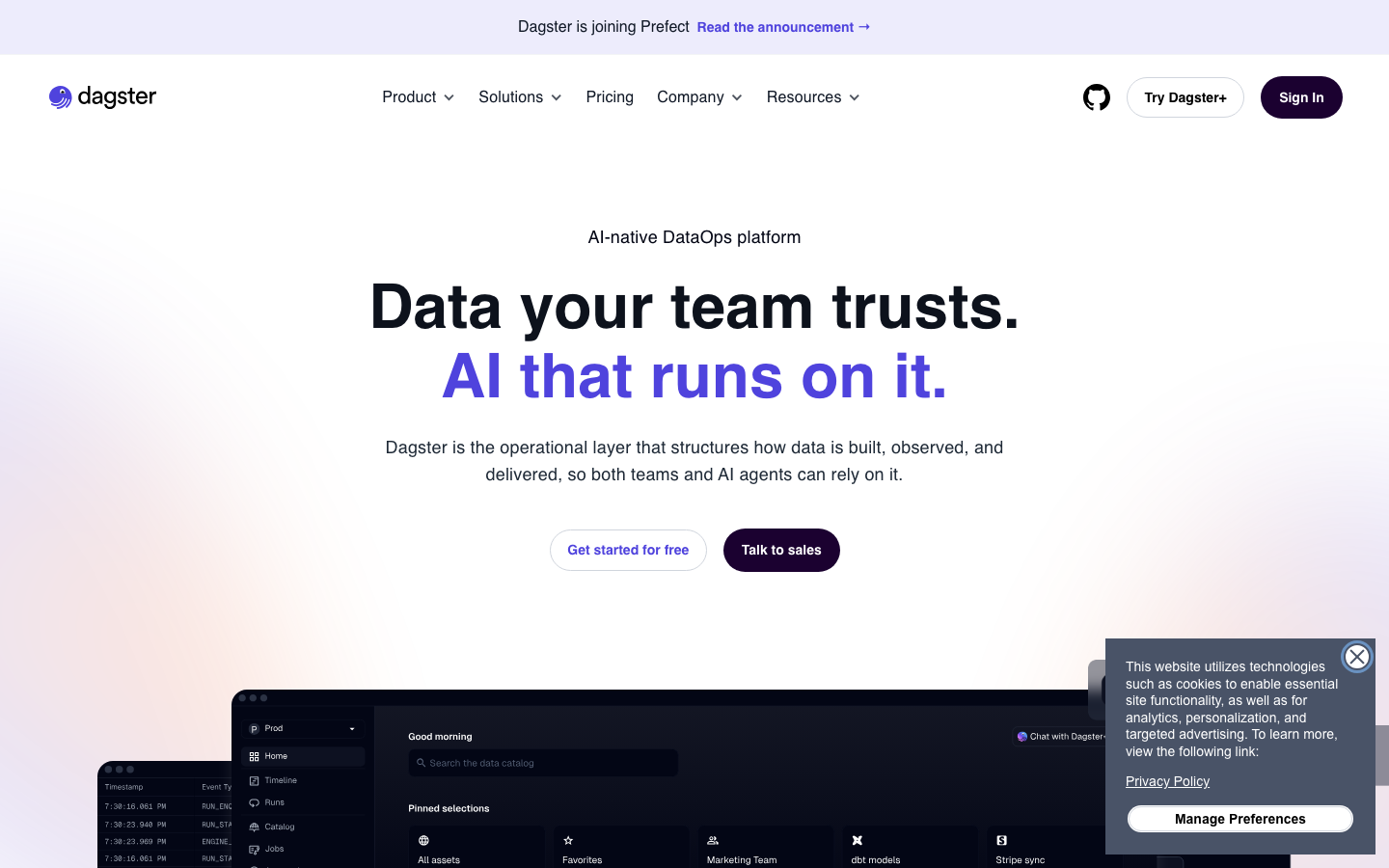
Dagster is a data asset-centered AI-native DataOps orchestration platform, officially positioned as "data your team trusts, AI that runs on it". Unlike traditional schedulers that only track whether a job is completed, Dagster understands the dependencies between assets (tables, files, models, reports) and attaches lineage, quality signals, and execution context to each asset, allowing both data teams and AI agents to work on trusted data.
| Parameters | Public information |
|---|---|
| Official positioning | AI-native DataOps platform, orchestrating, observing and activating data with data assets as the center |
| Core form | Python SDK + Dagster Web UI (Dagit) + API + Dagster+ Cloud |
| Target users | Data engineers, data scientists ML engineers, data analysts, platform engineers |
| Core Technology | Software-defined Assets, Asset Graph, Hybrid Deployment Architecture |
| Open Source License | Apache 2.0 |
| Deployment method | Self-hosted open source / Dagster+ Cloud (Solo / Starter / Pro three-tier) |
| Programming Language | Python (Core Engine) + TypeScript (Web UI) |
| GitHub Stars | ~15.9k |
| GitHub Forks | ~2.2k |
| Contributors | 649+ |
| Latest Release | 1.13.14 (Core) / 0.29.14 (Libraries), released on 2026-07 |
| Customer Cases | Kraft Heinz, Vanta, Bayer, Fanatics, AMD, EasyJet Holidays, Tampa Bay Rays, etc. |
| Integrated Ecosystem | Mainstream data tools such as dbt, Snowflake, Fivetran, Airbyte, Databricks, Spark, etc. |
The paradigm difference between asset first vs task first: Airflow takes DAG (task dependency graph) as the core, users define tasks and their execution order, and data is a "by-product" of the tasks; Dagster takes assets as the core, users declare data assets and their upstream and downstream relationships, and the system automatically derives the tasks that need to be run. The direct effect of this difference is that when adding a report, Airflow users need to manually insert a new task and adjust upstream and downstream dependencies; Dagster users only need to declare new assets, and the system will automatically embed them in the asset graph. For a complex data platform with 50+ assets, the maintenance cost of the former increases linearly with the number of assets, while the maintenance cost of the latter is basically constant.
Dagster+ AI positioning: Dagster's AI capabilities are not independent model products, but an intelligent operation and maintenance layer embedded in the orchestration platform - using the platform's existing metadata such as asset lineage, operation history, failure context, etc. to provide fault diagnosis, active monitoring and AI automatic repair capabilities. The goal is to push the data platform from "passive response" to "active discovery and automatic repair".
Dagster’s users and market recognition
Dagster's market recognition comes from two dimensions: open source community activity and enterprise-level customer verification. The latter provides verifiable data with more reference value.
Open source community size: GitHub has approximately 15.9k stars, 2.2k forks, 649 contributors, and 421 Releases, indicating that the project has passed the early verification stage and has a healthy community contribution and version iteration rhythm. The community ecosystem includes Slack channels (approximately 20,000+ members), Stack Overflow tags, and official blogs.
Enterprise-level customer verification: Dagster’s official website has disclosed multiple well-known enterprise customer cases, including Kraft Heinz (food giant), Vanta (safety compliance platform), Bayer (life sciences), AMD (chip manufacturer), Fanatics (sports e-commerce), EasyJet Holidays (travel), Tampa Bay Rays (MLB team), etc. These customers cover finance, manufacturing, retail, technology, sports analysis and other industries, indicating that Dagster has passed production context verification in organizations with different data maturity levels.
Quantitative Benefit Cases: According to customer stories disclosed on the official website, Vanta's data freshness increased from 7 hours to 30 minutes (14 times); Magenta Telekom's developer onboarding time was shortened from 3 months to 1 day (90 times); EasyJet Holidays' pipeline execution time was reduced from 2.5 hours to 10 minutes (15 times efficiency improvement); Tampa Bay Rays' analysis delivery speed increased 70%; Clippd completely eliminates manual tasks, saving 8 hours of labor per week.
Market position: In the open source data orchestration track, Dagster, Apache Airflow, and Prefect constitute the three main options. Airflow occupies the largest installed base with its earliest market entry and richest connector ecosystem. Prefect is known for its "Pythonic" development experience. Dagster's differentiation lies in its "asset-first" data governance model and native adaptation for AI/ML workloads. The three are not strictly substitutes. It is more common for teams to make choices based on their own data governance needs and workload types.
Dagster’s cost advantage: Use open source self-hosting to lower the entry barrier for orchestration, and determine the timing of cloud migration based on scale
The cost advantage of Dagster is not its absolute low price, but its flexible structure of "free open source core + pay-as-you-go cloud hosting", which allows teams to find the optimal cost point based on their own operation and maintenance capabilities and data scale.
C-side/open source self-hosting: zero subscription fee, operation and maintenance is the cost. The Dagster core engine and Dagit Web UI are completely free under the Apache 2.0 license. For data teams with Python operation and maintenance capabilities, self-hosting means that the explicit subscription cost is zero, but the labor costs of infrastructure (servers, storage, network) and ongoing operation and maintenance (version upgrades, failure recovery, security patches) need to be borne. Taking a data team of 3-5 people as an example, the annualized operation and maintenance cost of self-hosting is about 20,000-80,000 yuan (including server rental and part-time operation and maintenance hours), which is suitable for organizations with sensitive budgets and teams with DevOps capabilities.
Developer/Dagster+ Cloud: Starting from free quota, billing is based on the number of asset materializations. Dagster+ uses a credit billing model—each asset materialization or op execution consumes 1 credit. The Solo plan has a monthly fee of $10 ($0.040/credit based on volume), and the Starter plan has a monthly fee of $100 ($0.035/credit based on volume). Both provide a 30-day free trial. For a medium-sized data platform that performs an average of 500 asset materializations per day, the monthly fee for the Solo plan is about $10 + excess credit fees, and the annualized cost can be controlled at the level of several thousand dollars.
Enterprise/Pro plan: business confirmation required. The Pro plan offers unlimited code locations, unlimited deployments, cost tracking SSO/SAML, audit log SLA and dedicated support channel. Contact sales for pricing. For organizations with data sovereignty requirements, Dagster supports hybrid deployments—compute runs on own infrastructure and the control plane is hosted by Dagster.
Cost comparison of open source orchestration frameworks (deduction)
| Cost dimensions | Dagster (self-hosted) | Apache Airflow (self-hosted) | Prefect (self-hosted) |
|---|---|---|---|
| Open Source License Fee | $0 (Apache 2.0) | $0 (Apache 2.0) | $0 (Apache 2.0) |
| Infrastructure (Team of 3-5 people/year) | ~$3K-12K (including servers and bandwidth) | ~$3K-15K (Airflow components are more) | ~$3K-10K |
| Initial learning curve (engineer weeks) | ~1-2 weeks (asset model) | ~1-3 weeks (DAG definition) | ~0.5-1 week (Pythonic) |
| Cloud hosting starting price | $10/month (Solo) | Mainly self-hosted (MWAA and other hosting services are additional) | Undisclosed, subject to the official website |
| Enterprise version annual fee (deduction) | Business confirmation required | Business confirmation required | Business confirmation required |
| Vendor lock-in risk | Low (open source core, self-hosted) | Low (open source core) | Medium (core functionality relies on cloud services) |
Hidden Cost Tip: The true total cost of an orchestration platform is not just the subscription fee, there are additional expenses for connector maintenance, resource consumption for failed retries, cross-team permissions governance, and GPU scheduling of AI workloads. Dagster's credit billing model directly links costs with data activities, which is conducive to ROI calculations. However, you need to pay attention to the credit consumption speed in high-frequency scheduling scenarios.
Main functions of Dagster
Dagster's capabilities are designed around "full lifecycle management of data assets", covering the complete link from declaration, orchestration, observation to AI-assisted diagnosis.
-
Software-defined Assets: Use Python functions to directly declare data assets and their upstream and downstream dependencies, and the system will automatically deduce the execution sequence. There is no need to manually modify the pipeline definition when adding assets. Dependencies in the asset graph are implicitly declared by the parameter signature of the function. Suitable for dbt model management, SQL view update, ML feature table construction and other scenarios. Acceptance focus: After the number of assets exceeds 200, whether the execution plan automatically derived by the system is still predictable, and the accuracy of dependency detection.
-
Branch Deployments: Verify pipeline changes in an isolated sandbox environment and merge them into the production environment after passing them. Each Git branch corresponds to an independent set of Dagster deployments, including a complete asset graph and execution history. Especially important for AI/ML workflows - data scientists can iterate feature engineering pipelines on branches without affecting production data flow.
-
Event-driven automation (Sensors & Schedules): Supports cron-based time scheduling and event-based sensor triggers. The sensor can monitor external signals such as new S3 files, database table update Webhook callbacks, etc., and automatically trigger the materialization of related assets. Acceptance concerns: The impact of sensor polling intervals on execution delays in high-frequency event scenarios, and the idempotence guarantee between sensors and actuators.
-
Asset Checks: For key data asset configuration quality rules (row number fluctuation range, null rate threshold schema consistency, etc.), verification is automatically performed after each materialization. Block downstream consumption and send alerts (Slack, PagerDuty, etc.) on failure. Dagster also supports integrating dbt test, which directly maps dbt test results to asset inspection events.
-
Dagster+ AI Intelligent Operation and Maintenance: As the AI capability layer of Dagster+, it provides three core modules - Conversational Fault Diagnosis (Chat with Dagster+ AI): Use natural language to ask "Why did yesterday's pipeline fail?", and AI provides root cause analysis based on execution context and logs; Active Monitoring: Periodically scans the deployment context, automatically creates Issues to report failure modes; AI Automatic Repair: Starting from the Issue, an AI coding agent is dispatched to create repair code and upload it to GitHub Submit as a PR. This feature is currently in the early preview stage, and you need to contact the Dagster team to activate it.
-
Asset Lineage and Data Catalog: End-to-end tracking of the source and destination of each asset, supporting Column-level Lineage. Dagit UI displays dependencies between assets in an interactive directed graph, supporting search and focus modes. The Catalog function provides a read-only view for non-technical stakeholders, reducing cross-role communication costs.
Functional synergy: The above functions are not isolated capability points, but form a chain of "declared assets → automatic orchestration → quality verification → anomaly detection → AI diagnosis → automatic repair". For example, when an upstream data source schema change causes multiple downstream asset quality checks to fail, Dagster can automatically mark the affected assets, notify the relevant person in charge through an alarm, and generate an Issue in Dagster+ AI for further diagnosis, reducing the troubleshooting time of data engineers.
Dagster’s model and version evolution
Since Dagster was open sourced around 2020, it has experienced three stages of evolution, from "task orchestrator" to "asset center platform" to "AI-native DataOps platform".
Early stage: DAG orchestration and asset concept establishment (2020-2022)
- 0.x Series (~2020-2022): Establish core orchestration capabilities and support basic DAG definition and execution. An early concept prototype of Software-defined Assets was introduced, but the main user interface is still based on traditional op/job (task/job). Dagit UI provides basic execution status visualization.
- 0.12.x - 0.15.x: Gradually improve asset abstraction and introduce production-level capabilities of Asset Groups, Sensors and Schedulers. Enterprise-level users began to appear in the community.
1.x Series: Asset Center Model Maturity (2023-2025)
- 1.0 (2023): The official release of version 1.0, marking the software-defined asset model entering a stable state. Core API frozen, providing backward compatibility guarantees. Dagit UI has been massively refactored to support interactive exploration of asset graphs.
- 1.1 - 1.5: Introducing the Asset Checks quality framework, Partitions and Backfills capabilities. Deep integration with dbt, Snowflake, and Fivetran has entered a stable period.
- 1.6 - 1.9: Column-level Lineage is officially launched to enhance the data directory function. Introduce automatic execution (Auto-materialize) strategy to reduce manual intervention.
- 1.10 - 1.13: Dagster+ Cloud service gradually matures, launching Solo / Starter / Pro three-tier pricing. Introducing Branch Deployments and Components abstract framework. Started internal testing of Dagster+ AI capabilities.
Latest version: 1.13.14 (2026-07)
The latest verifiable Release on GitHub is 1.13.14 (Core)/0.29.14 (Libraries), which was released in July 2026. This version continues the high-frequency iteration rhythm (421 Release history), mainly focusing on stability improvements, UI enhancements and AI capability expansion. The version description is subject to the official CHANGES.md.
Dagster’s technical advantages
Dagster's technical competitiveness comes from the three-layer architecture of "asset model + event drive + AI enhancement" rather than a single performance indicator.
Software-defined asset model (mechanism → effect → scene): Traditional orchestrator requires users to define pipelines from a "task-dependency" perspective, and the data is the "result" after execution. Dagster elevates data assets to first-class citizens - developers use Python functions to declare assets and their upstream and downstream sources, and function parameters automatically deduce dependencies. The effect is: adding new assets does not require manual adjustment of DAG, and the asset graph evolves automatically; the blood relationship of assets no longer needs to be maintained separately because it is implicitly defined by the code structure. Applicable scenarios include rapidly changing data warehouse models (dbt models are frequently added, deleted, and modified) and ML feature engineering (feature columns are freely combined as asset sub-nodes). Mechanism Boundary: Asset models work great with highly dynamic dependency graphs (changing every hour), but extremely linear ETL processes (such as fixed 3-step data import-transform-export) are more intuitive using traditional DAGs, where the abstraction layer of the asset model is redundant.
Event-driven engine and hybrid computing architecture: Dagster's sensor framework supports two triggering modes: time-based (cron) and event-based (S3 file arrives at DB table to update Webhook). In Dagster+ Cloud, Hybrid Deployment allows computing to run on own infrastructure and the control plane to be managed by the cloud. This means users can take advantage of the cloud’s scheduling and observation capabilities without exposing their internal networks. The effect is: it not only meets data sovereignty requirements, but also reduces the operation and maintenance burden of the control plane. Applicable scenarios include finance, medical and other industries that have compliance requirements for data residency.
Context-driven design of Dagster+ AI: Dagster+ AI does not rely on external large models for general reasoning, but uses the existing rich metadata of the Dagster platform (asset lineage, running history, execution logs, quality inspection results, failure context) as the knowledge base of AI. When a user asks "Why did it fail?" the AI has access to the full context of that run, rather than just snippets of the log. This has a more accurate diagnostic capability than the general ChatBot method of accessing log files, but the boundary of the capability is limited by the richness of the metadata collected by the Dagster platform itself - fault information from external systems (such as Snowflake-side query failure) can only participate in diagnosis after being captured by Dagster.
Project pitfalls and governance mechanisms:
- Execution Plan Predictability: After the number of assets exceeds 500+, automatically derived execution plans may contain unnecessary rematerialization. It is recommended to regularly review asset dependency definitions and mark assets without side effects as "skippable".
- Sensor polling overhead: In the scenario of high-frequency external events (second-level S3 file generation), sensor polling may become a bottleneck. It is recommended to connect high-throughput events to a message queue (such as Kafka), and then pull them in batches by the Dagster sensor.
- Safety Boundary for AI Repair: The automatic repair function of Dagster+ AI will create a GitHub PR. For production-bound irreversible operations (such as DROP TABLE, data deletion), a manual approval process should be set up to ensure that the AI-generated code is reviewed before merging.
How to use Dagster
Dagster provides multiple usage paths from local development to production deployment, suitable for teams of different stages and sizes.
| How to use | Suitable for the crowd | Features | Cost |
|---|---|---|---|
| Open source self-hosting | Data team with operation and maintenance capabilities | Install dagster and dagster-webserver packages, start Dagit UI locally; fully control the infrastructure |
Free (operation and maintenance costs are borne by yourself) |
| Dagster+ Cloud Solo | Individual developer/small team | Hosting service, no operation and maintenance; starting at $10/month, 30-day free trial | $10/month + volume credit |
| Dagster+ Cloud Starter | Growing data team | Multi-user collaboration, catalog search and other advanced features | $100/month + volume credit |
| Dagster+ Cloud Pro | Enterprise-level production platform | Unlimited resource SSO, audit SLA, dedicated support | Business confirmation required |
| Hybrid deployment | Enterprises with high compliance requirements | Computing in own computer rooms, control plane in the cloud | Business confirmation required |
Local quick start example:
# Install Dagster core package and Web UI
pip install dagster dagster-webserver

# Start local development environment (default port 3000)
dagsterdev
Minimum Asset Definition Example (Python):
import dagster as dg
import pandas as pd
from sklearn.linear_model import LinearRegression

@dg.asset
def raw_sales_data() -> pd.DataFrame:
    """Original sales data declared as assets"""
    return pd.read_csv("sales_2026.csv")

@dg.asset
def sales_model(raw_sales_data: pd.DataFrame) -> LinearRegression:
    """Training model, raw_sales_data is an upstream dependency"""
    X = raw_sales_data[["ad_spend", "promo_discount"]]
    y = raw_sales_data["revenue"]
    return LinearRegression().fit(X, y)
How to enable Dagster+ AI: Dagster+ AI is currently in the early preview stage, and you need to contact the Dagster sales team to activate it. After activation, you can use conversational troubleshooting, view AI-generated issues, and configure GitHub integration for automatic remediation directly in the Dagster+ console.
Best Practice Suggestion: New teams are recommended to start with a self-hosted or Solo solution and first access 1-2 core data pipelines to verify whether the asset model is consistent with team collaboration habits. After passing the verification, decide whether to upgrade to the Starter or Pro plan based on the data size. Hybrid deployment (Hybrid) is suitable for mature data platforms with clear data sovereignty requirements and infrastructure operation and maintenance capabilities.
Product Pricing for Dagster
The pricing model is subject to the official real-time page. Usually a freemium or subscription system is adopted, basic functions can be used for free, and advanced functions or high-frequency use require payment.
Application scenarios of Dagster
Dagster's implementation scenarios focus on the data platform construction process that requires "multi-tool collaboration + cross-role collaboration + data governance". The following four types of scenarios have been verified at scale.
-
Data warehouse modeling and management (dbt integration): The data engineering team uses Dagster to orchestrate incremental updates to the dbt model. Each dbt model acts as a Dagster asset, with the upstream source table and the downstream BI report dependency. When the schema of an upstream data source changes, Dagster automatically flags all affected downstream assets and triggers quality checks. Financial customers such as SMV Bank have verified the stability of this model on large-scale dbt models (more than 1,000). Implementation Tips: The execution order of the dbt model is determined by the Dagster asset graph rather than dbt's own dependency analysis. It is necessary to maintain a consistent dependency statement with dbt in Dagster to avoid execution plan conflicts.
-
ML feature engineering and model training pipeline: an end-to-end process from raw data cleaning, aggregation, feature calculation to model training and registration. Each feature column serves as an asset sub-node, and each update of training data automatically triggers feature recalculation and model retraining. Dagster's lineage tracing helps the ML team answer "whether the delay of a certain feature affects the model inference effect." EvolutionIQ (AI-driven insurance insights company) uses Dagster to reduce the testing and debugging of model updates from hours to minutes, and the customer go-live cycle is shortened from months to less than a week. Implementation Tips: The GPU resource allocation and experimental version management of the ML pipeline need to be designed in conjunction with Dagster's execution strategy. It is recommended to separate hyperparameter search and data preprocessing into independent asset groups.
-
Data quality governance and anomaly discovery: Key asset allocation quality rules (row number fluctuation > 20%, null value rate > 5%, schema field increase or decrease) are automatically verified after each materialization. Block downstream consumption on failure ("circuit break" mode) and send alerts via Slack/PagerDuty. Combined with Dagster+ AI’s proactive monitoring capabilities, the system automatically identifies and reports abnormal patterns. Implementation Tip: Quality inspection itself will also consume credit. It is recommended to appropriately relax the frequency of inspections for high-frequency and low-risk assets and focus in-depth inspections on core business assets.
-
Infrastructure layer of AI agent and LLM workflow: Dagster's latest official positioning clearly mentions AI agents - using Dagster as a "trust layer" to provide trusted data context for AI agents. Specific scenarios include: the AI customer service agent uses Dagster's lineage information to verify whether the data source of the answer is the latest; the code generation agent uses Dagster's branch deployment to verify the impact of code changes on the data flow. This scenario is in the early exploration stage, and the automatic repair function of Dagster+ AI is an initial productization attempt in this direction.
Applicable groups of Dagster
Dagster's polymorphic deployment method and asset center model serve four types of core roles, each with different usage depth and focus.
-
Data Engineers and Platform Engineers: Core user group, responsible for the construction, orchestration, and operation and maintenance of data pipelines. Benefit from the declarative model of software-defined assets—new pipelines do not require modifications to the DAG, and the automatic evolution of the asset graph reduces maintenance costs. Focus on deployment stability CI/CD integration and resource monitoring. Not suitable for boundaries: If the team only has 1-2 simple ETL scripts and does not require multi-role collaboration, the abstraction layer brought by Dagster's asset model is over-designed. Airflow or a lighter scheduling tool like Cron + Python script might be more straightforward.
-
Data Scientists and ML Engineers: Responsible for feature engineering, model training and model evaluation. Dagster's asset lineage helps trace feature sources and calculation logic, and branch deployment allows iterative experiments without affecting production environments. Not suitable for boundaries: If the workflow is mainly exploratory analysis (Jupyter Notebook interactive exploration) and requires frequent manual adjustment of pipeline logic rather than automated orchestration, Dagster's declarative asset model will bring unnecessary constraints. Notebook is more suitable for quick verification, and Dagster is more suitable for automated production processes after verification.
-
Data analysts and business stakeholders: View the metadata, lineage, and quality status of data assets through the Catalog and focus modes of Dagit UI, and understand "whether the data is trustworthy" without writing code. Prerequisite: Analysts need to understand the basic concept of "assets" (equivalent to the tables or reports they use daily), and the lineage information of data assets needs to be accurately maintained by the data engineering team in advance.
-
Data platform leader and technical decision-maker: Evaluate Dagster’s compatibility with existing tool chains, team learning costs, and long-term vendor lock-in risks. Dagster's Apache 2.0 license and open source self-hosted path provide the lowest risk of vendor lock-in and are suitable as a long-term data platform foundation. Decision Prerequisite: The team needs to have sufficient Python technical capabilities and DevOps practices, otherwise the operation and maintenance burden of self-hosting may exceed the cost of cloud hosting.
Summary and Outlook
Dagster has established a differentiated positioning on the data orchestration track through the combination of "asset-first orchestration model + hybrid deployment architecture + AI-enhanced operation and maintenance". It is not the most "old" orchestrator (Airflow's community ecosystem and number of third-party integrations are still leading), nor is it the most "lightweight" choice (Prefect's development experience is more Pythonic), but for medium and large data teams with data governance requirements, multi-role collaboration requirements, and AI/ML workloads, Dagster's asset center model provides an abstraction layer that is more in line with the needs of modern data platform construction.
Core Benefits: The software-defined asset model builds data lineage and quality checks into the orchestration engine, reducing the additional cost of maintaining a separate data catalog. 15.9k GitHub Stars, 649+ contributors, and high-profile enterprise customers validate its maturity in production environments. The active monitoring and automatic repair capabilities of Dagster+ AI provide a feasible evolution direction for the intelligent operation and maintenance of the data platform. Hybrid deployment architecture meets the compliance requirements of finance, medical and other industries.
Current Limitations:
- Learning Curve: The programming paradigm of the asset model is significantly different from the traditional DAG thinking. Data engineers with Airflow experience usually need 1-2 weeks to adapt to the development method of "declaring assets first and relying on automatic derivation". For teams used to explicitly defining the order of tasks, this switch may bring an initial loss of efficiency.
- Community ecological gap: Compared with Airflow's more than 1,000+ official/community providers, Dagster still has a smaller number of integrated connectors, and you may need to write your own integration code when encountering unpopular tools.
- Dagster+ AI Preview Status: AI fault diagnosis and automatic repair capabilities are in early preview, and feature boundaries, accuracy, and production-grade stability have not yet been verified at scale. Teams that rely on this capability need to be mentally and process prepared that "AI output still requires manual review."
- Credit consumption in large-scale scenarios: The cost of the credit billing model rises rapidly in high-frequency operation scenarios. Teams that perform tens of thousands of materializations per day need to negotiate with sales for customized packages. Although the self-hosted solution can avoid this problem, it requires the team to bear the burden of infrastructure operation and maintenance.
Follow-up observation points: Dagster recently announced its merger with Prefect ("Dagster is joining Prefect"). How this integration will affect the product roadmap, community governance and long-term support strategies of the two projects deserves close attention by existing and potential users. The concentration of resources after the merger may accelerate the construction of AI functions and connector ecology, but it may also bring uncertainty to the integration of technology stacks.
Procurement and Adoption Risk Assessment: For data teams already using dbt + Snowflake/BigQuery, Dagster is the most worth evaluating orchestration option - its deep integration with dbt can significantly reduce the orchestration complexity of data modeling scenarios. It is recommended to try out the self-hosted or Solo solution on 1-2 core pipelines first to verify the actual collaboration effect and team acceptance of the asset model. For teams considering migrating from Airflow, Dagster's software-defined asset model can coexist with existing dbt + Airflow solutions - manage new assets in Dagster first, and gradually migrate the Airflow DAG to the Dagster asset graph, reducing the risk of a one-time migration. Enterprises need to confirm before purchasing: the SLA and commercialization schedule of the data-resident boundary Dagster+ AI preview function in Hybrid deployment mode, as well as the long-term support commitment for existing Dagster products after merging Prefect.
How to use Dagster
- Web client: You can use it by visiting the official website and registering an account. Most functions do not require installation.
- API access: Provides RESTful API, developers can obtain the API Key and integrate it into their own applications.
Version Info
- Dagster 1.x :There is no official precise date yet, and data asset orchestration capabilities will continue to be iterated.
- Dagster 0.x :There is no official precise date yet, but early versions establish the core concepts of data asset orchestration.
User Reviews