 DALL-E
DALL-E is an AI visual design tool developed by OpenAI and is known for its high-precision understanding and execution of complex text descriptions. DALL-E 3 has been integrated into ChatGPT, allowing users to generate images directly in conversations without a separate subscription. The API version is for developers and supports on-demand generation, image editing and built-in content security filtering. It is a core component of the visual creation capabilities in the OpenAI ecosystem.
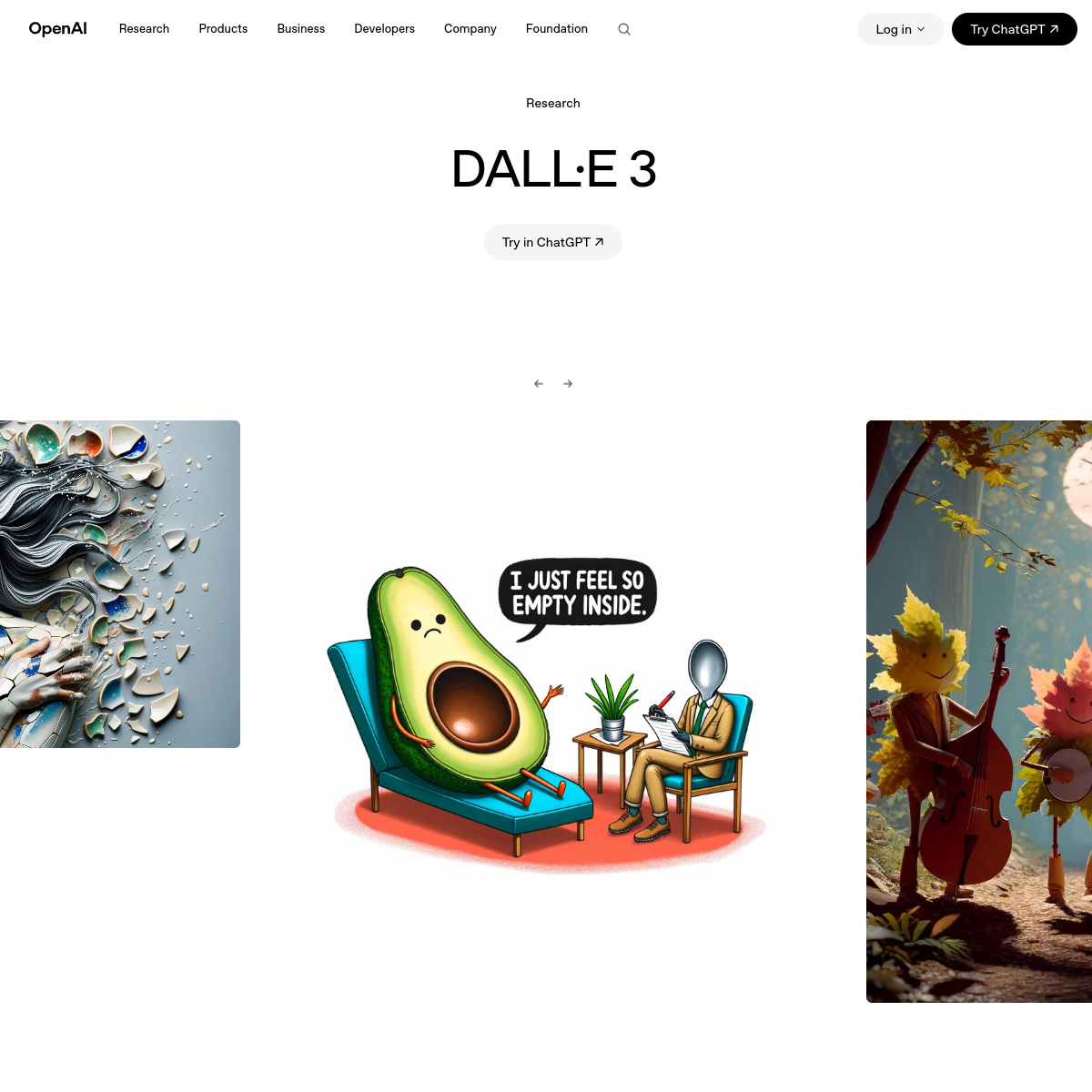
DALL-E — OpenAI text-to-image model, accurately understands complex prompt words
Core parameters and statistics
| Parameters | Details |
|---|---|
| Developer | OpenAI |
| Latest version | DALL-E 3 (October 2023) |
| Integration channels | ChatGPT (Plus/Team/Enterprise), OpenAI API |
| Support resolution | 1024×1024, 1024×1792, 1792×1024 (DALL-E 3) |
| API Price | Standard 1024×1024: $0.040/piece; HD $0.080/piece |
| ChatGPT access | Plus user limit of approximately 50 image generation per hour |
| Content security | Built-in content security filtering to refuse to generate illegal content |
| Prompt word rewriting | ChatGPT integrated version automatically rewrites and optimizes user prompt words |
| Core Strengths | Extremely accurate understanding of complex descriptions and text rendering |
| Company established | 2015, headquartered in San Francisco |
The most significant difference between DALL-E 3 and competing products such as Midjourney is the "prompt word following accuracy" - the user inputs a detailed scene description, and DALL-E 3 can present all details in the image with extremely high accuracy, without the need to specialize in "prompt word engineering" like Midjourney.
User and market recognition
After being integrated into ChatGPT, DALL-E 3 has become one of the most widely used AI image generation tools in the world, relying on ChatGPT's base of more than 100 million active users. There is no need to specifically learn prompt word skills, and images can be generated directly in the familiar ChatGPT conversation interface, which greatly lowers the threshold for ordinary users.
DALL-E's technical influence has been widely recognized in the industry - the first-generation DALL-E (2021) pioneered the feasibility of large-scale text to image conversion, DALL-E 2 (2022) established the quality standard in this field, and DALL-E 3 (2023) set a new benchmark in prompt word following accuracy, and was recognized by multiple independent evaluations as superior to competing products in text rendering (text generation within images) and complex scene understanding. Microsoft is further expanding user reach by deploying DALL-E 3 to hundreds of millions of Office and Windows users through its Bing Image Creator and Designer products.
Cost advantage
| How to use | Price | Main benefits | Applicable people |
|---|---|---|---|
| ChatGPT free version | $0 (limited) | Basic image generation, usage restrictions | Light experience |
| ChatGPT Plus | $20/month | Higher image generation limit, GPT-4 + DALL-E 3 | Individual users |
| OpenAI API (Standard) | $0.040/photo (1024×1024) | Pay-as-you-go, programmatic integration | Developer |
| OpenAI API (HD) | $0.080/photo (1024×1024) | Higher quality, more details | High quality requirements |
| Bing Image Creator | Free | Microsoft provides free access with daily limit | Regular users |
Compared with Midjourney (starting at $10/month, about 200 generations) or Adobe Firefly (charged by points), DALL-E's API price is very competitive in high-frequency programmatic usage scenarios, and is especially suitable for application development that requires dynamic generation of images on demand.
Main functions
- Text-to-Image generation (Text-to-Image): core function, input natural language description, AI generates corresponding high-quality images, DALL-E 3 has extremely high understanding and execution accuracy of complex and detailed descriptions.
- ChatGPT integrated generation: Generate images directly in the ChatGPT conversation interface. ChatGPT will automatically optimize user prompt words and support image modifications based on the conversation context (such as "change the background to a night scene").
- In-image text rendering: An important breakthrough of DALL-E 3 is the ability to accurately render text content (such as slogans, text on signs) in images, which is a historical weakness of tools such as Midjourney.
- Inpainting: Supports partial redrawing of a certain area of the selected image through the API, leaving other areas unchanged. It is suitable for image editing scenarios that require local modification.
- Multiple size ratios: Supports three ratios: square (1024×1024), vertical version (1024×1792) and horizontal version (1792×1024), covering the size requirements of different usage scenarios.
- Automatic optimization of prompt words (ChatGPT version): When used through ChatGPT, GPT-4 automatically analyzes and rewrites the user's simple description to generate prompt words for more detailed images, improving the generation quality for novice users.
- Built-in content security: OpenAI has built-in a multi-layer content security filtering mechanism in the DALL-E model to reject the generation of illegal content such as violence, pornography, and copyright-infringing characters, ensuring the safety of commercial and compliant use.
Model and version evolution
| Version | Time | Description |
|---|---|---|
| DALL-E 1 | 2021-01 | First generation release, creating a research direction in text-to-image conversion |
| DALL-E 2 | 2022-04 | 4x resolution improvement, Inpainting/Outpainting function |
| DALL-E 2 API Open | 2022-11 | Open API access to developers |
| DALL-E 3 | 2023-10 | Integrated ChatGPT, prompt word following accuracy greatly improved |
| DALL-E 3 API | 2023-11 | DALL-E 3 open to developers through API |
Technical advantages
Deep integration with GPT-4 (prompt word understanding): The biggest technical breakthrough of DALL-E 3 comes from the collaboration with large language models during the training process - the training data is re-annotated with detailed descriptions of images using GPT-4, allowing the model to learn to understand text descriptions that are much more complex than traditional image generation models, including complex semantics such as spatial relationships ("A is to the left of B"), attribute binding ("red balls and blue cubes") and text content rendering.
In-image text generation capability: DALL-E 3 has made a significant breakthrough in text rendering (generating correct text in images, such as text on signboards and posters). This requires the model to understand the shape and arrangement of characters at the pixel level, which is a common weakness of all previous mainstream image generation models. This capability gives DALL-E 3 a unique advantage in poster and design draft generation scenarios that require a combination of graphics and text.
OpenAI Content Security Framework: DALL-E's content security system adopts a multi-layer defense architecture, including prompt word filtering, constraints during generation and image post-processing detection. It meets the security requirements of commercial deployment while retaining creative freedom as much as possible. It is the core guarantee for OpenAI to invest a large amount of engineering resources in the commercial deployment of DALL-E.
How to use
| Entrance | Description |
|---|---|
| ChatGPT (recommended) | Visit https://chat.openai.com and describe the image to be generated directly in the conversation |
| OpenAI API | Refer to https://platform.openai.com/docs/api-reference/images, use API Key to call |
| Bing Image Creator | Visit https://www.bing.com/images/create and use a Microsoft account to generate it for free |
| Microsoft Designer | Accessed via designer.microsoft.com, a design tool powered by DALL-E 3 |
Typical usage steps (generating images through ChatGPT):
- Visit https://chat.openai.com to log in to your account (Plus users enjoy higher generation quota).
- Directly describe the image to be generated in the dialog box, such as "Generate a cyberpunk-style city night scene, with neon lights reflected on the street after the rain, and a pedestrian wearing a raincoat walking by."
- ChatGPT automatically processes the prompt word and calls DALL-E 3 to generate the image (usually 10-30 seconds).
- View the generated results and continue to indicate modifications in the conversation (such as "Change style to watercolor" or "Add a cat").
- When satisfied, right-click to save the image or click the download button.
- Developers: Use OpenAI Python SDK, call the
client.images.generate()method, and pass inmodel="dall-e-3"and prompt word parameters.
Product Pricing
- ChatGPT Free Edition: Basic image generation function, limited times per day, accessed through ChatGPT interface.
- ChatGPT Plus ($20/month): Higher DALL-E 3 image generation limit (approximately 50 times per hour), while enjoying all GPT-4 features, suitable for individual users.
- OpenAI API pay-as-you-go:
- DALL-E 3 Standard 1024×1024: $0.040/piece
- DALL-E 3 Standard 1024×1792 or 1792×1024: $0.080/piece
- DALL-E 3 HD 1024×1024: $0.080/photo
- DALL-E 3 HD non-square: $0.120/piece
- DALL-E 2 1024×1024: $0.020/piece (low-cost option)
- Bing Image Creator (Free): A free access entrance provided by Microsoft. There is a daily acceleration point limit. After using up, the speed will slow down but it can still be used for free.
Application scenarios
1. Creative visual generation for marketing and advertising The marketing team uses DALL-E 3 to quickly generate first drafts of event poster concept drawings, social media visuals, and advertising materials. It can quickly verify creative directions at a very low cost and reduce communication costs with designers. In particular, DALL-E 3's ability to render text on posters greatly reduces the workload of adding text in post-PS.
2. Product and content illustration generation Bloggers, news media, and content marketing teams use DALL-E 3 to generate images for articles to avoid copyright risks. The images generated by DALL-E 3 belong to the user, and there are no copyright issues for commercial use. ChatGPT integration allows writing and illustrating to be completed smoothly in the same interface.
3. Developers integrate AI image capabilities Application developers integrate DALL-E 3 into user-generated content (UGC) platforms, design tools, games and applications through APIs to provide end users with AI image generation functions. The pay-as-you-go billing model of the API is suitable for application scenarios with unstable usage.
4. Rapid prototyping of design concepts Product designers and UX designers use DALL-E 3 to quickly generate interface concept diagrams, brand visual directions and product appearance prototypes, completing multi-directional visual concept verification at the lowest cost and time before refining the design with tools such as Figma.
Applicable people
- Marketing and Content Creators: Need to quickly generate customized artwork and visual assets, DALL-E 3's prompt word accuracy and ChatGPT integration make the generation process extremely easy.
- Developers and Technical Teams: Need to integrate AI image generation capabilities into applications, and the DALL-E API is one of the most mature and well-documented options.
- Designers and Creatives: Used for concept exploration and creative prototyping, quickly generating multiple visual directions to choose from before refining the design.
- Education and Researchers: Quickly generate illustrative images for teaching materials, presentations, and research reports with no additional learning cost with ChatGPT Integration.
- Not suitable for scenes: Highly realistic photographic images of characters are required (realistic character generation is more restricted by OpenAI content policies); ultra-high resolution output (maximum 1792×1024) is required; there is a strong demand for highly controllable image styles (for example, Midjourney has a richer style parameter).
Summary and Outlook
DALL-E represents OpenAI's important layout in the field of multi-modal AI. Its deep integration with ChatGPT enables a seamless collaborative experience of "text generation + image generation". This combined advantage cannot be replicated by any independent image generation tool. DALL-E 3's technological breakthroughs in prompt word following accuracy and text rendering have established its unique value in accurately generating product descriptions and combining graphics and text to create content scenarios.
The current limitations are: the generation of realistic-style character images is restricted by OpenAI's strict content policy; the image style control options (refer to LoRA, etc.) are limited compared to tools that focus more on creative images such as Midjourney and Stable Diffusion; the API price is significantly different from Stable Diffusion self-hosting, and the cost of large-scale commercial deployment is relatively high.
Looking to the future, with the continuous evolution of OpenAI's multi-modal capabilities (such as image understanding and generation of GPT-4V and GPT-4o), DALL-E is expected to achieve a closer "understanding-generation" cycle - not only able to understand and describe generated images, but also understand existing images and generate relevant content based on them, further expanding the application boundaries of creative workflows.
Related tools:  Midjourney, stable-diffusion
Version Info
- :DALL-E 3 is officially integrated into ChatGPT, allowing ChatGPT Plus and Team users to generate images directly in conversations without the need for separate access. Compared with DALL-E 2, DALL-E 3 has greatly improved the accuracy of prompt word understanding. It can accurately understand and render complex text, multi-object relationships and detailed descriptions in images. It is also open to developers through the OpenAI API.
- DALL-E 2 :DALL-E 2 was released to the public. Compared with the original DALL-E, the resolution was increased by 4 times. The image quality and realism were significantly improved. It supported the image inpainting (Inpainting) and image extension (Outpainting) functions. It was open to developers through API and established an important milestone in the field of AI image generation.
- DALL-E (first generation) :OpenAI released the first generation of DALL-E, which for the first time demonstrated the ability of large-scale neural networks to generate images through text descriptions. It became a pioneering research result in the field of AI image generation. It was named in tribute to Salvador Dali (Dalí) and the Pixar animated character WALL-E. It was released in the form of a research paper and is not yet open to the public.
User Reviews