 Dappier
Free
Dappier
Free
Dappier helps media sites launch AI Q&A portals and realize commercialization through Agentic Ads and content distribution, building a complete link from content recall, dialogue interaction to advertising monetization.
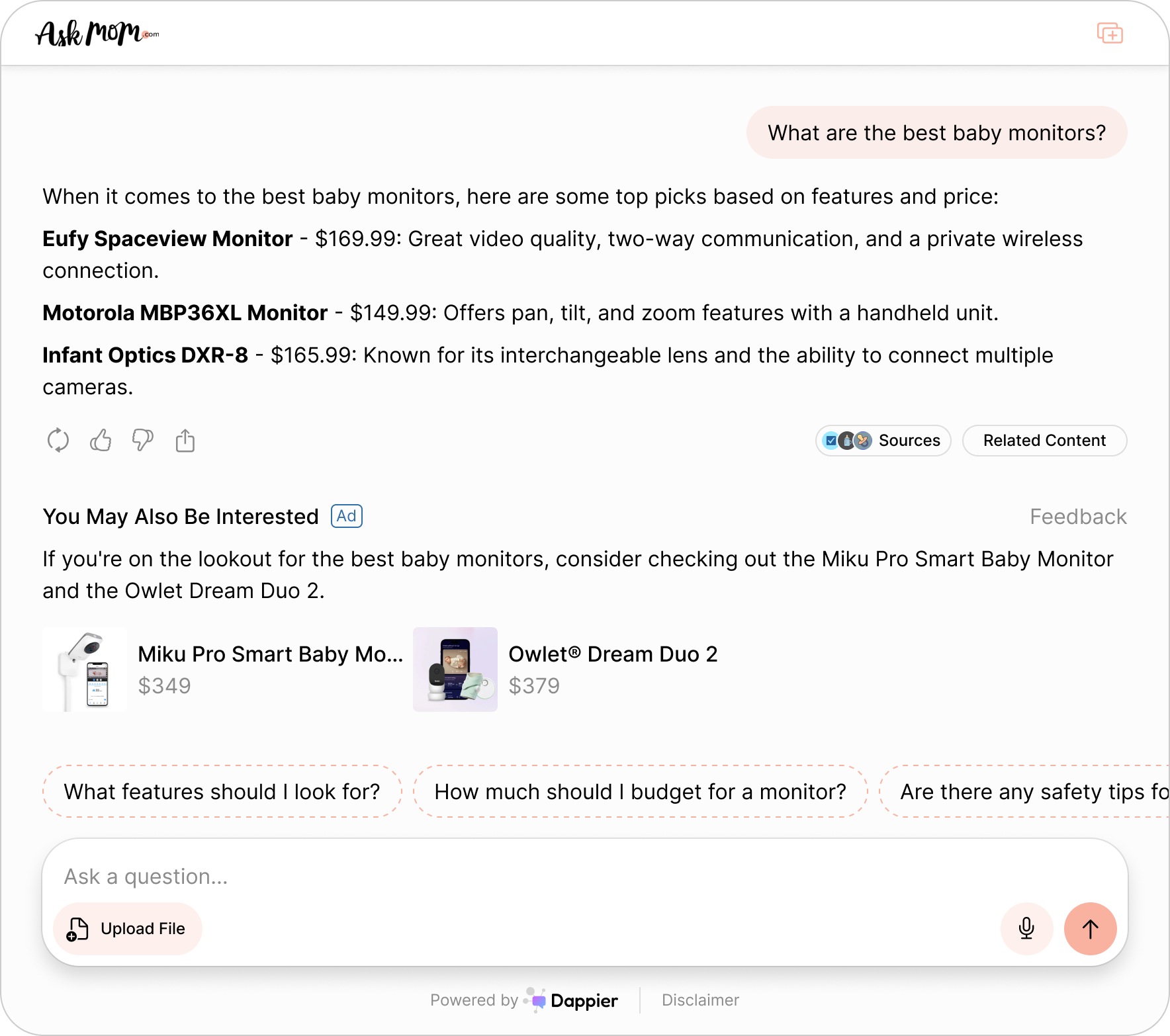
Dappier’s AI Q&A commercialization capability assessment
Core parameters and statistics
Dappier is not a traditional search engine tool, but an AI Q&A monetization platform for media content parties. Its core logic is to convert the site's existing content into conversational information services, and then use Agentic Ads to achieve commercialization in the question and answer link.
| Projects | Public Information |
|---|---|
| Official Positioning | AI Answers Economy, connecting content, conversations and advertising |
| Product Form | AI Q&A Portal + Agentic Ads + Content Distribution |
| Target customers | Media sites (Publisher), advertisers (Advertiser) |
| Deployment method | SaaS cloud hosting, no need to build your own infrastructure |
| Core pricing dimensions | Query volume (queries), advertising share |
| Latest solution version | AI Answers Economy solution version (2026-06) |
| First public release | Publisher Agent initial version (2024-01) |
| Support Platform | Web, API |
Speciality of business positioning: Dappier is not a conventional AI search tool. It does not provide a universal search engine entrance, but provides an embedded AI question and answer component for media sites. This means that its users are not end searchers, but content operations and monetization teams - its "parameters" are not model size or context length, but query quotas, ad fill rates and revenue share ratios.
Two-sided market structure: Dappier serves both Publisher (content supplier) and Advertiser (advertising demand side), similar to the AI version of an advertising alliance. Media sites gain traffic and advertising revenue by accessing AI Q&A, while advertisers gain native placement in conversation scenarios. The network effect of this structure determines the value of the platform - the more media connected and the richer the content, the stronger the willingness of advertisers to place ads, and vice versa.
Information Boundary: The official public page does not disclose the specific number of sites connected to the platform, the size of advertisers, historical revenue data or technical architecture details. The precise data of the above dimensions are subject to the official real-time page and business docking.
User and market recognition
Dappier’s market is not for pan-AI users, but for the content media industry that has existing traffic but faces declining advertising revenue. Its market recognition needs to be evaluated from both the media side and advertisers.
Attractiveness on the media side: For small and medium-sized media sites, Dappier’s selling point is that it can quickly launch a conversation portal that can generate revenue on existing sites without building a self-built AI Q&A system or purchasing multiple services. This has a clear integration scenario in mainstream CMS ecosystems such as WordPress - a plug-in or a piece of embedded code can complete the integration, and the cost of technical transformation is controllable. However, the current public page does not disclose the list of connected sites or the industry coverage ratio. The breadth of implementation is subject to official information.
Advertiser-side verification: The concept of Agentic Ads will be gradually accepted by the industry after 2025 - the CTR of traditional display advertising continues to decline, and native advertising in AI dialogue scenarios is regarded as the next growth point. Dappier is one of the pioneers in this field, but it also faces challenges in the education market: advertisers need to understand how to place ads in conversational contexts, how to bill (CPC/CPA/CPM), and how to track results. The public materials do not provide advertiser cases or delivery data, and the effect reference is based on the official Pilot project.
Competitive Landscape: Dappier’s competitors are not general search engines such as Google or Bing, but vertical solutions in the field of content commercialization and question and answer advertising, including Perplexity’s Publisher program, Glean’s in-enterprise question and answer advertising, and the extension of traditional advertising alliances in AI scenarios. Compared with these solutions, the difference of Dappier is that it does not rely on its own large model, but focuses on the productization layer of "Q&A experience + advertising monetization".
Cost advantage
Dappier's cost structure is special because it is not a pure tool subscription model, but a two-tier model that combines SaaS subscriptions and advertising sharing channels.
C-side/Personal: Dappier is not a tool for individual users. Ordinary visitors can use the AI Q&A function for free through Dappier-enabled media sites, and the cost of interaction is borne by the media party. For individuals, this is a "zero-cost" access to information, but they cannot directly use Dappier's independent services.
API/Developer: Dappier offers a pay-per-query developer package for teams that need to integrate AI Q&A into their own media or applications. The pricing page exposes three levels:
- Free to Try: $0/month, about 1,000 queries, suitable for technical evaluation and POC verification.
- Starter: $19/month, about 25,000 queries, suitable for commercialization of low-traffic sites.
- Professional: $99/month, about 100,000 queries, suitable for medium-sized content platforms.
The cost of a single query ranges from Free (limited by quota) to about $0.001/query for Professional, which has obvious cost advantages over general AI APIs (such as GPT-4o, which is about $0.01-0.03/query). But please note: Dappier's query is limited to the Q&A scenario of the media's own content, not a general LLM call, and the two cannot be directly replaced.
Enterprise/Media Commercialization Plan (Monetize): For media sites with a certain traffic base, Dappier’s Monetize plan adopts a traffic/advertising sharing model. The specific sharing ratio is not disclosed on the public page and needs to be confirmed by business docking. The explicit cost of this model is low (no subscription fee in the early stage), but the implicit cost is: the media’s content data and user interaction data will pass through the Dappier platform, and data sovereignty and brand security policies need to be included in the contract terms.
Hidden costs: For media parties, the biggest hidden cost is not subscription fees, but content adaptation. The quality of AI Q&A directly depends on how structured the media content is and how frequently it is updated. For a site with confusing content and stagnant updates, even if it is connected to Dappier, the Q&A experience and advertising revenue will be difficult to generate. In addition, inaccurate answers in AI Q&A scenarios may damage media brand trust, which requires setting up content review and manual confirmation mechanisms.
Main functions of Dappier
Dappier's functional matrix is designed around the three links of "content introduction → Q&A interaction → advertising monetization". It is not a simple stack of functions, but a comprehensive capability customized for media commercialization scenarios.
-
AI Q&A Portal Embedding: Deploy floating or embedded AI Q&A components on media sites through a piece of JavaScript code or CMS plug-in. Visitors can conduct conversational queries based on all or specified content on the site. Functional Value: Turn passive reading into active dialogue, improve page dwell time and content consumption depth. Acceptance concerns: Q&A response delay, site content coverage, support for non-text content (pictures/videos/PDFs).
-
Content Discovery and Distribution: The results of AI Q&A not only return text summaries, but also guide users to relevant articles or product pages on the site, increasing page views and advertising exposure opportunities. Functional value: In addition to advertising revenue, content distribution itself also has the strategic value of traffic redistribution. Acceptance concerns: The accuracy of distribution recommendations, the traceability of content sources, and the obtrusiveness of inserting links into conversations.
-
Agentic Ads: Embed native advertising slots in the conversational links of AI Q&A. Ads can appear in the form of content recommendations, sponsored answers, product inquiries, etc., which are closer to the conversation context than traditional banner ads. Functional value: In the context of the continued decline of display advertising CTR, conversational advertising is expected to achieve higher user intent matching. Concerns for acceptance: The distinction between advertising and Q&A content (otherwise it may mislead users), advertising review mechanism, and brand safety filtering capabilities.
-
Revenue settlement and data analysis: Provide Publisher with core indicator panels such as Q&A interaction volume, ad display/clicks, and revenue trends to support revenue optimization decisions. Functional value: Allow media parties to optimize Q&A content and advertising strategies based on data instead of blindly deploying them. Acceptance focus: Data refresh frequency, advertising revenue attribution model, and abnormal traffic identification mechanism.
Synergy between functions: The core value of Dappier does not lie in a single function, but in the data relationship between "Q&A experience → content distribution → advertising monetization". Question and answer data can optimize content recommendations, content recommendations increase advertising exposure, and advertising revenue feeds back content output. Whether this positive cycle can run through will determine the platform’s long-term appeal to the media—not just one-time SaaS revenue.
Dappier’s model and version evolution
Dappier's version information is mainly based on solutions and capability lines, rather than the digital version number of traditional software. The publicly verifiable version nodes are as follows:
Early verification phase (2024-01)
Publisher Agent Initial Version: Dappier’s first product launch to the market, focusing on helping media sites launch AI Q&A portals. The focus of this stage is to verify the core hypothesis of "whether content parties are willing to pay for Q&A interactions" rather than monetizing advertising. Judging from public information, the product positioning during this period was more tool-oriented, and the commercialization plan was not yet complete.
Advertising commercialization stage (2025-06)
Agentic Ads internal beta version: The introduction of conversation link advertising capabilities marks Dappier’s transformation from a pure tool to a platform-based business model. The release of this version means that the product has officially entered the two-sided market (Publisher + Advertiser) operation stage, but the public page does not disclose the number of internal beta customers or advertising fill rate and other performance data.
Platform plan phase (2026-06)
AI Answers Economy Solution Version: Dappier’s latest verifiable solution version officially positions AI Answers as an independent commercial product line and announces two-sided solutions and tiered prices for Publisher and Advertiser. This version marks the completion of Dappier's positioning transition from a "single question and answer tool" to an "AI question and answer economic platform".
Version evolution trend: From 2024 to 2026, Dappier’s iteration path is clear—first verify the product-market fit of the Q&A tool, then add advertising monetization capabilities, and finally integrate into a two-sided business platform. If it continues to evolve in this direction, possible directions for subsequent versions include: multi-modal question and answer capabilities, programmatic advertising docking, cross-site data network effects, etc.
Technical advantages
The technical value of Dappier is not in the underlying model itself, but in integrating "content recall - question and answer interaction - advertising monetization" into the same productization link.
Mechanism: Dappier establishes a content index for each accessed media site. When a user asks a question, the system retrieves relevant information from the site's content library, combines LLM to generate a natural language answer, and matches the appropriate advertising space according to the context in the answer link. The entire link from content access to advertising placement is within one platform.
Effectiveness: For media parties, there is no need to separately purchase the content retrieval system, AI question and answer service, and advertising engine. An integrated solution can verify the AI traffic monetization model. The time period from pilot to launch can theoretically be shortened from months to weeks - provided the content quality on the site meets minimum requirements.
Technical considerations: The effectiveness of Dappier is highly dependent on the structure of the content on the site. For traditional media that are mainly articles, NLP retrieval is relatively mature; but for sites that are mainly pictures, videos or interactive content, the quality of Q&A will be limited by the content indexing capabilities. This determines that the type of content Dappier is most suitable for is text-intensive media.
Architecture Inference: Although the official complete technical architecture has not been disclosed, it can be inferred from the product behavior that its link is media content → index construction → vector retrieval + keyword mixing → LLM summary generation → ad matching → result return. The ad matching section may use intent classification or keyword matching to determine ad context. The technical challenge with this link is the balance between Q&A latency and ad relevance - slowing down answers in order to load ads will directly harm the user experience.
How to use
The usage path of Dappier is divided into three entrances according to different roles, which are suitable for different stages from technical verification to large-scale operation.
| Access method | Suitable for the role | Key actions | Expected cycle |
|---|---|---|---|
| Media site embedding (JS code/CMS plug-in) | Media operations/technical team | Register → Get embed code → Configure Q&A scope → Go online | 1-3 days to complete initial deployment |
| API integration | Developer/product team | Obtain API Key → Access the Q&A interface according to the document → Customize UI | 1-2 weeks to complete the integration |
| Commercialization plan (Monetize) | Media commercialization team | Business communication → Sign sharing agreement → Configure advertising strategy → Go online | 2-4 weeks (including contract process) |
Typical deployment process:
- Content access: Specify the Q&A data source (full site content or specified categories) in the Dappier background, and the system will automatically create an index. At this time, you need to confirm the index synchronization frequency after the content is updated to ensure that the Q&A results will not expire.
- Experience Configuration: Customize the Q&A component’s brand style (color, font, dialogue guide), Q&A boundaries (whether to allow cross-site queries, whether to block sensitive content), and content disclaimers.
- Advertising Strategy Settings: Select ad types (native recommendations/sponsored answers/display ads), set review rules (brand safe keyword white/blacklist) and revenue distribution preferences.
- Launch and iteration: After release, the effectiveness will be evaluated using three core indicators: Q&A interaction rate, ad click-through rate, and page dwell time, and the content structure and advertising strategy will be continuously optimized based on data.
Getting Started Suggestions: During the technical verification phase, use the Free solution to test the Q&A effect on 1-2 high-traffic articles, and confirm that the answer quality and delay are acceptable before full rollout. When deploying for the first time, focus on verification: whether the accuracy of question and answer reaches internal standards, whether the advertising space will affect the first screen loading performance, and whether the revenue data can be audited.
Product Pricing
Dappier's pricing strategy presents a two-tier structure of "subscription query volume + free business plan" and does not rely on a single pricing dimension.
Subscription Tier (Billing by Query Volume):
- Free to Try: $0/month, 1,000 queries quota, suitable for technical evaluation and functional verification. After the quota is used up, you need to wait for the next month to reset or upgrade the package.
- Starter: $19/month, 25,000 queries, approximately $0.00076/query, suitable for individual bloggers or small-scale content testing.
- Professional: $99/month, 100,000 queries, approximately $0.00099/query, suitable for independent media or content platforms with medium traffic.
Business solution layer (Monetize):
- For media sites with stable traffic, it does not charge based on query volume, but allows the media to obtain income through advertising sharing on the basis of free subscription fees. The specific share ratio, settlement cycle, and guarantee conditions are not disclosed on the public page, and the official business terms shall prevail.
Cost Sensitivity Analysis: For small and medium-sized sites with a query volume of less than 100,000, the cost of the Professional package of $99/month is lower than the operation and maintenance cost of a self-built Q&A system. But for leading media with more than one million queries, the sharing model of the Monetize solution is more economical - but it should be noted that the revenue fluctuation under the sharing model depends on the ad fill rate and eCPM, and is not a stable and predictable cash flow.
Hidden Price: The way "queries" are counted for all plans needs to be clear in the contract - whether one conversation round counts as one query, or each LLM call counts as one query. Different billing definitions will cause the actual cost to differ several times, which is a term that must be verified when evaluating the economics of a package.
Application scenarios
Dappier's implementation scenarios focus on the dual demands of content-based sites for "conversational interaction + advertising monetization", rather than general search or customer service scenarios.
-
AI Q&A transformation of media sites: News websites, industry media, and vertical content communities upgrade the original "search box + article list" model to conversational content discovery by embedding AI Q&A components. Typical revenue deduction: Assuming that the site has an average daily PV of 100,000 and a content library of 5,000+ articles, AI Q&A can increase page views per session from 2.3 to 3.5-4.0, and advertising exposure will increase by 50-70% accordingly. This deduction is based on industry average data and is not an official commitment by Dappier.
-
Conversational Advertising Experiment on Content Platforms: For platforms that already have a membership system (such as industry report stations, course platforms), AI Q&A can be used as a value-added function to increase member stickiness, while at the same time creating an increase in advertising revenue through Agentic Ads. Scenario value: Subsidizing content production costs through advertising revenue without adding a paywall.
-
Traffic redistribution in vertical communities: The content of niche vertical communities (technology blogs, food reviews, travel sharing) often has good long-tail SEO traffic, but the advertising monetization efficiency is low. Dappier’s Q&A component recombines long-tail articles into conversational answers, increasing the probability of less popular content being discovered and clicked. Acceptance key: Whether the Q&A recall rate of long-tail content reaches a usable level, and whether the ad fill rate is sufficient in vertical scenarios.
-
E-commerce product Q&A (extended scenario): For product review sites, Dappier can provide a "comparative Q&A" - when a user asks "Which product A or product B is more suitable for me?", the system will embed affiliate marketing links or advertisements for related products in the comparative answer. This scenario has higher requirements for the quality of Q&A, and the content side needs to ensure the accuracy and timeliness of the evaluation information.
Applicable people
Dappier’s target user groups are concentrated on the media side that has content but lacks monetization methods, as well as the advertising side that hopes to seize the blue ocean of AI conversational advertising.
-
Media Operations and Commercialization Team: Has the ability to output daily content, but faces the pressure of declining traditional display advertising revenue and subscription conversion rates that are not as expected. Dappier provides a low-renovation cost-replacement path to monetization. Prerequisite: The site has a stable content update rhythm (recommended at least 5 articles per week), and the content is mainly text, which facilitates Q&A indexing.
-
Independent bloggers and content entrepreneurs: Individuals or small content teams cannot afford the technical costs and business negotiation threshold of building their own AI systems. Dappier’s Starter/Professional package is priced based on query volume, which is more friendly to individual bloggers in the initial stage. Boundary conditions: Monthly query volume needs to be evaluated - high-traffic bloggers may incur additional costs on the Professional package and should consider switching to the Monetize plan at this time.
-
Advertising agencies and brand advertisers: Focus on brand exposure opportunities in AI dialogue scenarios, hoping to reach high-intent users in Q&A scenarios through Agentic Ads. Prerequisites: The ad review process, brand safety strategy and target population matching need to be confirmed with Dappier or its partner media.
-
Unsuitable boundary: Dappier is not recommended in the following situations - low-traffic sites (average daily PV less than 1000) are difficult to generate sufficient advertising fill rates and revenue; non-text content-based media (mainly videos, pictures) Q&A experience is limited; scenarios that require a highly customized Q&A UI or private deployment (Dappier is a SaaS model and does not support self-hosting); fields that require extremely high compliance and content prudence for AI Q&A (medical advice, financial decision-making, legal consulting), AI The uncertainty of generating content can create brand risks.
Summary and Outlook
Dappier's core competitiveness lies in packaging "AI Q&A experience" and "advertising monetization" into a commercial product that can be directly embedded in media sites, allowing content providers without self-research capabilities to participate in the AI dialogue economy. Its biggest point of difference is not its technical depth, but its business model innovation of "question and answer + advertising" - it has chosen a path in the AI tool market that is closer to an advertising alliance than to pure SaaS.
Current limitations: The platform is still in the early stage of commercialization, and there are limited publicly verifiable site cases, advertiser scale, and revenue data, which makes procurement decisions difficult to evaluate. The quality of Q&A is highly dependent on the content quality of the media itself, and the platform has limited control over content generation. In addition, as an emerging advertising form, whether the CTR and eCPM of Agentic Ads are better than traditional display advertising still needs to be verified by industry data, rather than a single platform promise.
Technology evolution direction: Inferred from the roadmap, possible follow-up directions include multi-modal Q&A (processing image/video content), programmatic advertising docking (integration with DSPs such as Google Ad Manager), content quality scoring tools (helping the media optimize Q&A materials), etc. The actual route is subject to official release.
Procurement/Adoption Risk Assessment: For media sites with stable text content traffic, Dappier's Free or Starter plan is worthy of being a low-risk pilot in the direction of "AI Q&A monetization". It is recommended to spend 1-2 weeks to complete Q&A quality verification and ad fill rate testing on specific content categories, and then gradually expand after confirming the effectiveness. Before formally signing the Monetize solution, you need to focus on verifying the following terms: the share settlement cycle and data audit capabilities, the effectiveness conditions of the brand security audit mechanism, the boundaries of data privacy and content ownership (whether AI training data involves secondary use of media content), and contract exit and termination conditions (such as the data migration plan when the Dappier platform is changed or closed).
Related tools: perplexity, you-com
Version Info
- AI Answers Economy Solution Edition :Announced two-sided solutions and tiered prices for Publisher and Advertiser, officially positioning AI Answers as an independent commercial product line.
- Agentic Ads beta version :Introducing dialogue link advertising capabilities, supporting the embedding of native advertising spaces in AI Q&A, and entering the advertising commercialization verification stage. There is no official precise date yet.
- Publisher Agent initial version :The AI answering portal and content commercialization capabilities for media sites are initially launched, verifying the feasibility of the question and answer format in content scenarios.
User Reviews